Insurance policy checking software compares each policy a carrier issues with what was quoted, bound and requested, reports every difference with its page, and helps the agency get the carrier to correct it. Products range from document-comparison tools to checklists inside an agency management system to AI agents that read the whole package. Choosing between them is hard because every vendor demonstrates on documents it has seen before. Botminds' Insurance Policy Checking is one of the AI options, and the test below is the one we would ask any agency to run on it: take policies your own checkers have already worked, plant known errors, and count what the software finds, misses and invents.
The point of planting errors is that you know the answer. A live policy can only tell you what the software found; a seeded one tells you what it missed. Weight the seed the way your book actually goes wrong, and the score you get is close to the protection the software would give you on Monday morning.
A 24-error seed set, weighted the way a real book goes wrong
What is policy checking software?
Policy checking software is any tool that helps an agency prove an issued policy matches what was promised, and it comes in four kinds. A document-comparison tool shows text that changed between two PDFs, usually the expiring and renewal policies. A checklist or workflow inside the agency management system records that a person checked each item. A policy checking service sends the work to people elsewhere, which is a service rather than software and is weighed in policy checking services. And AI agents read the policy and its sources and produce cited findings for a person to decide.
Insurance Policy Checking is the fourth kind. Its five agents read the issued policy, compare each term with the quote, the binder and the expiring policy, search for every promised endorsement by form number, title and wording, check each form and edition against the carrier's state filings, and draft one correction request and a client note. A checker decides every finding and signs the file; nothing is sent until the checker sends it.
Why a vendor's accuracy figure tells you little
Because accuracy is a property of a tool on particular documents, and the vendor chose the documents. The U.S. National Institute of Standards and Technology makes the general point in its AI Risk Management Framework: accuracy measurements should be paired with clearly defined, realistic test sets that represent the conditions of expected use, with the test method documented (NIST AI 100-1, January 2023). For policy checking, the conditions of expected use are your carriers' forms, your state filings, your scans and your clients' contracts.
Three things differ from agency to agency and change scores sharply. The carriers' own proprietary endorsements, which a tool trained on standard forms may not recognise. The quality of the PDFs, from clean portal downloads to faxed and rescanned endorsements. And the promises: an agency whose book is construction contractors has contract-driven waivers, additional insured and primary wording on most accounts, while a book of small offices has few. A figure measured on someone else's book answers someone else's question.
How do you test policy checking software?
Plant known errors in policies you have already checked, give the software everything a checker would have, and compare its findings with your answer key. In our estimate, the protocol below takes about a week of one experienced checker's time to prepare and a day to score.
The seeded trial, step by step
- Pick five policies your checkers have already signed
At least three commercial packages with contract requirements, one with a scanned endorsement, one from a carrier that uses its own forms. Keep their quotes, binders, client requests, contracts and expiring policies.
- Write the answer key first
List any real differences your checkers found and the carrier corrected, so a "new" finding can be told apart from an invented one.
- Plant 24 errors across the five
Edit the issued PDFs: drop a named insured, halve an aggregate, remove a waiver from the forms schedule and its pages, attach a restrictive form, swap an edition, add a charge for a coverage the client rejected.
- Plant one promise the quote never carried
Add a requirement to a client request or contract that the quote and binder lack. Only a tool that reads the client's side will find it.
- Leave two policies clean as controls
Run two more signed policies untouched. Anything reported on them is either a real miss by your team or noise.
- Run the software blind
The vendor sees the documents and the request, never the answer key, and does not tune between runs.
- Run your own checkers on the same seed
Two checkers, timed, on the same files. Their score is the baseline the software has to beat.
- Score by severity, then read every invented finding
Count finds, misses and invented findings per severity level, and check each invented one against the policy before calling it wrong.
What errors should a policy check catch?
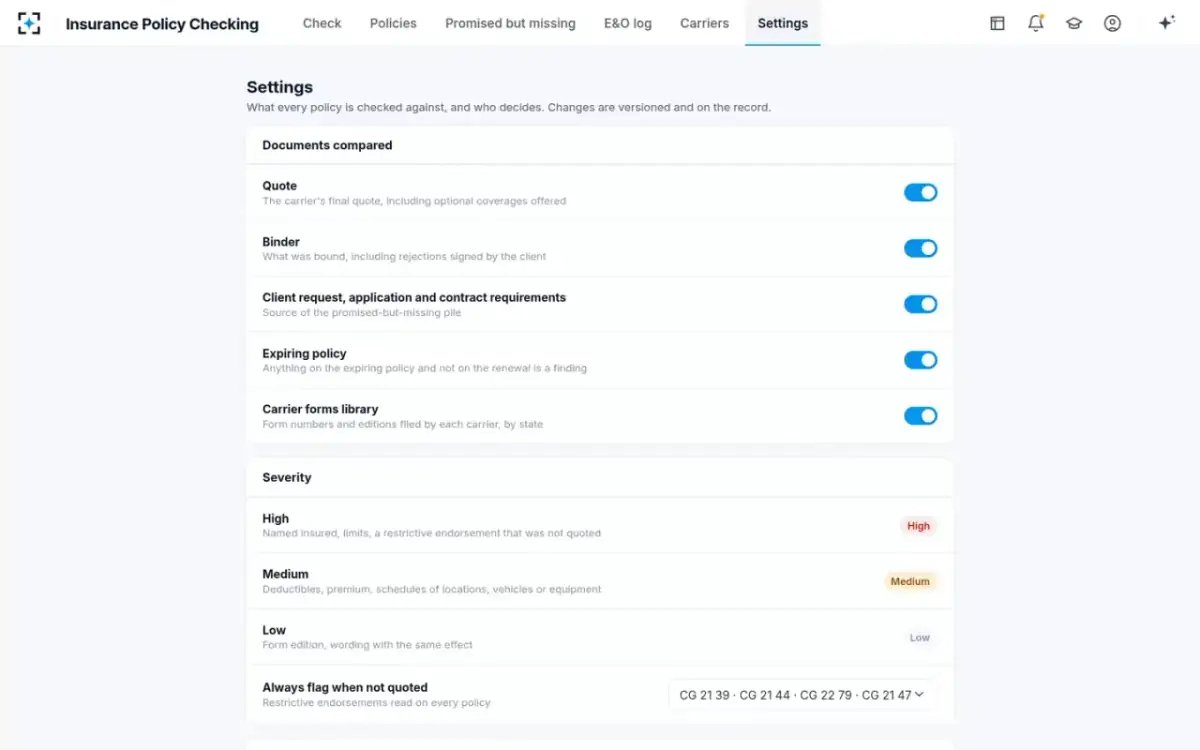
Every error a carrier can make between quote and issue, ranked by what it costs the client if nobody notices. The table gives the ones to plant, how to plant each, and the severity Insurance Policy Checking applies by default; an agency can change the severity rules in its settings.
The seed sheet: what to plant, and what a correct find looks like
| Error | How to plant it | Default severity | A correct find shows |
|---|---|---|---|
| Named insured left off | Delete the second named insured from the declarations | High | The binder's named insureds against the policy's, with both pages |
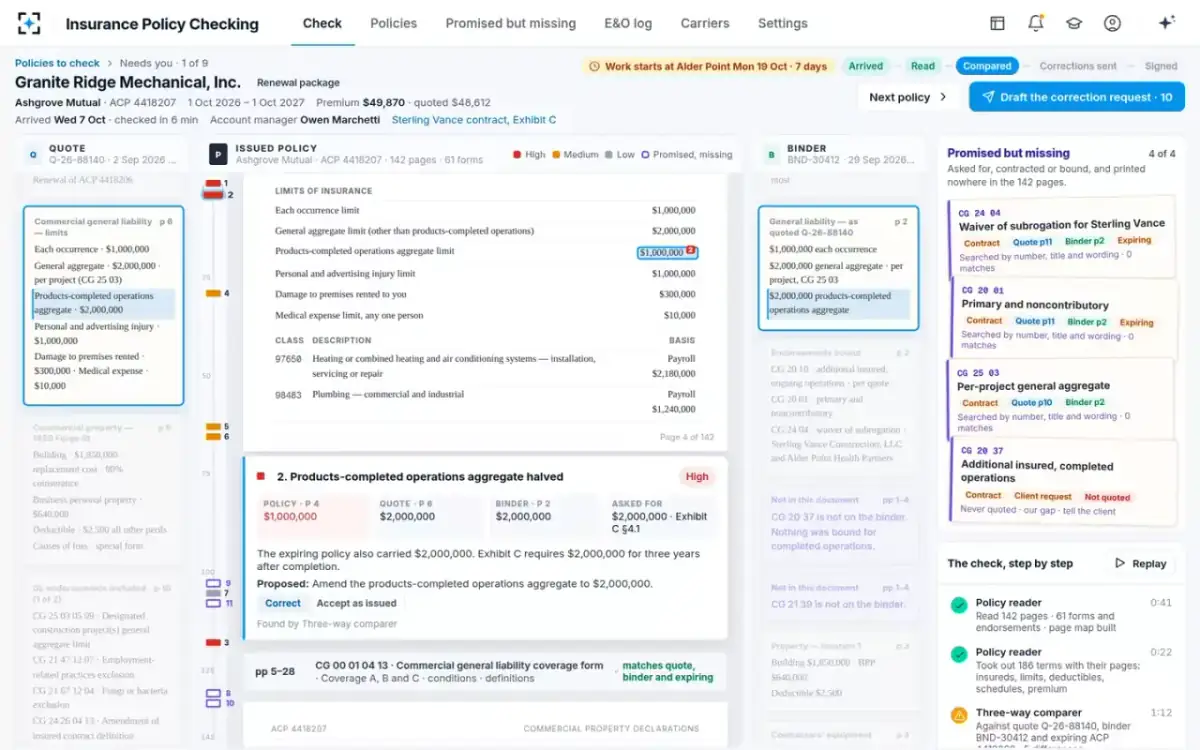
| Limit or aggregate cut | Change a products-completed aggregate from $2,000,000 to $1,000,000 | High | Policy, quote and binder values with their pages, and the contract's requirement if any |
| Restrictive endorsement added | Attach a contractual liability limitation that was not quoted | High | The form, its page, and "not quoted" |
| Promised endorsement missing | Remove a waiver of subrogation from the forms schedule and the body | High | Every place it was promised, the searches run, and where it should be |
| Never-quoted promise | Add an additional insured requirement to the client's request only | High | The request and contract pages, and that the quote never carried it |
| Deductible changed | Double a property deductible at one location | Medium | Location, both amounts and pages |
| Schedule item missing | Delete one item from an equipment or vehicle schedule | Medium | The item, its value and the schedule page |
| Premium for a rejected coverage | Add a terrorism charge the client rejected in writing | Medium | The charge, the signed rejection and the premium difference |
| Older form edition | Swap an endorsement's edition date | Low | Both editions and whether the carrier files the issued one in the state |
Two of these rows decide most trials. The promised endorsement that was removed tests whether the software can find something that is not printed. A tool that compares the policy only with the quote and binder will miss it; one that also compares the expiring policy finds it only when the expiring policy carried it. The never-quoted promise tests whether the software reads the client's side at all, because policy, quote and binder agree with each other and all three are wrong. A product that scores well on limits and premiums and misses both has automated the easy half of the job. Why the absent endorsement is the hard case is opened in AI insurance policy checking.
What a correct find looks like: one finding, three documents, one click
How to score the trial
Score three numbers by severity, not one number overall. Find rate is planted errors found divided by planted errors, reported separately for high, medium and low. Invented findings are findings that match no planted error and no real difference, counted per policy. And citation accuracy is the share of correct finds that cite the right page in the policy and in each source document.
Read every invented finding before counting it. On policies your team signed, some of the software's "extra" findings will be real differences your checkers missed, which is a result in the software's favour and a finding for your E&O manager. Count only the ones that are wrong after a second look. Then set the software's numbers beside your own checkers' on the same seed: the question is not whether the software is perfect, but whether a checker starting from its findings misses less than a checker starting from page one.
A vendor demonstration against a seeded trial on your own policies
Vendor demonstration: The vendor's sample policies, usually clean digital PDFs on standard forms.
Seeded trial: Your carriers' issued packages, including scans and proprietary endorsements.
Vendor demonstration: Errors the vendor knows are there.
Seeded trial: 24 errors you planted and the vendor has not seen.
Vendor demonstration: Rarely shown; a changed limit is easier to demonstrate.
Seeded trial: Seven planted, plus one promise the quote never carried.
Vendor demonstration: Not counted.
Seeded trial: Counted per policy, after checking each against the policy.
Vendor demonstration: None, or a claimed industry figure.
Seeded trial: Your own checkers, timed on the same files.
Vendor demonstration: That the product works on the vendor's documents.
Seeded trial: What it would have caught last quarter, and what it would have cost you to miss.
What is a good policy checking error rate?
No government, academic or non-profit source publishes a benchmark error rate for policy checking, by people or by software, so any vendor quoting an "industry" figure is quoting itself. Set the pass line from consequences instead. A missed high-severity item on the seed, such as a dropped named insured, a halved limit or a missing waiver, is a failure regardless of the overall score, because each is the kind of gap that becomes a claim against the agency. Medium items should be found at least as often as your own checkers find them. Low items, such as an older edition, matter mainly as noise: a tool that buries the checker in edition differences will be ignored.
Invented findings deserve their own limit. Each one costs a checker time to dismiss, and too many teach the team to skim, which is how real findings get missed. A practical line is fewer invented findings per policy than real ones, with none at high severity. What each missed item costs the agency, and how to put a number on it, is worked through in the cost of an errors and omissions claim against an insurance agent.
Can policy checking software read scanned policies?
Most can read a scanned page; the question is how well, and the seed should answer it. Put at least one image-only endorsement and one rescanned schedule in the trial, and see whether the number search still works when a stamp crosses the form's footer, and whether the title and wording searches find the form when it does not. Insurance Policy Checking reads issued policies as PDFs from the carrier portal or email, the day they arrive, and every value it reports carries its page, so a checker can see a misread at once.
Does policy checking software work with my agency system?
Ask which documents it needs and where its outputs go, rather than whether it "integrates". Policy checking runs on documents: the issued policy, the quote, the binder, the client's request or application, contracts with insurance requirements, the expiring policy and the carrier's forms list by state. Insurance Policy Checking works from those documents as the agency already receives them, and produces a difference report with page citations, one correction request to the carrier's underwriter, a client note for the account manager, a signed policy file and an open item for each exposure until the endorsement arrives. Where those outputs are stored is a decision for the agency's own systems.
The checking rules are settings, versioned, not the vendor's defaults
What does policy checking software cost, and what does it save?
Price the software against hours and exposure, using your own numbers. Hours first: our estimate for one complex commercial package is about eight hours by hand against about 1.2 hours with agents, most of what remains being the checker's own decisions. Multiply the hours saved per policy type by the policies of that type you receive each month and by your loaded cost per checker hour; that is the time side. Simple personal lines policies save far less per policy and should be counted separately.
Exposure is the larger side and the harder one to count. The cost of one missed endorsement that becomes a claim, from an uncovered loss to the E&O deductible and the account, dwarfs a month of checking hours, but we found no independent, published rate at which such claims occur. The honest approach is to count your own open exposures: how many differences are open today, and how many of them the client relies on within the next fortnight. On the solution's fictional sample book that was 47 open items on 33 policies, 19 of them relied on within seven days.
Where policy checking software fits, and where it stops
Insurance Policy Checking fits agencies and brokers whose commercial clients carry contract-driven endorsements, whose renewals arrive in seasonal waves, and whose checking backlog means policies are read weeks after they are issued, if at all. It fits less well a book of simple monoline personal policies, where a short checklist inside the management system may be enough.
It does not give coverage opinions: the forms library checker states what a form says and never gives legal advice, and whether a carrier's proprietary endorsement is equivalent to the one a contract names is the checker's call, with counsel where it matters. It does not send anything on its own. And it does not replace endorsement processing on the carrier's side, which is its own problem with its own error types, set out in insurance endorsement errors and a test that counts them.
Questions people ask
How accurate is automated policy checking?
It depends on the documents, which is why the only figure worth having is one measured on your own. A seeded test on five policies your team already signed, with 24 planted errors and two clean controls, gives find rates by severity, invented findings per policy and citation accuracy in about a week of preparation.
How many policies should a policy checking software trial use?
Enough to carry every error type twice and at least one of each awkward document: five seeded commercial policies and two clean controls cover the error types in the seed sheet, a scanned endorsement, a carrier's proprietary forms and a promise the quote never carried. More policies narrow the uncertainty; fewer leave whole error types untested.
Should the vendor see the answer key?
No. The vendor gets the same documents and request a checker would get, runs once, and does not tune between runs. Share the answer key afterwards and ask the vendor to explain each miss; how it explains them tells you as much as the score.
What if the software finds errors our checkers missed?
Check each one against the policy before scoring it. A real difference that your team signed off is a point in the software's favour and an open exposure for your E&O manager, and on policies already in force it may need a correction request today.
Is policy checking software the same as endorsement processing software?
No. Policy checking is the agency proving that what the carrier issued matches what was promised; endorsement processing is turning a requested change into an issued endorsement. Both meet at the endorsement, but they are tested on different errors.