An insurance policy checking checklist lists every part of an issued policy that must match what was quoted, bound and requested: the named insureds, the policy period, the premium, the forms schedule, the limits and deductibles, the schedules of locations, vehicles or equipment, the additional insured and waiver endorsements, any restrictive endorsements, the form editions, and the changes from the expiring policy. The hard part is not writing the list but knowing where each item sits in a package of 100 pages or more and what to compare it with. Botminds' Insurance Policy Checking checks these twelve areas on every policy its agents read, and the annotated pages below show what each one looks like in practice.
The package is from the solution's fictional sample book: a contractor's renewal of 142 pages and 61 forms from the fictional Ashgrove Mutual, issued for 1 October 2026. Every number in the mock-up is the sample policy's own.
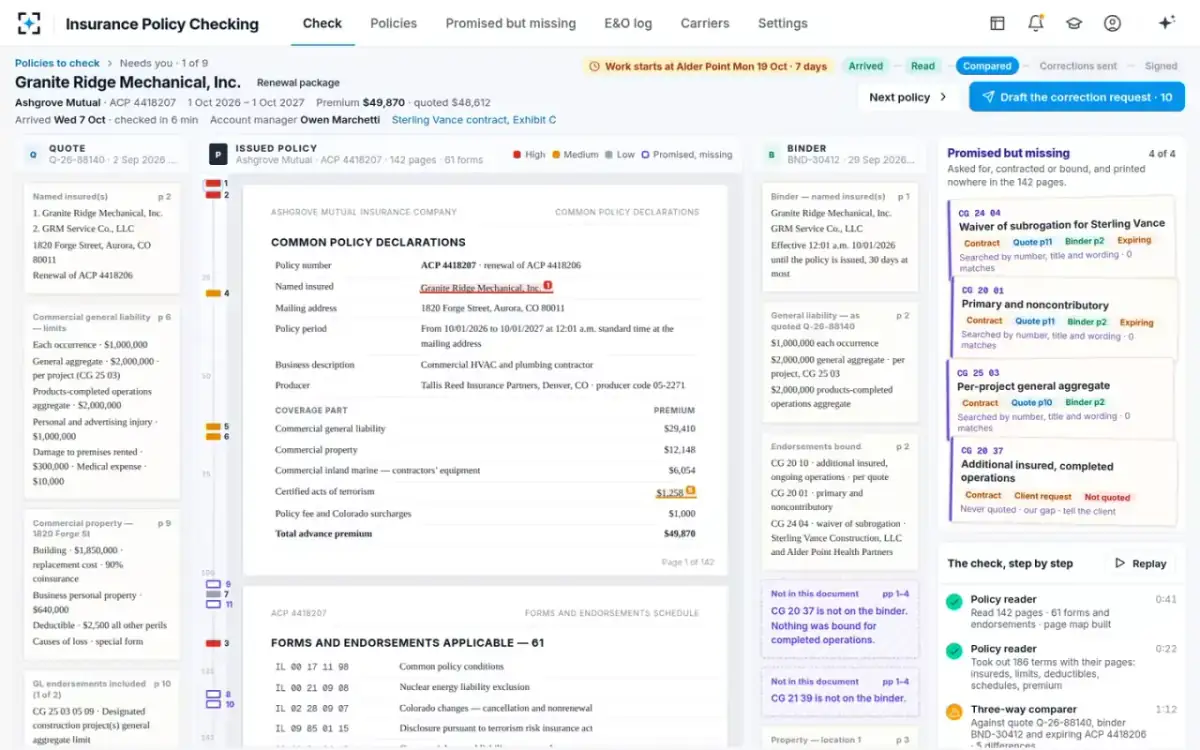
A commercial declarations page and forms schedule, annotated for the check
Common policy declarations
Forms and endorsements applicable: 61 (excerpt)
- 1Named insureds. The binder names two: the company and GRM Service Co., LLC. The affiliate is missing here.
- 2Period and time. Matches the binder's 12:01 a.m. on 1 October. Clean.
- 3Each coverage part. Opens a schedule to check: the equipment schedule lists 9 items, the quote 10.
- 4Lines that should not be there. Terrorism was rejected in writing on 28 September, yet it is charged.
- 5Total premium. $1,258 above the $48,612 quoted: the terrorism charge, exactly.
- 6Coverage form edition. Matches the quote and the expiring policy.
- 7Endorsement edition. The quote offered the 12 19 edition; 04 13 was issued. A low-severity question for the checker.
- 8A form nobody quoted. A restrictive endorsement that narrows contractual liability cover. High severity.
What should be on a policy checking checklist?
Twelve areas, ordered by what a miss would cost the client, each compared with the quote, the binder, the client's request and the expiring policy. The order matters because the checklist is most often abandoned halfway through a busy renewal season, and the items at the top are the ones that become claims.
The twelve-area policy checking checklist, highest risk first
- Named insureds
Every entity bound, spelled as on the binder. A missing affiliate is uninsured for its own operations.
- Liability limits and aggregates
Each occurrence, general aggregate and how it applies, products-completed operations aggregate; against the quote, binder and any contract minimums.
- Additional insureds and waivers
Every promised additional insured, primary and noncontributory and waiver endorsement, by form and by named party.
- Restrictive endorsements
Forms that narrow cover and were never quoted, such as contractual liability limitations or designated work exclusions.
- Changes from the expiring policy
Anything on the expiring policy and not on the renewal: the commonest home of a dropped waiver.
- Forms schedule completeness
Every form listed is attached, and every promised form is listed.
- Property locations, limits and deductibles
Each location, its limit, valuation and deductible.
- Schedules of equipment and vehicles
Item by item against the quote: a missing scissor lift is a missing limit.
- Premium
Total and by part, against the quote; charges for coverages the client rejected.
- Classifications and exposure basis
Class codes and payroll or sales, which drive both cover and audit.
- Form editions
Issued against quoted, and whether the carrier files the issued edition in the state.
- Mailing address and policy period
Dates and times against the binder, and the address notices will go to.
What do you check on the declarations page?
Who is insured, when, where, for what and at what price, each against the binder and the quote. The declarations page is the policy's summary, and most of its lines point somewhere else: a coverage part opens a set of limits, a premium line implies a schedule, a named insured implies every entity the client operates through. On the sample page five lines needed a second look and four led to findings, one of them in the equipment schedule behind the inland marine line.
The named insured line was the first. The binder named the company and its service affiliate; the declarations named only the company, so the affiliate's own work had no named-insured status. The terrorism line was the second: the client had signed a rejection on 28 September and the carrier charged $1,258 anyway, which also explained the third finding, a total premium of $49,870 against $48,612 quoted. A checker who reads only the total sees a $1,258 increase; one who reads each line sees which coverage it buys and that the client refused it.
What is a forms schedule?
The forms schedule is the list, usually on the first pages after the declarations, of every form and endorsement that makes up the policy, each with its number and edition date. Some states require it outright. Florida's insurance code says every policy shall specify "The form numbers and edition dates or numeric code indicating edition dates, when such code has been supplied to the office, of all endorsements attached to a policy" (Florida Statutes § 627.413(1)(g)).
The schedule is where checking is fastest and where it is most often skipped. The sample schedule lists 61 forms on two pages; most are conditions, state changes and standard exclusions that match the quote. Checking it means two passes. The first asks whether each listed form is one the quote offered, which is how the unquoted contractual liability limitation was found. The second asks whether each promised form is on the list at all, which is how four promised endorsements were found missing: a waiver of subrogation, primary and noncontributory wording, a per-project aggregate endorsement and completed-operations additional insured status.
What is a form edition date?
It is the month and year a standard form's wording was published, printed as the last four digits of the form number. The County of Sonoma's contract insurance guide spells it out for its own staff: "The last four digits are the edition date: 04 13 is the April 2013 edition" (County of Sonoma, Contract Insurance Requirements Reference Guide). A form number without its edition identifies a family of wordings, not one wording.
Editions matter to the check in two ways. A carrier files particular editions in each state, so an issued edition that differs from the quoted one may simply be the edition the carrier is allowed to use there, which is what the checker concluded on the sample additional insured form before accepting it with a reason. And editions of the same endorsement can differ in what they cover, which is why a claim can turn on one; Insurance Policy Checking's forms library checker compares every issued edition with the carrier's filings in the state and leaves the judgment to the checker.
Where each checklist item lives in a commercial package, and what to compare it with
| Item | Where it sits in the policy | Compare with |
|---|---|---|
| Named insureds, period, address | Common policy declarations, page 1 | Binder, application, expiring policy |
| Premium by coverage part | Common declarations; premium pages of each part | Quote, signed rejections, binder |
| Forms and endorsements | Forms schedule, usually pages 2–3 | Quote's forms list, binder, promise list |
| Liability limits and classifications | General liability declarations | Quote, binder, contract minimums |
| Locations, limits, deductibles | Property declarations and location schedule | Quote, statement of values |
| Equipment or vehicle schedule | Inland marine or auto schedules | Quote's schedule, client's list |
| Additional insureds and waivers | Endorsements, usually after the coverage form | Contracts, client request, quote, binder |
| State changes and notices | State amendatory endorsements, near the end | Carrier's filings in the state |
How do you check named insureds?
Against the binder and the application, entity by entity, spelling included. Every policy must name its parties; Florida's code begins its list of what a policy must specify with "The names of the parties to the contract." For a business client that usually means the operating company and any affiliates, joint ventures or property-holding entities that were bound, each in its exact legal name.
The sample shows the commonest failure. The binder on page 1 named Granite Ridge Mechanical, Inc. and GRM Service Co., LLC; the issued declarations named only the first. Insurance Policy Checking treats a named insured difference as high severity by default, and the correction request asked the carrier to add the affiliate on all coverage parts, citing the policy, the quote and the binder pages.
How do you check endorsements on a policy?
From a list of what was promised, not from the policy itself. The policy can only show the endorsements that are there; the checker needs a list, from the client's request, its contracts, the quote and the binder, of the endorsements that should be there, and then has to find each one by form number, by alternative form, by title and by wording. A certificate showing an additional insured or a waiver is not evidence that the endorsement exists; only the endorsement in the policy is, a point what "confers no rights" means on a certificate explains from the certificate's side.
Endorsements carry details a form number does not: the named organisations, the projects, the period after completion. A waiver endorsement on the policy that names the wrong general contractor keeps none of the promises. Building the promise list from a contract is the subject of contractual insurance requirements, and the agent that searches for each item is opened in AI insurance policy checking.
What changed from the expiring policy?
Anything on the expiring policy and missing from the renewal is a finding until someone decides otherwise, because renewals are where cover disappears without anyone choosing it. On the sample renewal, the waiver of subrogation and the primary and noncontributory endorsement had both been on the expiring policy and were dropped, and the products-completed aggregate fell from $2,000,000 to $1,000,000.
Courts see the same pattern. In Voss v Netherlands Insurance Co., a business owner's renewal proposal cut her business interruption limit from $75,000 to $30,000; she asked the broker's representative about it, and the response was that she "would take a look at it" (Voss, 22 NY3d 728, 732, 2014). The renewal issued at $30,000, a third loss followed, and the dispute over who was responsible for the limit reached New York's highest court. A check against the expiring policy turns that kind of change into a dated finding with an owner, rather than a conversation nobody followed up.
Twelve areas checked, each with its page and outcome
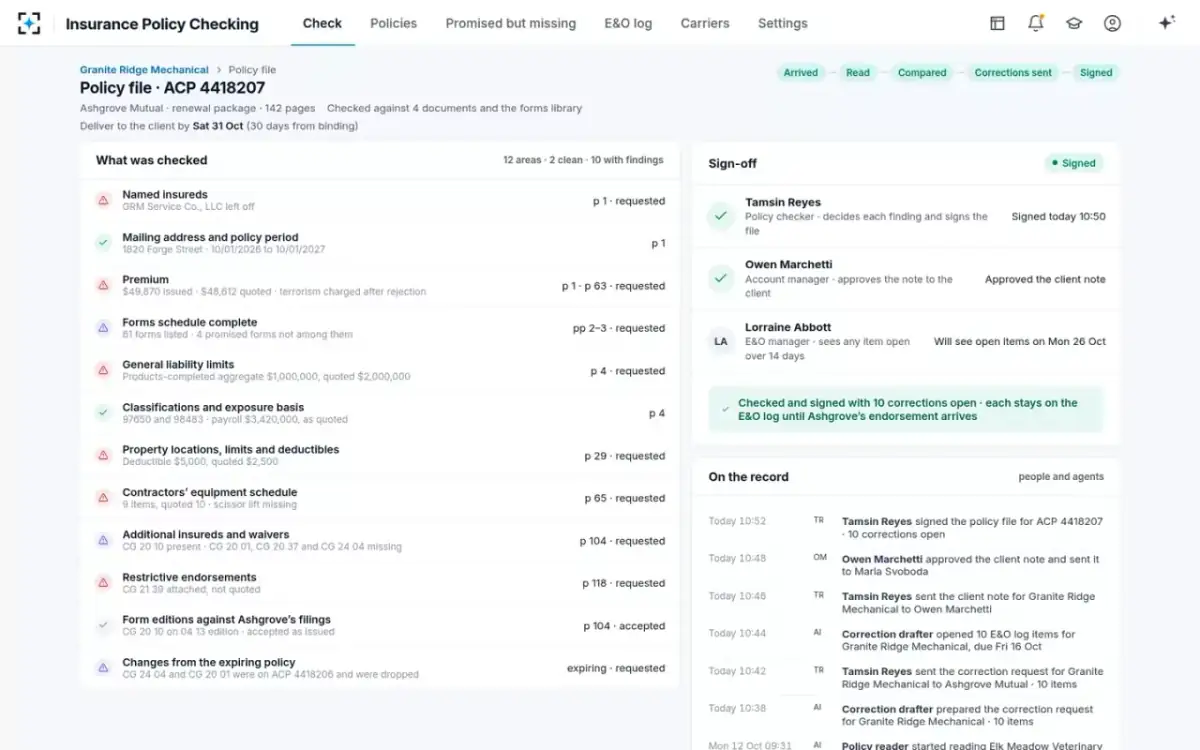
What are the most common policy issuance errors?
No government or research source publishes the mix of issuance errors, so the best evidence an agency has is its own. In the solution's fictional sample book, the largest single kind of finding was an endorsement promised and not issued, ahead of limits and deductibles, schedules, form editions, named insureds and premium. An agency that tracks its own findings this way learns which checklist items deserve the most time and which carriers to raise at the next meeting.
Where issuance errors cluster: promised endorsements first
The bar at the top is the argument for reading the checklist's third item as carefully as its first. A missing endorsement leaves no wrong number to notice, so a checker who reads the declarations and stops finds the bottom five bars and misses the top one. The way endorsement errors arise on the carrier's side, during processing, is described in insurance endorsement errors and how to count them.
What records should be kept after a policy check?
The signed file: what was compared, each finding with its pages, each decision and its reason, the correction request and the carrier's reply, what the client was told, and the endorsement that closed each item. States set minimum retention for agents' policy records; Florida's is at least five years after the policy expires, and a contract claim against a broker in New York can be brought for six years. A file built during the check, rather than reconstructed after a claim, is the one that answers both.
The package on screen: quote, issued policy and binder side by side
Questions people ask
How long does it take to check a commercial policy against a checklist?
By hand, our estimate for one complex commercial package is about eight hours, most of it reading and comparing; a simple policy takes a fraction of that. With Insurance Policy Checking's agents doing the reading, comparing and searching, our estimate falls to about 1.2 hours, most of it the checker's own decisions.
Should the checklist be the same for every policy?
The twelve areas apply to most commercial packages, but the promise list differs for every client. A contractor's checklist is dominated by contract-driven endorsements; a landlord's by additional insured status for managers or lessors; a manufacturer's by products and property values. The agency's severity rules, not the list, should change by line.
What is the difference between a policy review and a policy check?
A policy check compares the issued policy with what was quoted, bound and requested, to prove the carrier issued what was promised. A coverage review asks whether what was promised is right for the client's risks, which is advice. The checklist on this page is for the first.
Should the policy be checked against the quote or the binder?
Both, because they answer different questions. The binder is what was actually bound, and binder statutes such as Arizona's deem it to carry the endorsements it designates until the policy issues; the quote shows what the carrier offered, including options the client accepted or declined. A difference from either is a finding.
Do endorsements issued mid-term need the same checklist?
Yes, in a shorter form: the change requested, the effective date, the premium, and any named parties, against the agency's change request. Mid-term endorsements are often where a new contract requirement first appears.