An insurance binder is good for as long as it says, up to the moment the policy is issued, and in many states never longer than 90 days from its effective date unless the insurance regulator approves an extension. Arizona's statute says a binder is not valid beyond the issuance of the policy or 90 days, whichever is shorter; West Virginia forbids any agent or insurer to issue one for more than 90 days. The binder is temporary cover on the usual terms of the policy to come, and once that policy is issued the binder's promise ends and whatever the carrier printed takes over. Botminds' Insurance Policy Checking exists for that handover: it compares each issued policy with the binder, the quote and the client's request the day it arrives, so a difference is found while the binder's terms are still fresh and the carrier can still correct it.
The examples below come from the solution running on a fictional sample agency. Its binder for a contractor's renewal was dated 29 September, effective 1 October, and stated that it ran "until the policy is issued, 30 days at most". The policy arrived on 7 October. The contractor's crew was due on a hospital site on 19 October.
Two clocks start at binding: the binder's and the agency's check
- Binder in force6 days
- Unused term, to its 30-day limit24
- Policy arrives6
- Checked, request sent5 days
- Reply due4
- Crew on site3
- Policy arrives6
- Arrival to checked, by hand23 days
How long is an insurance binder good for?
Until the policy is issued or the binder's own term runs out, and within whatever ceiling the state sets. In Arizona the rule is written as a double limit: "No binder shall be valid beyond the issuance of the policy with respect to which it was given, or beyond ninety days from its effective date, whichever period is the shorter" (Arizona Revised Statutes § 20-1120(B)). West Virginia puts the same ceiling on the person issuing it: "no agent or insurer shall issue a binder covering a period in excess of ninety days from its effective date" (West Virginia Code § 33-6-18(b)).
Not every state frames it that way. Florida's binder section sets no 90-day ceiling of its own; instead it ties the notice rules to the binder's length, so that the notices of cancellation and nonrenewal its insurance code otherwise requires apply only to a binder that runs longer than 60 days (Florida Statutes § 627.420). And within any statutory ceiling, a binder can set a shorter term, as the sample binder did with 30 days. The answer for a given binder is therefore three readings: the binder's own words, the state's statute, and whether the policy has issued.
Three states' binder statutes, side by side
| Arizona § 20-1120 | West Virginia § 33-6-18 | Florida § 627.420 | |
|---|---|---|---|
| How long it lasts | Until the policy issues or 90 days from the effective date, whichever is shorter | Until the policy issues; no binder may be issued for more than 90 days | No 90-day limit in this section; the binder's own term |
| Extension | Beyond 90 days, if the policy has not issued, with the director's written approval or under the director's rules | Beyond 90 days, if the policy has not issued, with the commissioner's written approval or under the commissioner's rules | Not addressed in this section |
| What it includes | The usual terms of the policy and the endorsements designated in the binder, unless the binder clearly says otherwise | Same wording | Same wording |
| Notice to end it | Not addressed in this section | Not addressed in this section | Cancellation or nonrenewal notice only if the binder runs over 60 days; 5 days' notice before cancelling a motor vehicle binder under its auto cancellation sections, unless replaced |
| Lines excluded | Life and disability insurance | Conditional receipts of life and accident and sickness insurers; group policies | Applies to property, marine, casualty and surety binders |
Can a binder be extended?
Yes, but where a state caps binders at 90 days, an extension past the cap needs the regulator. Arizona allows a binder to be "extended or renewed beyond such ninety days" only if the policy has not been issued and only with the director's written approval or under the director's rules; West Virginia's statute says the same of its commissioner. Within the cap, extending a binder is a matter between the agent, the insurer and the binder's own terms.
For an agency, an extension request is a signal rather than a solution. A binder that needs extending means the policy has not been issued weeks after the cover began, and every week the client relies on a short document whose details, from the named insureds to the endorsements it designates, have not yet been tested against anything the carrier printed. The time is better used getting the policy issued and checked.
Is a binder the same as a policy?
No. A binder is temporary evidence of cover that borrows its terms from the policy to come; the policy is the contract. All three statutes above use the same words for what a binder contains: the usual terms of the policy it was given for, "together with such applicable endorsements as are designated in the binder, except as superseded by the clear and express terms of the binder" (A.R.S. § 20-1120(A)).
Two practical points follow from that sentence. A binder carries the usual terms of the policy, not the terms the client imagined, so its silence on an exclusion does not remove the exclusion. And it carries only the endorsements it designates, which is why a binder that names its endorsements by form number protects the client far better than one that says "per quote".
Binder against policy: what each one is, and what each one proves
Binder: Temporary cover, oral or written, until the policy issues.
Issued policy: The contract itself, with every form attached.
Binder: Until the policy issues, and within any state ceiling, often 90 days.
Issued policy: The full policy period, usually a year.
Binder: The usual terms of the policy to come, plus the endorsements it designates.
Issued policy: Exactly what is printed, including forms nobody quoted.
Binder: Only those named in it, unless the binder says otherwise.
Issued policy: Only those attached and listed on the forms schedule.
Binder: No longer valid in Arizona and West Virginia.
Issued policy: The only document that governs the cover.
Binder: The agency, on the day the policy arrives.
Issued policy: The agency, on the day the policy arrives.
What happens when a binder expires?
If the policy has been issued, nothing visible happens: the binder lapses and the policy takes over. If the policy has not been issued and the binder's term or the state's ceiling has run out, the client may have no written cover at all until the policy is issued or the binder is lawfully extended. Neither situation is safe to leave unexamined.
The first is the common case and the dangerous one. When the policy replaces the binder, every difference between them becomes the client's cover. A waiver of subrogation designated in the binder but missing from the policy is no longer the binder's promise; it is a gap in the contract that now governs, and it stays a gap until the carrier issues an endorsement.
What if the policy differs from the binder?
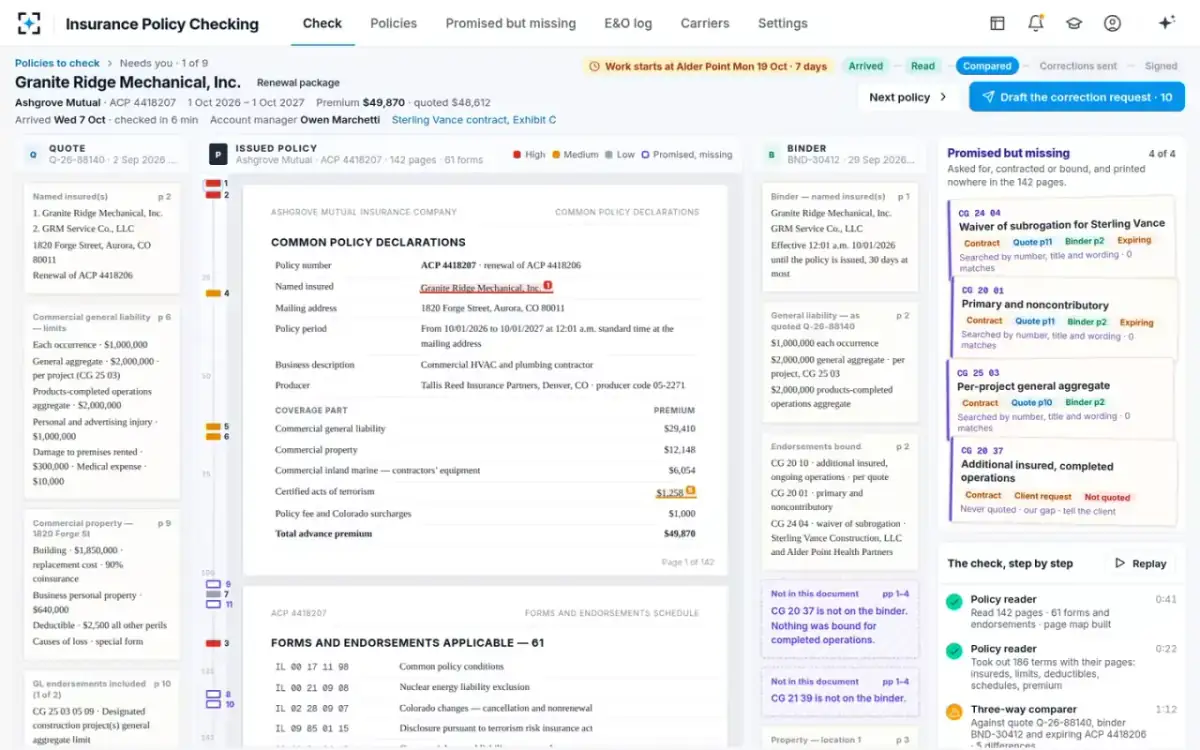
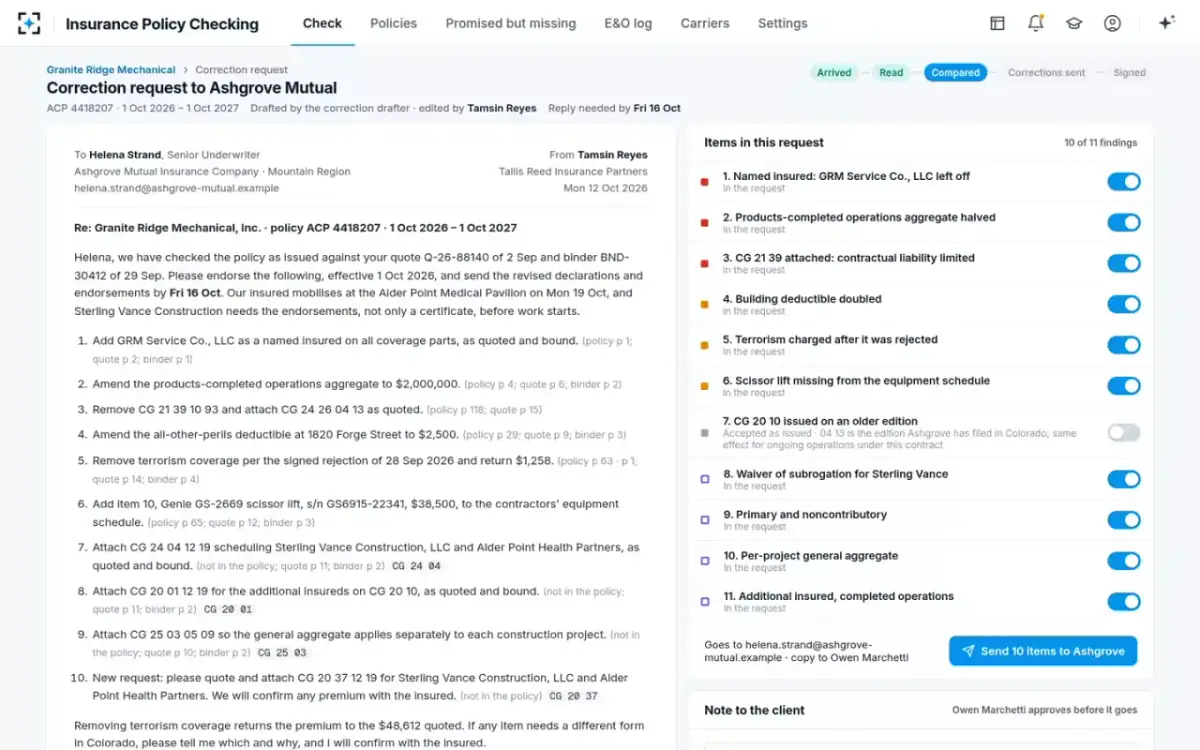
Then the policy, as issued, is what the client has, and the agency's job is to get it corrected before anyone relies on the difference. On the sample renewal the binder designated three endorsements by form number, an additional insured form, primary and noncontributory wording and a waiver of subrogation naming the general contractor and the owner, and listed a $2,000,000 products-completed operations aggregate. The issued policy carried the first, missed the other two endorsements, and printed the aggregate at $1,000,000. Insurance Policy Checking set each difference beside the binder's page and drafted one correction request to the underwriter.
A binder can also matter in court. Dissenting in New York's leading case on unread policies, Judge Pigott listed the limits of the rule that a client is presumed to know what its policy says, noting that the Appellate Division had held "the presumption is overcome when a broker fails to correct a clear misimpression created by a binder" (American Bldg. Supply Corp. v Petrocelli Group, Inc., 19 NY3d 730, 738, 2012). The majority went further and held that failure to read is not a bar at all; how that decision moves the duty to read onto the agency is set out in failure to procure insurance in New York.
The binder in its own column, beside the quote and the issued policy
Who issues a binder, the agent or the insurer?
Either, depending on the authority the insurer has given. West Virginia's statute addresses both: "no agent or insurer" may issue a binder beyond 90 days. An agent can bind only within the authority its agency contract with the insurer grants; a producer licence by itself confers no authority to commit an insurer, under the NAIC's producer licensing model. A broker acting for the client without binding authority asks the insurer or its underwriter to bind, and passes the binder on.
Who issued it matters for the check. A binder written by the agency under delegated authority is the agency's own statement of what the carrier will cover, so a policy that departs from it puts the agency in the position of having promised what the carrier did not deliver. A binder issued by the insurer is the carrier's own statement, which makes the correction request simpler: the underwriter is being asked to match its own document.
What a binder should carry, so the policy can be checked against it
A binder good enough to check a policy against names everything the client relies on, by number. The checklist is short, and each item exists because the statutes deem a binder to include only the usual terms and the endorsements it designates.
Seven things a binder should state
- Every named insured, spelled as on the application
An affiliate left off the binder is easily left off the policy, and named insureds are high-severity findings.
- Effective date and time, and how long the binder lasts
Within the state's ceiling; "until the policy is issued, 30 days at most" is clearer than silence.
- Each limit, aggregate and deductible, by coverage part
Including how the aggregate applies, for example per project, which is itself an endorsement.
- Every endorsement by form number and edition
Only designated endorsements are part of a binder; "per quote" invites a dispute about which quote.
- The parties named in additional insured and waiver endorsements
A waiver that names nobody may not reach the general contractor the contract requires.
- Coverages the client rejected, with the signed rejection
So a charge for a rejected coverage on the policy, such as terrorism, can be spotted and reversed.
- Any condition the binder sets, with its deadline
A binder subject to an inspection or a signed form needs the date it must be met.
The sample shows what that buys. Because the binder named CG 24 04 and both parties, the waiver's absence from the policy was a correction, quoted, bound and owed. Because the binder said nothing about completed-operations additional insured status, which the client's contract required, that item was a new request and the agency's own gap. A checker working from a binder that said "per quote" would have had to reconstruct both from emails. The full list of what to compare once the policy arrives is in the insurance policy checking checklist.
The correction request: the binder's page beside every item
Questions people ask
How many days is an insurance binder good for?
As many as the binder states, up to the date the policy issues and within the state's ceiling, which is 90 days from the effective date in states such as Arizona and West Virginia. Binders often set a shorter term themselves; the sample binder on this page said 30 days at most.
Is a binder proof of insurance?
A written binder is evidence that temporary cover exists on the usual terms of the coming policy and the endorsements it designates. It is not the policy, and once the policy issues, a binder stops being valid in states such as Arizona and West Virginia, so a third party relying on it should ask for the policy's endorsements.
Does a binder have the same coverage as the policy?
It is meant to: the binder statutes deem it to include the policy's usual terms and the endorsements it designates, unless its own clear terms say otherwise. Whether the issued policy actually matches the binder is a separate question, answered only by comparing them.
What happens if the policy is never issued before the binder runs out?
Where the state caps binders, an extension past the cap needs the regulator's written approval or must follow its rules; otherwise the client risks a gap in written cover. An agency should treat an unissued policy near the end of a binder as an open exposure, with an owner and a date.
Can a binder be cancelled?
Yes, subject to state notice rules. Florida, for example, requires no cancellation or nonrenewal notice for a binder of 60 days or less, but requires 5 days' prior notice before an insurer cancels a motor vehicle binder covered by its auto cancellation sections, unless a policy or another binder replaces it.