An insurance broker's duty of care, in the words New York's highest court keeps repeating, is to obtain the coverage a client requests within a reasonable time or tell the client it cannot be obtained; there is no continuing duty to advise unless a special relationship has formed. A failure-to-procure claim in New York is therefore fought over one question: what exactly did the client ask for, and what was it offered? The quote comparison a broker presents at renewal is the best answer either side will ever have, which is why it matters who prepares it, who checks it and who signs it. Botminds' Insurance Quote Comparison reads every carrier quote and form, cites each value to its page, ranks the carriers on the client's written requirements and leaves every judgement to a named person, so the comparison holds up when someone reads it again after a claim.
The examples on this page come from the solution's sample case: a fictional brokerage, Tollbridge Partners, renewing the cyber and privacy cover of a fictional client, Meridale Health Billing Services, against five fictional carriers. The law comes from the courts and regulators linked where it appears. It is New York's law unless the page says otherwise; other states phrase the duty differently, and nothing here is legal advice.
Who answers for an Insurance Quote Comparison proposal, step by step
Agent
Quote and forms readersFill each cell of the comparison with the value, its basis (each claim, aggregate, sublimit) and the quote page it came from; open every form on each schedule.
Never: Fill a cell without a cited passage, or from another carrier’s quote.
Agent
Like-for-like checkerCompares the wording behind values that read the same and marks the cell amber with both passages side by side.
Never: Decide whether a difference is acceptable.
A person decides
Account executive decides and approvesDecides every amber cell, chooses the recommendation and approves the proposal. The signature means: the differences were read and the advice follows from what the client asked for.
A person decides
Producer co-signsThe person who owns the relationship confirms the recommendation fits the requests the client made, in meetings as well as in documents.
A person decides
E&O lead signs off when neededSigns when the recommended quote still has an open amber cell, so a known gap is accepted by the person who owns the proposal standard.
A person decides
Client choosesPicks the carrier from options that each state what they give up. The choice, and what the client was told, stays with the comparison.
What is an insurance broker's duty of care? Obtain what was asked, or say you can't
In New York the duty is narrow and specific. The Court of Appeals restated it in 2012, quoting its own 1997 decision in Murphy v Kuhn, and repeated it in 2014:
“[I]nsurance agents have a common-law duty to obtain requested coverage for their clients within a reasonable time or inform the client of the inability to do so; however, they have no continuing duty to advise, guide or direct a client to obtain additional coverage”
New York Court of Appeals, American Bldg. Supply Corp. v Petrocelli Group, Inc., 19 NY3d 730 (2012), quoting Murphy v Kuhn (1997)
Two consequences follow. A client that wants to hold its broker liable has to prove a request, and not a vague one: the same opinion repeats the court's rule from Hoffend & Sons (2006) that a general request for coverage does not count; it must be a specific request for a certain type of coverage (American Bldg. Supply v Petrocelli), as failure to procure insurance in New York explains. And a broker who could not obtain what was requested is protected only if it said so, within a reasonable time. Both turn on documents: the request, the offers, and what the client was told about the gap between them.
That is the practical meaning of a duty of care in broking. It is not a promise that the client is well insured. It is a promise to deliver what was asked for, or to say plainly that it cannot be had, and a quote comparison is where both halves of that promise are kept or broken.
The specific request decides the case: what happened in Petrocelli
The facts of the 2012 case show how ordinary the failure is. American Building Supply subleased a Bronx building whose head lease required general liability insurance of at least $5,000,000 for bodily injury and property damage. It told its new broker, by its own account, that it needed cover if an employee was hurt, and that only employees ever entered the premises. The broker renewed the existing excess line policy, which carried a cross-liability exclusion removing bodily injury to any employee of any insured. Neither the client nor the broker read it. An employee was injured in October 2005, and the carrier disclaimed.
The Court of Appeals let the claim against the broker go to trial, four judges to two. The majority thought the request was corroborated by the facts: “Since no one but employees ever entered the premises, the coverage defendant obtained, which excluded coverage for injuries to employees, hardly made sense” (19 NY3d at 736). It also held that the client's failure to read the renewal policy did not, on these facts, end the claim; at most it was an argument for sharing the fault.
The dissent is the part a brokerage should read twice. Judge Pigott warned that letting the claim proceed would turn most such cases into a contest of memories about what was said in coverage discussions, a risk weighed in errors and omissions claims against an insurance agent. A written comparison that ties each requirement to the clause that imposed it, and each carrier's answer to the page that gives it, turns that battle into a reading exercise. The cross-liability exclusion in this case sat in the policy the whole time; what was missing was a document that set the client's request beside the policy's words.
What is a special relationship with an insurance agent?
A special relationship is the exception that adds a duty to advise, and New York's court has named the three situations that can create one. In Voss v Netherlands Insurance Co. (2014) it listed them, quoting Murphy: “(1) the agent receives compensation for consultation apart from payment of the premiums; (2) there was some interaction regarding a question of coverage, with the insured relying on the expertise of the agent; or (3) there is a course of dealing over an extended period of time which would have put objectively reasonable insurance agents on notice that their advice was being sought and specially relied on” (Voss, 22 NY3d 728).
The three situations that create a duty to advise, and where each shows up in a brokerage's files
| Situation (Voss, quoting Murphy) | How it arises at a brokerage | What the file should show |
|---|---|---|
| Compensation for consultation apart from premiums | A fee for a coverage review, a risk-management retainer, a consulting agreement alongside commission. | In New York, a fee needs a written memorandum signed by the client stating the compensation (Ins. Law § 2119), kept three years. The scope of advice belongs in it. |
| Interaction on a question of coverage, with the client relying on the broker | The client asks whether a limit is enough and the broker answers. In Voss, the client testified that the broker asked for her sales figures to calculate the business interruption limit. | The question, the answer, the information the answer rested on, and the client’s decision, written down with the comparison. |
| A long course of dealing that signals reliance | Years of renewals where the broker sets limits and the client signs what it is sent. | Requirements re-confirmed with the client at each renewal, so the file shows the client still chooses the limits. |
The Voss facts are a warning about renewal proposals in particular. The broker had placed $75,000 per occurrence of business interruption cover and, the client said, assured her it was enough and promised to review it each year as the business grew. When the roof failed twice in 2007, the client recovered $3,197 for the first loss and $30,000 for the second; meanwhile a renewal proposal had cut the limit to $30,000, she questioned it, and was told someone “would take a look at it.” The court sent the special relationship question to trial by four votes to three, while stressing that “special relationships in the insurance brokerage context are the exception, not the norm” (Voss).
Read together, the two cases tell a brokerage what its comparison is for. In the ordinary relationship it proves what was requested and what was offered. Where a special relationship may exist, it proves what the broker advised and why. Either way, a reduced limit, a new exclusion or a narrower basis that the comparison does not show is the line a court will read first.
Does an insurance broker have a fiduciary duty?
For advice on coverage, New York treats the broker-client relationship as an ordinary commercial one unless a special relationship has formed. Judge Pigott's dissent in Petrocelli put the point in Murphy's words: agents and brokers are not “personal financial counselors and risk managers, approaching guarantor status” (19 NY3d at 737). The fiduciary label does attach to money: under New York Insurance Law § 2120, agents and brokers are responsible “in a fiduciary capacity for all funds received or collected” and may not mingle them with their own without the principal's consent.
Two things change the picture. A fee does, because Voss's first situation is compensation for consultation, and New York's § 2119 allows a licensee to charge for reviewing or advising on a policy only “unless such compensation is based upon a written memorandum signed by the party to be charged and specifying or clearly defining the amount or extent of such compensation” (N.Y. Ins. Law § 2119). And the United Kingdom does: when a UK broker advises, ICOBS 5.3.1R says “A firm must take reasonable care to ensure the suitability of its advice for any customer who is entitled to rely upon its judgement” (FCA Handbook, ICOBS 5.3). The demands and needs statement a UK broker owes is the written form of that duty.
Where the client's part begins: requirements are the client's to state
The duty has an edge on the client's side too, and the comparison should mark it. In Petrocelli, Judge Pigott recalled that in Murphy the court had made clear “that insureds are in a better position to know both their own assets and ability to protect themselves than agents or brokers” (19 NY3d at 737). The client knows what its leases, customer contracts and lenders demand; the broker knows what the market will offer and where the wording differs. A comparison that mixes the two, with limits the broker chose presented as if the client had asked for them, blurs exactly the line a court will try to draw.
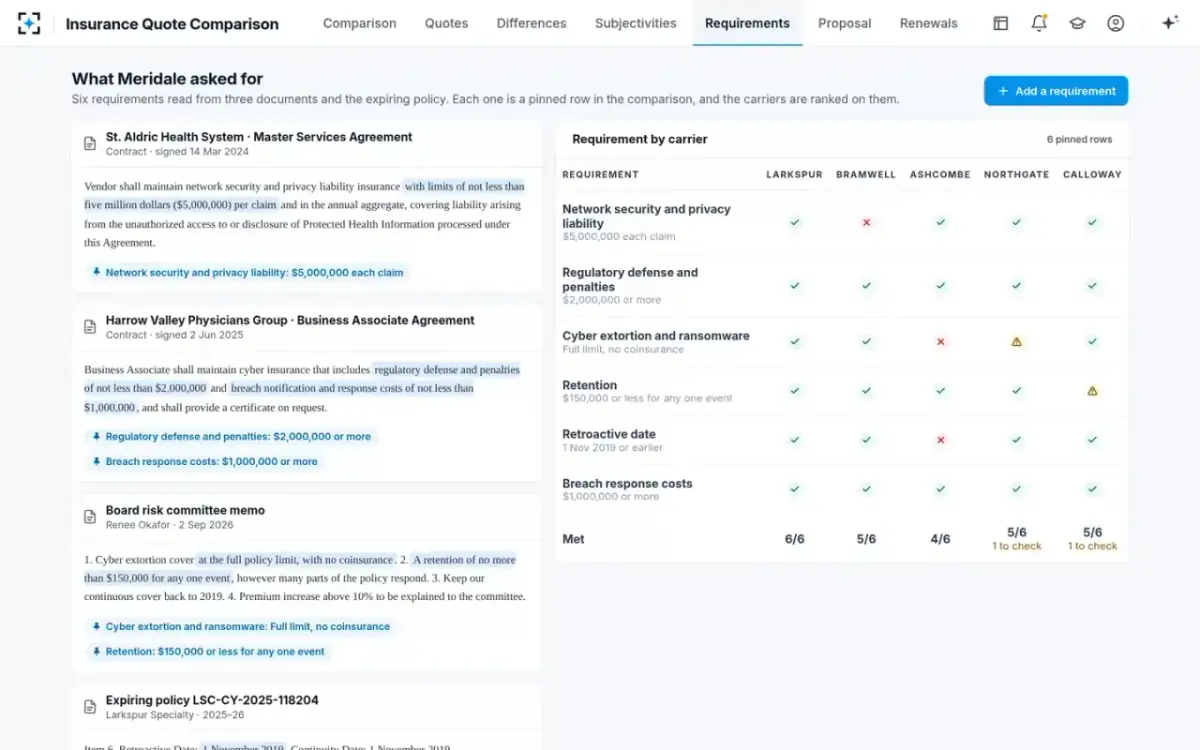
The practical answer is to make the client's requirements visible as the client's. In the sample renewal, six requirements were read from the client's documents: $5,000,000 privacy liability each claim from a hospital customer's master services agreement, regulatory defense and breach response minimums from a physicians group's business associate agreement, ransomware at full limit with no coinsurance and a retention of $150,000 or less from the client's board risk memo, and continuous cover back to 2019 from the expiring policy. Each became a pinned row with its source clause. Where the broker suggests something beyond those rows, such as a higher dependent business interruption limit, the proposal presents it as the broker's suggestion, which is the territory a special relationship would cover.
Does a broker have to recommend the cheapest quote?
No. Nothing in the New York duty asks a broker to recommend the lowest premium; the duty runs to the coverage requested. In the sample renewal, the cheapest of five quotes was the one that failed the client's own contract, and recommending it would have put the broker in exactly the position the Petrocelli broker was in.
Cheapest is not the comparison that matters: the sample renewal's two leading quotes
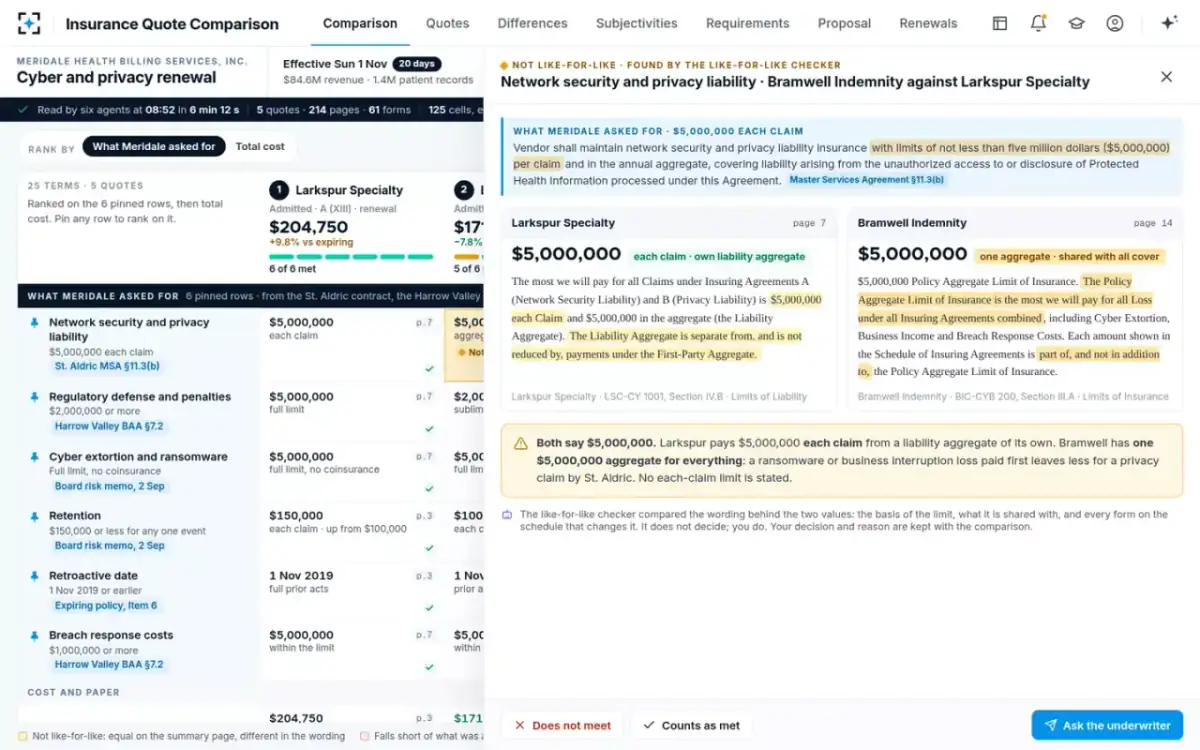
Bramwell Indemnity, cheapest: $171,900, down 7.8% on expiring
Larkspur Specialty, recommended: $204,750, up 9.8% on expiring
Bramwell Indemnity, cheapest: $5,000,000
Larkspur Specialty, recommended: $5,000,000
Bramwell Indemnity, cheapest: One $5,000,000 aggregate for all loss under all insuring agreements combined, ransomware and business interruption included
Larkspur Specialty, recommended: $5,000,000 each claim, from a liability aggregate separate from first-party loss
Bramwell Indemnity, cheapest: Does not give $5,000,000 per claim: marked not met by the account executive
Larkspur Specialty, recommended: Meets it
Bramwell Indemnity, cheapest: 5 of 6
Larkspur Specialty, recommended: 6 of 6
A broker may still present the cheaper option. Clients trade cover for price all the time, and that is their call. What protects the broker is that the trade is explicit: the proposal states what the cheaper quote gives up, in the client's terms, and the client's choice is recorded against that statement. In the sample proposal, the line for Bramwell reads that it does not give the client's customer $5,000,000 per claim. A client who chooses it anyway has made a specific, informed decision.
The not-like-for-like cell: both passages under the client's own requirement
Who is liable if the client chose the cheaper quote?
Usually the client carries that choice, provided the file shows it was a choice. The New York cases put the burden on the client to prove a specific request the broker failed to meet; a client who saw the gap, in writing, and chose the cheaper quote is in a weak position to say it asked for something else. A client who was shown two figures of $5,000,000 side by side is not.
The risk sits in three places. First, the requirement the client gave orally and nobody wrote down: Petrocelli was decided on deposition testimony about a conversation. Second, the difference the comparison did not show because the summary pages agreed: a basis, a shared aggregate, a coinsurance clause in an endorsement. Third, the choice that was made but not recorded: an email thread that ends in “go with the cheaper one” proves little about what the client understood. The spreadsheet that shows two equal cells fails on the second; a proposal without a recorded decision fails on the third.
What should a broker document when presenting quotes?
Document the request, the offers in the carriers' own words, the differences and the decision. The list below is our suggestion for a file that answers the questions New York courts ask; it is not a statutory checklist.
What a quote comparison should prove, one line per question a court asks
- Each requirement, with the clause or memo that imposes it
A contract’s insurance clause, a lender’s covenant, a board memo, the expiring policy. A specific request is the client’s case and the broker’s defense.
- Each carrier’s value with its basis and its page
Not “$5M” but “$5,000,000 each claim, separate liability aggregate, page 7”.
- Every form on each schedule, opened
Endorsements named only by number are where coinsurance, new exclusions and sublimits live.
- The differences, stated in the client’s terms
What each option gives up against each requirement, in one sentence the client can repeat.
- What could not be obtained, and when the client was told
The second half of the common-law duty: inform the client of the inability to obtain requested cover.
- The client’s choice, with what they were shown
The option chosen, the date, and the version of the proposal it was chosen from.
- Who prepared, checked and approved the comparison
Names and times, so a reviewer can see the work was checked by someone other than the person who built it.
- Disclosures and fee memoranda
In New York, Regulation 194 disclosures and any § 2119 fee memorandum are kept at least three years.
The last line has a precise source. New York's Department of Financial Services says a producer must keep a copy of a written disclosure “for at least three years after the producer provides the disclosure” (DFS, Regulation 194 FAQ). A brokerage that keeps the comparison and the proposal on the same schedule keeps the document that explains the disclosure.
What each signature means in Insurance Quote Comparison
A signature is only worth what the signer checked. In Insurance Quote Comparison each one is attached to a specific act, and the agents cannot sign, send or bind anything. The account executive's approval follows the decisions on every amber cell; the producer's co-signature follows the approval; the E&O lead signs when a recommended quote still has an amber cell open; the client chooses at the meeting.
The proposal: recommendation, options, citations and the sign-off chain
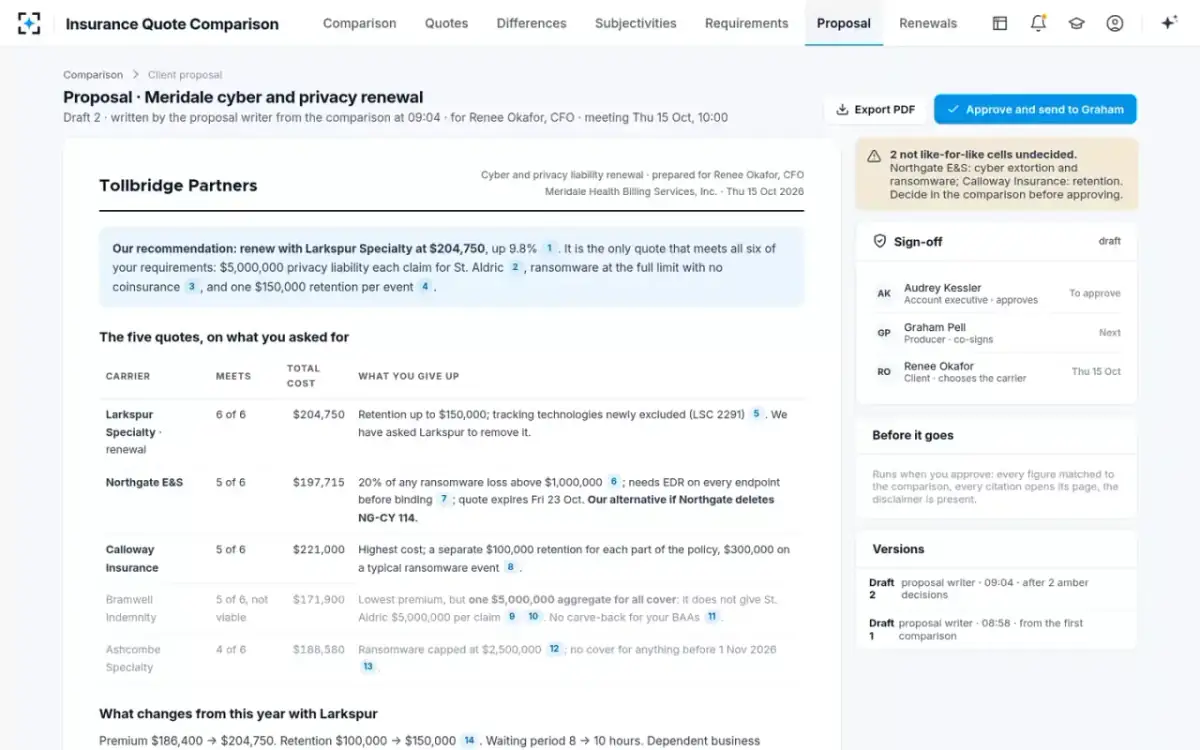
The same renewal, signed by five people for five different reasons
Today
Builds the side-by-side by hand and presents a summary that says five million without saying five million of what.
With agents
Starts from a cited comparison ranked on the client’s requirements and spends the time deciding the cells that only look equal.
Still theirs: Every amber decision and the approval
Today
Retypes quotes into a grid and chases subjectivities by email.
With agents
Sees each carrier’s conditions, which documents already meet them and one request to the client for the rest.
Still theirs: Binding, once the conditions are met
Today
Learns that the cheapest quote was wrong after the client does.
With agents
Co-signs a proposal in which the reason a quote is not recommended fits in one sentence.
Still theirs: The co-signature and the client relationship
Today
Owns a proposal standard with no way to check it was followed.
With agents
Sets what counts as not like-for-like and signs when a recommended quote has an open amber cell.
Still theirs: The proposal standard
Today
Is shown the lowest premium first and asks what she loses with it.
With agents
Reads her own contracts as the rows the carriers are ranked on.
Still theirs: The choice of carrier
The design follows the cases. Petrocelli turned on whether a request was made and met, so the requirements matcher writes each request as a row with the clause that imposed it. Voss turned on what the broker advised about a limit, so the proposal states what each option gives up and the client's choice is recorded with the version it was made from. A comparison built that way is also the starting point for the questions a client should ask about quotes, because the client sees the same rows.
The client's requirements, read from the documents that impose them
To see the whole case, from five quotes to the co-signed proposal, start from Insurance Quote Comparison.
Questions people ask
Does a broker have to advise on coverage limits?
Not in an ordinary relationship under New York law: the broker must obtain the limits requested, and has “no continuing duty to advise, guide or direct a client to obtain additional coverage”. A duty to advise on limits can arise from a special relationship, as the client argued in Voss, testifying that her broker set a $75,000 business interruption limit from her sales figures and assured her it was enough. Other states draw the line in their own words.
Can I sue my broker for the wrong coverage?
In New York a client can bring a negligence or breach of contract claim if it proves a specific request for coverage that the policy did not provide; a general request is not enough. In Petrocelli the court let such a claim proceed even though the client had not read the renewal policy, treating the failure to read as, at most, a reason to share fault. The outcome then turns on evidence of the request.
Does an insurance broker owe a duty to recommend the best carrier?
The New York cases speak of obtaining requested coverage, not of finding the best carrier. A UK broker that tells a client it advises on the basis of a fair analysis must analyze a sufficiently large number of contracts on the market under ICOBS 5.3.3R. In both places, writing down which markets were approached and what each offered is the defense.
Is a broker liable if the client never read the policy?
Not reading the policy does not automatically protect the broker in New York after Petrocelli, decided four to two in 2012. The two dissenting judges would have applied the old rule that an insured who accepts a policy is presumed to know its contents. A comparison that quotes the relevant wording gives the client a reading of the terms that matter, which makes the argument less likely to arise.
How long should a broker keep a quote comparison?
No single rule names the comparison itself. In New York, compensation disclosures under Regulation 194 and fee memoranda under § 2119 must be kept at least three years, and claims about a placement can surface later than that, so many brokerages keep the comparison and proposal with the policy file for as long as they keep the policy. Check the record-keeping rule of each state where the brokerage is licensed.