To compare business insurance quotes, write down what your contracts, lenders and board require; ask for each carrier's full quote with its list of forms; and compare what each quote would pay on the losses you are most likely to have, net of retentions, coinsurance and sublimits, before you look at the premium. Then add taxes and fees, check the conditions you must meet and the date each offer lapses, and ask your broker to state in one sentence what each option gives up. The premium is the easiest number to compare and the least informative. This guide is written for the owner, CFO or risk manager on the buying side; the worked example comes from Botminds' Insurance Quote Comparison, which brokers use to read every carrier's quote and forms and lay the options out against the client's own requirements.
The example is the solution's sample case: a fictional brokerage, Tollbridge Partners, renewing the cyber cover of a fictional company, Meridale Health Billing Services, with quotes from five fictional carriers. The figures in it are sample data and our arithmetic, not anyone's claims experience.
Five business insurance quotes compared on one bad year: what the premium hides
Larkspur · $504,750 in all
- Premium $204,750 · 41%
- Losses you pay $300,000 · 59%
Calloway · $621,000 in all
- Premium $221,000 · 36%
- Losses you pay $400,000 · 64%
Northgate · $797,715 in all
- Premium $197,715 · 25%
- Losses you pay $600,000 · 75%
Ashcombe · $813,580 in all
- Premium $188,580 · 23%
- Losses you pay $625,000 · 77%
Bramwell, cheapest premium · $2,171,900 in all
- Premium $171,900 · 8%
- Losses you pay $2,000,000 · 92%
How do I compare business insurance quotes?
Compare them on cover first and price second, in six steps. The Small Business Administration's advice is the right starting point: “Prices and benefits can vary significantly. You should compare rates, terms, and benefits for insurance offers from several different agents” (SBA, Get business insurance). The steps below are how to compare the terms and benefits part when the quotes run to forty pages each.
How to compare business insurance quotes, step by step
| Step | What to do | In the sample case |
|---|---|---|
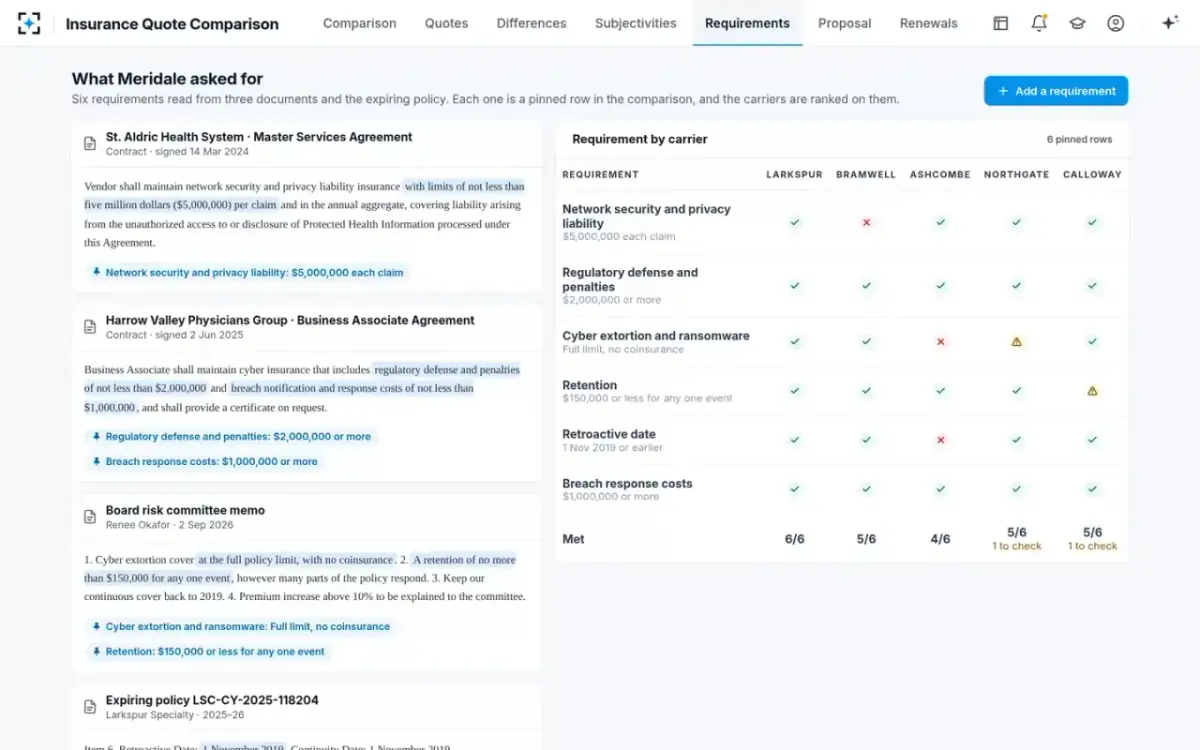
| 1. Write your requirements | List every insurance demand in your contracts, leases, loan agreements and board decisions, with the clause. | Six requirements from a hospital customer’s contract, a physicians group’s agreement, the board’s risk memo and the expiring policy. |
| 2. Get full quotes | Ask for each carrier’s quote, schedule and forms list, not a one-page summary. | Five quotes of 38 to 52 pages, 61 forms in all. |
| 3. Compare the basis, not the number | For each limit: each claim or aggregate, separate or shared, inside or outside the limit. | Five quotes read $5,000,000 for privacy liability; one was a single aggregate shared with everything. |
| 4. Price a bad year | Apply retentions, coinsurance and sublimits to the two or three losses you fear most. | The split above: the cheapest premium is the most expensive year. |
| 5. Add total cost and paper | Taxes and fees, and whether the insurer is admitted in your state. | Two non-admitted quotes carry a 5% surplus lines tax. |
| 6. Check conditions and dates | What each carrier needs before or after binding, and when each offer lapses. | 17 conditions across five quotes; one carrier’s quote lapses eight days after the meeting. |
Why is one business insurance quote so much cheaper than another?
Usually because it covers less, in a way the summary page does not show. Carriers price what they promise to pay, and a lower premium often buys a narrower promise: a shared aggregate, a sublimit, coinsurance above a threshold, a retention that applies more than once, a later retroactive date, or a new exclusion. Sometimes it is a genuinely better price for the same cover, which is why the comparison has to be done rather than assumed.
Six reasons a business insurance quote is cheaper, and how to spot each
| Reason | Where it hides | Example in the sample quotes |
|---|---|---|
| A shared aggregate | The limits section of the policy form, not the summary | Bramwell: one $5,000,000 for all loss under all parts of the policy |
| A sublimit | The schedule, often in small type beside the headline limit | Ashcombe: ransomware capped at $2,500,000 within a $5,000,000 policy |
| Coinsurance | An endorsement listed by number on the forms list | Northgate: you pay 20% of any extortion loss above $1,000,000 |
| Retention per part of the policy | The retention clause in the policy form | Calloway: $100,000 for each insuring agreement that responds |
| No prior acts cover | The retroactive date on the declarations | Ashcombe: retroactive date at inception, so nothing before 1 Nov 2026 |
| A new exclusion | The forms list, compared with last year’s | Larkspur’s renewal: LSC 2291 excludes tracking technologies |
The cheapest quote in the sample case, at $171,900, was not the worst in every row; it had a low retention and full limits on the schedule. Its problem was a single sentence in the limits section making the $5,000,000 one pot for everything. In a year with one large loss it is fine. In a year with two, the second claim gets what is left.
What should I look for in a business insurance quote?
Look for the words that qualify each number. The checklist below is what a buyer can ask a broker to confirm for every quote presented; a broker who compares quotes properly will already have the answers, with the page each one comes from.
What to look for in each business insurance quote
- The basis of every limit
Each claim, each occurrence or aggregate; separate or shared with other parts of the policy.
- Sublimits under the headline limit
Especially for the loss you most fear, such as ransomware or business interruption.
- How the retention applies
Once per event, or once for each part of the policy that responds.
- Coinsurance anywhere in the forms
A percentage of the loss you keep, often added by endorsement.
- Retroactive date and prior acts
Claims-made cover only reaches back as far as this date.
- Exclusions new this year
Compare the forms list with the expiring policy’s.
- Costs inside or outside the limit
Defense and breach costs that use up the limit leave less for the claim.
- Admitted or non-admitted paper, and total cost
Surplus lines quotes add tax and, in many states, sit outside the guaranty fund.
- Conditions before and after binding
Signed applications, attestations, inspections, with dates.
- The date the offer lapses
A quote you cannot bind before your meeting is not an option.
What is a sublimit?
A sublimit is a smaller limit for one kind of loss inside the policy's overall limit, and it is part of that limit, not in addition to it. The sample quote from Ashcombe puts ransomware at a $2,500,000 sublimit that sits inside the policy limit rather than on top of it. A buyer reading “$5,000,000 policy limit” on the summary would expect a $5,000,000 ransomware recovery; the most this quote would pay is half that.
Sublimits are where carriers manage the risks they worry about most, and they move with the market. Reviewing the cyber market, the GAO reported that the rising frequency and severity of attacks, “especially ransomware attacks”, had led insurers to reduce cyber limits for certain riskier sectors, such as health care and education, “and to add specific limits on ransomware coverage” (GAO-21-477, 2021). If your business is in one of those sectors, the sublimit row is the one to read first; comparing cyber insurance coverage goes through the cyber rows one by one.
How do I know if two quotes are like for like?
Ask for the wording behind each number, side by side. Two quotes are like for like when the same loss would be paid the same way under both, which you can only tell from the policy language. A broker using Insurance Quote Comparison sees both passages for every cell that reads the same but is not, and can show them to you.
Two quotes that both say $5,000,000, read the way a buyer should read them
Bramwell Indemnity, $171,900: One aggregate pays for every kind of loss under the policy, so a ransomware claim reduces the liability limit
Larkspur Specialty, $204,750: A liability aggregate of its own, which first-party payments cannot reduce
Bramwell Indemnity, $171,900: One pot of $5,000,000 for everything in the year.
Larkspur Specialty, $204,750: $5,000,000 for each liability claim, kept apart from your own losses.
Bramwell Indemnity, $171,900: $5,000,000 per claim: not met once anything else has been paid
Larkspur Specialty, $204,750: $5,000,000 per claim: met
What you asked for, read from your own documents
What questions should I ask my broker about quotes?
Ask questions whose answers are written down, and make your requests specific. In New York, a business that later claims its broker failed to get the right cover must show it asked for that cover specifically: the state's highest court has held that a general request is not enough; the client must have asked for the particular coverage (American Bldg. Supply v Petrocelli, 2012), a rule traced in failure to procure insurance in New York. “Make sure we're fully covered” is a general request. “We need $5,000,000 per claim for privacy liability, as our hospital contract requires” is a specific one.
Questions to ask your broker, and what a good answer looks like
| Ask | Why | A good answer |
|---|---|---|
| Which of my requirements does each quote fail, and why? | The ranking should start from your requirements, not the premium. | A list per carrier, each failure tied to a clause in your documents and a page in the quote. |
| Where do two equal numbers mean different things? | Basis and wording are where cheap quotes save money. | The passages side by side, with one line on what it means for you. |
| What would each quote pay on our likeliest bad loss? | Retentions, coinsurance and sublimits only show in a scenario. | A worked figure per carrier for one or two named losses. |
| What changed from last year? | Renewals narrow quietly: retentions, waiting periods, exclusions. | Each change, old and new, with the form that made it. |
| What must we do before and after binding? | An unmet condition can cost you the cover you chose. | Each condition with its deadline and the document that meets it. |
| When does each offer lapse? | An expired quote is not an option. | A date per carrier, before your decision meeting. |
| How are you paid on each option? | Commission can differ by carrier. | The basis of pay, and the amount if you ask. |
The last question in that table has a section of its own below. The others are questions a broker should be glad to receive; they are the same ones the broker needs answered to meet its own duty of care.
Should I always take the cheapest business insurance quote?
No, and in the sample case the cheapest premium was the most expensive year by far: $171,900 of premium and $2,000,000 of losses left with the client in the scenario above, against $204,750 and $300,000 for the quote the broker recommended. The cheaper quote can still be the right buy when its narrower cover does not touch your likely losses or your contracts, and only you can make that trade. Make it with the scenario in front of you.
Paper matters too. A non-admitted, or surplus lines, quote is not wrong, and in specialty lines it is often the only offer. It comes with differences a buyer should see. Florida, for example, requires every surplus lines policy to state on its face that no Florida regulator has approved its rates and forms, and to carry a notice that persons insured by surplus lines carriers do not have the protection of the Florida Insurance Guaranty Act if the insurer becomes insolvent (Fla. Stat. § 626.924). Federal law lets only the insured's home state charge premium tax on nonadmitted insurance (15 U.S.C. § 8201), so the tax in your total cost is your home state's; why a rater cannot price these quotes works through the arithmetic.
Can I ask my broker how much commission they make?
Yes, and in several places the rules say the broker must answer. New York's Regulation 194 requires every producer to give an initial disclosure in all cases and to state the amount of its compensation when the buyer asks (NY DFS, Regulation 194 FAQ). In the UK a broker must tell a commercial customer its commission promptly, in cash terms, when asked (FCA Handbook, ICOBS 4.4). Both rules are set out in insurance commission rates by line. Where a broker also charges you a fee, the NAIC's model producer licensing act would have it obtain your documented acknowledgment before taking insurer compensation as well (NAIC Model #218, § 18); states have adopted that section unevenly.
What commission is worth across the market
11.11%
of earned premium spent on commission and brokerage by insurers writing in Texas, all P&C lines, direct business, 2024
$80.7B
commission and brokerage expense in the same exhibit
The SBA's guide is blunt about why it matters: commercial agents “receive commissions from insurance companies when they sell policies, so it's important to find a licensed agent that's interested in your needs as much as his or her own” (SBA). A comparison that ranks carriers on your written requirements first, then on total cost, is the practical answer to that worry, because it shows why the recommended quote won.
What a broker using Insurance Quote Comparison hands you
The output a buyer sees is a proposal: the recommendation, each option and what it gives up against your requirements, what changes from this year, and what is needed to bind, with every figure cited to the carrier's page and a disclaimer that the policy wording governs. In the sample case it reads, for the cheapest quote, that it “does not give St. Aldric $5,000,000 per claim”, and for the alternative, that it is recommended only if the carrier deletes one endorsement.
The proposal a buyer reads: options, what each gives up, and citations
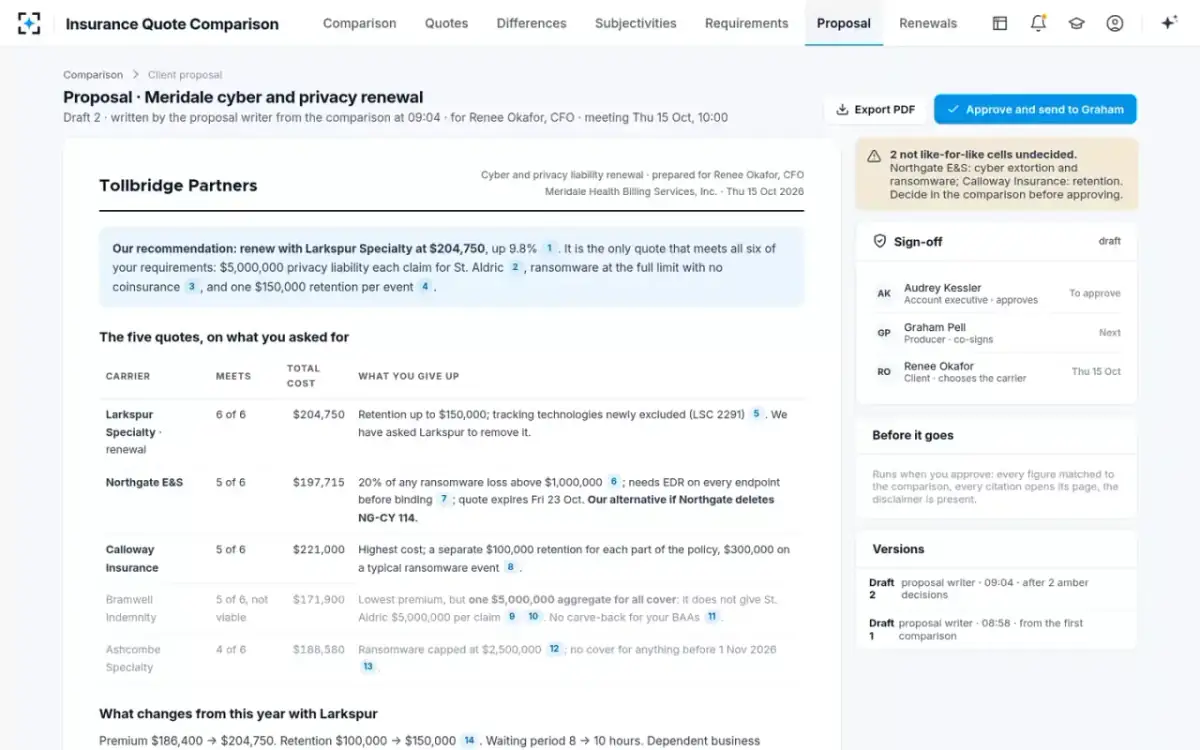
The buyer's decision stays the buyer's. The proposal is approved by the account executive and co-signed by the producer, and the client chooses. To see how the comparison behind it is built, start from Insurance Quote Comparison.
Questions people ask
How many business insurance quotes should I get?
Enough to cover the carriers that actually write your kind of risk; there is no fixed number. In specialty lines a broker may approach many markets and receive only a few bindable quotes. Five full quotes, as in the sample case, are plenty if each is compared on wording rather than premium.
What is the difference between a deductible and a retention?
Both are the part of a loss you pay before the insurer does; “retention” is the usual term in liability and cyber policies, and some retentions also apply to defense costs. What matters more than the word is how often it applies: once per event, or once for each part of the policy that responds. In the sample case a $100,000 retention applied three times to one ransomware event.
What does admitted and non-admitted mean on a quote?
An admitted insurer is licensed in your state, files its rates and forms there, and is usually backed by the state guaranty fund. A non-admitted, or surplus lines, insurer is not licensed in your state, is placed through a surplus lines broker, and adds a premium tax set by your home state. In Florida its policy must say its rates and forms are not approved by any Florida regulatory agency.
Should my business insurance be compared every year?
The renewal should be compared with the expiring policy every year, even if you do not shop the market, because terms change quietly. The sample renewal changed six of 22 terms, including a higher retention and a new exclusion that mattered to the client's payment portal.
What is a policy aggregate limit?
The most a policy pays for all claims in the policy period combined. If parts of the policy share one aggregate, a large loss under one part reduces what is left for the others. Ask whether your liability cover has an aggregate of its own, separate from first-party losses.