An insurance quote's validity period is the window in which the carrier will bind cover on the terms it quoted; after the date printed on the quote, the offer lapses and any new offer may differ. In commercial insurance there is no standard length: each carrier sets its own date, and in the sample case below five quotes for the same renewal lasted between 15 and 26 days from receipt. That makes the validity date a term of the comparison like any limit, because a quote that lapses before the client decides is not an option. Botminds' Insurance Quote Comparison records each quote's bind-by date and the conditions still open against it beside the carrier's figures, and the proposal states them, so the client compares offers that will still be there on the day it chooses.
The dates come from the solution's sample case: a fictional brokerage renewing the cyber cover of a fictional client, Meridale Health Billing Services, with five fictional carriers, for cover from Sunday 1 November 2026 and a proposal meeting on Thursday 15 October.
Five quotes, five clocks: the date each offer lapses and what is still open against it
Larkspur SpecialtyAdmitted · renewal
ReceivedMon 5 Oct
Bind bySat 31 Oct
Life26 days
After the meeting16 days
Open before bindingSigned renewal application
Bramwell IndemnityAdmitted · new market
ReceivedTue 6 Oct
Bind byFri 30 Oct
Life24 days
After the meeting15 days
Open before bindingSigned application; ransomware supplemental
Ashcombe SpecialtyNon-admitted · London
ReceivedWed 7 Oct
Bind bySat 31 Oct
Life24 days
After the meeting16 days
Open before bindingSigned proposal form
Calloway InsuranceAdmitted · new market
ReceivedFri 9 Oct
Bind byWed 28 Oct
Life19 days
After the meeting13 days
Open before bindingSigned application
Northgate E&SNon-admitted · surplus lines
ReceivedThu 8 Oct
Bind byFri 23 Oct
Life15 days
After the meeting8 days
Open before bindingSigned application; EDR on every endpoint, confirmed in writing (blocked)
How long is an insurance quote valid?
As long as the quote says. Commercial carriers print a validity or bind-by date on each quote, and no general rule sets one length for the market. In the sample case, quotes received between Monday 5 and Friday 9 October lapsed between Friday 23 and Saturday 31 October; the shortest lasted 15 days, the longest 26. The first to lapse was not the first to arrive.
Two practical consequences follow. The comparison must carry the date for each quote, because the order in which quotes expire rarely matches the order of preference. And the proposal meeting has to be scheduled against the earliest date that matters: in the sample case, the alternative recommendation lapsed eight days after the meeting, with a blocked condition still open.
Why do commercial insurance quotes expire?
Because the price and terms rest on information that goes stale, on rates that change, and on conditions the carrier expects to be met within a set time. The NAIC's market conduct examiners test whether underwriting, rating and classification rest on adequate information gathered close to the start of coverage (NAIC Market Regulation Handbook, chapter 21, property and casualty standard 8). A quote priced on loss runs and an application from early October is priced on information that will not be near inception forever.
Rates are the second reason. For admitted insurers in many states, the price must follow the rates on file at the time. New York's Department of Financial Services made the point in a 2008 opinion on a two-year rate guarantee attached to a binder: the guarantee was improper partly because it could depart from the insurer's filed rates and rating rules, explained in what a rater can and cannot compare, and the department noted that “An insurer may always issue a policy for a two-year term and thereby bind itself to the rates then in effect” (NY Insurance Department, Office of General Counsel opinion, 14 April 2008). A quote that lives past a rate change would be promising what the filing no longer allows.
The third reason is inside the quote itself. Several conditions in the sample quotes carry their own dates, such as an application dated within 30 days of binding, loss runs valued within 90 days, and a vulnerability scan with no critical findings within 30 days. A quote that waited too long would fail its own subjectivities.
Is a quote binding on the insurer?
A quote is an offer to provide cover on stated terms, if the offer is accepted before it lapses and the conditions attached to it are met; it is not cover. Cover starts when the carrier binds, usually through a binder, and a binder is a different instrument. New York's Court of Appeals summarised the law, in words the state's insurance department quoted in 2005: “It has long been settled in this State that an insurance binder is a temporary or interim policy until a formal policy is issued” and “a binder is limited in time until an assessment of risk is completed by the carrier” (NY Insurance Department, Office of General Counsel opinion, 9 August 2005, quoting Springer v Allstate).
What is the difference between an indication, a quote and a binder?
Each step commits the carrier to more, and each has its own clock. An indication is a carrier's view of roughly what it would charge, often before full underwriting information is in. A quote is a firm offer on stated terms, subject to its conditions, until its validity date. A binder is temporary cover from its effective date until the policy is issued, for no longer than the binder or the state's law allows. The policy is the contract.
Indication, quote, binder, policy: what each one commits
| Document | What it commits the carrier to | Its clock | In the comparison |
|---|---|---|---|
| Indication | Nothing firm: a likely price or range, often before full information | Usually none that binds anyone | Market summary only; never a column, because it cannot be bound |
| Quote | Cover on stated terms if accepted before it lapses and its pre-bind conditions are met | The quote’s validity or bind-by date | A column, with its date and open conditions beside the figures |
| Binder | Temporary cover on the policy’s usual terms and the endorsements the binder names | Until the policy issues or a statutory maximum; Arizona, for example, caps it at 90 days without the director’s approval | The basis for checking the issued policy, and for post-bind conditions |
| Policy | The full contract for the policy period | The policy period, subject to cancellation law | The wording that governs, against which the comparison is checked |
The difference between an indication and a quote matters most in a hard market, when brokers present indications to give the client an early view. Putting an indication in a column beside bindable quotes invites the client to choose a price nobody has offered.
Can a carrier change a quote before it expires?
A quote rests on the application and information the carrier was given, which is why most commercial quotes ask for the application to be signed and dated close to binding. If those facts change before binding, such as a new loss, a change of operations, or a condition that turns out to be unmet, expect the carrier to want to see them and to re-quote. On unchanged facts, the point of a validity date is the reverse: the quoted terms stand until it.
Even after binding, terms can move as the carrier completes its assessment. In the 2005 New York case, a commercial property binder was issued with a building limit of $450,000; after an inspection, the insurer issued the policy with a building limit of $512,000 and a higher premium, and the department accepted that the insurer could modify the terms and limits as part of issuing the policy, within the state's cancellation rules (NY Insurance Department, 2005). The comparison should therefore be checked again against the policy when it arrives, which is the job of the policy checking process.
What happens if a quote expires before binding?
The offer is gone, and what replaces it is a new quote that may differ in price, terms or conditions, or no quote at all. In the sample case, if the client had wanted the alternative carrier and could not confirm endpoint detection on its last 12 devices before Friday 23 October, the quote would have lapsed nine days before the policy was due to start. The brokerage would have been asking for an extension or a re-quote against the clock, with the other four quotes still running down.
The decision calendar: how many offers are still open on each day
- Proposal drafted12–15 Oct
- All five quotes open; EDR rollout ends 20 Oct15–23 Oct
- Four open: Northgate lapsed23–28 Oct
- Last three lapse28 Oct–1 Nov
The renewal case has a further date. When the expiring carrier is also quoting, its renewal quote carries its own validity, and letting it lapse while waiting for new markets can leave the client with fewer options, not more. The sample case's incumbent quote was among the last to lapse; in another renewal it could be the first, which is why the date on each page, not habit, sets the order of work.
Do quotes change if the effective date moves?
They can, and the safe assumption is that they will. A quote is for a stated policy period, priced on rates and information at a stated time; move the inception date and the carrier may re-rate on the rates then in effect, ask for refreshed information, or re-check conditions such as an application dated within 30 days of binding. Ask the underwriter to confirm in writing that the terms hold for the new date, and record the answer in the comparison.
Three clocks on every quote: the offer, the documents and the cover
Read a commercial quote's dates as three separate clocks, because they run out at different times and for different reasons. The offer clock is the validity or bind-by date: after it, there is nothing to accept. The document clock belongs to the conditions: an application dated within 30 days of binding, loss runs valued within 90 days, a scan with no critical findings in the last 30 days. Those can expire while the offer is still open, so a quote that was bindable on the day of the meeting may not be bindable a week later without fresh paperwork. The cover clock starts at binding: a binder's own life, and post-bind conditions due within a set number of days.
In the sample case the three clocks for Northgate's quote ran like this. The offer lapsed on Friday 23 October. The document clock was tighter than it looked: the application had to be dated within 30 days of binding, and the endpoint detection confirmation could not be given until the last 12 devices were done on Tuesday 20 October, leaving three days. The cover clock would then have started a 30-day deadline for the surplus lines affidavit. A comparison that shows only “valid until 23 Oct” shows one clock of three.
Can you extend an insurance quote?
You can ask, and often the answer is yes for a short period if nothing has changed; the request should go to the underwriter in writing before the quote lapses, with the reason and the new date sought. The answer, and any changed conditions, should replace the old date in the comparison the same day.
Each quote carries its valid-until date beside its pages
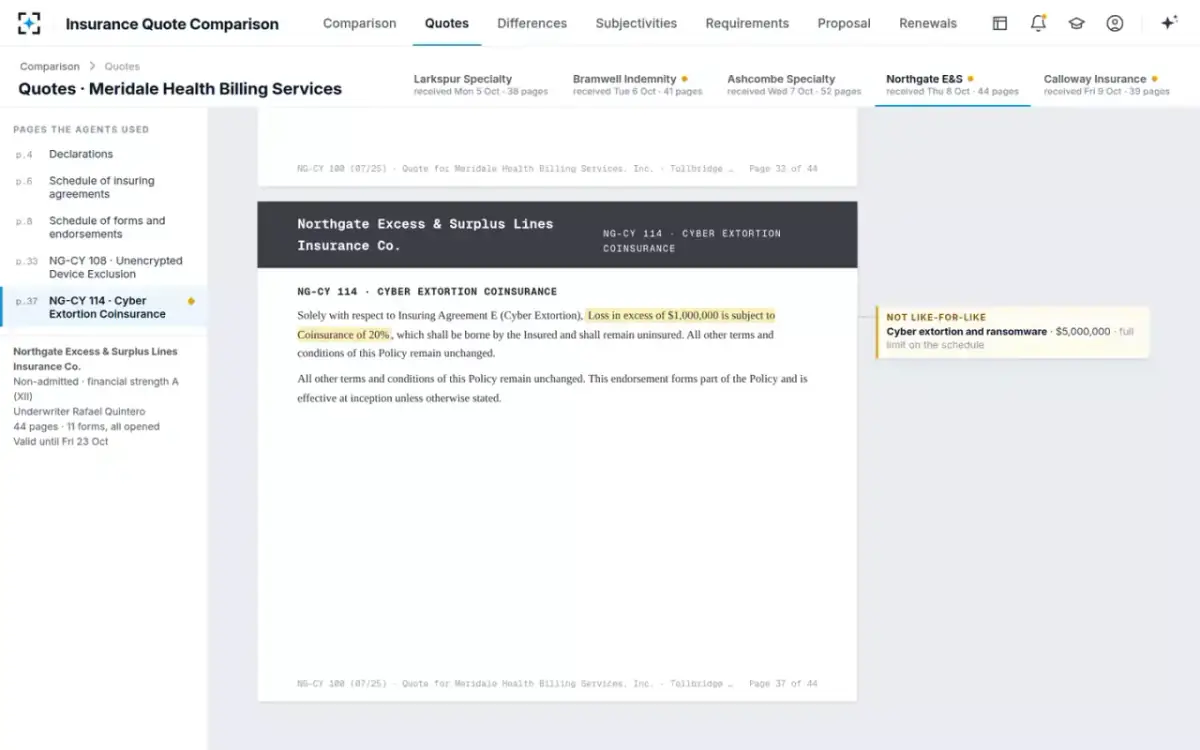
Putting the dates in the comparison
Dates belong in the comparison for the same reason limits do: the client is choosing among them. In Insurance Quote Comparison, “quote valid until” is one of the five cost and paper rows the sample brokerage compares for cyber, and the subjectivities view shows each carrier's bind-by date above its conditions. The proposal carries the date for any option that lapses before inception; in the sample case it says of the alternative that its “quote expires Fri 23 Oct”.
Bind-by dates above each carrier's conditions
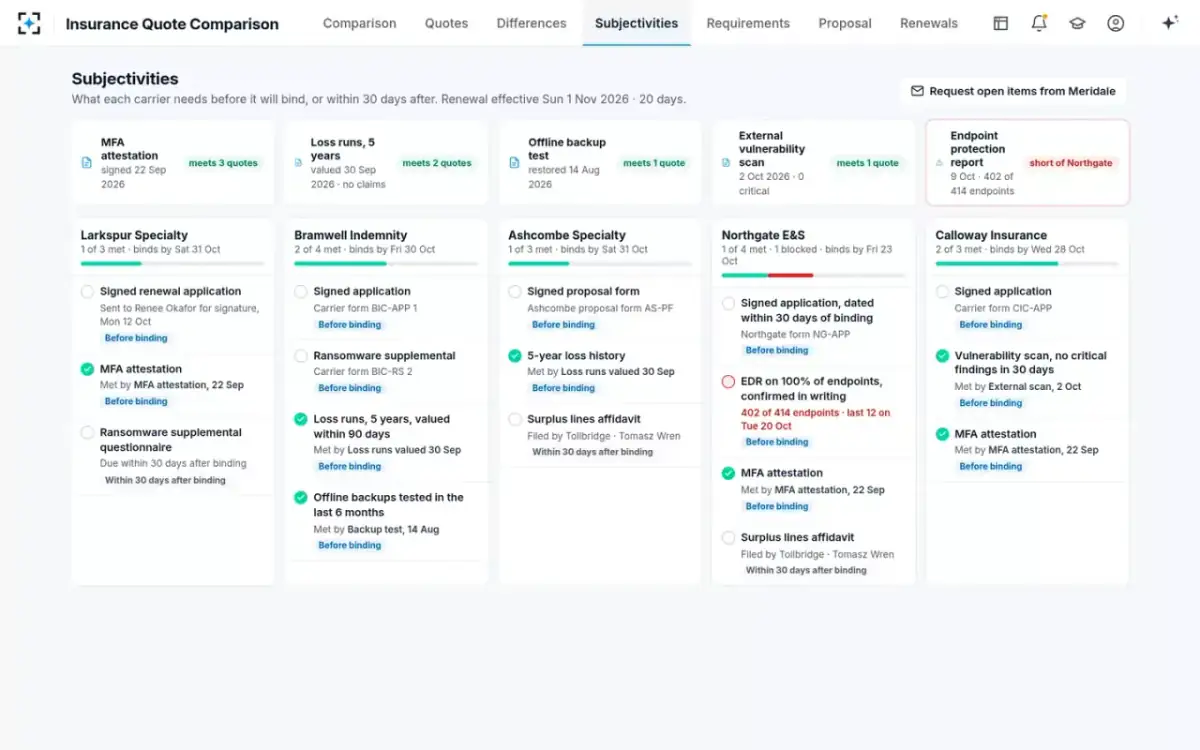
Dates to record for every quote in a comparison
- Date received
Starts the clock and shows which version of the quote is in the column.
- Valid-until or bind-by date
The last day the carrier will bind on these terms.
- Proposed effective date and policy period
The period the price was quoted for.
- Pre-bind conditions, each with its own date
Applications dated within 30 days, loss runs within 90, scans within 30.
- Post-bind deadlines, as calendar dates
“Within 30 days of binding” becomes a date once the bind date is planned.
- Any extension, with the underwriter’s written answer
The new date replaces the old one the same day.
- The decision meeting
Every quote that lapses before it is out of the running unless extended.
A comparison that carries these dates also carries the reason one option may be presented as conditional: the alternative in the sample proposal is recommended only if the carrier deletes an endorsement and the client confirms its controls before the quote lapses. How those conditions are tracked is the subject of the subjectivities guide; why the proposal is the broker's evidence is covered in the duty of care guide. The whole renewal is at Insurance Quote Comparison.
Questions people ask
Is an insurance quote valid for 30 days?
Sometimes, but there is no standard: the quote's own date governs. The five commercial quotes in the sample case lasted between 15 and 26 days from receipt, and the shortest belonged to the quote with a blocked condition.
Does a quote lock in the price?
Only on the facts and conditions it states, until its date. A new loss, a change in operations or an unmet condition can lead to a re-quote, and a quote that lapses is replaced by a new one that may be priced on different rates.
What is a bind order?
The broker's instruction to the carrier to bind cover on a quote, usually in writing and before the quote lapses, naming the quote, the effective date and any options chosen. The carrier's confirmation, usually a binder, is the evidence that cover exists; a bind order alone is not.
What does “subject to” mean on an insurance quote?
It introduces the conditions the carrier attaches to its offer, usually called subjectivities: documents or confirmations needed before binding or within a set time after. In the sample case the five quotes carried 17 of them, 14 due before binding, so the validity date and the conditions have to be read together.
Can the client accept one quote and keep another open?
Only until the second one lapses, and binding two carriers for the same risk is rarely intended. If the client wants a fallback, record both dates and the order of preference, and tell the second carrier before its quote lapses.