Commercial insurance quote comparison is the work of reading the quotes, declarations and forms that carriers send back for one commercial account and lining their terms up side by side, so the broker can see where cover differs and recommend on the client's requirements. A comparative rater does something earlier and narrower: it takes one set of risk details, runs them through several carriers' rating rules, and returns premiums for a standard risk before anyone has underwritten it. The two are often bought as if they were one product, and an agency that buys a rater to do the comparison ends up with fast prices for small accounts and the same spreadsheet for everything else. Botminds' Insurance Quote Comparison is a comparison tool, built for accounts where carriers' wording differs; this guide explains where a rater is the right tool, where only a comparison will do, and how to tell.
Examples come from the solution's sample case, a fictional brokerage whose account executive carries nine renewals in cyber and professional lines, and from New York and Florida law on rate and form filing, linked where it appears.
Comparative rater against commercial insurance quote comparison, row by row
Comparative rater: Before quotes exist: at submission or for a quick indication
Quote comparison (Insurance Quote Comparison): After quotes arrive: once carriers have underwritten and responded
Comparative rater: One set of risk details: class, revenue, payroll, location, limits wanted
Quote comparison (Insurance Quote Comparison): Each carrier’s quote, schedule and forms, the expiring policy and the client’s contracts
Comparative rater: A premium per carrier from that carrier’s rating rules
Quote comparison (Insurance Quote Comparison): Each term’s value, basis and page, and the differences between carriers
Comparative rater: Standard forms and filed or published rating rules
Quote comparison (Insurance Quote Comparison): Nothing about the forms: it opens every one on the schedule
Comparative rater: Small, standard accounts where carriers’ forms are alike and price decides
Quote comparison (Insurance Quote Comparison): Accounts where wording differs: specialty, E&S, cyber, professional liability, larger risks
Comparative rater: Price manuscript wording, surplus lines terms or risks rated by an underwriter
Quote comparison (Insurance Quote Comparison): Price a risk before a carrier quotes it
Comparative rater: Premiums to choose markets or to quote small accounts
Quote comparison (Insurance Quote Comparison): A cited comparison, the subjectivities, and a drafted proposal for a person to approve
What is a commercial insurance comparative rater?
A comparative rater is software that calculates premiums from several carriers at once for the same risk details, using each carrier's rating rules. It is a pricing engine: the agent enters the risk once, and the rater returns what each carrier's rules would charge for it. Where carriers make their rating available to raters and the class is standard, it saves the agent from entering the same submission into each carrier's portal.
Its strength rests on an assumption: that the price follows rules someone can write down and reproduce. For admitted insurers in most lines that is close to true by law. New York's Department of Financial Services, quoting the state's rate statute, describes the obligation on authorized insurers and licensed producers not to “knowingly, charge or demand a rate or receive a premium which departs from the rates, rating plans, classifications, schedules, rules and standards in effect” for the insurer, and the form statute that “no policy form shall be delivered or issued for delivery unless it has been filed with the superintendent” and approved or not disapproved (NY Insurance Department, Office of General Counsel opinion, 2008, quoting Ins. Law §§ 2314 and 2307). Filed rates on filed forms are what a rater can reproduce.
What is the difference between quoting and comparing?
Quoting produces an offer; comparing reads offers. A rater sits on the quoting side, even when the agent calls its output a comparison, because what it compares is prices calculated on the same assumptions. A quote comparison starts after each carrier has applied its own judgement, forms and conditions, and its job is to find where those choices make two equal-looking offers different.
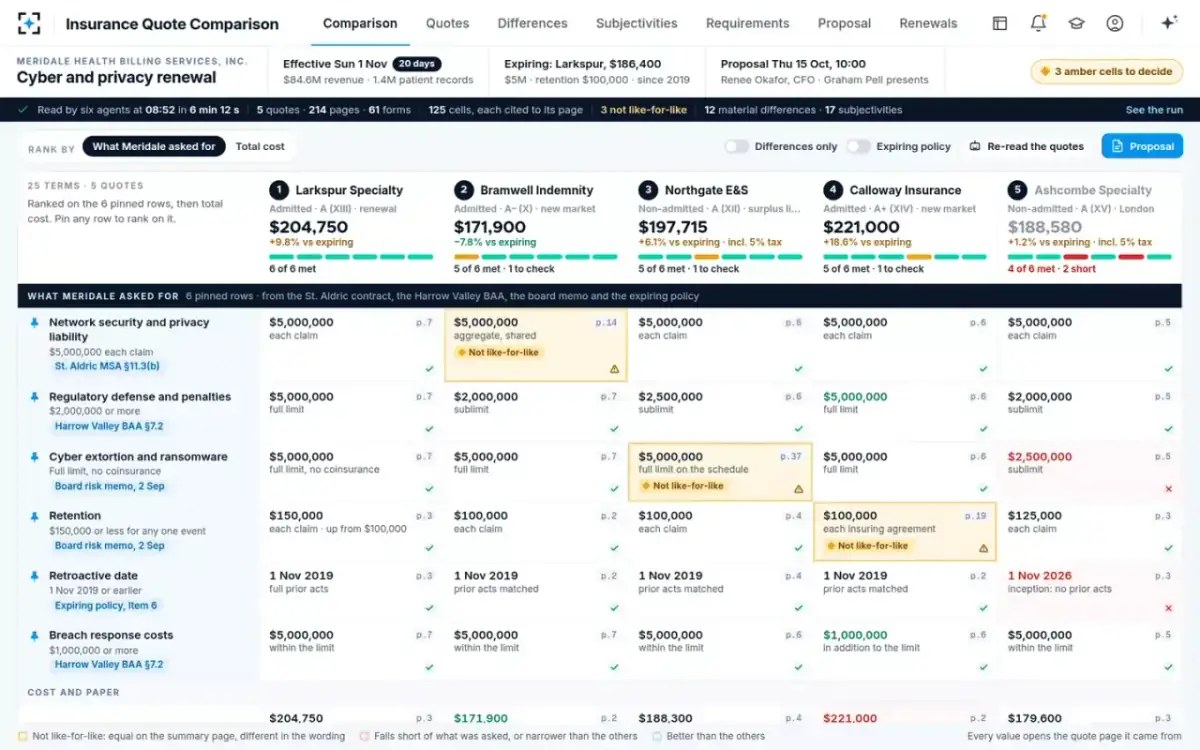
The difference shows in what each would have done with the sample renewal. Five carriers quoted the same cyber account. Every one showed $5,000,000 for privacy liability; one meant a single aggregate shared with everything, one added 20% coinsurance on ransomware in an endorsement, one applied its retention per insuring agreement, one capped ransomware at $2,500,000, and one offered no prior acts cover. A rater would have reported five premiums. The comparison found the five differences, three of which looked identical on the summary pages.
What a comparison produces that a rater cannot: value, basis and page per cell
Can raters quote commercial lines?
For some commercial business, yes: small accounts in standard classes, written by admitted carriers whose rating rules the rater can run. Outside that territory the assumption behind a rater breaks, for legal as well as practical reasons, because the rates and forms are not filed or not standard.
Two examples show where. Surplus lines insurers write on their own rates and forms; Florida requires every surplus lines policy to say so on its face, in the words “SURPLUS LINES INSURERS’ POLICY RATES AND FORMS ARE NOT APPROVED BY ANY FLORIDA REGULATORY AGENCY” (Fla. Stat. § 626.924). And admitted business can be exempt too. New York lets the superintendent “permit exemption from filing requirements only with respect to rates and policy forms” for commercial kinds of insurance (N.Y. Ins. Law § 6301), for insurers holding a special licence (§ 6302), where the risk produces a minimum annual premium “in excess of one hundred thousand dollars”, or is of “an unusual nature, a high loss hazard, or difficult to place” on the superintendent's list, or, until 30 June 2027, is placed for a large commercial insured that retains a special risk manager (§ 6303).
Where filed rates stop in New York's commercial market
$100K
minimum annual premium above which a risk can be written free of rate and form filing by a specially licensed insurer
$25K
annual commercial premium that, with one of several size tests such as 50 employees, makes an entity a “large commercial insured” for the special risk manager route
2027
year the special risk manager route ends: 30 June, unless extended
For a broker the conclusion is practical. The accounts where premium is large enough to matter, the risk is unusual, or the market is surplus lines are the ones where no rating manual describes the price, and where carriers' forms are most likely to differ. A rater has nothing to compute there; the comparison has the most to find.
Which commercial lines can be rated online?
No public body maintains a list, because it depends on which carriers expose their rating to which raters. The pattern follows from the law above: lines with standard classes, filed rates and largely standard forms, on small accounts, are the ones raters handle well; lines priced by an underwriter's judgement, written on manuscript or carrier-specific forms, or placed in the surplus lines market, are not. Within a single line the answer can change with size: a small cyber account may be rated online by an admitted carrier while a mid-size one goes to five markets and comes back in five different forms.
Cyber is the clearest case of wording beating price. The GAO found that cyber carriers do not define their common terms the same way (GAO-21-477), which is another way of saying that two cyber premiums are rarely prices for the same thing. The rows that most often hide a difference are worked through in the cyber insurance coverage comparison.
Do I need a rater and a comparison tool?
Most agencies with a mixed commercial book will use both, for different accounts, and the question is which accounts go where. The table is how we would sort them.
Rater, comparison, or both: sorting a commercial book
| Account | Rater | Quote comparison | Why |
|---|---|---|---|
| Small business package in a standard class, admitted markets | Yes | Rarely needed | Forms are alike; price and a few options decide. |
| Small account in a line with filed rates but carrier-specific endorsements | To choose markets | For the final two or three quotes | Endorsements are where the quotes differ. |
| Mid-size account, several admitted and non-admitted markets | Not for the final terms | Yes | Underwritten quotes on different forms; surplus lines tax changes the total. |
| Specialty, professional liability and cyber | Rarely | Yes | Wording and sublimits decide; terms are not consistently defined. |
| Large risks free of rate and form filing | No | Yes | There is no filed rate or form to compute from. |
| Renewal with the incumbent only | No | Yes, against expiring | The question is what changed, not what others would charge. |
Using both on one account: where the hand-off happens
On an account that needs both, the rater works at the front of the process and the comparison at the back, and the hand-off is the moment carriers stop being prices and start being documents. The rater helps decide which markets to approach and what range of premium to expect. Submissions go out; underwriters ask questions, add conditions and choose their forms. When the quotes come back, the rater's numbers are history: the comparison starts again from what each carrier actually offered.
Three things change between the two stages, and each is a reason not to carry the rater's output into the proposal. The premium moves, because underwriting adds or removes credits the rater's rules could not see. The terms move, because each carrier attaches its own endorsements, sublimits and retentions. And conditions appear: the sample quotes carried 17 subjectivities between them, 14 due before binding, with bind-by dates from 23 to 31 October. None of that exists at the rating stage. A proposal built on rater output and patched with the final premiums is a comparison of prices for policies nobody issued.
The total-cost line is the last trap. A rater's premium for an admitted carrier and a surplus lines quote's premium are not comparable until surplus lines tax is added, and federal law gives that tax to one state: “No State other than the home State of an insured may require any premium tax payment for nonadmitted insurance” (15 U.S.C. § 8201). In the sample case two non-admitted quotes carried a 5% tax, which moved one of them from $179,600 of premium to $188,580 in total: $8,980 of cost that a premium column never shows.
How do brokers compare commercial quotes today?
Where it is done by hand, the quotes arrive as PDFs in each carrier's layout, someone retypes the terms into a spreadsheet, and the account executive reads the summary pages and, time permitting, the forms. The weaknesses are predictable: values copied without their basis, endorsements never opened, conditions tracked in email, and validity dates missed. The insurance quote comparison spreadsheet guide shows how a complete sheet can still be wrong, cell by cell.
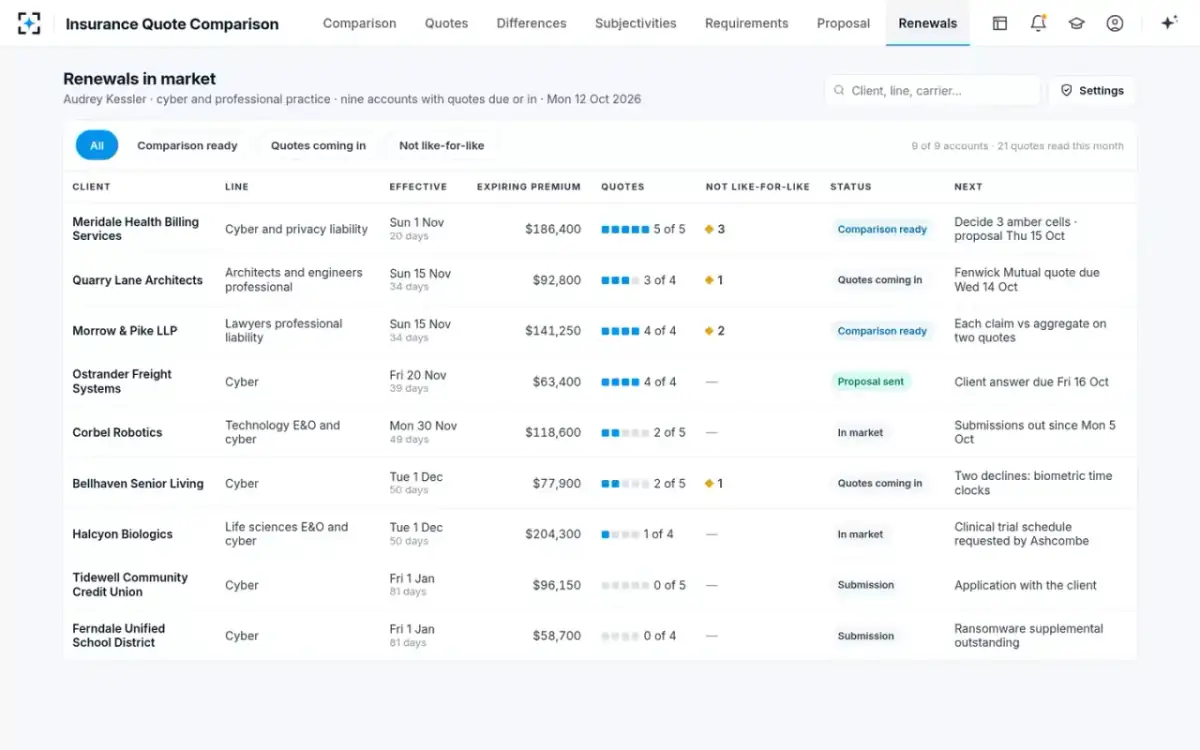
One account executive's renewals in market: lines a rater would not price
What is a quote comparison tool for brokers?
It is software that takes the quotes carriers return for one account and produces the comparison a broker presents: each term's value, basis and source, the differences that matter for this client, and a draft proposal. A good one reads documents rather than waiting for data entry, cites every value, opens every form, keeps the decision on differences with a person, and ranks carriers on the client's requirements before price. The checklist below turns that into questions a buyer can test on one past renewal.
What to test in a commercial insurance quote comparison tool
- It reads quotes in each carrier’s own layout
Not a template someone must fill in; ask to watch it read a quote you choose.
- Every value carries its basis and page
“$5,000,000” is not a value; “$2,500,000 ransomware sublimit, inside the policy limit, page 9” is.
- It opens every form on every schedule
And shows forms read against forms listed.
- It finds differences behind equal values
Shared aggregates, per-agreement retentions, coinsurance in endorsements.
- It ranks on the client’s requirements, then total cost
Including surplus lines tax, never premium alone.
- It tracks conditions and dates
Subjectivities, bind-by dates, post-bind deadlines.
- A person decides, and nothing goes out automatically
No sending to carriers or clients, no binding, no telling a client they are bound.
- It compares the renewal against the expiring policy
New exclusions and narrower terms show only against last year.
What does commercial quote comparison software cost?
No regulator or research body publishes prices for this category, and vendors price by volume, lines and setup. The useful calculation is on the value side, with your own numbers: hours per comparison now against hours with the tool, times the number of comparisons a year, times a loaded hourly cost, plus the differences the tool finds that your team would have missed. Our estimate for a five-carrier cyber renewal is about five hours by hand against about one with the solution; that is an estimate to replace with a measurement, and a two-week pilot on bound renewals is how to get one.
Where Insurance Quote Comparison fits, and where it does not
It fits after the market has answered: when quotes are in, in different layouts and forms, and the broker has to recommend one against a client's written requirements. It reads quotes, forms, the expiring policy and the client's contracts; it cites every value; a separate checker marks the cells that only look equal; the account executive decides; and the proposal is drafted for a person to approve. It does not rate risks before quotes exist, so it does not replace a rater for small standard accounts, and it does not bind or send. An agency with both kinds of account is likely to run both, and the sorting table above is where to start the conversation. To see the comparison on the sample renewal, start from Insurance Quote Comparison.
Questions people ask
Is a comparative rater the same as a quote comparison tool?
No. A rater calculates premiums from carriers' rating rules before quotes exist; a quote comparison tool reads the quotes carriers have issued and shows where their terms differ. The first helps choose markets and quote small standard accounts; the second helps recommend among underwritten offers.
Can a rater handle surplus lines quotes?
Generally not for the final terms, because surplus lines carriers write on their own rates and forms; Florida, for example, requires each surplus lines policy to state that its rates and forms are not approved by any Florida regulatory agency. A non-admitted quote also adds surplus lines tax set by the insured's home state, which belongs in the comparison's total cost.
Does commercial quote comparison work for renewals with one carrier?
Yes, and that is often where it pays first: the comparison becomes renewal against expiring. In the sample case the incumbent's renewal changed 6 of 22 terms, including a higher retention, a longer waiting period and a new exclusion found only in the forms list.
What is New York's exemption from rate and form filing?
Article 63 of New York's Insurance Law lets specially licensed insurers write qualifying commercial risks without filing rates and policy forms, such as risks producing more than $100,000 of annual premium or risks on the superintendent's list of unusual, high-hazard or hard-to-place classes. The exempt rates and forms are exactly the ones a rater cannot reproduce.
Should small agencies buy a quote comparison tool?
It depends on the book, not the size of the agency. An agency writing mostly small standard accounts may get more from a rater; one with specialty, cyber, professional or mid-size accounts spends its hours on reading quotes, and that is the work a comparison tool takes on.