Insurance data integration after an acquisition is the work of bringing the bought agency's clients, policies, carriers, notes and documents into the buyer's systems so that one team can service, renew and account for the combined book. Its cost has three parts, and buyers usually budget only the first: the staff hours and fees to move and clean the data; the cost of time, meaning the renewals processed twice and the systems run in parallel while the integration lasts; and the cost of what is found late, such as a renewal with a carrier the buyer is not appointed with, or a coverage declined by phone with no signed form. Botminds' Agency Acquisition Data Migration is one of three ways to pay for the work: six agents read, map, match and check the seller's whole book, and people decide. This guide prices all three in the reader's own numbers.
No public source publishes what agency integrations or system-vendor conversions cost, so every figure below is either your input, the solution's fictional sample book, or our estimate, and each is labelled. Wage rates come from the Bureau of Labor Statistics.
Staff hours to integrate one mid-sized acquired book, by option (estimated)
What does insurance data integration cost after an acquisition?
It costs staff time, external fees and the cost of time itself, and the third part is the one that changes most between options. Staff time is the integration team's hours, priced at what you pay them. External fees are the system vendor's conversion charge, any software licence and any contractor. The cost of time is everything that happens because the integration is not finished yet: renewals processed in the seller's system and carried over again, two systems licensed and supported at once, and problems that surface after day one, when they cost more to fix.
A useful way to price the first term is with a single blended rate. Private insurance agencies and brokerages paid an average of $104,375 per job in 2024 (BLS QCEW, NAICS 524210), which is about $50 an hour on a 2,080-hour year, our arithmetic before benefits. The median computer systems analyst, the closest published occupation to a data migration analyst, earned $105,850 in May 2025 (BLS Occupational Outlook Handbook), almost the same hourly rate. Use your own loaded rates if you have them; the comparison between options does not depend on the exact figure.
The first-year cost of an agency integration, term by term
| Term | How to price it | What drives it |
|---|---|---|
| Integration team time | Hours by role × your loaded hourly rate | Weeks to day one and the share of each person's time |
| External fees | Vendor conversion quote + licences + contractors | Records, tables, attachments, number of test loads |
| Renewals touched twice | Renewals per week × weeks to cutover × minutes to carry each over | Length of the integration and the renewal calendar |
| Two systems at once | Months of overlap × monthly cost of the seller's system | Cutover date and the archive you must keep readable |
| Problems found late | Count of exposures and appointment gaps found after day one | Whether anyone read the notes and checked appointments before cutover |
Three ways to integrate an acquired book
The three options differ in who decides what the seller's data means. With your own staff, the analyst and account managers decide everything, by hand, record by record. With the system vendor's conversion, the vendor maps and loads, and your team cleans up what does not fit. With agents, every field, code, client and policy is proposed with evidence, and your team decides the doubtful ones.
Three ways to pay for an agency integration, compared
| Own staff, by hand | System vendor's conversion | Agents propose, people decide | |
|---|---|---|---|
| Who maps fields and codes | Your analyst, from scratch | The vendor, to its schema | Agents propose with confidence; your analyst decides below 95% |
| Duplicate clients across both books | Found as clients call | Confirm in the statement of work | Grouped and explained; merged only on approval |
| Policies against declarations pages | Sampled, if at all | Confirm in the statement of work | Every policy compared; differences cited to the page |
| Inherited E&O exposures | A sample of files read | Not a loading task; confirm | Every note, email, certificate and open claim read |
| Renewals and appointments | Spreadsheet from the renewal list | Not a loading task; confirm | Renewals by carrier and week against your appointments |
| Weeks to day one | About 13 (estimate) | About 10 (estimate) | 6 (design target) |
The table explains the hour estimate in the opening figure. The by-hand option puts an analyst on the integration full time for thirteen weeks, half of the manager's and E&O lead's time, and a quarter of an account manager's: about 1,170 hours. The vendor option shortens the calendar to about ten weeks but keeps the clean-up with your staff, with the analyst at three-quarter time, the manager and E&O lead at half and an account manager at a quarter: about 800 hours. The agent option runs for six weeks with the analyst at half time on decisions, the manager at half time and the E&O lead and account managers at a quarter: about 360 hours. Change the shares to your team's and the bars move; their order rarely does.
How much does it cost to integrate an acquired agency? Price it in your own hours
Multiply each person's share of time by the weeks to day one and your loaded rate, add your external quotes, then add the cost of time. At $50 an hour the three staff estimates come to about $58,500 by hand, $40,000 for the vendor route before the vendor's fee, and $18,000 with agents before the licence. Those are the smaller numbers on the page.
Matching is where by-hand hours grow fastest, and the record-linkage literature has measured it at scale. When the Census Bureau moved its 1992 farm list to computerised matching, clerical review fell "from 75 clerks over 3 months to 6500 hours of review" (Winkler, U.S. Census Bureau, 2006). At forty hours a week, 75 clerks for three months is roughly 39,000 hours, so the review shrank to about a sixth, our arithmetic. An agency book is much smaller, but the shape is the same: the people stay on the pairs a machine cannot settle.
Where the staff hours go in each option (estimated)
Own staff, ≈1,170 h
- Analyst · 44%
- Manager · 22%
- E&O lead · 22%
- Account mgrs · 12%
Vendor converts, ≈800 h
- Analyst · 37%
- Manager · 25%
- E&O lead · 25%
- Account mgrs · 13%
Agents, ≈360 h
- Analyst · 33%
- Manager · 33%
- E&O lead · 17%
- Account mgrs · 17%
Should we convert the seller's data or rekey it?
Convert it, unless the book is very small or the export is unusable. Re-keying looks cheap because it needs no tools, but it is the option where every record is touched by a person under time pressure, and its errors are inconsistent: the same code translated three ways by three people. Conversion makes each translation once, as a rule, and applies it to every record.
The case for re-keying is narrower than it looks. It makes sense for a handful of accounts with unusual structures, or for records whose source is so damaged that typing from the declarations page is faster than fixing the field. Even then, keep the seller's original data in an archive: records of policies transacted are a regulatory duty, not a convenience. Florida, for example, requires agents to keep them for at least five years after policy expiration, on paper or in an electronic or photographic copy they can reach (Fla. Stat. §626.748).
What does the agency system vendor charge for conversion?
We found no independent, published conversion prices, and quotes are built from different units, so compare scope rather than headline price. Ask how the quote is counted (per record, per policy, per table or per agency), how many test loads are included and what a re-run costs, whether code mapping is done by the vendor or handed back as a spreadsheet, whether attachments and notes move and are linked to their policies, and how much history is carried.
Then ask what is not included, because that is where your staff hours go. In the comparison above, duplicate clients across both books, the declarations check, inherited exposures and the appointment check are not loading tasks, so confirm whether the quote includes them. None of that is a criticism of the vendor's work; it is work that only someone reading the seller's documents can do. The AMS data migration tool buyer's guide lists the questions for a demonstration.
Is it cheaper to run two systems?
For a few months, sometimes; for a year, almost never. Running the seller's system alongside the buyer's postpones the integration cost but adds three of its own: two licences and two sets of support, staff who key renewals in one system and report from another, and two code lists that drift further apart every week.
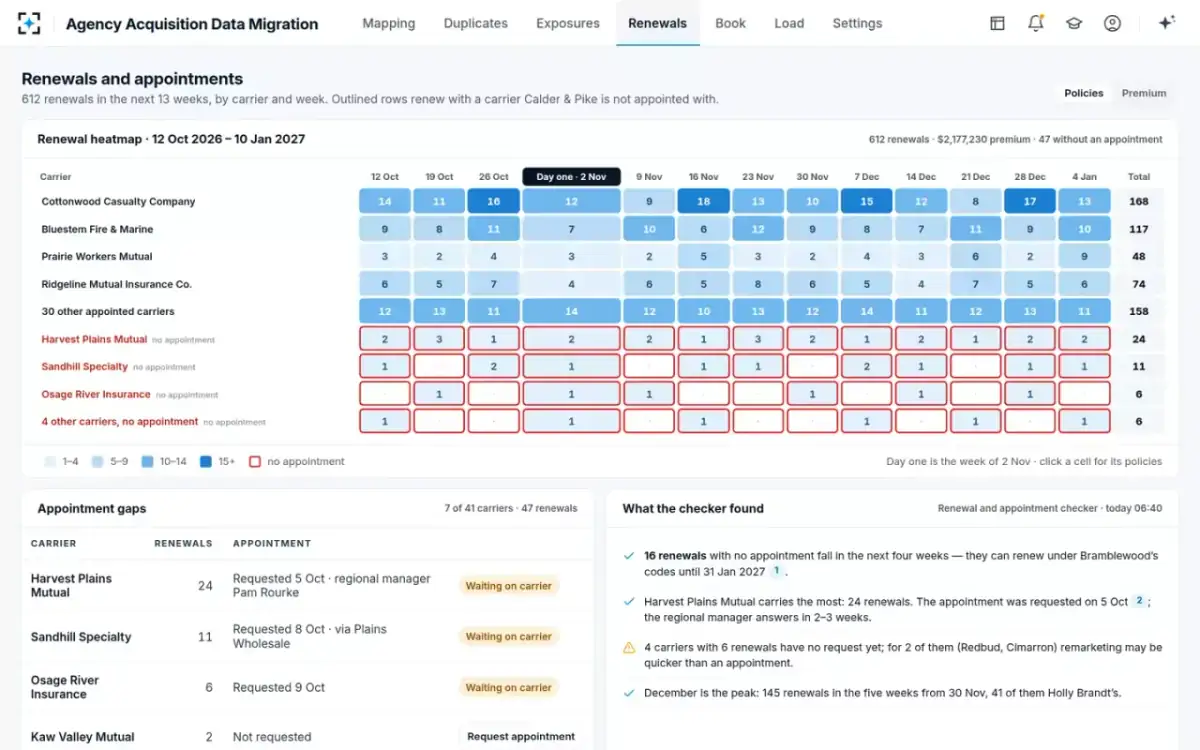
Appointments are the constraint that ends the experiment. A renewal can be written only with a carrier the agency holds an appointment with, and the NAIC's model producer licensing act requires the insurer to file a notice of appointment within fifteen days of the agency contract or the first application (NAIC Model #218, §14). In the sample acquisition, the purchase agreement let renewals continue under the seller's carrier codes until 31 January 2027, three months after day one; after that, every renewal with one of the seven carriers the buyer was not appointed with had to have a new appointment or a new market. Running two systems does not buy time against that date.
The renewal calendar keeps running while the integration does
What are hidden costs of agency integration?
Renewals touched twice, appointment gaps found late, and inherited exposures found after a client calls. Each grows with the length of the integration, which is why the calendar matters more than the hourly rate.
Renewals are the easiest to count. The sample book had 612 renewals in thirteen weeks, about 47 a week. Every week the integration runs is another week of renewals processed in the seller's system and carried over, or reconciled, at cutover. At the sample's pace, a thirteen-week integration carries about 612 renewals through that double handling, a ten-week integration about 470 and a six-week integration about 280, our arithmetic.
Renewals processed before cutover, at the sample book's pace
The commission on those renewals is what is at stake if one lands badly. Nationally, insurers' commission and brokerage expense was 11.11% of earned premium across all property and casualty lines in 2024 (Texas Department of Insurance, Insurance Expense Exhibit, from NAIC data). In the sample book, annual commission of $1,862,300 on $14,218,640 of written premium is about 13%, our arithmetic on the sample. A renewal that goes to a carrier with no appointment, or to a producer code that cannot be paid, is commission the buyer bought and does not collect.
Exposures found late are harder to price, because no public source counts what they cost when they become claims. What can be said is when they are cheapest: before day one, when the buyer can offer the declined coverage again at renewal with a declination form, rather than after a loss, when the question is who promised what.
How long does data integration take after an acquisition?
Long enough to read, map, match, check and tie out the book, plus whatever time the seller's export takes to arrive. Botminds estimates about thirteen weeks for a mid-sized agency by hand; the solution's design target is six weeks from close to day one. In the sample acquisition the deal closed on 1 October, the export arrived on 5 October, and day one was 2 November, with two test loads tied before the integration manager reviewed the open items.
The weeks that do not shrink are the ones spent deciding and signing. Test loads, tie-out and sign-off keep their two weeks in every option, because they are the point where a person confirms that what loads is what the buyer bought. The six-week integration plan lays those weeks out.
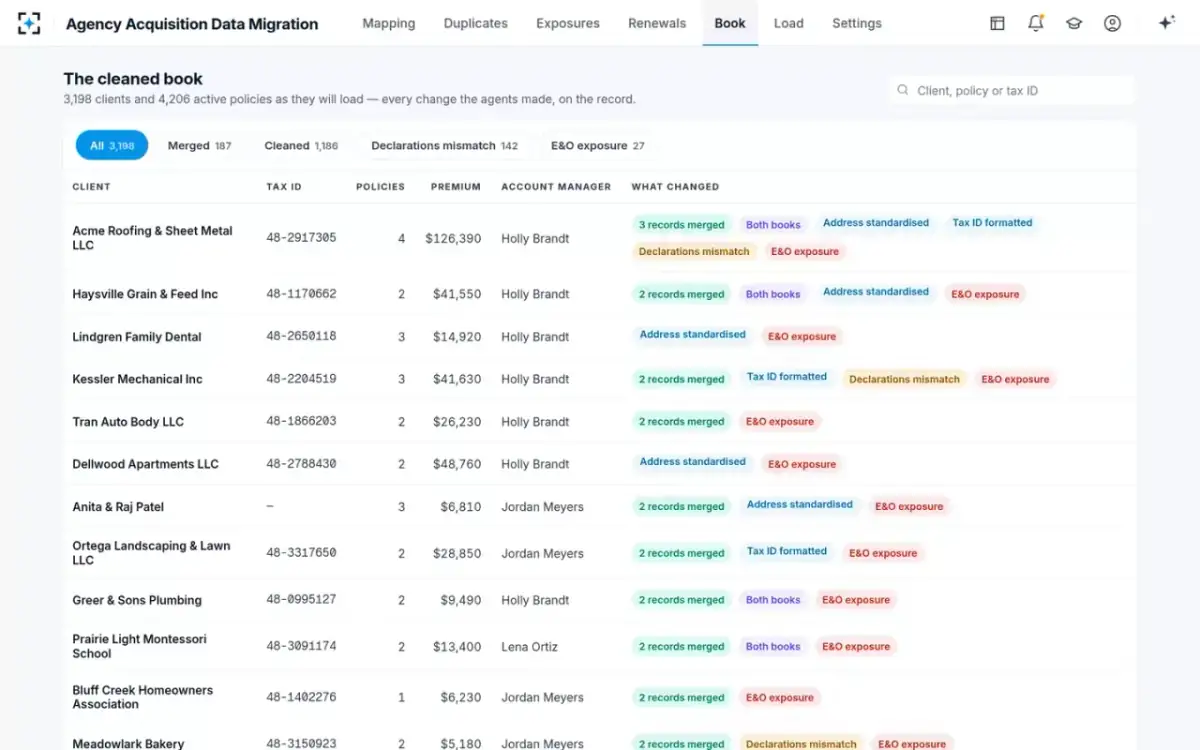
What the money buys: a book that loads with every change explained
How do you budget for an agency integration?
Budget each acquisition from its own export, not from the last deal's invoice. The size of the work is set by the number of fields and code values, duplicate clients, policies, notes, attachments and carriers without an appointment, all of which can be counted before close if the seller shares an extract. The acquisition checklist lists the data items to ask for in diligence.
Budget lines for an agency integration
- Team time
Each role's share of time × weeks to day one × loaded rate.
- External quotes
Vendor conversion, licences, contractors; how test loads and re-runs are priced.
- Renewals in flight
Renewals per week × weeks to cutover × minutes to carry each over.
- Parallel systems
Months of overlap × the seller's system cost, plus the read-only archive you must keep.
- Appointment gaps
Renewals with carriers you are not appointed with, by week, and the commission on them.
- Inherited exposures
Time for the E&O lead to own each one; the cost of finding them after day one is the reason to find them before.
Where Botminds' solution fits: it is priced against the second and third terms, the cost of time and the cost of late findings, as much as against staff hours. Where it does not: a buyer folding a tiny book into an identical system, with no duplicates and no new carriers, may find that its own staff are the cheapest option. Policy Servicing's guide to policy administration system replacement cost covers the carrier-side version of the same arithmetic.
Questions people ask
What is the cost of an AMS conversion?
There is no published price. Build it from your staff hours at your loaded rate, the vendor's quote for the scope you need, and the cost of the weeks the conversion runs, which at the sample book's pace means about 47 renewals a week handled twice.
Who pays for the data integration, buyer or seller?
The buyer, almost always, because the work serves the buyer's systems. The seller's part is the export and the answers about its codes, and a purchase agreement can require both by a date; a late export is the most common reason the calendar slips.
Is insurance data integration the same as data migration?
Not quite. Migration moves the data from one system to another once; integration makes the combined book work as one, including matching clients the buyer already had and aligning carriers, producers and codes. After an acquisition you need both.
Can the integration cost be financed into the deal?
That is a deal-structure question for the buyer's lenders and advisers. What the integration team can supply is a cost built from the seller's own export, counted before close, so that the figure in the model is not a guess.
What wage rate should we use to price staff time?
Your own loaded rate, if you have it. As a public reference, private agencies and brokerages paid an average of $104,375 per job in 2024, about $50 an hour before benefits, and the median computer systems analyst earned $105,850 in May 2025.