A policy administration system replacement costs four things: the new system and its implementation, the conversion of the in-force book, the months of running two systems side by side, and correcting whatever the conversion got wrong after it reaches customers. The first is quoted by vendors. The other three are estimated by the insurer, usually too low, and the conversion is the one that moves most. No government, regulator or academic source publishes a benchmark for the total, so the useful answer is a method: price the replacement per policy converted and proved, including every convert, load and compare cycle, and the replacement becomes comparable across waves, vendors and approaches. Botminds' Policy Data Conversion exists to cut the cost of that unit, by letting agents do the reading, re-rating and comparing that people otherwise do by hand.
Old systems consume the budget that would replace them: federal evidence
75%
of the federal IT budget went on operations and maintenance in fiscal 2015
GAO-16-468
5,233
of about 7,000 federal IT investments spent all their funds on operations and maintenance
GAO-16-468
12
steps GAO sets for a reliable cost estimate, from defining its purpose to updating it with actual costs
GAO-20-195G
What does a policy administration system replacement cost?
It costs what your book costs to convert and prove, plus what the vendor charges. There is no published, independent benchmark: the figures that circulate come from consultancies and vendors, and we do not repeat them. What can be said with confidence is where the money goes and which terms grow with the book. Licence and implementation scale with the products you configure. Conversion scales with the number of in-force policies, the number of products and forms, how much of the rating sits outside fields, and above all how many times each wave has to be converted, loaded and compared before it can be signed.
That last term is the one programmes underestimate. A wave that needs three test loads instead of two costs half as much again in reconciliation and tracing, and a book with rating inputs in remarks and on scans produces more differences per load. GAO's cost guide names the pattern: "Many cost estimating challenges can be traced to over-optimism" (GAO Cost Estimating and Assessment Guide).
What is a policy administration system, and what does replacing it include?
A policy administration system holds each policy from quote to renewal: the products and forms it is written on, the rating that produces its premium, its endorsements and changes, its renewals and cancellations, and the documents sent to the customer. It sits beside billing and claims, the other core systems, and feeds both. Replacing it means configuring the products and rating in a new system, building its connections to billing, claims, agents and documents, converting every in-force policy, and retiring the old system without losing the history examiners can still ask for.
Policy administration system replacements are usually budgeted as technology projects. The conversion is a business project inside them: each in-force policy has to come out the other side as the same policy, and the proof of that is what consumes the people.
The cost per policy converted, stage by stage
Build the estimate per policy converted and signed, stage by stage, with your own inputs. The table names the stages, what drives each one and the unit to count it in. The middle column shows the counts from a fictional sample conversion as it runs through Botminds' Policy Data Conversion: Larkhaven Mutual's wave 3, 18,412 homeowners policies, at test load 3. They are there to show scale, not to be copied.
A unit-cost model for converting an in-force book, per policy converted and proved
| Stage | What drives the cost | Count it in | Sample wave count |
|---|---|---|---|
| Profile and map | Products, forms, fields and code values; how many have no clean target | Code values decided by a person | 1,318 code values; a handful doubtful |
| Read scanned documents | Rating inputs and coverage that exist only on paper | Documents read; pages a person must read | 41,206 read; 12 to a person |
| Load and re-rate | Policies in the wave; test loads before sign-off | Policies × test loads | 18,412 × 3 test loads |
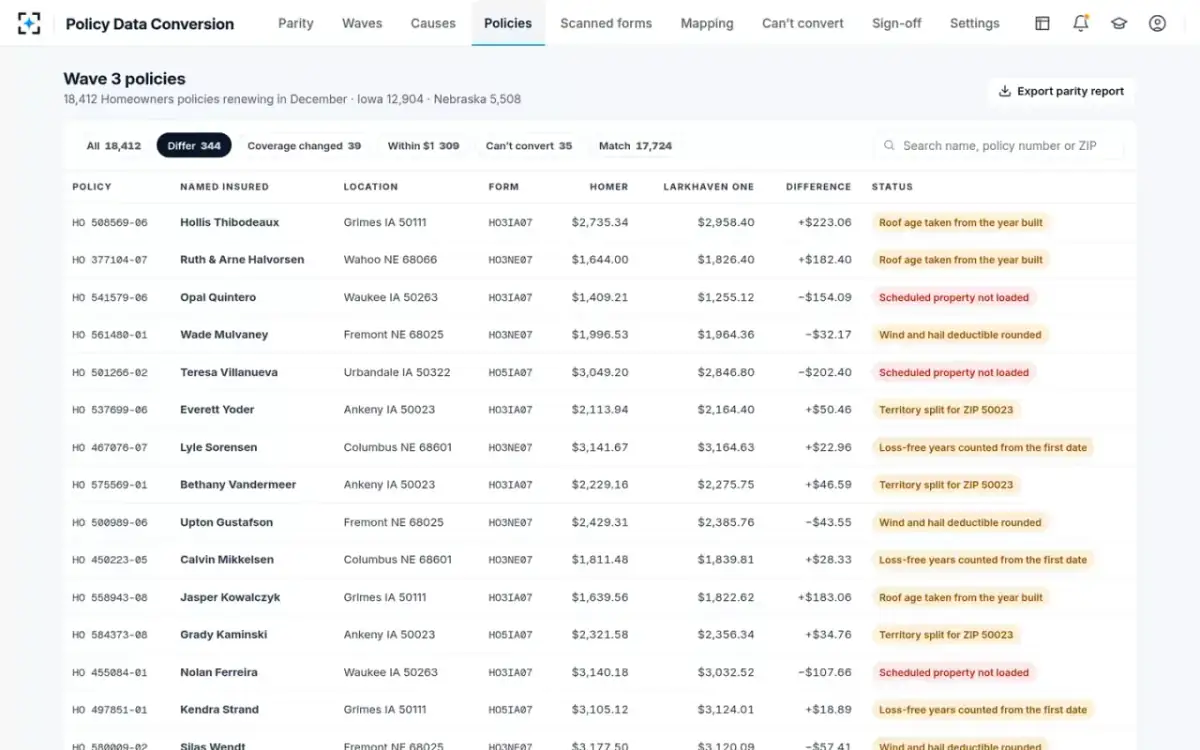
| Reconcile and trace | Policies that differ, and how long each takes to explain | Differing policies per test load | 472 at test load 3 |
| Fix the map and reload | Causes of difference; rules to write and approve | Causes per wave | 6 causes |
| Convert by hand | Policies that cannot convert automatically | Policies, at hand-conversion time each | 35 policies |
| Sign the wave | People who must sign, and the evidence they need | Waves | 1 of 6 waves |
| Run two systems | Months the legacy system stays live for unconverted waves | Months of overlap | Six waves renew over about six months |
| Correct after go-live | Differences that reach customers: refunds, interest, notices, calls | Policies wrong at renewal × cost each | Zero by design: the wave signs only when it ties out |
Two rows dominate most conversions: load and re-rate, and reconcile and trace, because both repeat on every test load. Profiling and mapping are paid once per product; reading scanned documents is paid once per document; reconciling is paid again every time the wave is loaded. The fastest way to lower the unit cost is to cut the number of cycles each wave needs, and the cost of each one.
Cost per policy converted and proved
Cycles
test loads × cost of one convert, load and compare cycle
Reconciling and tracing dominate each cycle when done by hand.
Conversion lead
Reading
documents to read × cost per document + pages a person reads
Scans that carry rating inputs or scheduled coverage.
Forms specialist
Exceptions
policies that cannot convert × hand-conversion cost
Missing data, mismatched addresses, estates.
Policy services
Overlap
months both systems run × monthly run cost of the legacy system
Licences, hosting, the people who still know it.
Program manager
Correction
policies wrong at renewal × (refund + interest + notice + handling)
The term a signed, policy-by-policy tie-out is meant to keep at zero.
Compliance
The cycles drive the bill: convert, load and compare
Each cycle is the same work: profile and map, load a test batch and re-rate it, reconcile premium and coverage, trace each difference, fix the map, reload, and write the sign-off. Botminds' estimate for one cycle on one wave, done by hand, is 22 working days; with agents reading, re-rating and comparing, five. Those are estimates, not measurements at a customer, and the split is shown below.
Where one convert, load and compare cycle's working days go
- Profile and map4 d
- Load and re-rate3 d
- Reconcile5 d
- Trace causes5 d
- Fix and reload3 d
- Sign-off report2 d
- Profile and map1 d
- Load and re-rate1 d
- Reconcile½
- Trace1 d
- Fix1 d
- Sign½
Multiply it out. The sample conversion has six waves, and wave 3 took three test loads. If every wave needed three, that is 18 cycles: about 396 working days of cycle work by hand on the estimate above, against about 90 with agents. Change the inputs to your own: the number of waves, the test loads you expect, the people on each cycle and their day rates. Do the arithmetic both ways, and keep the cycle count as a variable, because it is the term your estimate is least sure of.
The work a cycle has to explain, one policy at a time
What a conversion error costs after go-live
A conversion error that reaches customers is priced by the regulator, one policy at a time. We found no published regulatory action that names a system conversion as the cause, but regulators do publish what rating errors of the same kind cost, and the pattern is consistent. In a 2024 Texas consent order over an error in base rates by territory, the insurer estimated more than 766 policies overcharged and more than $13,000 in refunds, had to pay each overcharge back with 5% simple interest, and said it would not recover premium from anyone undercharged (Texas Department of Insurance, Order 2024-8733).
The larger cases show how long a wrong rating input can run. New York found that one insurer group had failed to use its filed rating territories and territorial factors from January 2003 to February 2016; it made restitution of $3,091,571 including interest and paid a $450,000 penalty (NY DFS consent order, 2018). Another insurer's rating errors over nine months of 2014 produced both overcharges and undercharges, $346,455 in restitution and a $1,300,000 penalty, alongside other findings (NY DFS consent order, 2023). A territory code that splits in a new system is exactly the kind of input that goes wrong in a conversion.
When rating errors reach policyholders, the bill is refunds, interest and penalties
Price the correction term with your own numbers: policies likely wrong at renewal, average overcharge, interest, the cost of a corrected notice and the calls it brings. Then compare it with the cost of the cycles that would have found those policies first. In ordinary exams, examiners find step-level errors at rates that would be alarming in a conversion: North Carolina found incorrect premiums in 30 of 100 sampled homeowners files at one insurer, with errors in protection class, deductible factor, base rate and protective device credit (North Carolina Department of Insurance, 2023).
The cost of running two systems while the waves convert
Every month a legacy system stays live is a month of its full running cost on top of the new one. GAO found the federal government spent "about 75 percent of the total amount budgeted for information technology (IT) for fiscal year 2015 on operations and maintenance", and that 5,233 of about 7,000 investments spent all their funds that way (GAO-16-468). Those are federal systems, used here as an analogy, but the mechanism is the same for an insurer: until the old system is retired, its cost competes with the new one.
Converting on renewal spreads the overlap across the renewal year, because each wave can only go live when its renewals come round; a single cut-over shortens the overlap but moves every policy at once. The trade-off is set out in the policy administration system implementation plan guide. In the sample, six waves renew from October to March, so the legacy system carries a shrinking book for about six months.
Legacy insurance system replacement cost: estimate it the way GAO tells agencies to
GAO's cost guide gives a public, tested method: twelve steps, from defining the estimate's purpose to updating it with actual costs, producing an estimate that is "comprehensive, well-documented, accurate, and credible" (GAO-20-195G). Three of its practices matter most for a conversion budget.
Break the work down so nothing is omitted or counted twice. The guide wants a work breakdown structure "at an appropriate level of detail to ensure that cost elements are neither omitted nor double-counted"; the table above is one, per policy. Run a sensitivity analysis on the inputs you are least sure of: test loads per wave, share of policies that differ, documents that need a person. Watch the legacy assumptions. The guide's own example of over-optimism is a programme that planned to reuse 80,000 lines of code from a legacy system and could reuse only 10,000. The conversion equivalent is a plan that assumes the legacy fields hold every rating input.
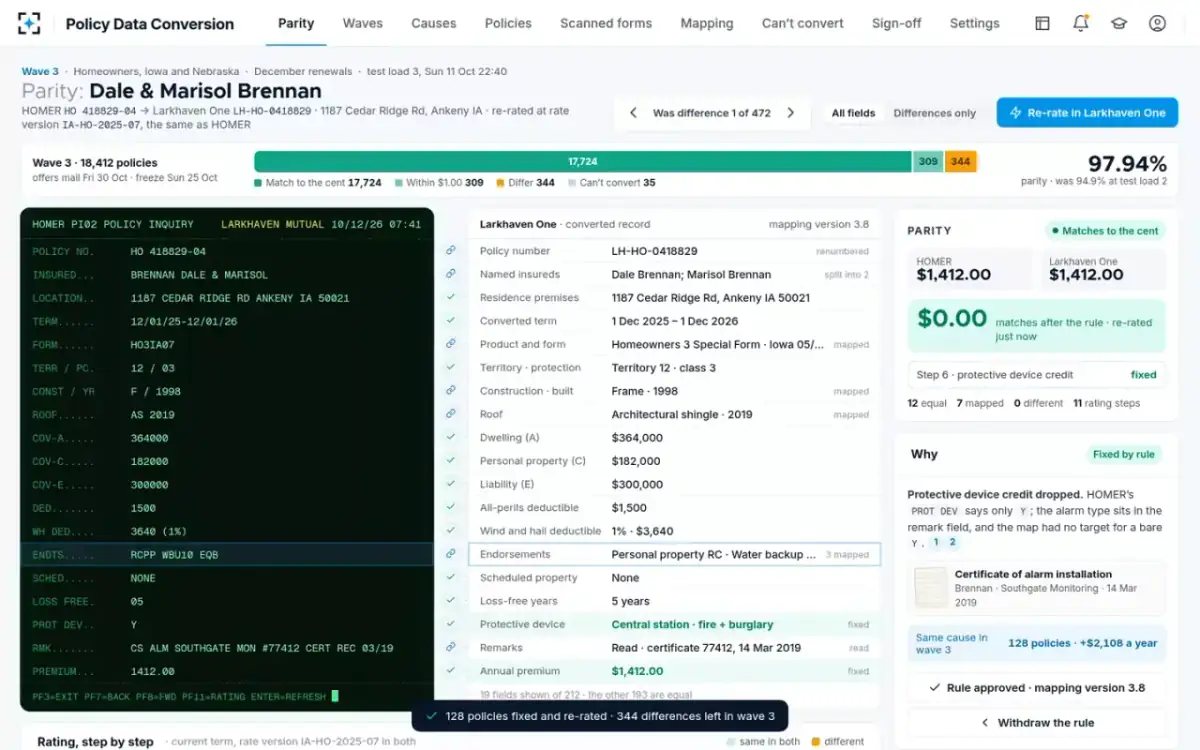
The guide also expects unit costs to fall as more units are produced. A conversion should show the same curve: the first wave pays for most of the mapping and most of the rules, and later waves should need fewer cycles. In the sample, parity on wave 3 rose from 88.4% at test load 1 to 94.9% at test load 2 and 97.94% after the first fix at test load 3. Track cost per policy by wave; if it does not fall, the map is not learning.
Where Botminds' Policy Data Conversion changes the arithmetic
It changes the cycle term and the correction term. Six agents read the legacy extracts and scanned documents, convert and re-rate every policy at the legacy rate version, group differences by cause and draft one rule per cause, and tie out the wave on count, premium and every coverage, so the days per cycle fall and every policy is compared before it reaches a customer. People approve every rule and sign every wave.
It does not change the licence or the implementation of the new system, and it does not shorten the overlap on its own: renewal dates do that. What to look for in any tool that claims to cut conversion cost is in the insurance data migration tool guide, and why legacy books are expensive to leave in the first place is the subject of legacy policy administration systems.
One approved rule, 128 policies fixed: the cycle cost falls by cause, not by policy
Questions people ask
How much does a policy administration system cost?
No government or independent research source publishes a benchmark; published figures come from vendors and consultancies. Build your own: licence and implementation from vendor quotes, plus conversion priced per policy converted and proved, plus months of running two systems, plus expected correction cost after go-live.
Why do conversion budgets overrun?
Mostly because the number of convert, load and compare cycles is set by hope. Each extra test load repeats the reconciling and tracing, which Botminds estimates at ten of the 22 working days in a by-hand cycle. GAO's cost guide traces many estimating failures to over-optimism, including planning to reuse more of a legacy system than proves usable.
Is it cheaper to keep the legacy policy system?
Sometimes, for a while. The running cost of an old system rises as the people who know it leave, and GAO found federal agencies spending about three quarters of their IT budget on operations and maintenance. Compare the yearly cost of keeping it with the per-policy cost of leaving it, wave by wave.
What is insurance core system modernization?
It is the replacement or rebuilding of an insurer's core systems: policy administration, billing and claims. For policy administration the hard part is not the new system but the in-force book, which has to be converted and proved policy by policy before the old system can be retired.
How long does a policy admin system implementation take?
Long enough to cover at least one full renewal cycle if you convert on renewal, since each wave goes live when its renewals come round. In the sample conversion the six waves renew between October and March; the configuration and testing before the first wave come on top.