“Renewal” or “to renew” means the issuance and delivery by an insurer, at the end of the policy period, of a policy superseding a policy previously issued and delivered by the same insurer.
New York Insurance Law §3425(a)(6)
Renewal vs rewrite comes down to two questions: when the new policy starts, and who issues it. A renewal continues the same coverage with the same insurer into a new term. A rewrite replaces the policy with a new one, often with a new number, sometimes a new company in the group, sometimes new forms, and sometimes in the middle of a term. For a policy conversion, where an insurer moves its in-force book onto a new policy administration system, the difference matters because statutes attach different notices to each. Under definitions like New York's above, a policy issued by the same insurer at the end of the term to supersede the old one is a renewal, whatever system printed it and whatever number it carries. Botminds' Policy Data Conversion is designed for that case: it converts each policy on renewal and proves it still rates and covers the same before the offer goes out.
Renewal vs rewrite: the short answer for a conversion
If the same insurer issues the converted policy at the end of the term, with the same coverage and the premium the legacy system would have charged, the conversion is a renewal, and the notices owed are the ordinary renewal notices. Change the company, the forms, the coverage or the premium, or move the policy mid-term, and the answer starts to depend on the state, and on whether anyone noticed the change.
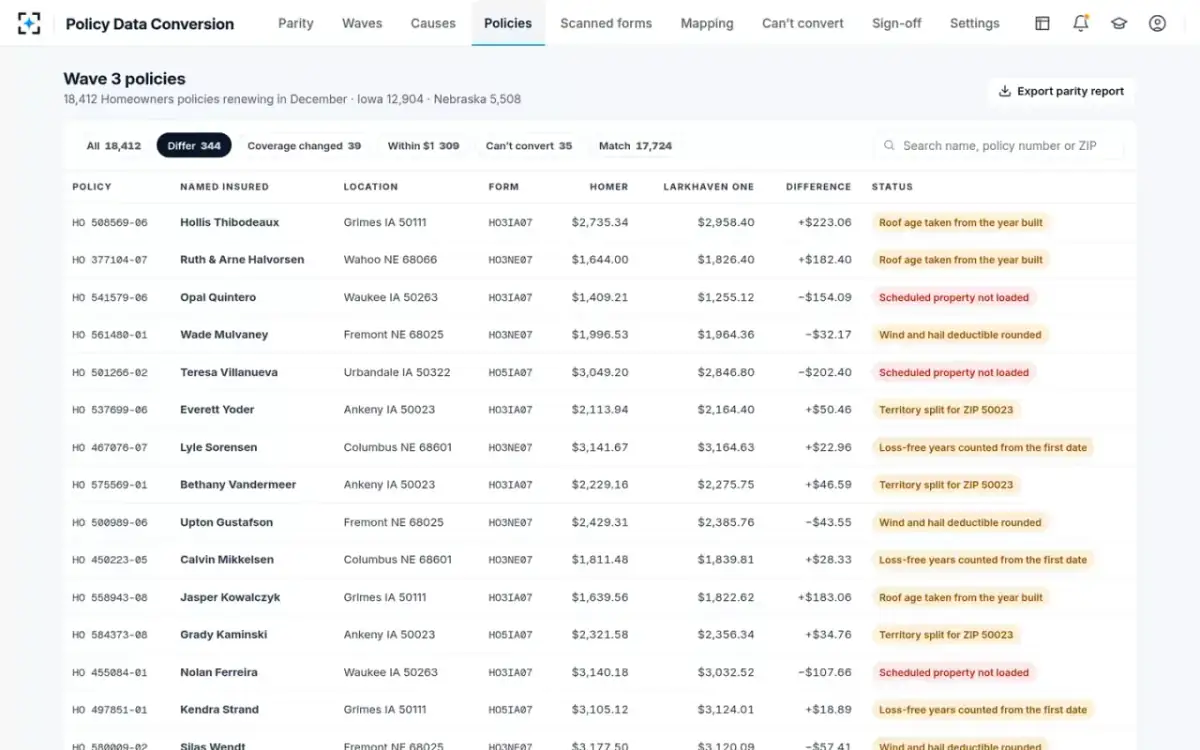
The trouble is that a conversion can change coverage or premium without anyone deciding it should. In a fictional sample conversion run through Botminds' Policy Data Conversion, Larkhaven Mutual's third wave of 18,412 homeowners policies had 472 policies whose converted premium or coverage differed at its third test load: dropped credits, rounded deductibles, a split territory, jewelry schedules that never loaded. Each of those, unfixed, would have turned an ordinary renewal into a renewal with an unannounced change.
What a conversion counts as, and the notice it can owe
| What the conversion does | What it counts as | Notice it can owe (examples) |
|---|---|---|
| Same insurer, new system, same forms, premium and coverage, at the end of the term | A renewal: a superseding policy from the same insurer | The ordinary renewal offer or policy, on the state’s usual clock (Iowa personal lines: 60 days) |
| Same insurer, new forms with substantially equivalent coverage | Nebraska: not a cancellation or refusal to renew | Texas: if any change is material, notice of each one at least 30 days before renewal, and to agents |
| Same insurer, coverage reduced or premium changed by the conversion | A renewal with a change, whether intended or not | California: the offer must name the reduced limits; New York: conditional renewal or premium-change rules may apply |
| Moved to another insurer in the same group | Texas: not a refusal to renew; Iowa personal lines: not a nonrenewal; Florida: a renewal; Nebraska: a cancellation only if coverage or rates are substantially less favorable | Florida: notice of the transfer at least 45 days ahead with the new insurer’s financial rating (60 days and approval for residential) |
| Rewritten mid-term | A cancellation of the old policy and a new one | The state’s cancellation rules; in Texas a mid-term coverage cut without consent is itself a cancellation |
What the statutes say a renewal is
Statutes that define renewal look at three things: the insurer, the timing and the act of superseding. New York's definition, quoted at the top of this page, requires the same insurer, the end of the policy period and a policy "superseding a policy previously issued and delivered", and it adds that a certificate or notice extending the term also counts (N.Y. Ins. Law §3425(a)(6)). Nothing in it turns on the policy number, the system that issued it or the format of the declarations page.
That is the legal ground under converting on renewal. A new policy number, a new declarations layout and a new system do not make a rewrite in law, as long as the same insurer issues the policy at the end of the term. What can still make trouble is what changes inside the policy.
Same company, new system: a renewal with a new policy number
Converting on renewal within the same company is the clean case, and the one to aim for. In the sample, each converted homeowners policy gets a new number in the new system, and the comparison view shows the legacy number beside it. The customer receives the renewal offer they were due anyway, produced by the new system.
The renewal itself still has its clock. Iowa, where most of the sample wave sits, has required a personal lines renewal policy or offer at least 60 days before the end of the term since 1 January 2025, and its offer must state the renewal premium "based on the known exposure as of the date of the offer to renew" (Iowa Code §515.129C). For a conversion that means the converted policy has to be re-rated and proved before the offer is produced, not after.
Each difference would turn a plain renewal into a renewal with a change
Rollover vs renewal in insurance: moving policies to an affiliate
A rollover moves a policy from one insurer to another, usually at renewal; when both insurers belong to the same group, several states treat it as a renewal or at least not as a refusal to renew, provided conditions are met. Conversions often coincide with a rollover, because a new system is a natural moment to retire an old company or paper.
The states differ in what they ask. Texas says the transfer of a policyholder "between admitted companies within the same insurance group is not considered a refusal to renew" (Tex. Ins. Code §551.004). Iowa says, for personal lines, that "the transfer of a policy between affiliates of an insurance company shall not be considered a nonrenewal" (Iowa Code §515.129B(3)), and its general rule excuses a nonrenewal notice only if, among other conditions, "the transfer results in the same or broader coverage" and the insured is told at least 30 days ahead (§515.125(2)). Nebraska treats a transfer within the same group as a cancellation or refusal to renew "only if the transfer results in policy coverage or rates substantially less favorable to the insured" (Neb. Rev. Stat. §44-522(5)(b)).
Florida goes furthest: "The transfer constitutes a renewal of the policy and may not be treated as a cancellation or a nonrenewal of the policy", but the insurer must give notice at least 45 days before the transfer "along with the financial rating" of the receiving insurer, and residential policies need substantially similar coverage, 60 days' notice and the regulator's approval (Fla. Stat. §627.4133(8)). A conversion that also moves policies to an affiliate inherits all of these conditions, and the "same or broader" and "substantially less favorable" tests are exactly what a policy-by-policy comparison measures.
New forms at renewal: when a renewal carries a material change
Moving onto new forms at renewal is still a renewal in most states, but a change in coverage on the new form can owe a notice of its own. Nebraska is explicit that "an insurer's substitution of insurance upon renewal which results in substantially equivalent coverage shall not be considered a cancellation of or a refusal to renew a policy" (§44-522(5)(a)). The protection rests on substantially equivalent coverage, which someone has to be able to show.
Texas defines a material change as one that "reduces coverage", "changes conditions of coverage" or changes the insured's duties, and protects such a change at renewal only if the insurer gives written notice clearly indicating each material change at least 30 days before the renewal date, with a separate notice to agents (Tex. Ins. Code §551.1055). California's renewal offer must list any lower limit or removed coverage and name each one (Cal. Ins. Code §678; a sample notice is annotated in the conditional renewal notice sample). A conversion that maps an old endorsement to a new one with a narrower grant is a material change whether or not anyone meant it; that is how the scheduled jewelry in the sample would have been lost.
When a conversion is really a cancellation and a new policy
A conversion done mid-term is a rewrite in the strict sense: the old policy ends before its term and a new one starts. That brings the state's cancellation rules into play for the old policy, and its new-business rules for the new one. In Texas, an insurer that reduces or restricts coverage during the term by endorsement or other means, without the insured's consent, has cancelled the policy for the purposes of the cancellation rules (Tex. Ins. Code §551.103). A mid-term conversion that drops a coverage by mistake can therefore be a cancellation nobody sent a notice for.
This is the strongest legal argument for converting on renewal rather than in a single mid-term cut-over, and it is developed in the policy administration system implementation plan guide.
Renewal vs rewrite, point by point
Renewal: At the end of the term.
Rewrite: At the end of the term or mid-term.
Renewal: The same insurer.
Rewrite: The same insurer, an affiliate or another company.
Renewal: Often the same; a new one does not change the answer in law.
Rewrite: Usually new.
Renewal: Carried over: first effective date, loss-free years, tenure credits.
Rewrite: At risk unless deliberately carried over.
Renewal: The ordinary renewal offer, plus notice of any change the state requires.
Rewrite: Cancellation or transfer notices for the old policy, as the state requires, and new-policy documents.
Renewal: The goal: same coverage, same premium at the legacy rates.
Rewrite: What an unplanned difference can turn the conversion into.
What is a converted policy? Two meanings of insurance policy conversion
"Policy conversion" means two different things in insurance, and search results mix them. In life and health insurance, a conversion is usually the insured's right to turn group or term coverage into an individual or permanent policy without new evidence of insurability; market conduct examiners check, for example, "that conversion options are included in notices of individual terminations" (NAIC Market Regulation Handbook, 2017).
In policy administration, a converted policy is one that has been moved from a legacy system onto a new one: the same contract, re-created in the new system's products, forms and rating. That is the meaning on this page. The two can meet: a life insurer replacing its administration system converts policies that themselves carry conversion privileges, and those privileges have to survive the move. The administrative meaning, and how it differs from a plain data migration, is the subject of data conversion vs data migration.
The rewrite trap: history that resets
The most common way a conversion turns a renewal into something closer to a rewrite is by losing history. Credits that depend on how long a customer has been insured, how long since their last claim or when the policy first started read dates the new system may not have. In the sample, the new system counted loss-free years from the first effective date it was given, and 74 policies lost loss-free credit worth $1,850 a year in total.
Nothing in that is a decision to rewrite. It is a conversion error that makes the policy behave like a new one in the one respect the customer would notice: the price. The protection is the same as for every other cause: re-rate each converted policy at the legacy rate version and compare it step by step, so a tenure credit that vanished shows up as a difference before the renewal offer leaves.
Loss-free years counted from the wrong date: a renewal that priced like new business

What to decide before the first wave
The conversion team, product owners and compliance should settle these questions once, in writing, before any policy converts. They decide which notices each wave owes, and the rest of the plan follows from them.
Six decisions that settle renewal vs rewrite for a conversion
- Same insurer, or an affiliate?
If any policies change company, list each state’s transfer conditions and notice periods.
- Same forms, or new ones?
If new, compare coverage form by form and decide which changes are material in each state.
- At renewal, or mid-term?
Mid-term moves bring cancellation rules into play for any difference.
- Which differences are intended?
A deliberate change gets its notice; an unintended one gets fixed before the offer.
- How is history carried?
First effective dates, loss-free years and tenure credits mapped and tested like any other rating input.
- Who signs that a wave is a plain renewal?
Someone has to attest that no policy changes premium or coverage without a decision and a notice.
The notices a conversion can owe when the answer is not a plain renewal, and how to keep them on the risk register, are set out in data migration risks and mitigation.
Questions people ask
Is a rewrite a new policy?
Usually, yes: a rewrite replaces the existing policy with a new one, often with a new number and sometimes a new company or new forms. Whether the law treats it as a renewal depends on who issues it and when; under New York's definition, a superseding policy issued by the same insurer at the end of the term is a renewal.
Does a new policy number mean the policy was not renewed?
Not by itself. Statutory definitions of renewal, such as New York's, turn on the same insurer issuing a superseding policy at the end of the term, not on the number. A conversion that assigns new numbers at renewal is still a renewal if nothing else changes.
Is moving a policy to an affiliated insurer a nonrenewal?
In several states, no, if conditions are met. Texas says a transfer within the same group is not a refusal to renew; Iowa says the same for personal lines; Florida calls it a renewal with 45 days' notice; Nebraska treats it as a cancellation only if coverage or rates become substantially less favorable.
Can a system conversion reset loss-free or claims-free years?
It can, if the new system counts from a date the conversion did not carry correctly. In the sample conversion 74 policies lost loss-free credit because the new system counted from the first effective date it was given; the fix was a conversion rule, approved by the conversion lead.
What does book transfer mean in insurance?
A book transfer moves a block of policies, often an agency's book, from one insurer to another. Outside a group of affiliated insurers it is not a renewal by the same insurer, so each policy is new business for the receiving insurer, and the transferring insurer's own termination rules govern how the old policies end. A carrier's system conversion is a different event: the insurer stays the same.