Data migration and data conversion are often used as synonyms, but they describe different amounts of work. A data migration moves data from one system or platform to another and proves that it all arrived. A data conversion goes further: it changes the data's structure and meaning to fit a new system's products, forms and rules, and then proves that what it produced is equivalent to what it started from. In insurance the difference is sharp. Migrating a policy administration system's data means moving policy records; converting it means each in-force policy must come out the other side as the same policy, with the same coverage and the same premium when re-rated. Botminds' Policy Data Conversion handles that second job: agents read the legacy data and scanned forms, convert and re-rate every policy, and trace each difference to its cause for a person to decide.
Where a data migration stops and a policy conversion keeps going
Agent
ExtractRead the legacy policy, coverage, rating, remark and claims data, and link each policy to its scanned documents.
Never: writes to the legacy system.
A person decides
MapDecide how each legacy product, form, field and code value lands in the new system; a migration maps structure, a conversion also maps meaning.
Agent
Load and countLoad the converted policies and tie counts and control totals. A data migration usually ends here.
Agent
Re-rateRate each converted policy’s current term in the new system at the rate version the legacy system used.
Never: changes a premium to force a match.
Agent
CompareCompare every field and every rating step with the legacy policy, and every coverage by value.
A person decides
Decide by causeApprove or reject one rule for each cause of difference; every policy it touches is converted and re-rated again.
A person decides
SignSign the wave only when count, premium and coverage tie out, or each open item is accepted with a reason.
Data conversion vs data migration: the short answer
Migration is about location: the data moves. Conversion is about form: the data is changed to fit new rules, and must still mean the same thing afterwards. A migration from one database server to another, with the same application on top, needs no conversion. A move from a legacy policy administration system to a new one is both: the data migrates, and every policy is converted onto new products, forms and rating.
So the test of success differs. A migration succeeds when everything arrived intact. A conversion succeeds when everything that arrived is equivalent: the same customer, coverage, premium and history, expressed in a different system's terms.
What is a data migration?
A data migration moves data from a source to a target: a new database, a new platform, a cloud environment, a new application. Its controls are about completeness and integrity: counts in both directions, control totals on key amounts, checks that nothing was truncated, duplicated or corrupted, and a cut-over that does not lose transactions made during the move. Migrations are often repeatable and largely technical; the target accepts the data with little change in meaning.
GAO's guide to assessing data reliability supplies two working definitions that a migration's tests are built on: "Completeness refers to the extent to which relevant data records and fields are present and sufficiently populated", and "Accuracy refers to the extent that recorded data reflect the actual underlying information" (GAO-20-283G). A migration has to show both. A conversion has to show a third thing that neither definition covers: equivalence after the meaning has been changed.
What is data conversion in insurance?
Data conversion in insurance is the move of an in-force book from a legacy policy administration system onto a new one, with every policy re-created on the new system's products, forms and rating, and proved to be the same policy. It usually happens in waves, often on each policy's renewal, and each wave goes through several cycles of converting, loading and comparing before it is signed.
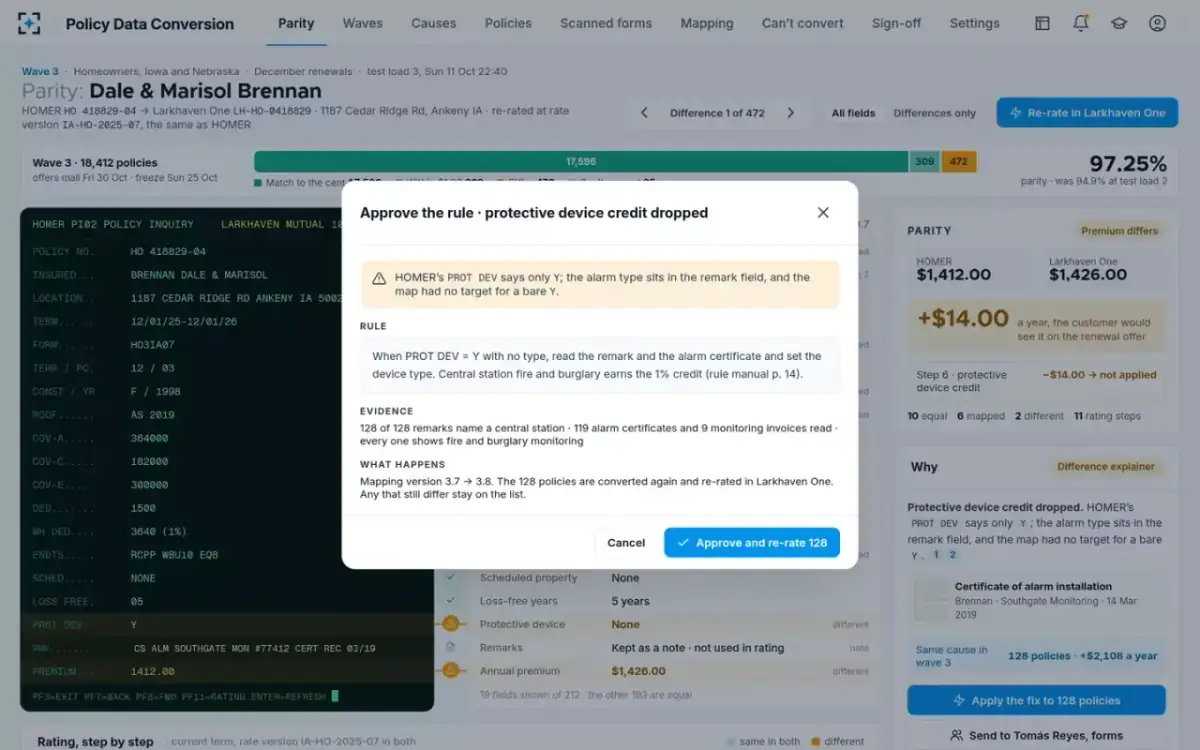
The hard part is meaning. A legacy system may store a roof as an age class while the new one needs a year; a deductible in dollars where the new one wants a percentage; a territory code that the new rate tables split in two; a protective device as a bare Y, with the device type in a remark and on a scanned certificate. Every one of those is a conversion decision, and every one changes a premium if it is made wrongly. In a fictional sample wave of 18,412 homeowners policies, those four alone changed premiums on 359 policies.
What one policy conversion wave has to compare, in the sample
212
fields compared on every converted policy
Fictional sample conversion
11
rating steps compared, from base premium to the last endorsement
Same rate version on both sides
41,206
scanned documents read for one wave of 18,412 policies
12 went to a person
Data conversion meaning and data migration meaning, in regulators' words
Regulators use "conversion" for the larger event and "migration" for the move inside it. Bank regulators' IT examination guidance puts it this way: "A system conversion is a major change to an existing system and may involve migrating the system from one platform type to another", and "strong conversion controls (including documented conversion plans, adherence to entity change management processes, and comprehensive management oversight) are critical to prevent data corruption, performance degradation, and operational disruption" (FFIEC IT Examination Handbook, 2024). The guidance is written for banks, but the vocabulary carries over: the migration is one part of the conversion.
The same guidance names what an improperly planned conversion costs: it "can disrupt the business and create inefficiencies, internal and external user dissatisfaction, and accounting problems". For an insurer, the external user is a policyholder whose renewal changed.
Why only a conversion has to prove each policy rates the same
Because what examiners test is the policy, and a conversion is the only kind of move that can change one. State market conduct standards ask whether each premium follows the filed rates or the company's rating plan, and whether policies and endorsements are issued and renewed accurately, on time and in full (NAIC Market Regulation Handbook standards, 2024; the measures built on them are in policy servicing KPIs and metrics). A pure migration that moves a database under the same rating engine cannot change the rate charged. A conversion that moves a policy onto a new rating engine can, one input at a time.
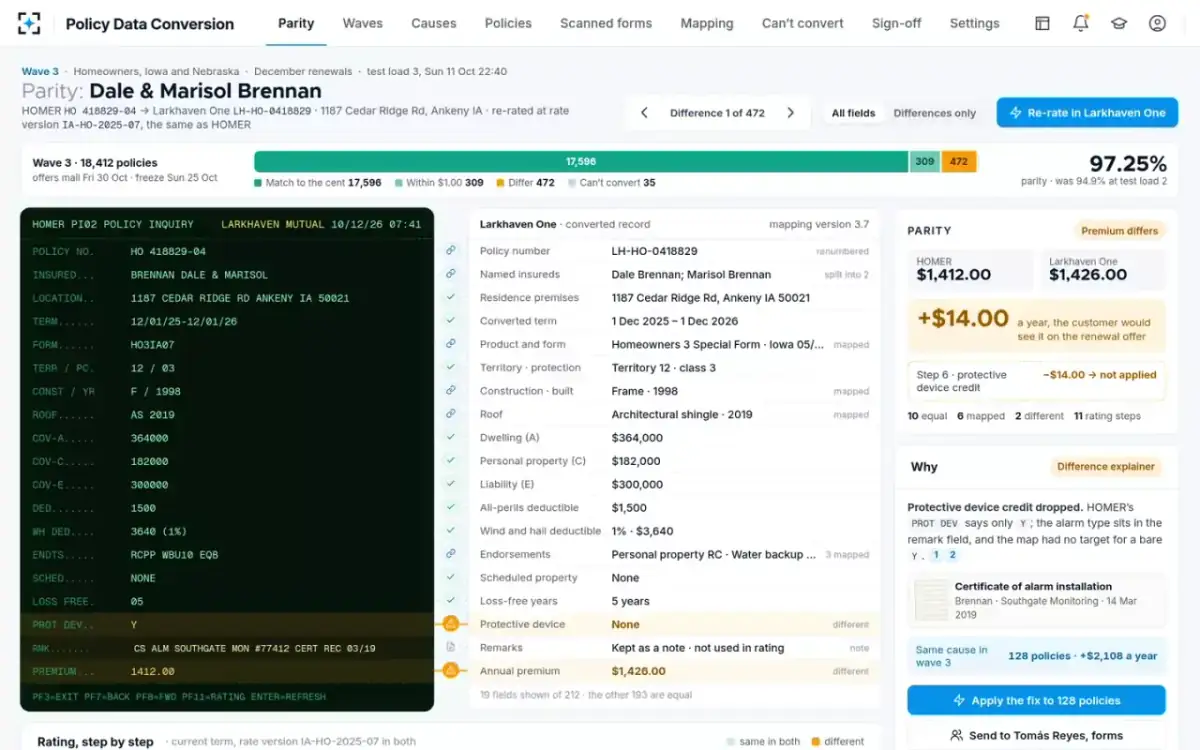
The proof therefore has to be per policy, at the same rate version, and step by step. In the sample, one converted homeowners policy came out $14.00 a year higher; comparing its 11 rating steps showed ten equal and one, the protective device credit, missing in the new system. A migration's control totals would have absorbed the $14 into a $31 million wave without a trace. How such a comparison is reported is shown in the reconciliation report example.
A conversion compares meanings, not just values
Complete, accurate, equivalent: the three tests
A migration needs the first two tests; a conversion needs all three. Complete: every policy, every coverage, every form and endorsement arrived, which counts and control totals show. Accurate: each value that arrived reflects the source, which field comparisons and tracing to source documents show.Equivalent: each converted policy, read through the new system's products, forms and rating, is the same policy, which only a re-rate and a coverage comparison show.
The third test catches what the first two cannot. In the sample, the jewelry schedules that never loaded were complete by count, since the endorsements tied, and arguably accurate field by field, since the schedule premium was carried. Only the equivalence test found that 39 policies had lost $333,900 of scheduled coverage.
Data migration vs data conversion, side by side
Data migration: Where the data lives.
Data conversion: Where it lives and what form it takes: new products, forms, codes and rating.
Data migration: Everything arrived intact.
Data conversion: Everything that arrived means the same thing.
Data migration: Counts, control totals, integrity checks, cut-over.
Data conversion: All of those, plus per-policy re-rating, step-by-step and coverage comparison, tracing to scans.
Data migration: Few: mostly technical.
Data conversion: Many: every doubtful mapping, every rule, every accepted difference.
Data migration: Loudly: missing rows, load errors, outages.
Data conversion: Quietly: a premium or coverage that loads cleanly and is wrong.
Data migration: The project.
Data conversion: Often the customer, at renewal or at a claim, unless the conversion compares every policy.
When a migration alone is enough
Three common moves in insurance are genuine migrations and need no conversion: rehosting, archiving and consolidating copies. Rehosting moves the legacy policy system itself, unchanged, onto new hardware or a cloud platform: the same programs rate the same policies, so counts, control totals and a parallel run are enough.Archiving moves closed terms out of the live system into a store where they can be read but not changed; the test is that each archived term can still be retrieved and printed as it was. Consolidating copies, such as moving a reporting database to a new warehouse, changes nothing a customer sees.
The line is crossed the moment the target system will rate, renew or print a policy using rules the source system did not use. From then on the data is being interpreted, and interpretation is where conversions go wrong. A programme that rehosts its legacy system first and replaces it later has done a migration and still owes a conversion; the two should be planned, tested and signed as separate events, with the equivalence test attached only to the second.
The distinction also decides what the old data needs. Terms that have ended can usually be migrated to an archive as they are, because nobody will re-rate them; the in-force book, which the new system will renew, has to be converted. In the sample, the legacy mainframe keeps the policies that cannot convert yet, including 35 in wave 3, and renews them itself until a person resolves each one, so the old system's data is migrated in parts and converted in parts, wave by wave.
Who owns which part
The migration is usually owned by engineers; the conversion needs people who know the products, the forms and the customers. On a policy conversion those are four distinct seats, and the boundary errors happen between them, which is the subject of every seat on a policy conversion.
Migration and conversion roles on a policy administration system move
Today
Builds extracts, staging and load jobs; proves counts and totals.
With agents
Same job: the load still has to be complete and fast.
Still theirs: The pipeline
Today
Writes the mapping specification and reconciles results by hand.
With agents
Starts from every policy re-rated and compared, with differences grouped by cause.
Still theirs: Every conversion rule
Today
Finds the remark and the scan behind a doubtful value.
With agents
Sees only values below the confidence threshold, with their policies and pages.
Still theirs: Doubtful mappings
Today
Hears about conversion errors from customers.
With agents
Owns the policies that cannot convert, before renewal offers go out.
Still theirs: The customer side
Insurance data migration that is really a conversion: how to tell
If any of four things is true, the project is a conversion, whatever its name. The products, forms or rating change between systems. Rating inputs or coverage live outside fields, in remarks or on scans. Codes in the old system do not map one to one onto the new. Or the customer will receive a document, such as a renewal offer, produced by the new system from the moved data. A legacy policy administration replacement usually meets all four.
Calling it a migration is harmless if the plan still contains the equivalence test. The risk is that the name sets the scope, and the scope stops at the load. What to look for in a tool that does the whole job is set out in the insurance data migration tool guide, and why legacy policy data needs so much interpretation is covered in legacy policy administration systems.
A conversion decision: one rule, its evidence and what it changes
Questions people ask
Is data conversion part of data migration?
It is usually the other way round: a system conversion contains a migration. The migration moves the data; the conversion also reshapes it for the new system and proves it is equivalent. Bank regulators' IT guidance describes a system conversion as a major change that "may involve migrating the system" to a new platform.
Is ETL a data migration or a data conversion?
Extract, transform and load is the mechanism used by both. The transform step is where conversion decisions are applied, but the tool does not prove equivalence: proving each policy rates and covers the same needs re-rating and comparison after the load.
What is data transformation in a policy conversion?
It is the set of rules that turn legacy values into the new system's values: codes to new codes, dollar deductibles to percentages, age classes to years, remarks to structured fields. In the sample conversion the map covers 9 products, 64 forms, 212 fields and 1,318 code values.
Does a data conversion change the data?
It changes the form, not the meaning: the values are expressed in the new system's terms, but the policy they describe must stay the same. If a conversion changes what a policy costs or covers, that is an error unless someone decided it and sent the notice it requires.
What is a test load in a data conversion?
A trial conversion of a wave into a test copy of the new system, followed by re-rating and comparison. Each test load ends with a list of differences to fix; in the sample, wave 3 moved from 88.4% of policies matching at test load 1 to 97.94% after the first approved rule at test load 3.