An insurance data migration tool moves in-force policies from a legacy policy administration system to a new one, and the one worth buying proves that each policy is still the same policy afterwards. Two things separate it from a generic extract-and-load tool. It reads the rating inputs that never lived in fields, in remarks and on scanned forms. And when it is not sure how a legacy value maps, it asks a named person instead of guessing, because a confident wrong mapping loads cleanly and surfaces months later as a premium change on a customer's renewal. Botminds' Policy Data Conversion is built that way: agents read, map, re-rate and compare every policy, and every value below a confidence threshold waits for a person.
It is written for a carrier converting its policy administration system; an agency moving client records between agency management systems after an acquisition faces a different job, with different data and no rating engine. This guide sorts the tools on the market by method rather than brand, shows where guessing costs money, and ends with the questions to ask in a demonstration, including where our own solution fits and where it does not.
Mapping that asks: every uncertain value gets an owner before it gets a premium
Agent
Profile the legacy valueCount every code value in the extract, with the policies that carry it, and read the remarks and scanned forms linked to a sample of them.
Never: drops a value because it is rare.
Agent
Propose a targetPropose the new product, form or value with a confidence and the evidence behind it, such as 128 of 128 remarks naming a central station.
Agent
Approve, or askAt or above the threshold (95% in the sample) the mapping is approved on its own. Below it, the value goes to the product and forms specialist or the conversion lead by name.
Never: maps below the threshold without a person.
A person decides
Decide the doubtful valueChoose the target, write a rule, or mark the policies as cannot convert, with the sample policies and their documents on screen.
Agent
Re-rate and compareConvert every affected policy again and re-rate its current term at the legacy rate version, step by step.
Never: changes a premium, rate or coverage to force a match.
A person decides
Sign the map versionEach decision moves the map to a new version with who approved it; a rule can be withdrawn, and its version stays on file.
What should an insurance data migration tool do that a generic tool does not?
It should prove equivalence, not just completeness. A generic migration tool is judged on whether every row arrived; a policy conversion is judged on whether every policy rates and covers the same. State market conduct examiners test the second: whether the premium follows the filed rates, and whether each policy was renewed accurately and completely. Neither shows up in a row count.
Proving equivalence takes four abilities a generic tool lacks: reading rating inputs that sit in free text and on scans; re-rating each converted policy in the new system; comparing rating step by step rather than the total; and tracing each difference to the legacy value or page that caused it. The difference between the two jobs is the subject of data conversion vs data migration.
Insurance data migration software: four kinds, sorted by method
Four kinds of product are sold for this job, and most programmes use more than one. Knowing which kind you are looking at tells you, before any demonstration, which errors it can find. A tool that never opens a scanned form cannot find a credit that only exists on one, however good its mapping screens.
Four kinds of insurance data migration software, and what each can prove
| Kind of tool | What it moves and checks | Reads remarks and scans | An uncertain mapping |
|---|---|---|---|
| Conversion utility from the new policy system vendor | Loads legacy data into the vendor’s own tables; validates formats and required fields | Rarely | Defaults or rejects, as the load rules say |
| General extract, transform and load platform | Moves and reshapes data at volume; counts rows and sums fields | No | Whatever the transformation rule says, applied silently |
| Data quality and profiling tool | Finds blanks, invalid codes, duplicates and outliers in the extract | No | Flagged if it breaks a rule, not if it is plausible |
| Agents that read, re-rate and ask | Converts each policy, re-rates it at the legacy rate version and compares every field and rating step | Yes, citing the page | Sent to a named person below a set confidence |
Why a confident wrong mapping costs more than a visible gap
A value that fails to load is cheap: somebody sees it. A value that loads with the wrong meaning is expensive, because nothing flags it until a customer, an examiner or an actuary does. Every conversion produces three kinds of mapping failure, and only the first one is visible at load.
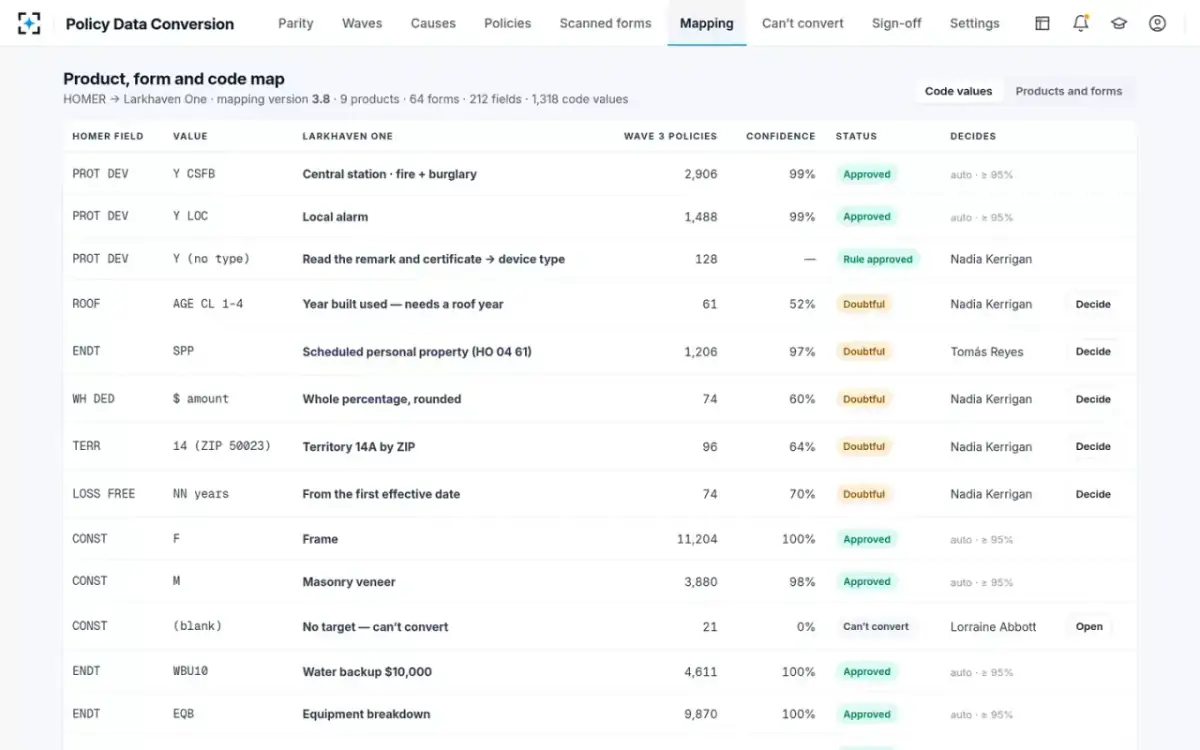
Take a sample conversion on fictional data, Larkhaven Mutual's wave 3 of 18,412 homeowners policies, as it runs through Botminds' Policy Data Conversion. A rejected value: 21 policies had no construction code at all, so they could not convert and went to a person. A silent default: the legacy system stored a roof age class, the new system needed a year and fell back to the year the house was built, so a roof replaced in 2021 on a 1962 house was rated as if it were as old as the house, and one policy went from $1,644.00 to $1,826.40. Across the wave that cause touched 61 policies and added $11,894 a year. A dropped value: the protective device field said only Y, the map had no target for a bare Y, and a 1% alarm credit vanished from 128 policies, worth $2,108 a year.
When rating errors like these reach policyholders, regulators order the fix one policy at a time. In a 2024 Texas order over an error in base rates by territory, the insurer had to calculate a corrected premium "for each policy in the Review Period", refund each overcharge with 5% simple interest, and said it would not recover premium from anyone undercharged (Texas Department of Insurance, Order 2024-8733). That is the asymmetry a guessed mapping creates: the overcharges come back with interest, the undercharges stay lost.
Where the asking happens: a confidence threshold with a name on it
The tool should state its confidence in every mapping and stop below a threshold the insurer sets. In the sample conversion the threshold is 95%: values at or above it are approved on their own, and the rest wait for the product and forms specialist or the conversion lead. Confidence is not decoration. In the sample, four of the six causes of premium differences came from values mapped at 52% to 70% confidence. The other two never reached the map at all: the alarm type behind a bare Y, which had no target, and the items on scanned jewelry schedules, which were missing from the extract.
The mappings that changed premiums were the ones the agents were least sure of
The other half of the design is who receives the question. A threshold that sends doubtful values to a shared queue recreates the problem: nobody owns the decision. In the sample, each doubtful value names its decider, and the map is versioned so every decision can be traced and, if it was wrong, withdrawn.
Every code value with its confidence, its policies and the person who decides
What a policy data conversion tool must read besides fields
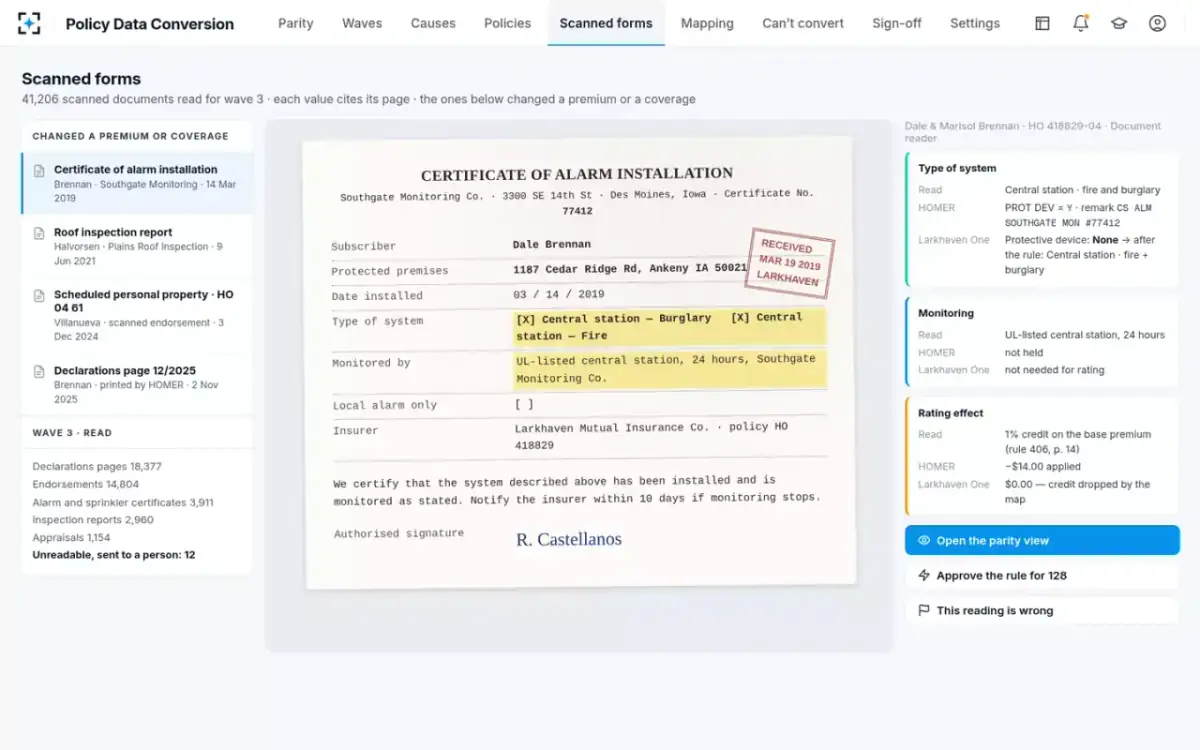
It must read the remarks and the scanned documents, because that is where a legacy system keeps the rating inputs its fields could not hold. A fixed record layout has no place for an input a later product needs, so the input goes into a remark or onto an attached page. In the sample, the alarm type behind a protective device credit was in both: a remark reading CS ALM SOUTHGATE MON #77412 CERT REC 03/19 and a scanned certificate of alarm installation. The legacy field said only Y.
The volume is not small. For the sample wave of 18,412 policies the agents read 41,206 scanned documents: 18,377 declarations pages, 14,804 endorsements, 3,911 alarm and sprinkler certificates, 2,960 inspection reports and 1,154 appraisals. Twelve were unreadable and went to a person. The ones that mattered were few and specific: an alarm certificate that restored a credit, a roof inspection report that supplied a roof year, a scheduled personal property endorsement whose four jewelry items, worth $18,400, never reached the extract.
The credit the field map could not see
Can an AI data migration agent be trusted with rating inputs?
Only inside limits you can audit, and only after it has been tested on a wave you have already reconciled. The useful question is not whether a model is accurate in general, but whether each of its outputs can be checked against a source. Market conduct examiners already ask whether an insurer "has appropriate controls, safeguards and procedures for protecting the integrity of computer information" (NAIC Market Regulation Handbook standards, 2024). A tool that writes rating inputs into the new system is part of that control environment, and an examiner can ask how each value got there.
An agent that cites the page and position of every value it reads makes that tracing cheap. One that cannot cite its source should not be setting rating inputs. In the sample, the agents work under fixed limits: read-only on the legacy system, never inventing a value they cannot read, never mapping below the threshold without a person, never changing a premium, rate or coverage to make a policy match, and never applying a rule or signing a wave.
Same rate version, or no comparison
A migration tool must re-rate each converted policy at the rate version the legacy system used for that term. Otherwise a rate change looks like a conversion error and, worse, a conversion error hides inside a rate change. Rate version mix-ups reach policyholders on their own. In 2024 an insurer told Texas it had calculated rate deviation factors "based on filed, but superseded, rate deviations", and then disclosed a separate "system error related to implementation of the rates filed"; together they overcharged an estimated 409 Texas policies by more than $40,000 (Texas Department of Insurance, Order 2024-8700).
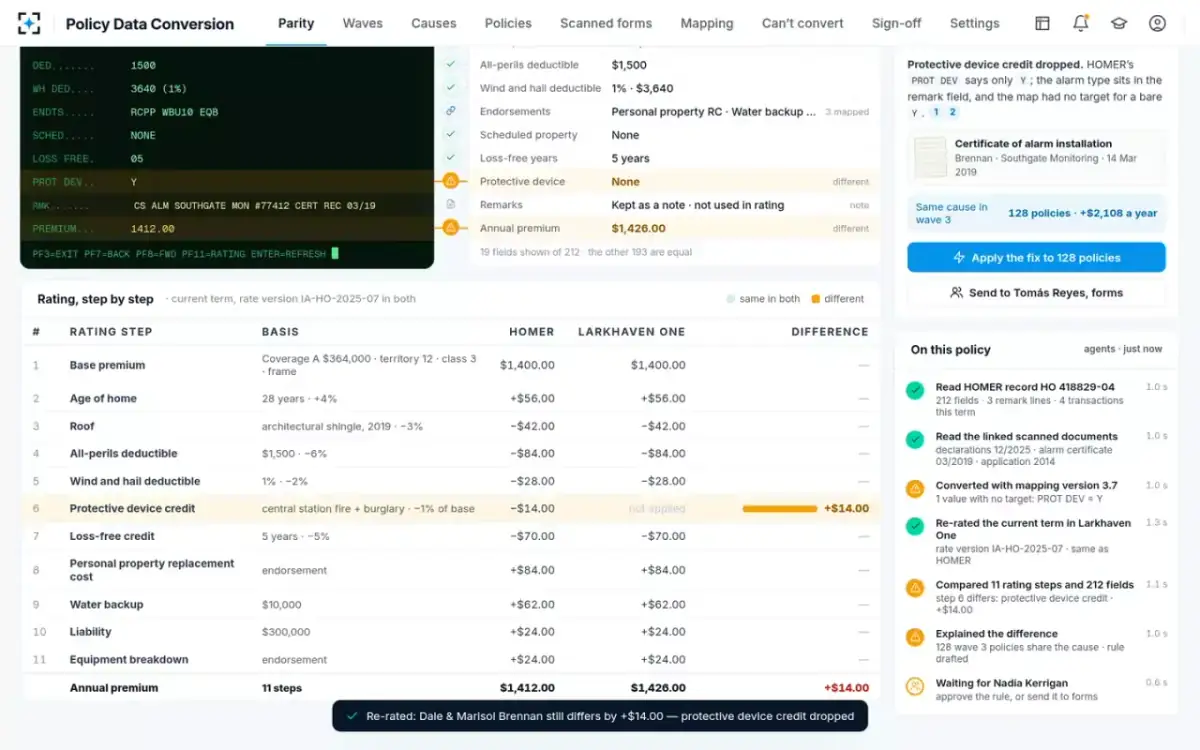
Comparing step by step is what makes the version rule useful. A homeowners premium in the sample is built in 11 steps, from base premium through age of home, roof, deductibles and protective device credit to endorsements. A tool that compares only the final premium learns that a policy differs; one that compares each step learns which step, and from there which legacy value. The same kinds of step errors show up in ordinary market conduct exams: North Carolina examiners found incorrect protection classes, deductible factors, base rates and protective device credits in 30 of 100 homeowners files they sampled (North Carolina Department of Insurance, 2023), errors that had nothing to do with a conversion but show where rating goes wrong.
Eleven rating steps, one difference, one cause
Policy administration system migration tool: questions for the demonstration
Ask each vendor to show these on a sample of your own policies, not on the vendor's demonstration book. A tool that has only ever seen clean data will look perfect on clean data. A bank regulator's guidance makes a similar point about conversions generally: "Reference checking with a conversion partner's other clients can be helpful" (FFIEC IT Examination Handbook, 2024).
Eight questions to put to any insurance data migration tool
- Does it re-rate every converted policy?
Not a sample, and not just the premium total: every policy, every rating step, in the new system.
- At which rate version?
The one the legacy system used for that term. Anything else mixes rate changes with conversion errors.
- What does it do with a value it is unsure of?
It should state its confidence and stop below your threshold, naming who decides.
- Does it read remarks and scanned forms?
Ask to see a credit or a schedule recovered from a scan, with the page cited.
- Does it compare coverage as well as premium?
Limits, schedules, forms, endorsements and mortgagees. A coverage difference should block sign-off.
- Can it change a premium to make a policy match?
The answer must be no. Fixes change how the policy is converted, not what it costs.
- Is every fix a versioned rule with an approver?
You will need to show an examiner who decided what, and when.
- Does it write to the legacy system?
It should be read-only there. The legacy system stays your system of record until the wave signs.
Where Botminds' Policy Data Conversion fits, and where it does not
It sits between the legacy system and the new one, alongside the load tools you already have. Six agents read the legacy extracts and scanned documents, propose the map with a confidence, convert and re-rate every policy in the new system's test environment at the legacy rate version, group every difference by cause and draft one rule per cause, then tie out each wave on count, written premium and every coverage. People approve every rule, decide every doubtful mapping and sign the wave in order.
It does not replace the new system's rating engine: it calls it. It does not replace the vendor's load utility or your extract jobs: it reads their output and produces converted policies ready to load. It does not decide rate changes or coverage changes; those stay with your product owners, and the agents never change a premium to force a match. And it is not needed everywhere: a small, clean book with every rating input in fields and a like-for-like product in the new system may be served by a field map and per-policy re-rating alone. The cost of each approach, per policy converted, is worked through in policy administration system replacement cost, and what the sign-off should contain is in the reconciliation report example.
Questions people ask
Is extract, transform and load software enough for an insurance data migration?
It is enough to move the data, not to prove the policies. Load tools count rows and sum fields; they do not re-rate a policy or read a scanned endorsement. In the sample wave, a field map dropped a 1% alarm credit from 128 policies without a single load error.
What does an insurance data conversion tool cost?
List prices are rarely published, so compare tools by cost per policy converted and proved, including every convert, load and compare cycle. Botminds estimates one by-hand cycle on one wave at 22 working days, against 5 with agents reading and comparing; your own figures belong in the model.
Do AI data migration tools replace the conversion team?
No. They take the reading, re-rating and tracing, which is most of the hours. Decisions stay with people: in the sample, the conversion lead approves every rule, the forms specialist decides every mapping below 95% confidence, and three people sign each wave in order.
How should a tool handle policies that cannot convert?
It should leave them on the legacy system with a reason and an owner, never convert them with defaults. In the sample wave 35 policies stayed behind: 21 missing a construction type, 9 with a ZIP that did not match the county, and 5 with a deceased named insured and the estate pending.
Can we test a data migration tool before buying it?
You should. Give it a wave you have already converted and reconciled by hand, hold back your results, and count what it finds that you found, what it finds that you missed, and what it misses. That back-test is the strongest evidence a vendor can offer.