An acquisition integration manager is the person who carries a bought business from the signed purchase agreement to the morning its people and customers work inside the buyer's systems, and who answers for that date. When the business is an insurance agency, the job is mostly data: the seller's agency management system holds every client, policy, carrier code, note and declarations page, and none of it lands in the buyer's system until someone has read it, mapped it, matched it and tied it out. The manager runs that work, decides what nobody else may decide, and signs the day-one load. Botminds' Agency Acquisition Data Migration is built for this team: six agents read the seller's export, map every field and code, match duplicate clients, check policies against their declarations pages, list inherited errors-and-omissions exposures and flag renewals that land where the buyer has no carrier appointment, while people make every decision that matters.
The role exists because agency acquisitions come in series and most of the businesses bought are small. Bureau of Labor Statistics data count 160,547 private establishments in insurance agencies and brokerages in 2024, nine in ten of them with fewer than ten employees. An acquirer that buys several a year cannot staff each one like a corporate merger, so the integration manager's real product is a repeatable method, run by a small standing team.
The industry an integration manager works in: many sites, most of them small
160,547
private insurance agency and brokerage establishments in 2024
up from 135,508 in 2014
90%
of agency establishments had fewer than ten employees, first quarter 2024
143,671 of 159,239
6.2
jobs per establishment in 2024, against 5.2 in 2014
our arithmetic on the same series
What does an acquisition integration manager do?
An acquisition integration manager owns three things: the day-one date, the list of decisions that have to be made before it, and the signature on the load that moves the seller's book into the buyer's system. Everything else on the team feeds one of those three. The manager does not map fields or read activity notes; the manager makes sure someone with the authority to decide has seen each doubtful mapping, each proposed client merge and each inherited exposure, and that nothing the team could not resolve reaches day one without a reason written beside it.
In an agency deal the date is less flexible than it looks. Renewals keep arriving whether or not the system is ready, the seller's staff need to know which system they log into on Monday, and the buyer's carrier appointments decide where each renewal can be written. A manager who lets the date drift is not buying time; the renewal calendar keeps moving, and every renewal that is processed in the old system before cutover is one more record to carry over by hand.
The Government Accountability Office, summarising what private and public organisations had learned about mergers, put the staffing principle plainly: dedicating a strong and stable implementation team "is important to ensuring that it receives the focused, full-time attention needed to be sustained and successful" (GAO-03-669, July 2003). The report was written for federal agencies, not insurance agencies, but the failure it warns about is the one that sinks agency integrations: a migration run in the gaps of people's day jobs.
Who should be on an agency integration team?
Four seats do the work on almost every agency integration: the integration manager, a data migration analyst, an errors-and-omissions and compliance lead, and the account managers who came over with the book. Behind them sit the buyer's agency system administrator, its licensing and appointment staff, and its finance team for commission and trust accounting, each pulled in for specific decisions rather than full time.
Each seat answers a different question. The analyst answers what does this field mean. The E&O lead answers what did we just buy that could become a claim. The account managers answer is this the same client, and what did they actually ask for. The manager answers is it ready, and who decided. A team missing one of those voices tends to discover the gap on day one, through a client.
Four seats on an agency integration, and what each keeps when agents do the reading
Today
Runs several integrations at once, chases status by email and learns of blockers in the last week.
With agents
Sees every doubtful mapping, waiting merge and unowned exposure on one tie-out, and signs the day-one load.
Still theirs: The date, the sign-off and every accepted risk
Today
Builds the field map and code lists by hand from a seller export that arrives late.
With agents
Decides the doubtful mappings and merges from proposed rules with the evidence beside them.
Still theirs: Every mapping below the auto-approve threshold
Today
Samples the seller's files and reads notes for declined coverage and promises not kept.
With agents
Owns a ranked list of inherited exposures, each with the document it came from.
Still theirs: Each exposure, its owner and the report to the E&O carrier
Today
Services the book while answering the team's questions about codes and clients.
With agents
Sees upcoming renewals by carrier and week, and the ones that land without an appointment.
Still theirs: The client conversation and the remarketing call
What moves to agents, and what each seat does instead
The work that moves is the work that consists of reading and comparing at volume: profiling every table in the export, proposing a target for every field and code value, standardising names, addresses and tax IDs so duplicates can be found, comparing each policy with its declarations page, and reading every note, email and certificate for something the buyer will have to answer for. The work that stays is the work that commits the agency: merging two client records, deciding what a code meant, owning an exposure, and telling a client anything.
The figure below sets the two ways of running the same four seats side by side. The right column is how Agency Acquisition Data Migration divides the work; it is a design, and the hours it saves depend on the book.
The integration team before and after agents: the same seats, different weeks
Integration run by hand: Status meetings and a spreadsheet of open items; the true state of the book is known only after a test load.
With Agency Acquisition Data Migration: Open decisions, waiting merges and unowned exposures counted live; signs a load that has tied out to the export.
Integration run by hand: Writes the field map and every code translation, often from screenshots of the seller's system.
With Agency Acquisition Data Migration: Reviews the mappings the mapper could not settle, each with sample values and a drafted rule.
Integration run by hand: Reads a sample of client files; the rest of the notes are never read.
With Agency Acquisition Data Migration: Works a ranked exposure list built from every note, email, certificate and open claim.
Integration run by hand: Answer code questions between renewals; find duplicate clients when a client calls twice.
With Agency Acquisition Data Migration: Confirm merges for their own clients and plan renewals that land without an appointment.
Integration run by hand: Whoever touched the record last.
With Agency Acquisition Data Migration: A named person for each mapping below 95% confidence, each merge and each exposure, with the reason kept.
What is the role of the data migration analyst?
The data migration analyst decides what the seller's data means. That sounds like clerical work until you meet a real export: a status code that means two things, account manager initials shared by two people, a free-text prior-carrier field with hundreds of spellings, a line-of-business code that covers both contractors equipment and builders risk. Each of those is a judgement with consequences, because a wrong translation turns into a wrong renewal date, a wrong carrier or a coverage nobody can find.
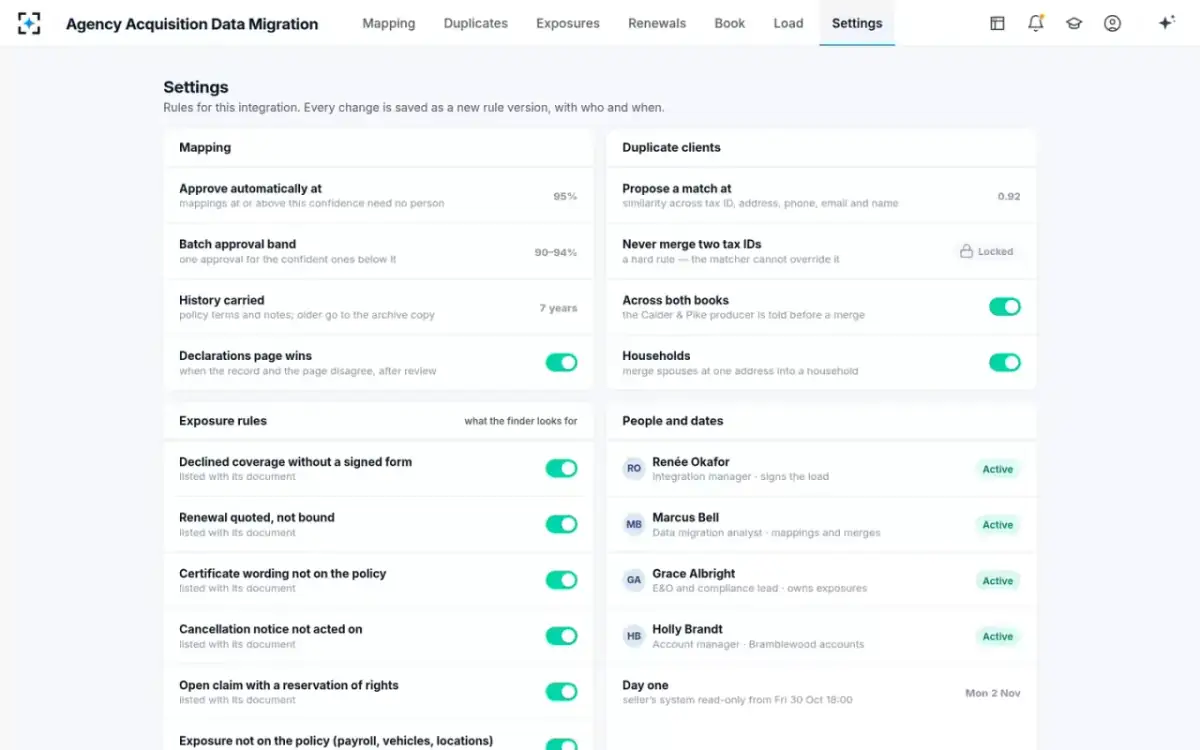
In the solution's sample acquisition, the seller's system used the status "R" on 1,286 policies. Of those, 1,212 kept their policy number from the prior term, which means renewed, and 74 had a new number and a different prior carrier, which means rewritten. The field and code mapper put its confidence at 61%, below the 95% at which it may approve a mapping on its own, so it proposed a rule with the evidence and left the decision to a person. That is the analyst's job in the new model: fewer translations, each one harder, each one recorded with who decided and why.
Agents change what the analyst needs to be good at. Typing speed in a mapping spreadsheet matters less; knowing the buyer's own code lists, the carriers' products and the questions to ask the seller's staff matters more. The analyst is also the person best placed to say when a pattern of doubtful mappings means the export itself is wrong. The data mapping template for an agency migration sets out the columns that make those decisions auditable.
Who owns the seller's clients during integration?
During the integration the seller's account managers keep servicing their own clients, and the buyer decides who owns each client record. Those are separate questions. Servicing follows people and licences; the record follows the buyer's rules for merging clients it already has. The integration manager's job is to make sure the two answers are written down before day one, not discovered after it.
Licensing sets the outer limits. The NAIC's Producer Licensing Model Act requires an agency operating as a business entity to hold its own producer licence and to designate a licensed producer responsible for its compliance, and it lets renewal commissions be paid to a producer only if that producer was licensed when the policy was first sold (NAIC Model #218, §§6 and 13). So the seller's producer codes, licences and designated responsible producers are integration data, not HR paperwork: they decide who can be paid on the renewals that the buyer is about to inherit.
Merges across the two books raise a quieter question of ownership. When the seller's client is already a client of the buyer, as one in five of the duplicate clusters were in the sample, someone at the buyer already looks after part of that relationship. The sample setting tells the buyer's producer before such a merge is approved. How to decide whether two client records are the same insured covers the rules that settle those cases.
Who decides what is a setting, not a habit
How long does an insurance agency integration take?
There is no published, trustworthy benchmark for how long an agency integration takes, so the honest answer is a method: count the work, then see where it waits. Most of an integration's calendar goes on four things that happen in sequence, getting and reading the seller's export, mapping fields and codes, cleaning records and merging duplicate clients, and checking policies and exposures, followed by test loads and sign-off.
Botminds' own estimate for a mid-sized agency acquisition puts that sequence at about thirteen weeks by hand. The solution's design target is six weeks from close to day one, and the saving is not spread evenly: the first four stages shrink to about a week each, while test loads, tie-out and sign-off keep their two weeks, because those are people checking and deciding.
Where an integration's weeks go, by hand and with agents (estimated)
By hand: about 13 weeks
- Reading the export, 4 wk · 31%
- Mapping, 3 wk · 23%
- Merging duplicates, 2 wk · 15%
- Policies and E&O, 2 wk · 15%
- Tie-out and sign-off, 2 wk · 16%
With agents: 6-week target
- Reading, 1 wk · 17%
- Mapping, 1 wk · 17%
- Merging, 1 wk · 16%
- Policies and E&O, 1 wk · 17%
- Tie-out and sign-off, 2 wk · 33%
A plan for those six weeks, week by week with a deliverable and a sign-off each, is in the post acquisition integration plan template.
How many acquisitions can one integration team handle?
One team can run several integrations at once if each runs on the same method and the team is sized to the books, not to the deal count. GAO's forum participants made the same point about scale: "the size of the implementation team needs to be scaled to the size of the merger and transformation" (GAO-03-669). In agency terms, the drivers of team size are the number of policies and attachments, the number of duplicate clients across both books, and the number of carriers the buyer is not yet appointed with, not the purchase price.
The population of targets argues for a small standing team. In the first quarter of 2024 three in four agency establishments counted fewer than five employees (BLS QCEW). A book of that size might hold a few thousand clients and a few thousand policies; the reading is the large part, and it is the part agents take. What does not shrink with the book is the number of decisions per integration that need someone senior, which is why the manager's seat is the bottleneck when deals stack up.
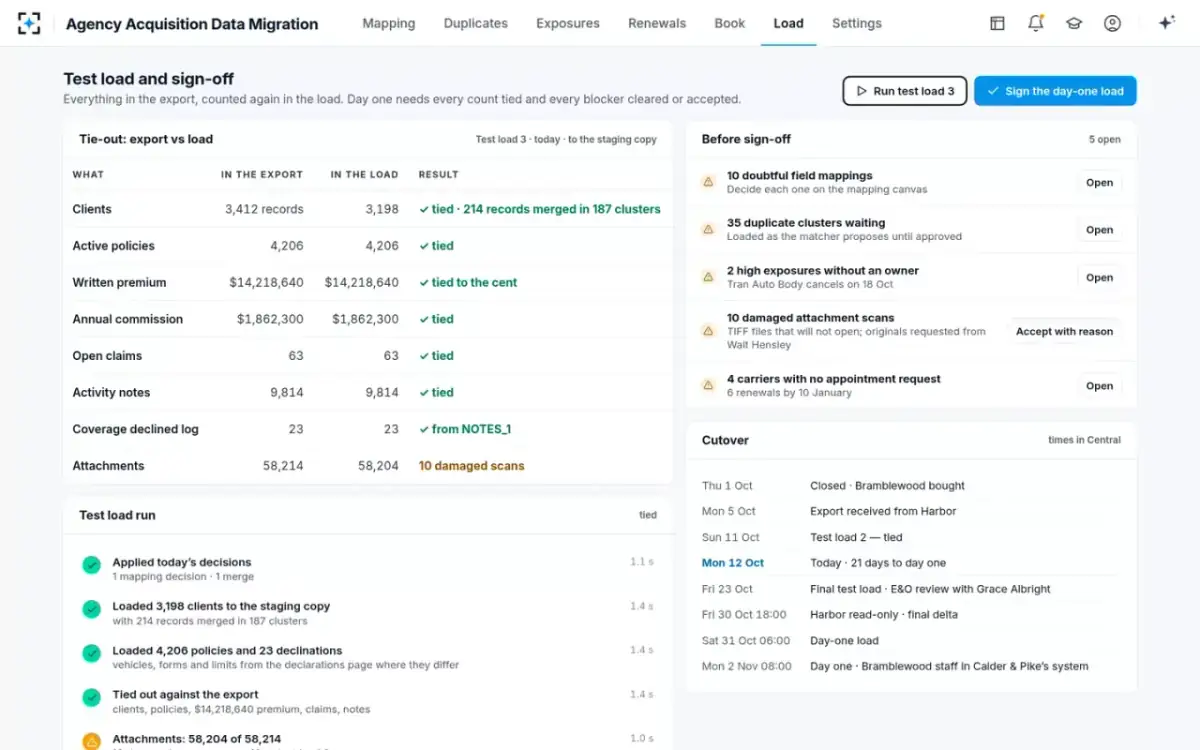
A practical rule is to count decision load rather than deals. In the sample acquisition, the open items before sign-off were ten doubtful field mappings, 35 duplicate clusters waiting for approval, two high exposures without an owner, ten damaged attachment scans and four carriers with no appointment request. A manager can carry several integrations at that level of open decisions; the same manager cannot carry one where the whole field map is still a spreadsheet.
What goes wrong in agency integrations, and where the manager sees it first
Agency integrations fail in a few recurring ways, and almost all of them are visible in the data before day one if someone looks. The manager's tie-out is the place to look: the seller's export counted again in the load, client by client, policy by policy, premium to the cent.
Five ways agency integrations go wrong, and the signal that shows each early
- Codes translated by guess
A status, carrier or line code mapped to the most common meaning. Signal: doubtful mappings closed without a recorded rule.
- Duplicate clients merged too eagerly, or not at all
Two insureds with different tax IDs collapsed into one, or one insured left as three records. Signal: merges approved without the evidence, or a cluster queue that never shrinks.
- Policies that disagree with their declarations pages
A vehicle, location or limit endorsed on paper and missing from the system. Signal: the count of policy-to-declarations differences, by kind.
- Inherited exposures nobody owns
A coverage declined by phone with no signed form, a quote never bound. Signal: high exposures without an owner on the tie-out.
- Renewals that land without an appointment
The buyer cannot write a renewal with a carrier it has no appointment with. Signal: renewals by carrier and week against the buyer's appointment list.
Data security belongs on the manager's list too. The NAIC's Insurance Data Security Model Law expects a licensee to adjust its security programme for "the Licensee's own changing business arrangements, such as mergers and acquisitions, alliances and joint ventures, outsourcing arrangements and changes to Information Systems" (NAIC Model #668, §4). An export of the seller's whole book, sitting with an integration team and a migration vendor, is exactly such a change; the states that adopted the model differ in detail, so the manager's compliance lead checks the buyer's own state law.
The integration manager's view: everything in the export, counted again in the load
What skills does an integration manager need?
An integration manager in an agency deal needs program discipline, enough insurance operations knowledge to judge the data, and the authority to make the team decide. The first is the usual project skill set: a dated plan, a list of open items, and the habit of closing them. The second is what separates an agency integration manager from a generic one: knowing why a renewal and a rewrite differ, why a declarations page outranks a system record, what a carrier appointment is, and why a declination without a signature is a problem.
The third skill is the hardest to hire for. The manager has to stop a load that does not tie out even when the date is close, and has to accept a known risk in writing when stopping would cost more. Agents make the second part easier to do well, because every open item arrives with its evidence and its proposed resolution; they do not make the decision. The pay data are a reminder of who is on the other side of every decision: the median insurance sales agent in agencies and brokerages earned $61,550 in May 2025 (BLS Occupational Outlook Handbook), and the account managers who came with the book carry most of the client relationships the buyer paid for.
Integration managers who come from IT tend to underweight the E&O side; those who come from operations tend to underweight the tie-out. What E&O tail coverage covers and what it will not see is the short course for the first group.
Questions people ask
Is an integration manager the same as a project manager?
No. A project manager runs a plan; an integration manager also owns the decisions that the plan exists to reach and signs the result. In an agency acquisition that means signing the day-one load and accepting, in writing, any risk still open when it runs.
Does an acquisition integration manager need an insurance licence?
Not to run the integration. The NAIC model act requires a licence to sell, solicit or negotiate insurance, and the agency itself needs a designated licensed producer responsible for its compliance. The manager needs that person, and the licensing team, on every decision about producer codes and appointments.
Should the seller's staff be on the integration team?
Yes, for specific decisions. The seller's account managers know what their codes meant and which records are the same client, and their answers settle mappings no export can explain. They keep servicing their clients at the same time, so ask them for decisions, not data entry.
When does the integration manager's job end?
At the earliest, once the day-one load has run and every item accepted at sign-off has been closed. In practice the job ends when the last renewal written under the seller's carrier codes has moved to the buyer's, which in the sample acquisition was a date in the purchase agreement three months after day one.
Do small agency acquisitions need a full-time integration manager?
They need full-time attention for a few weeks, not necessarily a full-time hire per deal. Because nine in ten agency establishments have fewer than ten employees, most acquirers run a standing team that takes deals in sequence, with the manager's seat sized to the number of open decisions, not the number of deals.