The Form 5500 search tool most people mean is the Department of Labor's free EFAST2 Form 5500 Search, which finds an employee benefit plan's annual report by plan name, sponsor name, EIN or filing ID and downloads the filing as a PDF; the same data is published in bulk as monthly datasets. For group life and disability, the page that matters is Schedule A. For each insurance contract it shows the insurer, the persons covered, the contract year, the premium, and the commissions and fees the insurer paid to each agent or broker. A consultant or carrier preparing to quote can read the incumbent's premium and the current broker's pay before the RFP lands. Botminds' Group Benefits Quote Comparison does not search filings; it compares the proposals and certificates once they arrive, and this page shows how the public filing and the comparison fit together.
The market figures below are our own count from the Department of Labor's public Schedule A dataset for form year 2024, downloaded on 27 October 2026; the filing on this page is fictional, and the case examples come from the solution's fictional sample case.
An annotated Schedule A for one insured LTD contract: what each line tells a quoting team
Line 1(a)–(c)
Insurer name, EIN and NAIC company code
Filed valueArdent Mutual Life · NAIC code on file
What it tells youThe incumbent, identified by company, not by brand. One insurance group can file under several companies.
Line 1(e)
Approximate persons covered at the end of the contract year
Filed value612
What it tells youAn estimate by the plan administrator. Compare it with the employer data you were given.
Line 1(f)–(g)
Policy or contract year
Filed value1 Jan 2025 – 31 Dec 2025
What it tells youThe renewal date. A contract year can differ from the plan year.
Line 2(a)–(b)
Total commissions and total fees paid
Filed value$12,060 · $3,170
What it tells youEverything paid by the insurer to agents and brokers on this contract, bonuses included.
Line 3
Each person paid, in descending order
Filed valueLarkspur Benefits Group: $12,060 commission; $3,170 fees, purpose: persistency bonus
What it tells youThe broker of record, and what kind of extra pay it receives.
Line 8
Benefit type boxes
Filed value8f Long-term disability
What it tells youWhich line this contract insures. A box for life (8d) or temporary disability (8e) means another contract to find.
Line 9
Experience-rated contracts: premium, claims, retention
Filed valueBlank
What it tells youIf filled, it shows claims charged and the insurer's retention: the closest a public filing comes to a loss ratio.
Line 10(a)
Premiums paid to the carrier, non-experience-rated
Filed value$96,480
What it tells youThe incumbent's premium for the contract year.
Line 11–12
Did the insurer fail to provide information?
Filed valueNo
What it tells youA "Yes" with a line 12 note tells you what is missing before you rely on the rest.
How do I search Form 5500 filings for one employer?
Search EFAST2 by the employer's EIN if you have it, otherwise by sponsor name. The search "defaults to Plan Name," and "you can search for a specific Form 5500 by Plan Sponsor name, Employer Identification Number (EIN), or Acknowledgement ID (AckID)," the help page says; names match "anything that contains the exact words you entered, in any order," and an asterisk widens a name (EFAST2 Form 5500 Search help).
Filters narrow a broad search: welfare benefit types, participants, business codes, state and zip code, and form year. A filing opens as a ZIP archive containing the PDF, with every schedule attached, and a results list can be exported to CSV. Since 28 March 2023 the search shows "only the latest filing for a plan year," so an amended filing replaces the original in the results.
Three public routes to the same filings, and when to use each
| Route | What you get | Best for |
|---|---|---|
| EFAST2 Form 5500 Search | One filing at a time as a PDF, with all schedules and attachments; results export to CSV | Reading one employer before a quote |
| Form 5500 datasets | Every filing's structured data by form year, one file per schedule, updated around the first of each month | Counting a market, or screening many employers |
| Bulk image service | Filed PDFs in bulk, by request to the Department | Developers automating document downloads |
Welfare plans list their benefits with codes on the main form: 4B for life insurance, 4F for temporary disability, 4H for long-term disability (2025 instructions). A plan showing 4B and 4H will usually attach separate Schedules A for its life and LTD contracts, unless one contract covers both.
Which plans file a Form 5500, and which do not?
ERISA welfare plans file a Form 5500 unless an exemption applies, and the exemption that matters here is size. An unfunded or fully insured welfare plan "which covers fewer than 100 participants at the beginning of the plan year" is not required to file an annual report (29 CFR 2520.104-20). Any plan that does file must attach a Schedule A "if any benefits under the plan are provided by an insurance company" (2025 instructions).
So the search tool works for the cases that are marketed by RFP and not for most small groups. In our count of 2024 filings, the median contract insuring long-term disability alone covered 190 people; the middle half covered between 97 and 522. Governmental plans, and church plans that have not elected in, are outside this part of ERISA altogether (29 U.S.C. § 1003(b)) and will not appear.
What does Schedule A show, line by line?
Schedule A shows one insurance contract per schedule: who insures it, how many people it covers, its contract year, what was paid to agents and brokers, which benefits it provides, and, for welfare contracts, the premium. Experience-rated contracts also show claims and the insurer's retention, which is the most valuable line a quoting carrier can find in a public document.
The instructions are precise about what line 2 includes: every fee and commission attributable, directly or indirectly, to the contract, counting any payment, cash or not, whose eligibility or amount depends on the value of the business placed, which brings persistency and profitability bonuses in (2025 instructions). The instructions' exact words, and how they sit beside the other disclosure rules, are set out on their own page.
Experience-rated contracts are a minority. Of the 14,439 Schedule A contracts insuring long-term disability alone in our count, 1,326 reported experience-rated premium on line 9, about 9%; the rest reported a single premium on line 10(a). For those, the filing gives the price but not the claims.
Can you see broker commissions on Form 5500?
Yes: line 2 gives the totals and line 3 names each agent, broker or other person paid, largest first, with sales and base commissions separated from fees, and the purpose of each fee. What the filing does not show is what an employer pays a consultant directly, outside the insurance contract; that is not a payment by the insurer and is not a Schedule A line.
Across the market, broker pay falls steeply with case size. Among contracts insuring long-term disability alone that paid any broker compensation, the median was 15.0% of premium for contracts with $10,000 to $100,000 of premium and 2.8% for contracts over $2 million. The share paying no broker compensation at all rose with size, from 4.2% to 14.0%.
Median broker pay on LTD-only contracts falls from 15.0% of premium to 2.8% as cases grow
Read one filing against that curve. A $96,480 contract paying $15,230 of broker compensation, as in the fictional Schedule A above, sits close to the median for its size; the same 15.8% on a $600,000 contract, about $95,000, would be nearly three times the median for that size. Either way, the number is a fact to know before you quote, not a judgement on the broker: who must disclose broker pay, to whom, and where the rules stop is covered on its own page.
Is Form 5500 public, and how current is it?
It is public by design. Schedule A carries the legend "This Form is Open to Public Inspection," and the instructions warn filers that "The Schedule A and its attachments are open to public inspection, and the contents are public information and are subject to publication on the Internet" (2025 instructions).
It is not current. A filing is due "by the last day of the 7th calendar month after the end of the plan" year, with one extension of up to 2½ months, so a calendar-year plan's 2025 report can arrive as late as 15 October 2026. A consultant marketing a 1 January 2027 renewal in September is reading the 2024 contract year, or the 2025 year if the employer filed early. A filing also follows the insurer's contract year, which the instructions allow to differ from the plan year.
What our count of 2024 filings says about the LTD market
The filings also show who writes the business. In our count, ten insurance companies, counted by NAIC company code, accounted for 90.8% of the premium on contracts insuring long-term disability alone; five accounted for 68.1%; 158 companies reported any. Because two companies in one insurance group count separately, concentration by group is higher still.
Ten insurers wrote nine-tenths of the premium on LTD-only contracts in 2024 filings
Premium on 14,439 LTD-only Schedule A contracts, 2024
- Five largest insurers · 68.1%
- Next five · 22.7%
- Other 148 insurers · 9.2%
Group life alone, 10,898 contracts
- Five largest · 76%
- Next five · 14.2%
- Other 298 · 9.8%
For a consultant that concentration has a practical edge. Most cases are marketed to the same handful of carriers, so their certificates are worth knowing well, and a carrier's specimen certificate can change between forms. In the sample case the certificate that ended benefits at 60% of indexed earnings was form TL-GLTD-C 07/24; the employer's current certificate was a 2021 form.
How do I find an employer's group life carrier?
Find the employer's welfare plan in the search tool, open the filing, and read each Schedule A whose line 8 box d, life insurance, is checked: line 1(a) names the carrier and line 1(c) gives its NAIC code. If the employer has several welfare plans, each has its own plan number; a filing whose main form lists code 4B is the one to open.
If nothing comes back, the plan may be under 100 participants, a government or church plan, or filed under a different sponsor name such as a parent company. The EIN search is the reliable route, and the help page notes that it does not matter whether the EIN is entered with a hyphen.
Turning one filing into a pre-quote note
Read the filing for five things and write them down before the RFP arrives. Each gives the comparison a baseline that does not depend on what the incumbent chooses to say in its renewal.
Five things to take from an incumbent's Schedule A before quoting
- The incumbent and its contract year
Line 1: company, NAIC code and policy year. The renewal date is the end of the contract year.
- The premium, and the persons covered
Line 10(a) or 9(a), divided by line 1(e), gives a rough annual premium per person to compare with the renewal.
- Broker pay and its shape
Lines 2 and 3: commissions against fees, bonus fees named in line 3(d), and who is paid.
- Claims, if experience-rated
Line 9(b) claims charged against line 9(a) premium: the nearest public figure to a loss ratio.
- Anything the insurer did not provide
Lines 11 and 12. In our count, 3.2% of LTD-only contracts answered yes.
Then check the filing against the renewal. In the sample case the incumbent's current annual premium for life, AD&D, STD and LTD was $869,850 and its renewal $966,187, +11.1%, guaranteed for one year. The filing for the contract year just ended shows what was actually paid, which is the right baseline for "against today."
Today's premium in Group Benefits Quote Comparison: the baseline for every proposal
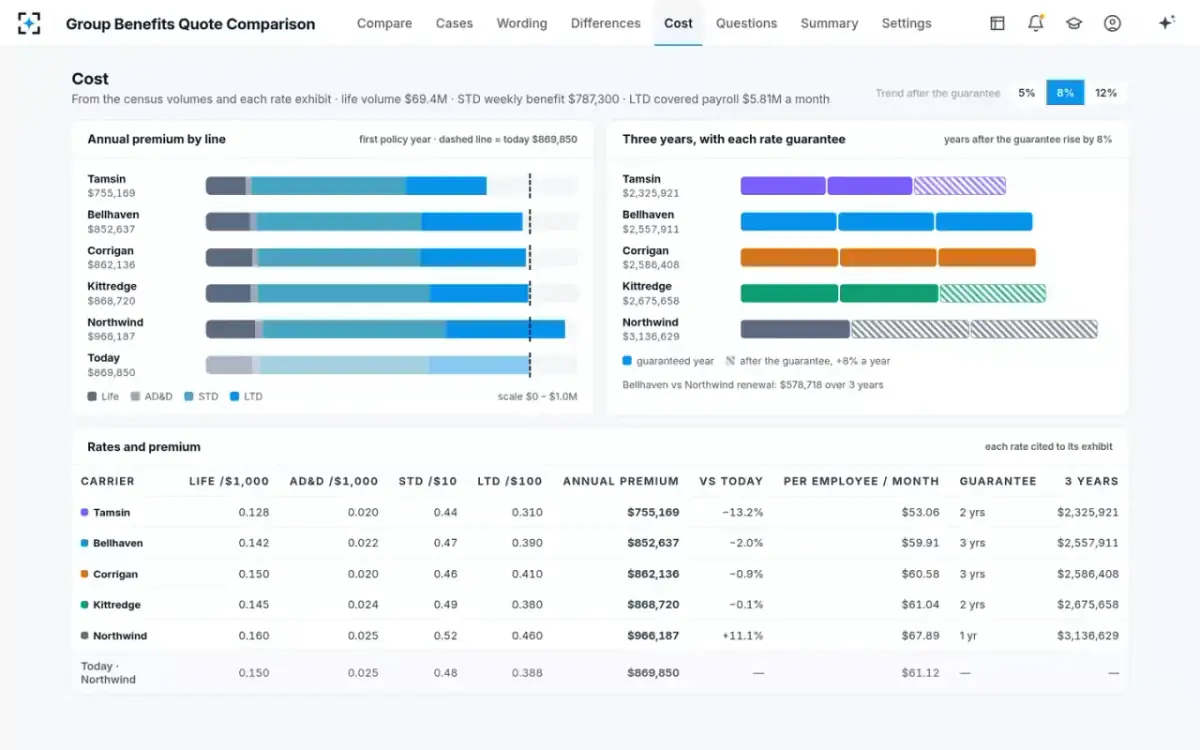
Where the filing ends and Group Benefits Quote Comparison begins
The filing ends at price and pay. It does not show the plan design, the definitions of disability, the limitations or the takeover terms; for that, a quoting team needs the incumbent's certificate and the competing proposals. That is where Group Benefits Quote Comparison begins: agents read every proposal, rate exhibit and certificate, line them up against today's plan, and show each difference with its page, while the consultant decides.
What the filing cannot show: twenty-one documents from five carriers
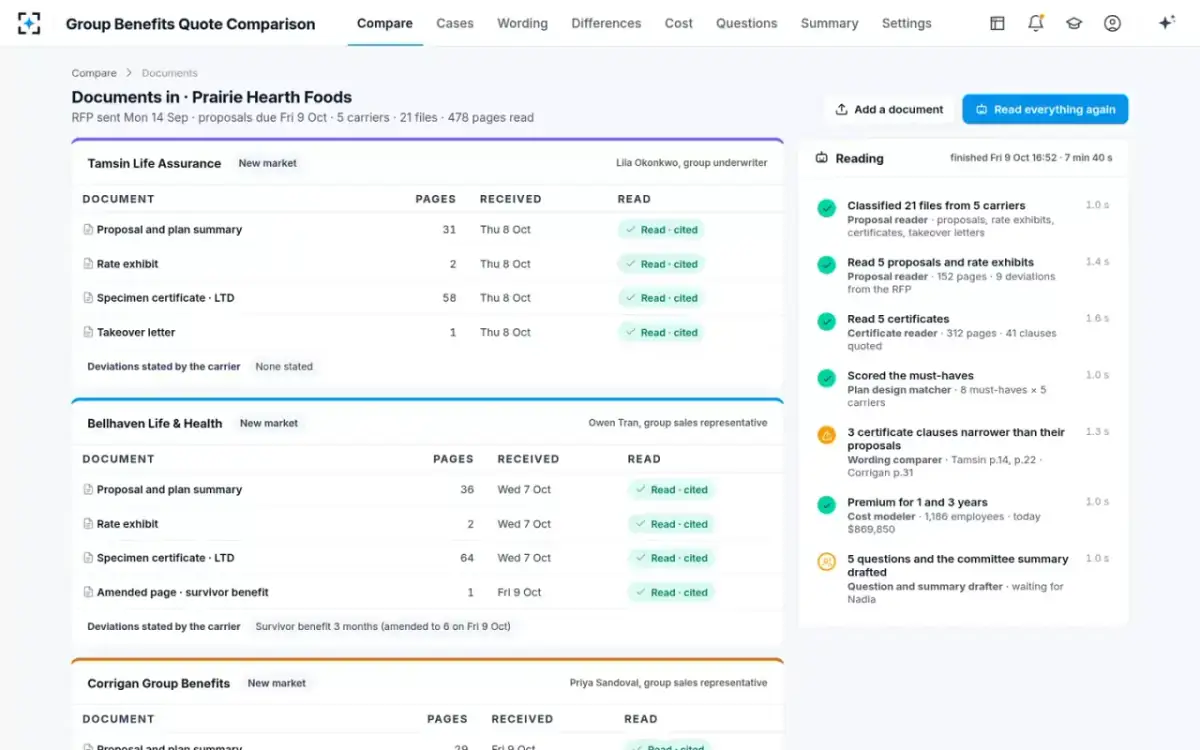
For a carrier, the two together are a quoting plan: the filing for the incumbent's price, broker and contract year; the certificate for what the price buys. For a consultant, they are a check: the incumbent's renewal against what was actually paid, and every competing certificate against today's. When in the renewal season each of those steps falls is mapped on its own page, and the full case is on Group Benefits Quote Comparison.
Questions people ask
Is the DOL Form 5500 search free?
Yes. EFAST2's Form 5500 Search and the Form 5500 datasets are published by the Department of Labor at no charge; a results list can be exported to CSV and each filing downloads as a ZIP archive with its PDF.
What does Schedule A show for group life insurance?
The insurer and its NAIC code, the contract number, the approximate persons covered, the contract year, total commissions and fees with each person paid, the benefit type boxes, and the premium. Experience-rated contracts also show claims and the insurer's retention.
Why can't I find a company's Form 5500?
The plan may have fewer than 100 participants and be fully insured, which generally exempts it from filing; it may be a government or church plan; or it may file under a parent company's name or a different plan name. Searching by EIN avoids most name problems.
How far behind is Form 5500 data?
A calendar-year plan's report is due by 31 July of the following year, or 15 October with an extension, and the datasets are refreshed around the first of each month. During an autumn renewal season the latest complete year is usually one to two years old.
Does Form 5500 show what an employer pays its broker in fees?
Only payments by the insurer that relate to the contract. A fee the employer pays a consultant directly is not on Schedule A; Schedule C covers some service-provider compensation for large plans, under its own rules.
Can a carrier use the Schedule A premium to price a quote?
It can use it as context: the incumbent's premium and persons covered, and claims if the contract is experience-rated. The plan design and certificate wording behind the premium are not in the filing, so a quote still needs the RFP's data and the current certificate.