Broker compensation disclosure requirements for an employer's insured group life and disability plans come from three places, and the best-known federal rule is not one of them. The 2021 federal disclosure for brokers and consultants, ERISA section 408(b)(2)(B), applies to group health plans, which the Department of Labor reads to include dental and vision, and the older federal disclosure rule covers pension plans. For a plan that insures only life and disability, the main federal disclosure is the line on the insurer's Schedule A to the plan's Form 5500 that reports every commission and fee paid to agents and brokers, filed after the plan year, and only by plans with 100 or more participants. State insurance rules add a third layer: New York, for example, requires producers to explain their role and how they are paid at or before the application. Botminds' Group Benefits Quote Comparison is built for the brokers and consultants who market those plans, so this guide sets the rules out side by side.
Market figures are our own count from the Department of Labor's public Schedule A dataset for form year 2024, downloaded on 27 October 2026. Examples come from the solution's fictional sample case. This is a guide to the rules, not legal advice for a particular plan.
Where broker compensation is disclosed, by kind of plan
| Plan | Before the contract | After the plan year | On request |
|---|---|---|---|
| Group health, dental or vision (any size) | ERISA 408(b)(2)(B): written disclosure of services and direct and indirect compensation "reasonably in advance" of the contract, its extension or renewal | Schedule A, if 100+ participants and insured | State producer rules, such as New York's |
| Insured group life and disability only, 100+ participants | No federal broker disclosure rule; state producer rules apply | Schedule A lines 2 and 3: every commission and fee the insurer paid, by person | State producer rules; the plan's annual report on request |
| Insured group life and disability only, under 100 participants | No federal broker disclosure rule; state producer rules apply | Usually none: fully insured small welfare plans are exempt from filing | State producer rules |
| Pension plans | 29 CFR 2550.408b-2(c) disclosure to the responsible plan fiduciary | Schedule A and Schedule C | Under the same regulation |
Do brokers have to disclose compensation?
It depends on the plan and the state. For group health plans, yes: since 27 December 2021, a broker or consultant expecting $1,000 or more must disclose its services and its direct and indirect compensation in writing to the plan fiduciary before the contract is entered into, extended or renewed. For insured life and disability plans, no federal rule requires that disclosure up front; the insurer reports the compensation after the year on Schedule A, and state insurance law decides what the producer must tell the employer at the sale.
The health rule's scope is set by one definition: "The term 'covered plan' means a group health plan as defined in section 1191b(a)" of the statute (29 U.S.C. § 1108(b)(2)(B)(ii)(I)(aa)). The Department of Labor read it to include limited-scope dental and vision plans, which "are 'covered plans' subject to the requirements of ERISA section 408(b)(2)(B)" (DOL FAB 2021-03, Q3). The pension rule, for its part, defines its covered plan as "an 'employee pension benefit plan' or a 'pension plan'" (29 CFR 2550.408b-2(c)(1)(ii)). A plan that only insures life and disability is neither.
Does the CAA broker disclosure apply to life insurance?
Not to a plan that provides only life and disability benefits. The Consolidated Appropriations Act, 2021 added the disclosure to ERISA for group health plans, and Congress amended it again on 3 February 2026 (Public Law 119-75), which rewrote the brokerage category as "Services (including brokerage services)" and added that disclosures follow "regulations issued by the Secretary addressing time, manner, and content of such disclosures" (29 U.S.C. § 1108, statutory notes). The covered plan is still a group health plan.
The list of services in the statute shows where the line sits. Brokerage is covered when provided "with respect to selection of insurance products (including vision and dental), recordkeeping services, medical management vendor, benefits administration (including vision and dental), stop-loss insurance, pharmacy benefit management services" and similar health services. Group life and long-term disability are not on it.
One grey area deserves a sentence in any engagement letter. Many employers wrap several benefits into one ERISA plan. Whether a broker's work on the life and disability lines of a wrapped plan is work for a "covered plan" is not answered in the Department's bulletin, and a cautious broker discloses compensation for every line placed under such a plan.
What is Schedule A commission disclosure?
Schedule A commission disclosure is the insurer's report, attached to the plan's Form 5500, of everything it paid agents, brokers and others in connection with the contract. Line 2 gives "the total of all insurance fees and commissions directly or indirectly attributable to the contract or policy placed with or retained by the plan," and line 3 lists each person paid "in descending order of the amount paid," separating sales and base commissions from fees and giving each fee's purpose (2025 Form 5500 instructions).
What Schedule A lines 2 and 3 must include, in the instructions' own words
Counts as compensation
"sales and base commissions and all other monetary and non-monetary forms of compensation where the broker's agent's, or other person's eligibility for the payment or the amount of the payment is based, in whole or in part, on the value (e.g., policy amounts, premiums) of contracts or policies ... including, for example, persistency and profitability bonuses."
Element (b), commissions
"monetary amounts paid by an insurer that are charged directly to the contract or policy and that are paid to a licensed agent or broker for the sale or placement of the contract or policy."
Element (c), fees
"payments by an insurer attributable directly or indirectly to a contract or policy to agents, brokers, and other persons for items other than sales and/or base commissions (e.g., service fees, consulting fees, finders fees, profitability and persistency bonuses, awards, prizes, and non-monetary forms of compensation)."
Not reportable
Occasional non-monetary gifts "valued at less than $50," with "the aggregate value of gifts from one source in a calendar year" under $100, and insurer payments for administrative services where "there is no direct or indirect charge to the plan."
Two limits make Schedule A a weaker disclosure than its detail suggests. It arrives late: the Form 5500 is due seven months after the plan year ends, extendable by 2½ months, so the employer learns what the broker was paid well after the renewal it was paid for. And small fully insured welfare plans, under 100 participants at the start of the plan year, are generally exempt from filing (29 CFR 2520.104-20). How to find and read one employer's Schedule A is covered on its own page.
How are benefits brokers paid on group life and disability?
Mostly by the insurer, as a commission built into the premium, with fees on top that the Schedule A instructions class separately: service fees, bonuses and similar payments. In our count of 2024 filings, among contracts insuring long-term disability alone that paid any broker compensation, the median was 15.0% of premium for contracts with $10,000 to $100,000 of premium, falling to 2.8% for contracts over $2 million.
The mix shifts with size as well as the level. On small contracts, fees were about a fifth of broker pay; on the largest, over two-fifths, and 41.9% of the largest contracts paid fees and no commission at all. A broker's pay on a large case looks less like a percentage commission and more like a negotiated fee, even when the insurer pays it.
As LTD contracts grow, more of the broker's pay is fees rather than commission
$10,000–$100,000 of premium · 8,136 contracts
- Commissions · 78.4%
- Fees · 21.6%
$100,000–$500,000 · 2,629
- Commissions · 76%
- Fees · 24%
$500,000–$2 million · 935
- Commissions · 68.8%
- Fees · 31.2%
Over $2 million · 461
- Commissions · 57%
- Fees · 43%
The Department of Labor has noticed the same blurring of labels. In its 2021 bulletin on the health rule it wrote:
"Historically, consultants tended to work on a fee-for-service basis, and brokers worked for commissions. However, many brokers now work on a fee-for-service basis, and many consultants work for commissions."
U.S. Department of Labor, Field Assistance Bulletin 2021-03 (30 December 2021), in a footnote on brokers and consultants
What are bonus commissions, and where do they show up?
Bonus commissions are payments an insurer makes to a broker on top of base commission, tied to the volume, growth, persistency or profitability of the broker's business with that insurer. On Schedule A they are not hidden: the instructions name "persistency and profitability bonuses" as compensation to report, and as fees in element (c), "awards, prizes, and non-monetary forms of compensation" alongside them.
What Schedule A cannot show is the incentive. A bonus that depends on the broker's whole book with one insurer is allocated across contracts by "any reasonable method," so one employer's share can look small while the incentive to keep business with that insurer is large. That is why New York's rule, below, requires producers to tell purchasers that compensation "may vary depending on a number of factors, including ... the volume of business the producer provides to the insurer or the profitability of the insurance contracts."
Can an employer ask what its broker earns?
Yes, and in some states the producer must answer. New York's Regulation 194 is the most detailed example. At or before the application, a producer must tell the purchaser its role in the sale, "whether the insurance producer will receive compensation from the selling insurer or other third party based in whole or in part on the insurance contract the producer sells," that compensation may vary, and that the purchaser may ask for more (11 NYCRR 30.3(a)). A group policyholder is a purchaser under the rule (11 NYCRR 30.2(b)).
If the purchaser asks before the contract is issued, the producer must disclose in writing "the nature, amount and source of any compensation" and "a description of any alternative quotes presented by the producer, including the coverage, premium and compensation that the insurance producer ... would have received based in whole or in part on the sale of any such alternative coverage" (11 NYCRR 30.3(b)). The rule does not apply to renewals, except that a request made less than 30 days before or after a renewal must be answered in writing within five business days (11 NYCRR 30.5(e)).
That alternative-quotes clause is the one a quote comparison should be ready for. An employer in New York that asks can learn what its broker would have earned on each proposal the broker presented, so the comparison the committee saw and the compensation behind each column should be kept together.
Questions a benefits committee can ask before it decides
A benefits committee does not need to wait for a Form 5500 to understand how its broker is paid on each proposal. The questions below are ones any employer can ask, whatever its state; the rules above decide which ones a broker must answer.
Six compensation questions for the committee's marketing review
- What will you be paid on each proposal you presented?
Commission rate or amount by line and carrier, the same basis New York lets a purchaser request for alternative quotes.
- Do any of these carriers pay you bonuses, and on what basis?
Volume, growth, persistency or profitability with that insurer, across your whole book.
- Is compensation built into the rates, and is it the same in every proposal?
A lower premium can reflect a lower commission assumption, not a better price.
- Do we also pay you a fee directly?
Fees paid by the employer do not appear on Schedule A.
- What did the insurer report on our last Schedule A?
Lines 2 and 3 of the plan's most recent filing, if the plan files.
- Who signs the recommendation, and who checks it?
A recommendation that a second person co-signs is easier to defend.
Where Group Benefits Quote Comparison fits, and where it does not
The solution compares what carriers propose: rates and premium, plan design, deviations, and the certificate wording, each with its page. It does not compute or disclose a broker's compensation, and it does not decide what a broker must disclose; that is for the practice and its counsel under the rules above. What it does is keep the comparison the committee saw, every question sent to a carrier, and the signed summary together, with every number traced to its source, which is what a request for alternative-quote information needs.
The committee summary in Group Benefits Quote Comparison: every number traced, signed and co-signed
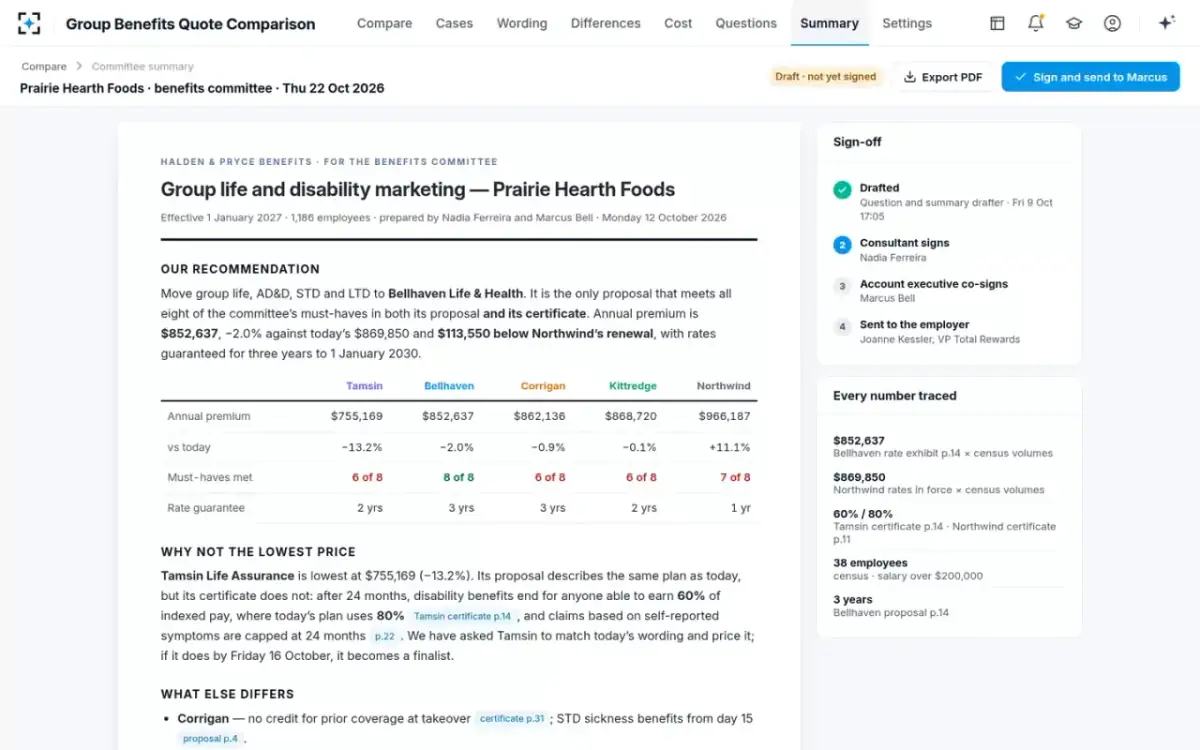
If commission levels differ between proposals, that difference is inside the premium the solution compares. A consultant who wants it visible can ask each carrier to state the commission assumed in its rates, and the drafted questions, each citing its page and sent only on the consultant's approval, are where that request goes.
Questions to carriers, drafted with their pages and held for the consultant's approval

What to ask any vendor of AI tools for benefits brokers, including about client data, is set out as ten questions, and the full case is on Group Benefits Quote Comparison.
Questions people ask
What is the CAA broker compensation disclosure?
It is ERISA section 408(b)(2)(B), added by the Consolidated Appropriations Act, 2021: brokers and consultants to group health plans who expect $1,000 or more must disclose their services and direct and indirect compensation in writing, reasonably in advance of the contract, its extension or renewal. It applied from 27 December 2021 and was amended in February 2026.
Does the CAA disclosure apply to small group health plans?
Yes. The Department of Labor said the rule "applies to group health plans regardless of size," including small plans that are exempt from filing a Form 5500. It does not reach plans that provide only life and disability benefits.
Is there a broker compensation disclosure template?
The Department of Labor declined to issue one for the health rule, saying it was "not feasible" to give a model form for every compensation structure. A disclosure should state services, direct and indirect compensation, how it is paid and any compensation on termination, as the statute lists.
Where can I see what a broker was paid on a group life plan?
On Schedule A lines 2 and 3 of the plan's Form 5500, if the plan has 100 or more participants and files. The filings are public through the Department of Labor's Form 5500 search and datasets.
Are persistency bonuses disclosed?
Yes, on Schedule A: the instructions name "persistency and profitability bonuses" among the compensation to report, as fees in line 3 element (c) with their purpose.
Does New York require brokers to disclose commissions on group insurance?
New York's Regulation 194 requires producers to disclose their role and whether they are paid by the insurer at or before the application, and the amount and source of compensation, including on alternative quotes, if the purchaser asks. A group policyholder counts as a purchaser.