A benefits comparison spreadsheet lines up each carrier's proposal for an employer's group plans as a column, with today's plan beside them: rates and premium by line, plan design provision by provision, the rate guarantee, the carrier's stated deviations, and the definitions and limitations that decide whether a claim is paid. It is the document a benefits committee decides from, so its errors become the employer's errors. The weak point is not the template but the habit of one person keying five proposals and then checking their own keying. Botminds' Group Benefits Quote Comparison is built on the opposite rule: one agent keys the proposals, another reads the certificates and checks the keyed summary against them, and the consultant, who keyed nothing, signs.
The examples below use a fictional sample case as it runs through the solution: Prairie Hearth Foods, 1,186 employees, marketing group life, AD&D, short-term and long-term disability for 1 January 2027 to five carriers. The research on spreadsheet errors is academic and linked where it is used.
Maker, checker, signer: who keys, who checks, who decides in Group Benefits Quote Comparison
Agent
Proposal readerKeys each proposal and rate exhibit: plan design, rates, rate guarantee and deviations from the requested design, every value with its page.
Never: fill a value the proposal does not state
Agent
Certificate readerReads the specimen certificates: definitions, limitations, exclusions, offsets and takeover terms, quoted word for word with form number and page.
Never: paraphrase wording, or read a summary twice in place of a missing certificate
Agent
Wording comparerChecks the keyed summary against the certificate and today's plan, clause by clause, and marks each narrower, broader or the same, with both passages.
Never: decide what is material; that comes from the practice's settings
Agent
Plan design matcherScores every carrier on the committee's must-haves and ranks them: must-haves met, then annual premium.
Never: waive a must-have the committee set
A person decides
Benefits consultantReads the differences, approves each question to a carrier and signs the committee summary with a reason.
A person decides
Account executiveCo-signs before the employer sees the summary.
What should a benefits comparison include?
A benefits comparison should include, for every line and every carrier, the price, the plan design and the wording that governs a claim, each with the page it came from. Most templates stop at the first two. The third is where carriers differ most, because two proposals can quote the same benefit percentage, maximum and elimination period and still pay different claims.
The rows a group life and disability comparison needs, and where each value is found
| Row | What it holds | Where to find it |
|---|---|---|
| Rates and premium | Rate by line per unit (life per $1,000, STD per $10 of weekly benefit, LTD per $100 of covered payroll), volume, annual premium, change against today | Rate exhibit; the employer's data for volumes |
| Rate guarantee | Years, and any condition attached | Rate exhibit or proposal letter |
| Plan design | Benefit percentage, maximum, elimination period, own-occupation period, benefit duration | Proposal and plan summary |
| Deviations | Anything the carrier quoted differently from the RFP | Proposal; often a single paragraph |
| Definitions | Disability, gainful occupation, indexed pre-disability earnings, any occupation | Specimen certificate, definitions section |
| Limitations and exclusions | Mental and nervous, substance use, self-reported symptoms, pre-existing conditions | Specimen certificate |
| Takeover terms | Credit for prior coverage, actively-at-work rule, who covers employees on leave | Certificate and takeover letter |
| Today's plan | The same rows for the incumbent | Current certificate, not the renewal summary |
The source column is not decoration. A summary plan description must set out the circumstances in which benefits can be denied, lost, reduced, offset or recovered (29 CFR 2520.102-3(l)), and those circumstances are written in the certificate, not in a proposal summary. The Supreme Court has also held that the information in a summary plan description is not itself part of the plan's terms (CIGNA Corp. v. Amara, 2011). A comparison built on summaries compares the carriers' marketing, not their contracts.
Why one person cannot check their own spreadsheet
One person cannot reliably check their own keying, because people find a minority of the errors they make and are confident about the rest. That is the consistent finding of spreadsheet research, which has measured both how often people make errors and how often inspectors catch them.
What spreadsheet research has measured
3.9%
average cell error rate across 14 laboratory studies of 967 people building spreadsheets alone
60%
average share of planted errors found by inspectors, across nine experiments with over 1,000 participants
94%
of spreadsheets examined in 85 intensive inspections contained errors
The per-cell rate sounds small until it meets a large sheet, and the catch rate is worse than it sounds. In inspection experiments detection depends on the kind of error; of fourteen errors in one study Panko cites, "three had detection rates below 10%, and half had detection rates below 40%" (Panko, 2015). Even the simplest errors in that study were caught by fewer than 60% of the participants, and no participant found them all.
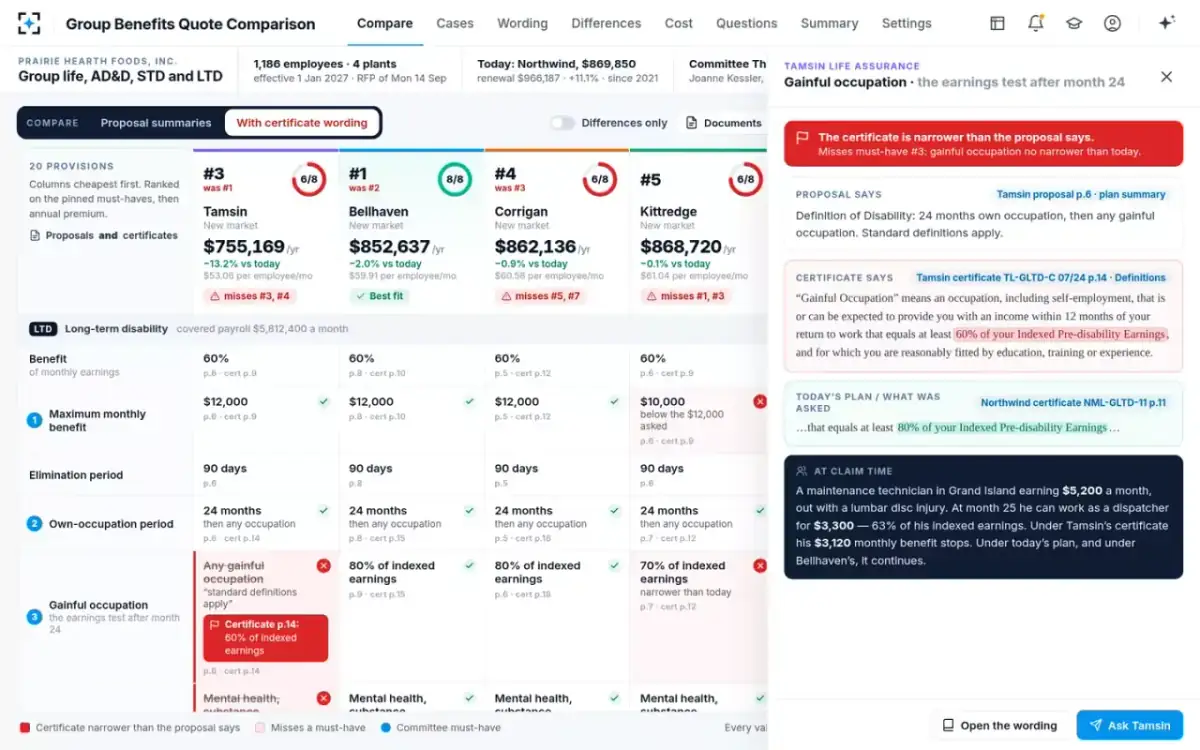
A benefits comparison is a hard case for inspection. Twenty long-term disability provisions for five carriers is a hundred keyed values before life, AD&D and short-term disability are added, and the errors that matter are often omissions, which the same research calls "especially dangerous because their detection rate tends to be very low": a proposal that says "standard definitions apply" leaves out the definition, and the person who keyed "standard" has no reason to look for what is missing. In the sample case, that one phrase hid an earnings test of 60% where the employer's current plan uses 80%.
How do brokers compare group insurance quotes today?
Most brokers compare group quotes by keying each proposal's summary into a workbook, one carrier per column, then reading certificates where time allows. The product team's estimate for a five-carrier life and disability case is about 15.5 hours by hand: five hours keying rates, designs and deviations, four reading certificates against the summaries, two scoring must-haves, an hour and a half on cost and three on questions and the summary.
The order of that work is the problem, more than its length. Keying comes first and takes the time; certificate reading comes last and gets what is left. A comparison built in that order ranks carriers on their summaries and then, if anyone finds the narrower wording, has to unwind the ranking a few days before the committee.
The same grid on proposal summaries alone: the cheapest carrier meets every must-have
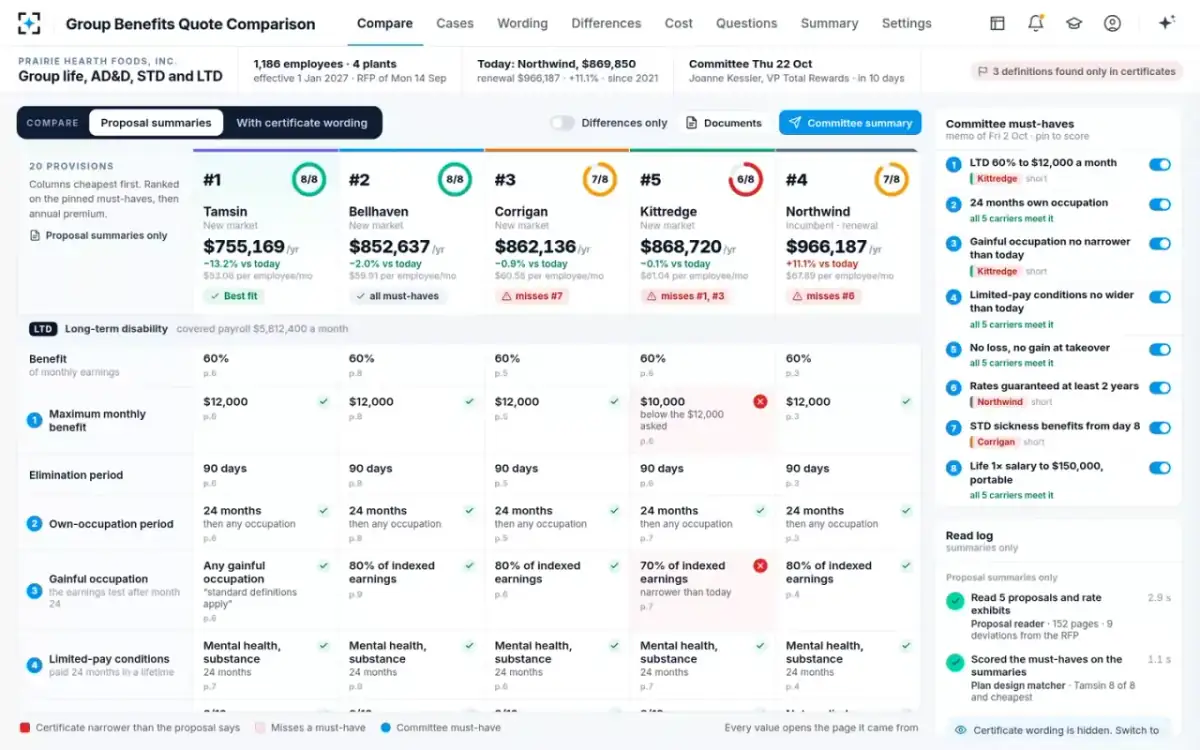
The maker-checker split in Group Benefits Quote Comparison, value by value
A maker-checker split means the person or agent that enters a value never confirms it. In the solution, the proposal reader keys every value with its page, and a different agent, the wording comparer, checks each value that a certificate also states against the certificate's own words and against today's plan. Where the two disagree, the cell is flagged; the comparer does not decide which is right or whether it matters.
One person's workbook against a split between keying, checking and signing
One person keys and checks: The consultant or an analyst keys five proposals; each value is typed from memory of a page.
Group Benefits Quote Comparison: The proposal reader keys each value with its page; a value the proposal does not state stays empty.
One person keys and checks: Read if time allows, usually for the carrier the consultant expects to recommend.
Group Benefits Quote Comparison: Every certificate is read; each definition is quoted word for word with form number and page.
One person keys and checks: The same person re-reads their own sheet.
Group Benefits Quote Comparison: The wording comparer checks the keyed summary against the certificate and today's plan and shows both passages.
One person keys and checks: Decided cell by cell, often unconsciously, by what gets highlighted.
Group Benefits Quote Comparison: Set by the practice once: any definition narrower than today counts as material.
One person keys and checks: Re-sorted by hand when something changes.
Group Benefits Quote Comparison: Re-scored on the pinned must-haves whenever a value changes.
One person keys and checks: The author sends it.
Group Benefits Quote Comparison: The consultant signs with a reason; the account executive co-signs.
The split matters most where the two readers see different documents. In the sample case, the switch from summaries to certificate wording moved Tamsin from first to third, because its certificate defines gainful occupation at "60% of your Indexed Pre-disability Earnings" (certificate page 14) and limits disabilities based on self-reported symptoms to 24 months (page 22), and moved Corrigan down because its certificate applies its pre-existing condition limitation to employees insured under the prior plan. Three of the twelve material differences in the case were found only in certificate wording.
One cell opened: what the proposal says, what the certificate says, and today's plan
How do you check a benefits spreadsheet for errors?
Check a benefits spreadsheet in two ways: recompute every derived number from its inputs, and re-read every keyed value against its source page. The first catches arithmetic and transposition; the second catches what the keying left out. Neither works if the checker is the person who keyed it.
The recomputation is quick when each rate carries its unit. Take the incumbent's renewal in the sample case. Life: $69.4 million of volume at $0.160 per $1,000 a month is $133,248 a year. AD&D: the same volume at $0.025 is $20,820. Short-term disability: $787,300 of weekly benefit at $0.52 per $10 is $491,275. Long-term disability: $5,812,400 of monthly covered payroll at $0.460 per $100 is $320,844. Together they reproduce the renewal's $966,187 to within a dollar of rounding.
Recomputing one carrier's premium from its rate exhibit: four lines, four units
| Line | Volume | Rate and unit | Monthly | Annual |
|---|---|---|---|---|
| Life | $69.4 million of insurance | $0.160 per $1,000 | $11,104 | $133,248 |
| AD&D | $69.4 million of insurance | $0.025 per $1,000 | $1,735 | $20,820 |
| STD | $787,300 of weekly benefit | $0.52 per $10 | $40,940 | $491,275 |
| LTD | $5,812,400 of covered payroll | $0.460 per $100 | $26,737 | $320,844 |
| Total | $80,516 | $966,187 |
The second check, re-reading, is where the split earns its keep. Panko's work suggests an inspector finds roughly six errors in ten. A second reading of the same proposal gives a second chance at those errors, but only a reading of the certificate can show what the proposal left out. That is why the solution's checker reads the certificate rather than re-reading the proposal.
Eight checks for a benefits comparison spreadsheet
- Every derived number recomputes
Premium = volume × rate × 12, line by line, against each exhibit.
- Every rate has a unit
Per $1,000, per $10 of weekly benefit, per $100 of covered payroll; a rate without a unit cannot be checked.
- Every value has a page
A cell that cannot be traced is an opinion.
- "Standard" is never a value
Replace it with the certificate's wording, or mark it missing and ask for the certificate.
- Today's plan is checked from its certificate
The incumbent's renewal summary is a summary too.
- Deviations are rows, not footnotes
Corrigan's STD sickness benefit from day 15 instead of day 8 is a plan design change.
- The checker did not key
Assign the second reading to someone, or something, that saw the source fresh.
- The signer reads the differences, not the grid
Twelve ranked differences are reviewable; four hundred cells are not.
What is a plan design comparison, and where does it end?
A plan design comparison sets the carriers' benefit structures side by side: percentage, maximum, elimination period, own-occupation period, benefit duration, the life multiple and its cap. It ends where the definitions begin. Two carriers can both show "24 months own occupation, then any occupation" and mean different things by "any occupation": in the sample case, Tamsin's certificate measures it "as it is performed in the national economy," while today's plan counts occupations "available within 50 miles of your residence."
That is why the solution's grid has a switch between "Proposal summaries" and "With certificate wording," and why the practice's settings treat any definition narrower than today's plan as material and flag certificate wording the proposal does not mention, even where a must-have is met. The twelve differences most worth looking for in a long-term disability certificate are laid out as a test on their own page.
Is there a template for comparing benefit quotes?
Any template with the eight row groups above will do, provided each value cell has a source cell beside it and today's plan is a column. The template is the easy part. What makes a comparison trustworthy is the discipline around it: a value is never typed without its page, the checker reads a different document from the maker, and the person who signs reads the ranked differences rather than the whole grid.
For property and casualty quotes the rows are different, with limits, deductibles and endorsements; Botminds' Insurance Quote Comparison guides cover that in an insurance quote comparison spreadsheet for commercial lines. In the sample case, the two rows that decided the recommendation were the gainful occupation definition and the takeover terms.
Where the agents fit, and where they stop
The agents do the keying, the certificate reading, the checking and the arithmetic. They do not decide what matters for an employer, what to ask a carrier, or what to recommend: the practice sets what counts as material, the committee sets the must-haves, and the consultant approves every question and signs the summary. Nothing reaches a carrier or an employer without a person's approval.
Nor does the solution replace the workbook every consultant keeps. The grid, the differences and the cost model carry a page for every value, so they can be checked or exported, and how the comparison works alongside an existing workbook and agency system is set out on its own page. To see the case from the first proposal to the signed summary, start from Group Benefits Quote Comparison.
Questions people ask
What columns should a benefits comparison chart have?
One column per carrier with today's plan first, and beside each value a source: the proposal page, the certificate page or the rate exhibit. A chart without sources cannot be checked, and a chart without today's plan cannot say whether a proposal is narrower or broader.
How many errors does a typical spreadsheet contain?
Research summarised by Raymond Panko of the University of Hawai'i puts the average cell error rate in laboratory studies at 3.9%, and found errors in 94% of the spreadsheets examined in 85 intensive inspections. The per-cell rate is low; the chance that a sheet with hundreds of keyed values has no error at all is not.
Should a benefits comparison include the certificate wording?
Yes, for every line where definitions decide claims, which in group life and disability means at least long-term disability. In the sample case three of twelve material differences appeared only in certificate wording, including a gainful occupation definition at 60% of indexed earnings where the summary said "standard definitions apply."
Who should check a benefits comparison spreadsheet?
Someone who did not key it, reading the source documents rather than the sheet. In a small practice that may be the account executive; in the solution it is an agent that reads the certificates while another keys the proposals, with the consultant and the account executive signing.
Can a comparison spreadsheet show cost over the rate guarantee?
It should. Show the first year and three years, holding each carrier's rates through its guarantee and applying a stated trend after it. In the sample case a three-year guarantee made a carrier 2.0% below today in year one and $578,718 cheaper over three years than the incumbent's one-year renewal.
Is a benefits comparison the same as a plan design comparison?
A plan design comparison is part of it: the benefit structures side by side. A full comparison adds the rates and guarantee, the deviations, the certificate definitions and limitations, and the takeover terms, each against today's plan.