AI for employee benefits, in a brokerage, mostly means software that reads documents and drafts: it turns carrier proposals, rate exhibits and certificates into a comparison, answers questions about a case from its documents, and drafts the questions and summaries a consultant would otherwise write. The value is real where the reading is careful, and the risk is real where it is not, because a missed definition in a long-term disability certificate is paid for by an employee at claim time. The test of any tool is not how fluent it sounds but whether it reads certificates as well as proposals, shows the page behind every value, keeps one employer's data away from another's, and leaves the recommendation and the signature with the consultant. Botminds' Group Benefits Quote Comparison is built to those rules; the ten questions below are the ones we would ask any vendor, ourselves included.
The examples come from the solution's fictional sample case, a five-carrier group life and disability marketing for a manufacturer called Prairie Hearth Foods. Rules and frameworks are linked where they are used.
Ten questions for any AI vendor, with the answer to listen for and the warning sign
Answer to listen for: Every specimen certificate and policy, every page, against the proposal and today's plan.
Warning sign: "It reads the plan summary and rate exhibit." Definitions live in the certificate.
Answer to listen for: One click from any cell to the passage, with form number and page.
Warning sign: Values without sources, or a citation to a whole document.
Answer to listen for: Leaves the value empty and says so; flags a missing certificate.
Warning sign: Fills the usual market wording, or reads the summary again in its place.
Answer to listen for: Today's plan, the RFP's requested design, and the other carriers.
Warning sign: Only the carriers against each other: narrower than what?
Answer to listen for: The practice, in versioned settings; the software applies them.
Warning sign: The model decides what to highlight, case by case.
Answer to listen for: No question to a carrier and no summary to an employer goes without sign-off.
Warning sign: Auto-send, or "it emails the carrier for you."
Answer to listen for: On our own closed cases, with known differences planted, counting misses and false alarms.
Warning sign: A single accuracy percentage from documents we have never seen.
Answer to listen for: Written terms on storage, access, retention, separation between clients and model training.
Warning sign: Vague answers about "the cloud" or training on customer documents.
Answer to listen for: Documents kept as received with a fingerprint; every read, edit, approval and send with who and when.
Warning sign: Only the final output survives.
Answer to listen for: The consultant, from scores the committee's must-haves drive; the software drafts only what the scores support.
Warning sign: "The AI picks the best carrier."
How is AI used in employee benefits brokerage today?
In brokerage, AI is used mostly for reading and drafting: extracting rates and plan designs from proposals, comparing definitions across certificates, answering questions about a case from its documents, and drafting carrier questions and committee summaries. It is used much less, and should be used carefully, for decisions: choosing a carrier, deciding what an employee loses, or sending anything to a client unreviewed.
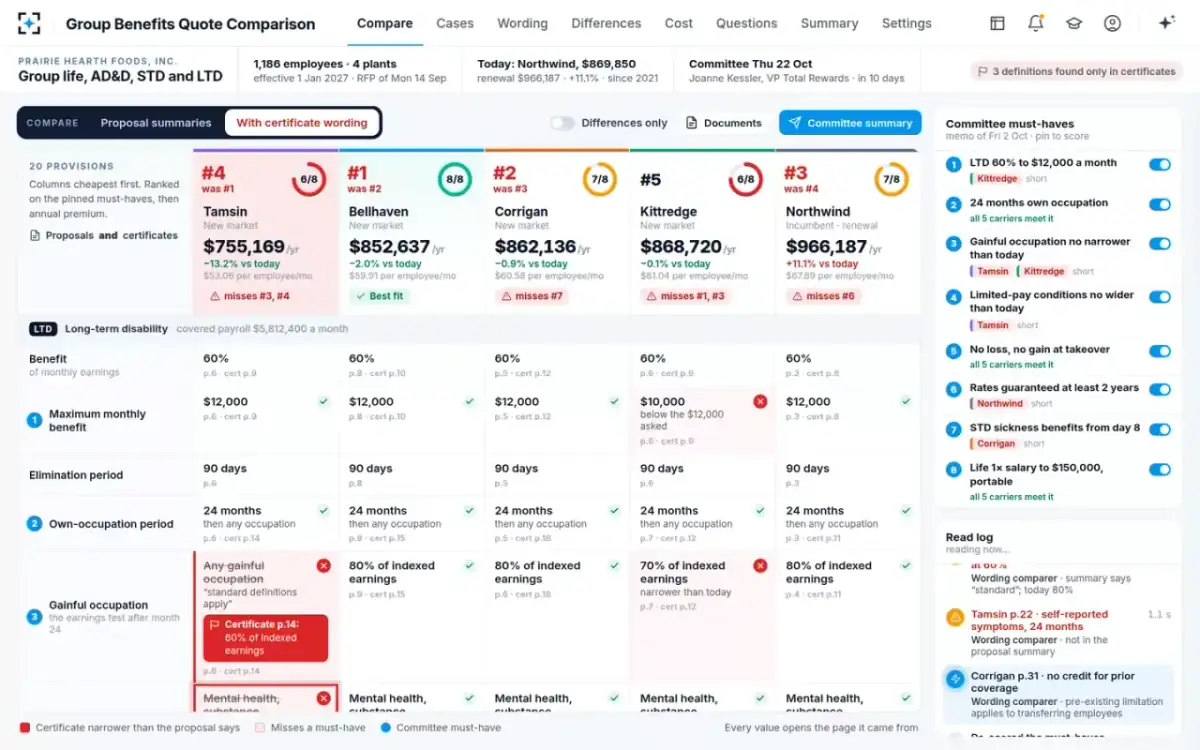
In the sample case the division of labour looks like this. Six agents read the 21 files from five carriers, 478 pages, in 7 minutes 40 seconds; they key every value with its page, quote 41 definitions and limitations word for word, score each carrier on the committee's eight must-haves, model one- and three-year cost, and draft five questions and a committee summary. The consultant reads the twelve ranked differences, approves the questions, and signs; the account executive co-signs; the employer's committee chooses.
Group Benefits Quote Comparison's agents reading the certificates, each finding cited
Can AI compare group insurance proposals reliably?
It can compare them reliably when it reads the certificates and cites what it reads, and only then. A comparison of proposal summaries, however fast, reproduces the summaries' omissions: in the sample case the cheapest proposal described its definitions as "standard," and only the certificate showed an earnings test of 60% of indexed earnings where today's plan uses 80%. With certificate wording, that carrier dropped from first to third.
Reliability has to be shown on your documents. The U.S. National Institute of Standards and Technology's AI Risk Management Framework asks that accuracy be measured on realistic test sets that reflect how the system will actually be used, with the test method written down, and it ties trust to being able to see why an output is what it is: "Transparency is often necessary for actionable redress related to AI system outputs that are incorrect or otherwise lead to negative impacts" (NIST AI 100-1, AI RMF 1.0). A page behind every value is that transparency in a brokerage's terms. For a brokerage, the realistic test set is a closed case the consultant already knows, with differences planted in it; a twelve-trap test for LTD certificates gives a kit and a scoring sheet.
A one-week evaluation of any AI comparison tool, on your own cases
- Pick two closed cases the consultant remembers well
One where the cheapest carrier won, one where it did not.
- Plant known differences in copies of the certificates
An earnings test, a limitation, a takeover term; note each page.
- Run the tool without telling it what was planted
Count catches with page and both passages, misses and false alarms.
- Open ten random cells and check their pages
Every value should open to the words it came from.
- Find the cells the documents leave empty
They should stay empty, or be flagged, not filled.
- Change one must-have and one materiality setting
The ranking should move, and the change should be on the trail.
- Try to send a question to a carrier without approval
It should not be possible.
- Ask for the data terms in writing
Storage, access, retention, separation between clients, and whether your documents train any model.
Is AI safe for employee benefits data?
It can be, but safety is a set of written terms and controls, not a feature. A group life and disability case carries employees' names, ages and salaries, and sometimes health information, for example about employees on disability leave at a change of carrier; whoever processes them is handling plan data that a fiduciary must protect.
Two public sources set the frame. The Department of Labor confirmed in September 2024 that its cybersecurity guidance "generally applies to all employee benefit plans, including health and welfare plans," and pointed fiduciaries to its tips for hiring a service provider with strong cybersecurity practices (EBSA Compliance Assistance Release 2024-01). For insurers and licensed producers, the NAIC's Insurance Data Security Model Law sets out an information security program, oversight of third-party service providers and notice of a cybersecurity event (NAIC Model Law #668); it applies only as each state has enacted it.
Data questions for any AI vendor, and why each one matters to a brokerage
| Ask | Why it matters |
|---|---|
| Where are client documents stored, and in which country? | Employee salaries, ages and medical details are in every case file. |
| How is one employer's data kept from another's, and from other customers? | A brokerage works many employers at once; a mistake crosses clients. |
| Are our documents used to train any model? | A yes, or a vague answer, should be resolved in the contract before any data moves. |
| Who at the vendor can see our documents, and is that logged? | Access you cannot audit is access you cannot explain to a client. |
| How long are documents kept, and how are they deleted? | Retention should follow the brokerage's own schedule, not the vendor's. |
| What is the breach notice commitment? | State insurance data security laws set notice duties; the vendor's promise should support yours. |
Carriers face an additional set of rules that brokers should know about but that are not theirs to meet. The NAIC's members adopted a model bulletin on insurers' use of AI systems on 4 December 2023 (NAIC model bulletin), and states have since adopted it one by one; the state-by-state adoption map tracks where. New York's circular on AI and external data in underwriting and pricing says insurers "should be able to demonstrate that ECDIS do not serve as a proxy for any protected classes" (NY DFS Circular Letter No. 7, 2024). A comparison tool used by a broker does not underwrite or price, but a vendor that cannot explain those rules is unlikely to have thought hard about its own controls.
What should brokers ask an AI vendor about the work itself?
Beyond data, ask how the tool behaves when it is unsure, who owns each decision, and what record it leaves. The best answer to "what happens when the document is silent?" is the dullest one: nothing is filled. The solution's proposal reader "never fills a value the proposal does not state," and its certificate reader flags a missing certificate "instead of reading the summary twice."
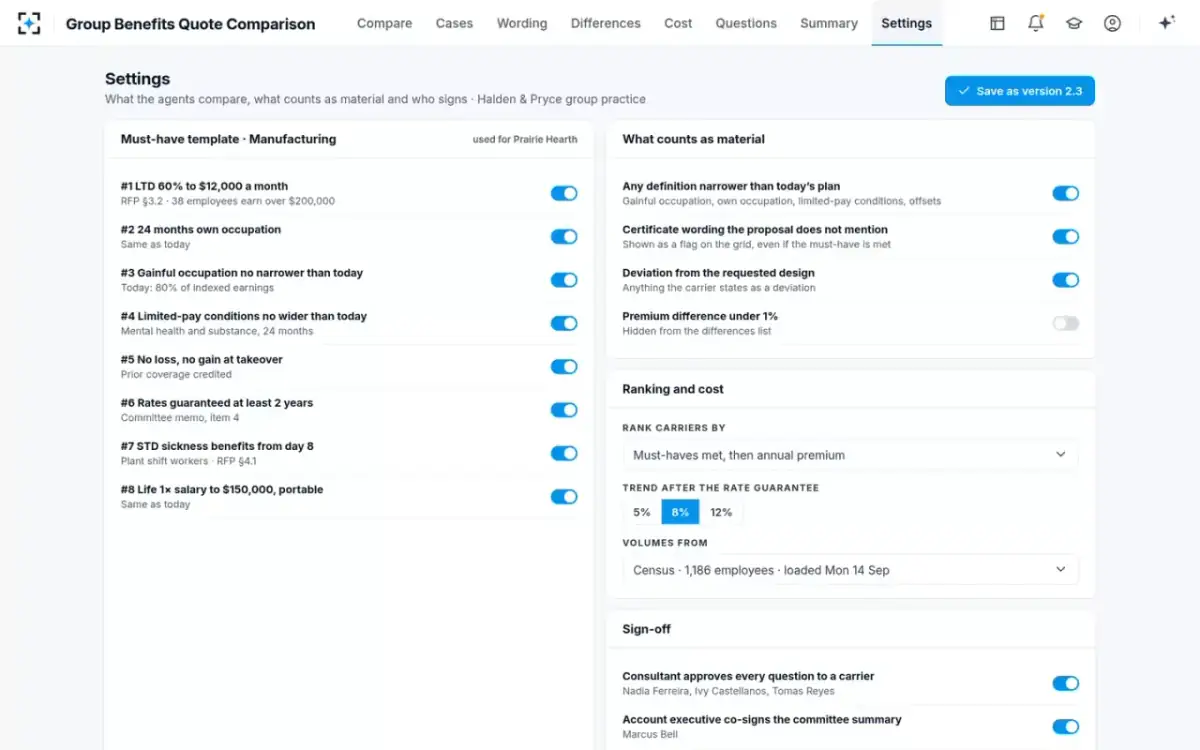
Ask too what the tool will not do. In Group Benefits Quote Comparison, agents never change a carrier's rate, never waive a must-have the committee set, never send anything to a carrier, and recommend only what the scores support. Materiality comes from the practice's settings, which are saved as versions, so a comparison can be read later against the rules in force when it was made.
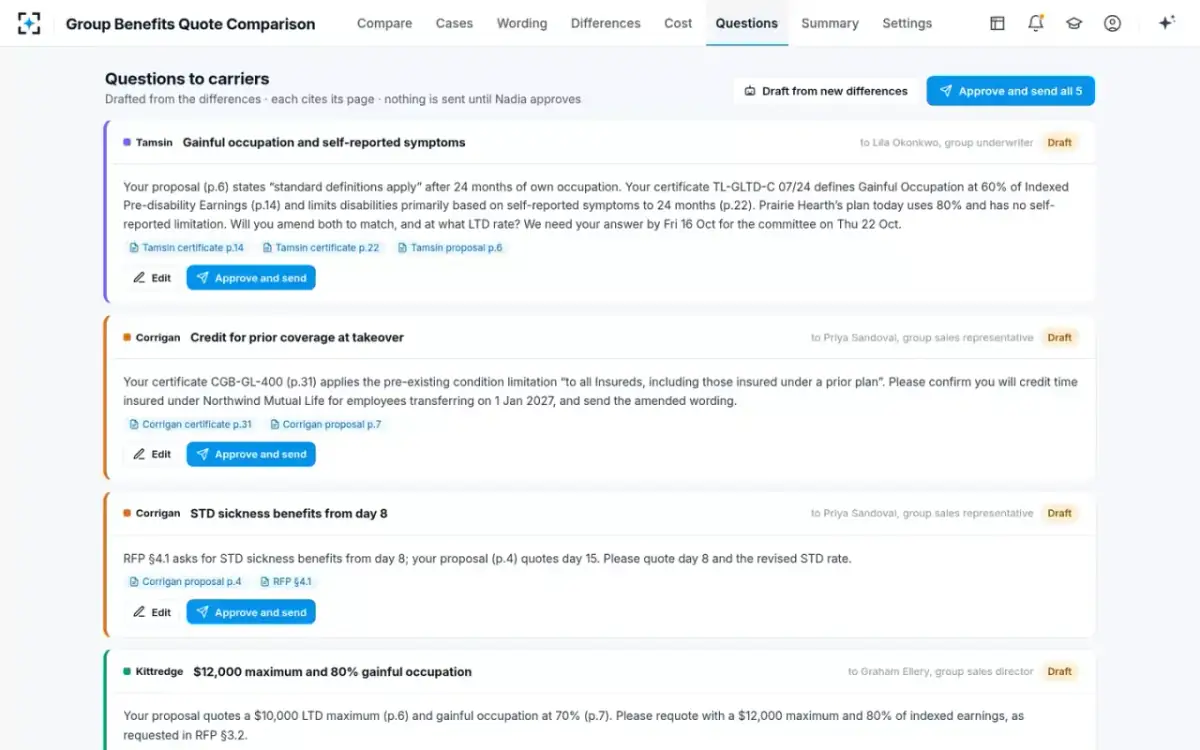
Questions to carriers: drafted with their pages, held until the consultant approves
Will AI replace benefits brokers?
Not the parts of the job that carry responsibility. A broker's value in a marketing case is judgement about what matters for this employer, the relationship with carriers that gets an amendment priced in time, and a signature on a recommendation the committee can rely on. Rules point the same way: New York, for example, requires a producer to describe "the role of the insurance producer in the sale" and how it is paid (11 NYCRR 30.3(a)), duties a person in the sale answers for.
What AI replaces is the keying and much of the first read. By the product team's estimate, a five-carrier life and disability case takes about 15.5 hours by hand, of which nine are keying proposals and reading certificates; with the solution, about 1.7 hours, most of them the consultant's review. The hours move from typing to judging.
How much does AI for benefits brokers cost, and what is it worth?
Prices vary by vendor and are usually quoted per seat, per case or per year; we do not publish a price list here, and a vendor that will not price a pilot on your own cases is telling you something. What a brokerage can work out for itself is the value side, from its own volumes.
A year of value from AI comparison in a group practice, in your own numbers
Hours returned
Marketing cases a year × (hours per case by hand − hours with the tool)
The product team estimates about 15.5 and 1.7 hours for a five-carrier life and disability case; use your own timings.
Practice lead
Season capacity
Extra cases a consultant can carry through the autumn committees
Most January renewals compete for the same weeks; capacity in October is worth more than in March.
Practice lead
Errors avoided
Material differences found in certificates per case × the cost of finding one after the vote
In the sample case, three of twelve differences were in certificate wording only.
Consultant
Tool and set-up cost
Subscription + configuration of templates and settings + the consultant's review time
Ask for a pilot on closed cases before committing.
Operations
The third term is the one most models leave out. A certificate difference found after the committee has voted costs a reopened decision, a difficult call to the employer, or an employee paid less at claim time. What one earnings-test difference is worth to a claimant puts numbers on it, and what a comparison tool should leave in your existing systems covers the integration questions.
How Group Benefits Quote Comparison answers the ten
Six specialist agents read every proposal and certificate and score them on the employer's must-haves; the consultant decides and signs. Every value carries its proposal and certificate page; definitions are quoted, never paraphrased; any definition narrower than today's plan is material by the practice's setting; nothing goes to a carrier unapproved; the committee summary is signed and co-signed; and carrier documents are kept as received with a fingerprint, with every read, edit, approval and send on the activity trail.
The practice's rules, saved as versions: must-haves, materiality, ranking, sign-off
Ask us to run it on one of your closed cases and score it with your own consultant. The full sample case, from the first proposal to the signed summary, is on Group Benefits Quote Comparison.
Questions people ask
What are AI tools for employee benefits used for?
In brokerages, mainly reading carrier documents, comparing proposals and certificates, answering questions from a case's documents, and drafting carrier questions and committee summaries. Employers and administrators also use AI for enrolment and employee questions, which raise their own data and accuracy questions.
Can AI read benefits certificates accurately?
Accuracy has to be measured on your own documents. NIST's AI risk framework asks for accuracy to be measured on test sets that reflect real use; for a brokerage, that means a closed case with known differences planted in its certificates.
Does a broker need client consent to use AI on employee data?
That depends on the brokerage's contracts with the employer and on state privacy and insurance data security law. At a minimum, the employer should know what tools process its employees' data, and the vendor's storage, access and retention terms should be in writing.
Is the NAIC AI bulletin binding on benefits brokers?
The model bulletin is written for insurers' use of AI systems and has effect only where a state adopts it. It does not govern a broker's comparison tool directly; the state-by-state adoption map shows where it applies to insurers.
Should AI recommend the carrier?
No. It can rank carriers on the committee's must-haves and price, show why the cheapest is not first, and draft the summary; the consultant should recommend and sign, and the employer's committee should choose.
How long does it take to start using AI for quote comparison?
Mostly the time to configure the practice's must-have templates, plan grid and summary style, and to test on a sample of past cases. Run the evaluation on closed cases first; a live renewal season is the wrong place to discover what a tool misses.