What to look for in long term disability insurance, for a group plan, is how the certificate decides a claim: the definition of disability and its earnings test, the length of the own-occupation period, the limits on mental health and self-reported conditions, the pre-existing condition rule and whether prior coverage counts at a change of carrier, what counts as pre-disability earnings, the maximum, the benefit duration by age, the offsets, and whether the insurer has discretion. Price and the benefit percentage are the easy rows. The rest decide whether an employee is paid in month 25, and they are written in a certificate that runs to fifty or sixty pages. Botminds' Group Benefits Quote Comparison reads those certificates for brokers and consultants comparing carriers; this page gives a test any comparison method, human or software, can be run against.
The examples come from a fictional sample case as it runs through the solution, Prairie Hearth Foods marketing its group life and disability plans to five carriers; the test kit is our own. Research and rules are linked where they are used.
The most each method can catch in a twelve-trap test, given what it reads
How to test what a comparison catches: plant the differences yourself
The quickest way to judge a comparison method is to give it a case where you already know the answers. Take today's certificate and four competing specimen certificates, plant twelve known differences in copies of them, and count how many each method finds, with the page and both passages. Run the same case through an analyst with a workbook, a quoting tool and any software you are evaluating.
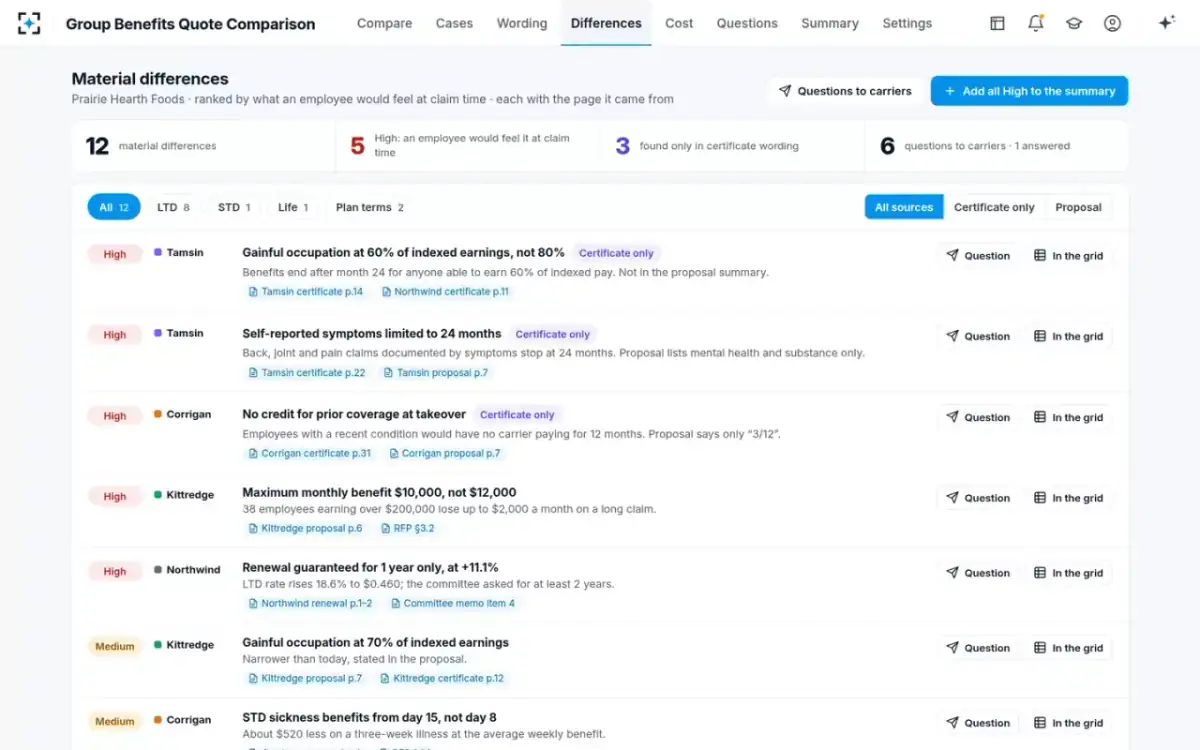
The traps below are chosen because each one changes what an employee is paid and because most can be stated in a way that looks harmless in a summary. Seven are placed in certificate sections a summary need not repeat; in the sample case one carrier's proposal described its post-24-month definition with the words "standard definitions apply," and the certificate behind it defined gainful occupation at 60% of indexed earnings.
Twelve traps to plant in a group LTD certificate, each against today's plan
- 1. Gainful occupation at 60% of indexed earnings, not 80%
Definitions section. After the own-occupation period, a claimant able to earn 60% is no longer disabled.
- 2. Any occupation measured in the national economy
Definitions. Today: occupations available within 50 miles of home.
- 3. Own-occupation period of 12 months, not 24
Plan summary and certificate.
- 4. Maximum monthly benefit of $10,000, not $12,000
Plan summary. Affects everyone earning over $200,000 at a 60% benefit.
- 5. Mental and nervous limit of 12 months, not 24
Plan summary and limitations section.
- 6. A 24-month limit on self-reported symptoms
Limitations section only. Back, joint and pain claims documented by symptoms stop at month 24.
- 7. Pre-existing look-back of 6 months, not 3
Plan summary ("6/12" instead of "3/12") and exclusions.
- 8. No credit for time insured under the prior plan
Exclusions or takeover provision. The limitation applies to transferring employees.
- 9. Pre-disability earnings exclude bonuses and commissions
Definitions. Lowers both the benefit and the earnings test for sales staff.
- 10. Benefit duration reducing from age 60 instead of 62
Plan summary's duration table.
- 11. Family Social Security benefits deducted
Other-income section only. Today deducts the claimant's own benefit.
- 12. A clause giving the insurer discretion to interpret the plan
Claims or general provisions. Changes how a court reviews a denial.
What is the definition of disability in an LTD policy?
An LTD definition of disability usually has two stages: during an own-occupation period, often the first 24 months of benefits, the claimant is disabled if unable to do their own occupation; after it, only if unable to do any gainful occupation they are suited for. Each stage has an earnings test, and the second stage's percentage and geography decide most long claims.
A public example shows the shape. Washington's Health Care Authority describes its state employees' LTD plan with an own-occupation test for the first 24 months, under which a claimant who works but cannot earn more than 80% of indexed pre-disability earnings is partially disabled, and an any-occupation test after that, with the line at 60% (Washington HCA, PEBB long-term disability insurance). Neither number is wrong. What matters in a comparison is whether a proposal moves either one against what employees have today, which is trap 1, and what that move is worth to three claimants is worked through separately.
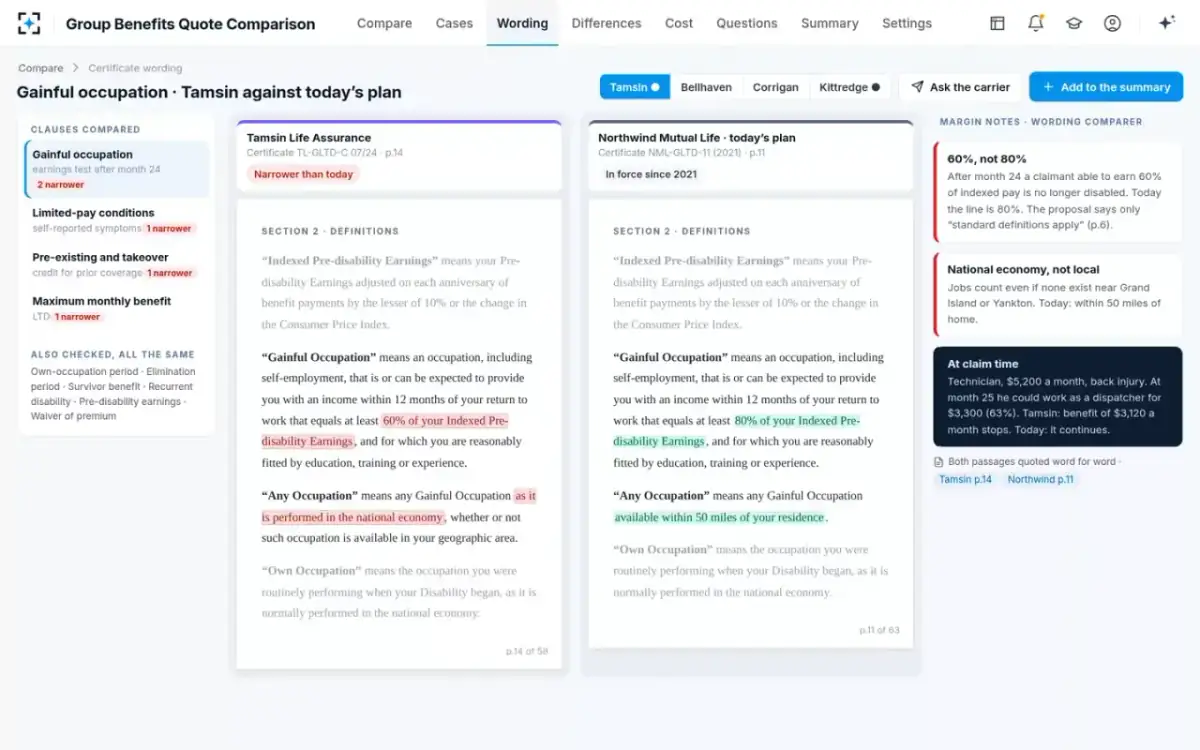
The geography of "any occupation" is the second half of the same definition, and trap 2. In the sample case one certificate counted any gainful occupation "as it is performed in the national economy, whether or not such occupation is available in your geographic area," where today's certificate counted occupations "available within 50 miles of your residence." A dispatcher job that exists nationally but not near Grand Island ends a claim under the first wording and not under the second.
What is the own occupation period, and why the end of it matters so much?
The own-occupation period is the stretch, commonly 24 months of benefits, during which the claimant is measured against their own job. Its end is the most consequential date in a long claim, because that is when the narrower any-occupation test begins.
Actuarial data shows how much happens at that date. The 2015–2024 group LTD termination study by the Society of Actuaries Research Institute and LIMRA, covering eighteen companies and "over 43 million life-months of exposure," found that the end of own-occupation periods moves recoveries more than the industry's 2008 table assumed (SOA Research Institute and LIMRA, September 2026). An earlier SOA report explains why "recovery" overstates what happens: claims that end because the definition changes from own occupation to any occupation are counted as recoveries (SOA, 2016 LTD study report). A 12-month own-occupation period, trap 3, is therefore a priced change, not a drafting choice.
What is a mental and nervous limitation, and the self-reported cousin?
A mental and nervous limitation caps benefits for disabilities caused by mental health conditions; in the sample case every carrier limits mental health and substance use claims to 24 months in a lifetime. It is legal in LTD where it would not be in a medical plan because disability income coverage sits outside the federal health-coverage rules.
Federal rules list disability income coverage among the benefits that are always excepted from those rules (45 CFR 146.145), and the Department of Labor, explaining excepted dental and vision plans, listed among the requirements excepted benefits are outside "the mental health and substance use disorder parity provisions" and "the Affordable Care Act market reforms" (DOL Field Assistance Bulletin 2021-03). So the limit is a contract term to compare, carrier by carrier, which is trap 5. The SOA's experience committee flags how the limit also clouds the statistics: results with internal limits depend on how claim terminations are categorised, "especially important in examining results for Mental & Nervous claims" (SOA, 2016).
Trap 6 is the newer and quieter one: a limit on disabilities primarily based on self-reported symptoms, 24 months in the sample case. It reaches back, joint and pain conditions that are documented mainly by what the claimant reports, and it is the kind of clause a summary leaves out. In the sample case, one carrier's proposal listed only the mental health and substance limits; its certificate, on page 22, added the self-reported symptoms limit.
Twelve material differences in the sample case, ranked by what an employee would feel
What is a pre-existing condition exclusion in LTD, and what happens at takeover?
A pre-existing condition exclusion denies LTD benefits for a disability caused by a condition treated within a look-back period before coverage began, if the disability starts within an exclusion period after it; a "3/12" rule means three months of look-back and twelve months of exclusion. Washington's state employee plan, for example, notes "a 12-month exclusion period and a preexisting condition exclusion" (Washington HCA).
The exclusion is ordinary for a new hire. At a change of carrier it can strand an employee who was covered yesterday, which is why trap 8, no credit for time insured under the prior plan, is the one to look for. The NAIC's Group Coverage Discontinuance and Replacement Model Regulation sets a floor where a state adopts it (NAIC Model 110, 2002 edition): for people covered under the prior plan, benefits for a pre-existing condition under the new carrier's limitation are the lesser of the new plan's benefits without the limitation, or the prior plan's. In the sample case one carrier's certificate applied its limitation to everyone, people transferring from the prior plan included, while its proposal said only "3/12"; what the takeover rules require and what they leave open has its own page.
The five quieter traps: earnings, maximum, age, offsets and discretion
Five more provisions change claims without changing the headline design, and each has a specific place to look.
Where the quieter traps hide, and the question that exposes each
| Trap | Where it is written | What to ask |
|---|---|---|
| 9. Pre-disability earnings | Definitions | Do bonuses, commissions and overtime count, and over what period are they averaged? |
| 4. Maximum monthly benefit | Plan summary | How many employees earn above the salary the maximum implies (the maximum divided by the benefit percentage, times 12)? |
| 10. Benefit duration by age | Duration table | At what age does the schedule start to shorten, and is it the same as today's? |
| 11. Other income offsets | Deductible income section | Are dependants' Social Security benefits deducted, or only the claimant's? |
| 12. Discretionary authority | Claims or general provisions | Does the certificate give the insurer discretion to decide eligibility or construe terms? |
Two of these have a legal edge. Age-based reductions are allowed if cost-justified, and the EEOC's rule gives an LTD example: "With respect to disabilities which occur at age 60 or less, benefits cease at age 65" and "With respect to disabilities which occur after age 60, benefits cease 5 years after disablement" (29 CFR 1625.10). A proposal whose schedule differs from today's is a change in what older employees can expect, which is trap 10.
Discretion, trap 12, changes the court case rather than the claim. Under the Supreme Court's Firestone decision, a court reviews a denial afresh unless the plan expressly gives the administrator discretion to decide eligibility or construe its terms, in which case the court defers (Firestone Tire & Rubber Co. v. Bruch, 1989). That matters more in disability than anywhere else in benefits: the Department of Labor, in its 2016 claims rule, cited a study finding that long-term disability claims "accounted for 64.5% of benefits litigation" in 2006 to 2010 (81 FR 92316). Two certificates with the same benefit and different discretion clauses are not equal.
"Even though fewer private-sector employees participate in disability plans than in group health and other types of plans, disability cases dominate the ERISA litigation landscape today."
U.S. Department of Labor, final rule on disability claims procedures, 81 FR 92316 (19 December 2016)
How to score the test so that a vague answer does not count
Score a catch only when the method names the clause, quotes both passages and gives the page; a cell that says "differs" without the words is a lead, not a catch. Count false alarms as well, because a method that flags everything has caught nothing.
A scoring sheet for the twelve-trap test
| Result | Counts as | Why |
|---|---|---|
| Clause named, both passages quoted, page given | Catch | A reviewer can verify it in a minute. |
| Clause named, no passage or page | Half | Someone still has to find the words before a carrier can be asked. |
| Difference found but marked "same" | Miss | The wrong answer, given confidently, is worse than none. |
| Trap planted, nothing flagged | Miss | The case the test exists for. |
| Flag where nothing was planted | False alarm | Costs review time; three or more suggests the method flags wording, not meaning. |
| Difference found against the RFP, not today's plan | Half | Narrower and broader only mean something against what employees have now. |
The ceilings in the first chart follow from where the traps are planted. A method that reads rate exhibits catches none, because no trap is a rate. One that reads summaries can catch at most five. Reading the certificate's definitions page adds three, the earnings test, the geography and the earnings definition. Only a reading of every certificate page against today's plan can reach twelve, and a real method should then be scored on its misses and false alarms within that ceiling.
How do LTD definitions differ between carriers in a real comparison?
They differ most in the definitions the summaries compress. In the sample case, five carriers quoted the same 60% benefit, 90-day elimination period and 24-month own-occupation period, so on their summaries they looked alike. Their certificates did not: gainful occupation was 80% of indexed earnings in three, 70% in one, and 60% in one; any occupation was national in one and local in today's plan.
One clause in two certificates in Group Benefits Quote Comparison: changed words marked
Why do carriers differ at all? Partly because the design is priced. Research by Autor, Duggan and Gruber on one large insurer's data found that a higher replacement rate and a shorter elimination period each make workers significantly more likely to claim (NBER Working Paper 18172). Definitions move claim costs in the same way, so a cheaper proposal can be cheaper for a reason written in its certificate.
Where Group Benefits Quote Comparison reads for the traps
The solution's certificate reader quotes each definition, limitation, exclusion, offset and takeover provision word for word with form number and page, and its wording comparer aligns the same clause across every certificate, the carrier's own summary and today's plan, marking each narrower, broader or the same with both passages. The practice's settings make any definition narrower than today's plan material, and flag certificate wording the proposal does not mention even where a must-have is met. If a certificate is missing, the agent says so rather than reading the summary twice.
What the agents do not do is decide which trap matters for this employer. That is the consultant's call, made from the ranked differences, and it is why a planted-trap test is worth running on any method, including this one: ask for it to be run on your own past case. Where in a specimen certificate each of these clauses usually sits is annotated on its own page, and the whole case is on Group Benefits Quote Comparison.
Questions people ask
What is an earnings test in LTD?
The share of indexed pre-disability earnings a claimant can earn and still count as disabled. Washington's state employee plan uses 80% during the first 24 months and 60% after; a move from 80% to 60% after month 24 ends benefits for someone able to earn between the two.
How do I compare long term disability insurance quotes?
Compare price and plan design from the proposals, then compare the definitions, limitations and takeover terms from each specimen certificate against today's certificate. In the sample case, the cheapest proposal met all eight of the employer's must-haves on its summary and six on its certificate.
Is group long term disability insurance subject to the mental health parity law?
No. Disability income coverage is an excepted benefit under the federal health-coverage rules, and the Department of Labor lists the mental health parity provisions among the requirements excepted benefits are outside. That is why mental and nervous limits remain common in LTD.
What is a good own occupation period for group LTD?
Twenty-four months is the length in Washington's state employee plan and in all five proposals in the sample case. The right answer is today's period unless the committee decides otherwise, because the 2015–2024 study by the Society of Actuaries Research Institute and LIMRA found that the end of the own-occupation period has a larger effect on claim terminations than the older industry table assumed.
Why does a discretionary clause matter in a disability policy?
Under Firestone, a court reviews a denial afresh unless the plan gives the insurer discretion, in which case the court defers to the insurer unless it abused that discretion. With long-term disability claims making up 64.5% of ERISA benefits litigation in the 2006–2010 study the Department of Labor cited, the clause affects real cases.
Should HR read the whole LTD certificate?
Not every page, but someone should read the schedule of benefits and the definitions, limitations, exclusions, other-income, takeover and claims sections of every competing certificate against today's. Together those sections hold all twelve traps on this page.