A disability earnings test is the line in a long-term disability (LTD) policy that says how much a claimant can earn, or could earn, and still be disabled. It is written as a percentage of indexed pre-disability earnings: under an 80% test, someone able to earn up to 80% of what they earned before, adjusted for inflation, still counts as disabled; under a 60% test the line drops, and anyone able to earn between 60% and 80% loses the benefit. The change rarely shows in a carrier's proposal, because it sits in the certificate's definitions. That is why Botminds built Group Benefits Quote Comparison to read each certificate against today's plan: in its sample case, the cheapest proposal summarised its definition as "standard" and the certificate set the test at 60%.
The claimants on this page are fictional, and their figures are our estimates; the first is taken from the sample case as it runs through the solution, an employer called Prairie Hearth Foods marketing its LTD plan to five carriers. The rules and thresholds are linked where they appear.
Three claimants at month 25, under an 80% test and a 60% test
80% of indexed earnings: Still disabled. The $3,120 monthly benefit continues, reduced only if he actually works.
60% of indexed earnings: No longer disabled. The benefit stops, whether or not he finds the dispatcher job.
80% of indexed earnings: Still disabled. The $4,500 benefit continues.
60% of indexed earnings: No longer disabled. The benefit stops.
80% of indexed earnings: Still disabled. The $2,400 benefit continues.
60% of indexed earnings: Still disabled. The $2,400 benefit continues.
What is an earnings test in disability insurance?
An earnings test in disability insurance converts "can this person work?" into a number: the claimant is disabled if unable to earn more than a stated percentage of indexed pre-disability earnings. It appears in two places in most group LTD certificates, and a comparison has to read both.
The first is the partial disability or loss-of-earnings test during the own-occupation period, typically the first 24 months of benefits: a claimant who works but earns less than the percentage keeps a reduced benefit. The second is the gainful occupation threshold in the any-occupation definition that follows: an occupation counts as "gainful" if it pays at least the percentage, and a claimant able to do a gainful occupation is no longer disabled. Washington's state employee LTD plan shows both in plain words: "unable to earn more than 80 percent of your indexed predisability earnings" for the first 24 months, then "unable to earn more than 60 percent of your indexed predisability earnings in that occupation and in all other occupations for which you are reasonably suited" (Washington Health Care Authority).
The second test is the one this page prices. It measures capacity, not pay: the question after month 24 is whether a suitable job paying the percentage exists, not whether the claimant has taken it.
What does an 80 percent earnings test mean in practice?
An 80 percent earnings test means a claimant stays disabled as long as the best work they can do pays less than 80% of their indexed pre-disability earnings. For someone whose indexed earnings are $5,000 a month, the line is $4,000; at 60% it is $3,000. The band between the two, $1,000 a month of earning capacity in this example, is where the test decides the claim.
Where the line falls for three levels of pre-disability earnings
| Indexed monthly earnings | 80% test: disabled if unable to earn more than | 60% test: disabled if unable to earn more than | The band in between |
|---|---|---|---|
| $4,000 | $3,200 | $2,400 | $2,400 to $3,200 |
| $5,200 | $4,160 | $3,120 | $3,120 to $4,160 |
| $7,500 | $6,000 | $4,500 | $4,500 to $6,000 |
That last point is worth reading twice. With a 60% benefit and a 60% gainful occupation test, the line sits at the benefit amount, exactly so before indexing: a claimant who can earn what the plan pays has no claim. Under an 80% test, the plan keeps paying until earning capacity reaches a third more than the benefit.
Three claimants, two tests: who keeps a benefit after month 24
The test matters only for claimants whose capacity lands in the band, and those are the claimants it matters to entirely. Two of the three fictional claimants below lose their whole benefit under a 60% test; the third is untouched.
Three fictional claimants at the end of the own-occupation period
Today
Earned $5,200 a month; LTD pays $3,120. At month 25 he can work as a dispatcher for $3,300, 63% of indexed earnings.
With agents
Under an 80% test he is still disabled and the benefit continues. Under a 60% test he is not, and it stops.
Still theirs: $37,440 a year of benefit at stake
Today
Earned $7,500 a month; LTD pays $4,500. At month 25 she can do scheduling work paying $4,800, 64% of indexed earnings.
With agents
Same split: disabled at 80%, not disabled at 60%. No Social Security benefit fills the gap, because $4,800 is far above the Social Security work limit.
Still theirs: $54,000 a year of benefit at stake
Today
Earned $4,000 a month; LTD pays $2,400. At month 25 the only suitable work pays $2,200, 55% of indexed earnings.
With agents
Disabled under both tests; the benefit continues either way. The earnings test only matters between 60% and 80%.
Still theirs: Nothing at stake on this clause
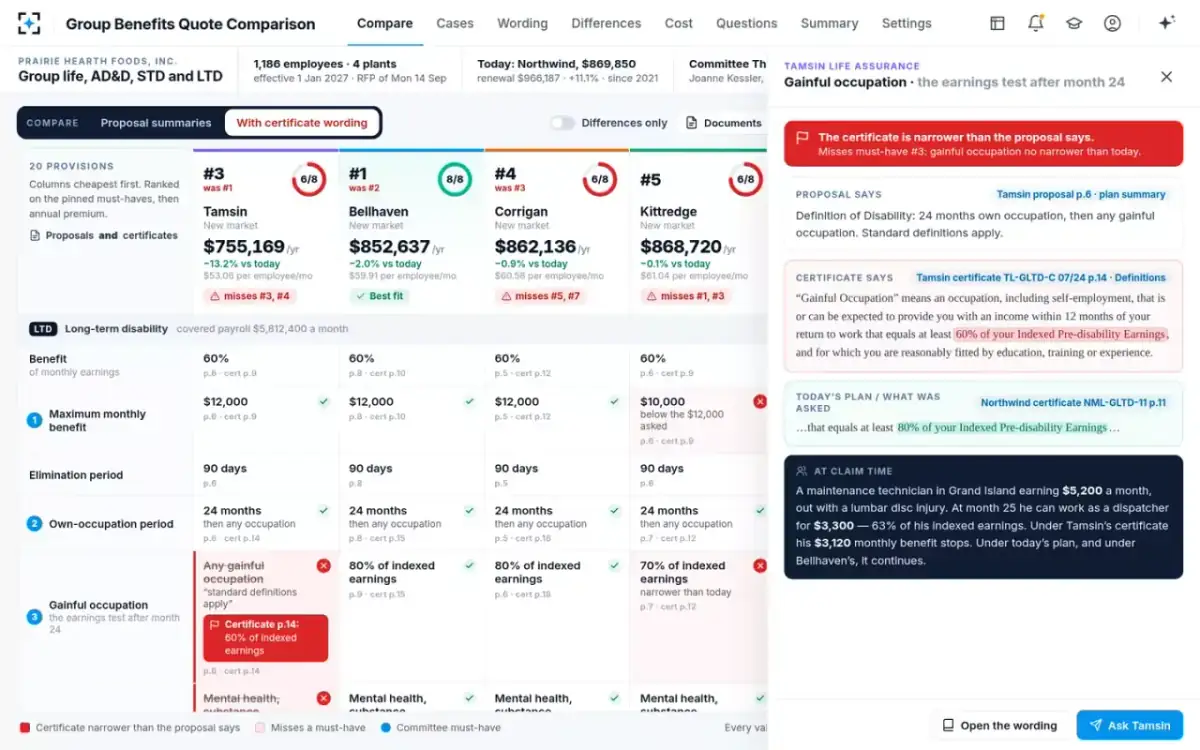
The sample case's technician is the example the solution itself shows the consultant: "A maintenance technician in Grand Island earning $5,200 a month, out with a lumbar disc injury. At month 25 he can work as a dispatcher for $3,300 — 63% of his indexed earnings. Under Tamsin's certificate his $3,120 monthly benefit stops. Under today's plan, and under Bellhaven's, it continues." Every figure in that sentence comes from the certificates and the employer's data; none of it appears in the proposal.
A year of benefit kept, by claimant and test
A year is the smallest unit of loss. An any-occupation benefit can run to age 65 or Social Security normal retirement age for a younger claimant, so for a technician disabled at 45 the 60% test removes not one year of benefit but, potentially, the rest of the claim. We have not multiplied it out, because how long a claim lasts depends on recovery and mortality that no single example can assume.
Why Social Security does not fill the gap
Social Security disability will not replace an LTD benefit lost to a 60% test, because its own test is far stricter. Social Security treats earnings above a monthly amount as substantial gainful activity, and that amount for non-blind people is $1,690 a month in 2026, rising to $1,770 in 2027 (Social Security Administration, substantial gainful activity amounts).
Anyone in the 60–80% band of the examples on this page can earn well above $1,690 a month: the technician's capacity is $3,300, the supervisor's $4,800. Neither would be found disabled by Social Security on those facts, so there is no Social Security benefit to offset and no public income to fall back on. The LTD plan is the only income, and the earnings test decides whether it continues.
The "Social Security earnings test" people also search for is a third rule again. It is the retirement earnings test, which "applies only to people below normal retirement age" and withholds retirement benefits above an exempt amount, $25,560 a year in 2027 for people reaching that age after 2027 (Social Security Administration). It has nothing to say about an LTD claim.
What is indexed pre-disability earnings, and does indexing help?
Indexed pre-disability earnings are the claimant's earnings before the disability, raised each year of the claim by an index so the earnings test keeps pace with wages and prices. The certificates in the sample case raise them "on each anniversary of benefit payments by the lesser of 10% or the change in the Consumer Price Index."
Indexing raises the line in both tests in the same proportion, so it does not change who falls in the band, only where the band sits in dollars. What it does change is the comparison with job offers: a $3,300 job is 63% of $5,238 of indexed earnings but would be 60% of $5,500. Two years of indexing can move a claimant across the 60% line without anything else changing, which is one more reason to read the definition of indexed earnings, not only the percentage, and to keep it the same as today's when a carrier changes.
Can I work part time on long term disability?
Usually yes, within the earnings test. Washington's state employee plan puts it plainly: during the first 24 months "you are considered partially disabled if you are working but unable to earn more than 80 percent of your indexed predisability earnings"; above that line, the claimant is no longer disabled. After the own-occupation period the same logic applies with the any-occupation percentage, 60% in that plan.
How much the benefit is reduced depends on the certificate's formula, which is another clause to compare. A part-time worker whose plan uses a proportional formula keeps a share of the benefit equal to the share of earnings lost; other formulas deduct work earnings above a threshold. The comparison should quote the formula from each certificate rather than summarise it.
What the cheaper test buys the employer, and who pays for it
The cheaper test buys a lower LTD rate, and the price difference is small beside one claim. In the sample case, the proposal with the 60% test quoted LTD at $0.310 per $100 of covered payroll, against $0.390 for the carrier that matched today's 80%. On $5,812,400 of monthly covered payroll, that is $216,221 a year against $272,020: a saving of about $55,800 a year on the LTD line.
Set that beside the claimants. Two claimants in the band, a technician and a supervisor, lose $91,440 of benefit in their first year after month 24. The employer saves premium; the employees in the band lose income. A lower rate for a narrower definition is what the arithmetic of insurance would predict, since a certificate that pays fewer long claims costs less to insure. Part of the difference may come from the same carrier's 24-month self-reported symptoms limit, which the sample proposal also left out, so the saving cannot be attributed to the earnings test alone.
Group Benefits Quote Comparison opens the cell: the proposal says standard, the certificate says 60%
Who pays for the difference also changes what it is worth. Benefits are taxable to the extent they are "attributable to contributions by the employer which were not includible in the gross income of the employee" (26 U.S.C. § 105(a)), while benefits bought with an employee's after-tax premium are generally excluded from income (26 U.S.C. § 104(a)(3)). The $37,440 is gross; its value to the technician depends on who paid for the coverage.
Why do earnings tests differ between carriers?
They differ because definitions are priced, and because carriers draft their own certificates. Actuarial experience shows how much turns on the end of the own-occupation period: the joint 2015–2024 study by the Society of Actuaries Research Institute and LIMRA found that the end of own-occupation periods affects recoveries more than the industry's 2008 table assumed (SOA Research Institute and LIMRA, 2026). The any-occupation test that begins at that point, and its percentage, is where much of that effect lands.
In the sample case the five proposals set the test at 80% in three, 70% in one, which said so in its proposal, and 60% in one, which did not. A 70% test sits between the others: the technician at 63% would keep his benefit; a claimant able to earn 75% would not.
The definition in two certificates, word for word
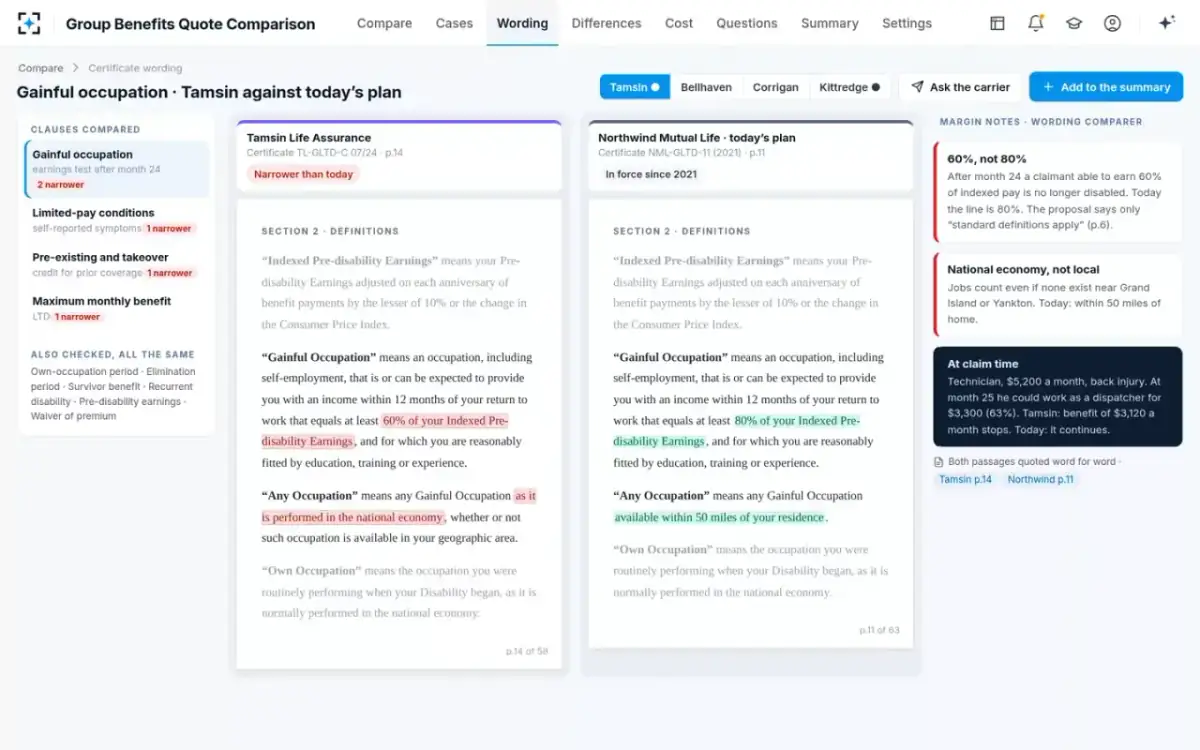
How Group Benefits Quote Comparison puts the earnings test in front of the committee
Put it in front of the committee as a claim, not a percentage. A row reading "gainful occupation 60%" invites a nod; a sentence reading "a technician able to work as a dispatcher at month 25 loses his $3,120 benefit under this carrier and keeps it today" invites a decision. The solution writes that sentence into the committee summary under "Why not the lowest price," with the certificate page beside it.
Then give the committee a way to keep the cheaper carrier if it wants to: ask it to match. In the sample case the drafted question asks the carrier to amend gainful occupation to 80%, drop the self-reported symptoms limit and price both, with an answer date before the committee. If the carrier changes the test anyway after the vote, employees are owed notice: a summary of a material modification is due within 210 days after the end of the plan year in which the change was adopted (29 CFR 2520.104b-3).
The other eleven provisions worth testing in an LTD certificate are set out as a planted-trap test, and when in the renewal season this question has to be asked is mapped by role. The full sample case is on Group Benefits Quote Comparison.
Questions people ask
What is the earnings test in long term disability?
It is the percentage of indexed pre-disability earnings a claimant can earn, or could earn, and still be disabled. Washington's state employee plan uses 80% during the first 24 months of benefits and 60% after, the same two-stage shape as the certificates in the sample case.
Does the earnings test use what I earn or what I could earn?
After the own-occupation period, the certificates in the sample case look at what an occupation "is or can be expected to provide," which is capacity, whether or not you take the job. During partial disability in the own-occupation period, Washington's plan looks at a claimant who is "working but unable to earn more than" the line, which is actual pay.
Is a 60% earnings test legal?
Yes. Earnings tests are contract terms written in the certificate, and Washington's own state employee plan uses 60% after 24 months. What matters in a comparison is whether a proposal moves the test against today's plan without saying so.
How does an earnings test affect benefits when I return to work?
While earnings stay below the test's line, most certificates pay a reduced benefit by a formula in the certificate; once earnings or earning capacity cross the line, benefits end. The formula and the line are both worth comparing between carriers.
What is the Social Security earnings limit for disability in 2026?
For people who are not blind, Social Security treats earnings over $1,690 a month in 2026 as substantial gainful activity; the amount is $1,770 for 2027. It is a dollar line, not a percentage of past pay, so it is much stricter than an LTD earnings test for most workers.
Should a broker flag a change from 80% to 60%?
Yes, as a material difference, and with the certificate page. In the sample case, together with a self-reported symptoms limit, it moved the cheapest carrier from first to third once the certificate was read.