Specimen certificate means a sample copy of a group insurance certificate: the booklet a carrier issues to each covered employee under a group policy, shown before any employee is covered, usually with the employer's details left blank or filled with sample values. It matters because it carries the full wording, the definitions, limitations, exclusions, offsets and claims terms, that a proposal reduces to a few lines or to "standard definitions apply." In a group life and disability RFP, a broker asks each carrier for its specimen certificate so the employer can see what it would be buying. Botminds' Group Benefits Quote Comparison reads every specimen certificate in a marketing case, quotes each clause word for word with its form number and page, and sets it beside the proposal and today's plan.
The certificate annotated below is fictional, written to show where clauses usually sit; page numbers are illustrative. Rules and cases are linked where they appear, and screens show the solution's fictional sample case.
One fictional LTD specimen certificate, section by section: what each holds and what to compare
Cover and certificate holderpp. 1–2
What it holdsPolicyholder, policy number, form number and effective date; the statement that the certificate describes a group policy.
What to compareThe form number and date: a specimen is one version of a form, and carriers revise forms.
Schedule of benefitspp. 3–6
What it holdsBenefit percentage, maximum, elimination period, own-occupation period, benefit duration by age.
What to compareEverything a proposal summary also shows. Check the duration table, which a summary may shorten to a phrase.
Eligibility and effective datespp. 7–9
What it holdsEligible classes, waiting period, actively-at-work rule, when increases take effect.
What to compareWho is covered on the takeover date, and who is not.
Definitionspp. 10–16
What it holdsDisability, own occupation, any occupation, gainful occupation, indexed pre-disability earnings, pre-disability earnings.
What to compareThe earnings test percentage, the geography of any occupation, and what counts as earnings. The section that decides long claims.
Benefits and the partial disability formulapp. 17–21
What it holdsHow the benefit is calculated, work incentives, survivor benefit, recurrent disability, rehabilitation.
What to compareThe formula that reduces a benefit when a claimant works.
Deductible sources of incomepp. 22–24
What it holdsOffsets: Social Security, workers' compensation, state disability, other plans.
What to compareWhether family Social Security benefits are deducted, or only the claimant's.
Limitationspp. 25–27
What it holdsMental and nervous, substance use, self-reported symptoms, special conditions; 24 months each in this certificate.
What to compareAny limit that is not in the proposal summary.
Exclusions, including pre-existing conditionspp. 28–30
What it holdsThe look-back and exclusion periods, and other exclusions.
What to compareWhether the pre-existing limitation applies to employees transferring from the prior plan.
Prior coverage and takeoverp. 31
What it holdsCredit for time insured under the prior plan; coverage for people not actively at work on the effective date.
What to compareCompare with the takeover letter; ask for the letter's promise to be in this section.
Claims, discretion and appealspp. 32–36
What it holdsProof of loss, time limits, the insurer's authority to interpret, appeal steps.
What to compareA clause giving the insurer discretion changes how a court reviews a denial.
Termination, portability and conversionpp. 37–40
What it holdsWhen coverage ends; what an employee can take with them.
What to compareDifferences matter mostly for life; check them for LTD as well.
ERISA informationpp. 41–44
What it holdsPlan administrator, agent for service, rights statement; often appended to make the booklet part of the summary plan description.
What to compareWho the plan administrator is, and whether this booklet is presented as the SPD.
What is a specimen certificate, and why does the word "specimen" matter?
A specimen certificate is the certificate form itself, not one issued to a person. The word tells you two things: the wording is the carrier's standard form, and it is not yet anyone's contract. A carrier quoting a case sends the specimen to show what employees would receive; once the case is sold, the carrier issues certificates on that form, sometimes with amendments negotiated during the sale.
Because it is a form, the form number and date matter. In the solution's sample case the certificate that defined gainful occupation at 60% of indexed earnings was form TL-GLTD-C 07/24, and the employer's current certificate was form NML-GLTD-11 from 2021. Comparing a 2024 specimen with a 2021 in-force certificate is exactly the comparison an employer needs, and exactly the one a proposal summary cannot give.
What is the difference between a certificate and a policy?
The policy is the contract between the insurer and the policyholder, usually the employer or a trust; the certificate is the document given to each covered employee describing the coverage the policy provides. For a long-term disability plan the two are usually written to match, and the certificate is what employees, HR and claims examiners read.
Four documents that describe the same LTD plan, and which one governs what
| Document | Who issues it | Who gets it | What it is for |
|---|---|---|---|
| Group policy | Insurer | Policyholder (the employer or a trust) | The insurance contract |
| Certificate (or booklet) | Insurer | Each covered employee | Describes the coverage the policy provides to that employee |
| Summary plan description | Plan administrator, usually the employer | Each participant, as ERISA requires | Explains the plan "in a manner calculated to be understood by the average plan participant" |
| Proposal summary | Carrier's sales team | Broker and employer during marketing | Sells the plan; not a plan document |
Washington's Health Care Authority shows the everyday version: for its state employee LTD plan, "The following document—called a Plan Booklet—provides in-depth descriptions of the benefits for LTD coverage" (Washington HCA). Booklet, certificate and certificate booklet are used interchangeably; the test is whether the document holds the definitions and limitations in full.
Is the certificate the summary plan description?
Often it is presented as part of one, but the two have different jobs, and the courts treat summaries carefully. An SPD must, among other things, identify "any insurance company ... through which the plan is funded or benefits are provided," and state "circumstances which may result in disqualification, ineligibility, or denial, loss, forfeiture, suspension, offset, reduction, or recovery" of benefits (29 CFR 2520.102-3(q) and (l)). A certificate with an ERISA section added can meet those requirements.
The Supreme Court has drawn the line between a summary and the plan itself. Rejecting an argument that summary plan descriptions are plan terms, it said ERISA "obliges plan administrators to furnish summary plan descriptions, but does not suggest that information about the plan provided by those disclosures is itself part of the plan" (CIGNA Corp. v. Amara, 563 U.S. 421 (2011), syllabus).
"... ERISA §102(a), which obliges plan administrators to furnish summary plan descriptions, but does not suggest that information about the plan provided by those disclosures is itself part of the plan."
CIGNA Corp. v. Amara, 563 U.S. 421 (2011), syllabus
For a broker the lesson runs one way. If even the SPD is not the plan, a proposal summary certainly is not. The document to compare is the one that will govern a claim: the policy, or the certificate written to match it. And participants can see it: on written request the administrator must furnish the plan's "contract, or other instruments under which the plan is established or operated" (29 U.S.C. § 1024(b)(4)), which is how an employee or an incumbent's broker can obtain today's wording for the comparison.
Why ask for a specimen certificate in an RFP?
Ask for it because the definitions that decide long claims are not in the proposal, and because asking late turns a comparison into an argument. In the sample case three of twelve material differences between carriers were found only in certificate wording: a gainful occupation definition at 60% of indexed earnings, a 24-month limit on claims based on self-reported symptoms, and a pre-existing condition limitation applied to employees transferring from the prior plan.
The same clause in a proposal summary and in its specimen certificate
Proposal and plan summary: "Definition of Disability: 24 months own occupation, then any gainful occupation. Standard definitions apply." (proposal p. 6)
Specimen certificate: "'Gainful Occupation' means an occupation, including self-employment, that is or can be expected to provide you with an income within 12 months of your return to work that equals at least 60% of your Indexed Pre-disability Earnings" (certificate p. 14)
Proposal and plan summary: Not stated.
Specimen certificate: Measured "as it is performed in the national economy, whether or not such occupation is available in your geographic area." (p. 14)
Proposal and plan summary: Mental health and substance use, 24 months. (p. 7)
Specimen certificate: Also disabilities primarily based on self-reported symptoms, 24 months. (p. 22)
A practical RFP line: "Include the specimen certificate and policy form for each line quoted, with form numbers, and mark every provision that differs from the incumbent's certificate attached." Carriers will not always mark differences, but asking makes the form number part of the proposal, and an answer that omits the certificate is itself a fact to record in the comparison. In the solution, a missing certificate is flagged as missing; the certificate reader never reads the summary twice in its place.
Where are the LTD limitations in a certificate, and what else to read first?
Limitations usually sit after the benefit and offset sections and before the exclusions, under a heading such as "Limited Benefits" or "Special Conditions." Read four sections first, in this order, because they hold most of what changes a claim: definitions, limitations, exclusions with the pre-existing condition rule, and the prior coverage or takeover section.
Who reads a group LTD certificate, and what each one is looking for
Today
Reads the summaries in the marketing fortnight and the certificate of the likely winner.
With agents
Reads the differences between every certificate and today's, each with both passages.
Still theirs: What to ask and what to recommend
Today
Prices the carrier's standard form; amendments are requested late.
With agents
Gets cited questions about specific clauses while there is time to price them.
Still theirs: Every rate and amendment
Today
See a rate table and the summary.
With agents
See what an employee would lose or keep at claim time, with the page.
Still theirs: The decision
Today
Reads the booklet for the first time when a claim is denied.
With agents
Has the same wording the committee was shown before it chose the carrier.
Still theirs: The right to request the plan documents
Today
Reads the plan terms, and any discretion clause decides how closely.
With agents
The same: the certificate wording, not the summary, is what is reviewed.
Still theirs: The standard of review
What is a discretionary clause, and where is it in the certificate?
A discretionary clause gives the insurer authority to decide eligibility for benefits and to interpret the plan's terms, and it usually sits in the claims or general provisions section near the back. It matters because of how courts review denials: since Firestone, a court looks at a denial afresh unless the plan expressly gives the administrator discretion to decide eligibility or to construe its terms, and with that grant the court applies a deferential standard, asking only whether the decision was an abuse of discretion (Firestone Tire & Rubber Co. v. Bruch, 489 U.S. 101 (1989)). The ERISA appeals process for disability quotes the holding and shows what it does to the file a court reads.
Two certificates with the same benefits and different discretion clauses are therefore not equal for an employee who has to appeal. A comparison should quote the clause, or note its absence, for each carrier, just as it would an earnings test.
What the regulators require a certificate to say about a change of carrier
Where a state has adopted the NAIC's discontinuance and replacement model, the certificate must describe any extension of benefits: "An applicable extension of benefits or accrued liability shall be described in any policy or contract involved as well as in group insurance certificates" (NAIC Model 110, § 6E(1)). That is why the prior coverage and extension sections belong on the list of sections to read in every specimen. What those takeover rules require, and what the slogan for them gets wrong, has its own page.
Reading the certificates: the cheapest column flagged as each clause is aligned
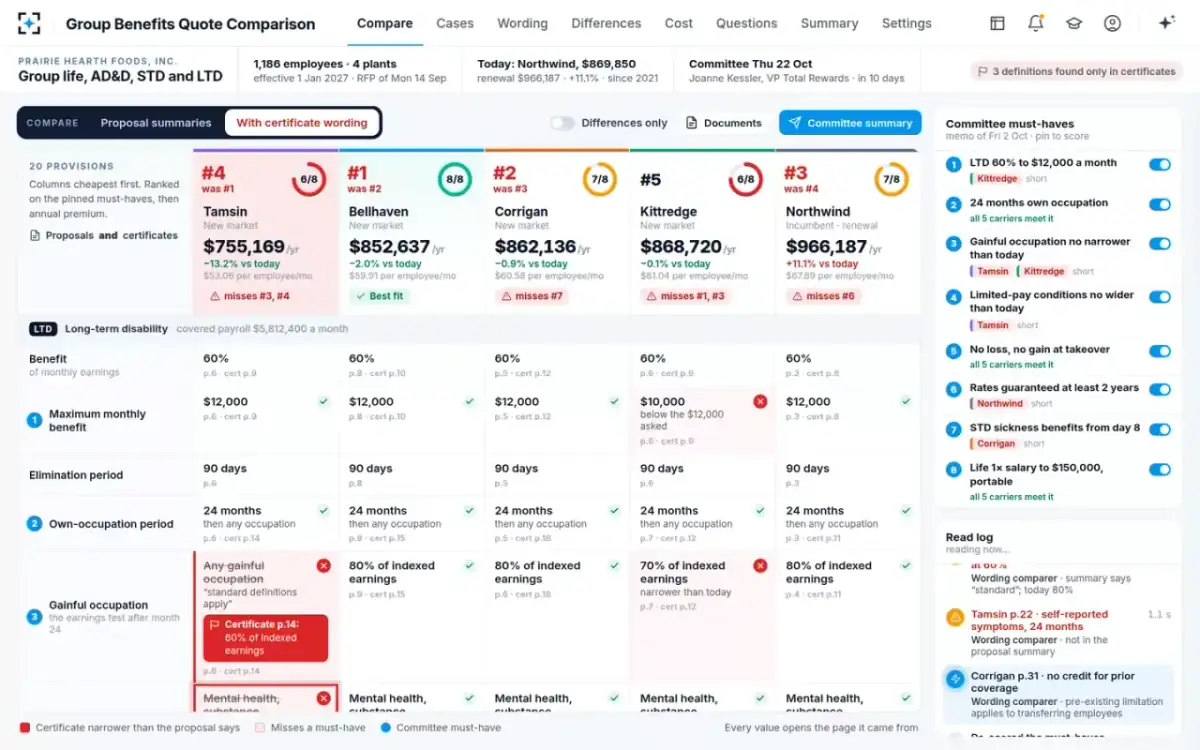
How Group Benefits Quote Comparison reads a specimen certificate
The solution's certificate reader reads every specimen certificate and policy in a case and quotes definitions, limitations, exclusions, offsets and takeover provisions word for word, with form number and page; it never paraphrases wording. The wording comparer then aligns the same clause across every certificate, the carrier's own summary and today's plan, and marks it narrower, broader or the same, always showing both passages.
One clause, two certificates, changed words marked in Group Benefits Quote Comparison
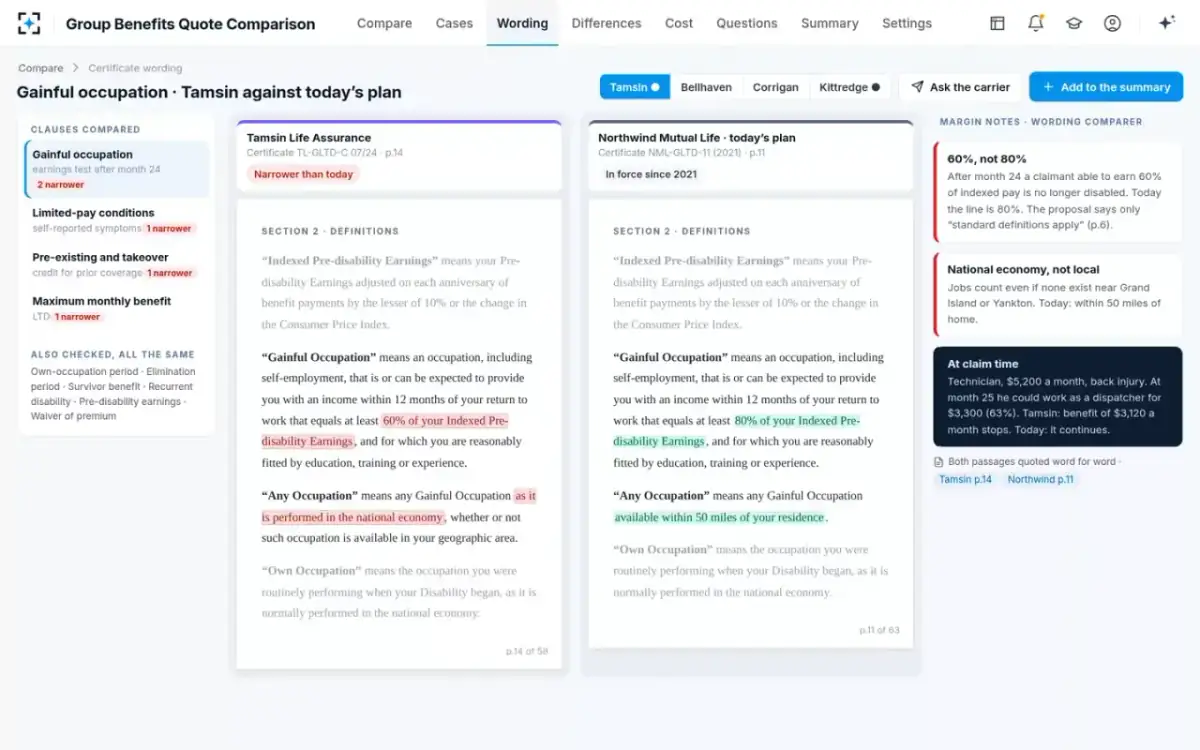
The consultant decides what the differences mean for the employer, approves any question to the carrier and signs the summary. Twelve differences worth planting in a test certificate turn this anatomy into a way to check any comparison method, and the full case is on Group Benefits Quote Comparison.
Questions people ask
What does specimen mean on an insurance document?
It means a sample: the document shows the form's standard wording, not coverage issued to a particular person. A specimen certificate cannot be used as proof that anyone is insured.
What is a specimen certificate of insurance in property and casualty?
In commercial property and casualty, a certificate of insurance is a one-page summary of a policy given to a third party such as a landlord or contractor, and a specimen is a sample of that form. It is a different document from a group benefits certificate, and it proves less than people assume: what "confers no rights" means on a certificate of insurance covers that use.
Does an employee get the certificate or the policy?
The employee gets the certificate; the employer or trust holds the policy. Under ERISA, a participant can make a written request for the instruments under which the plan is operated, which include the insurance contract.
Can a specimen certificate change after the sale?
Yes. The carrier may issue certificates on a later form, or with amendments agreed during the sale. Record the form number of the specimen you compared and check that the issued certificates match it, including any amendment the carrier agreed to.
How long is a group LTD certificate?
In the solution's sample case the five certificates came to 312 pages, and the two shown on screen run to 58 and 64 pages. Most of what changes a claim is in four sections: definitions, limitations, exclusions and the takeover provisions.
What does a certificate of insurance include for group life?
Look for the schedule of benefits and any age reductions, eligibility and effective dates, any evidence of insurability requirement, the beneficiary rules, any waiver of premium on disability, and the portability or conversion rights when employment ends. The age reductions and the waiver of premium are the two most worth comparing between carriers, because they change what older and disabled employees keep.