The RFP intake process for group benefits is everything a carrier does between a broker's request for proposal arriving and a census that rating can price: reading the RFP letter, making the employee census usable, checking it against the letter and the employer's current plan, asking the broker what the file leaves open, and signing the result. It is hard because the inputs arrive in every layout and rarely agree with one another. Botminds' Group Census & RFP Intake Automation splits that process into fourteen tasks and gives each to an agent or a person: agents read, map, check and draft, each with its source, and the underwriter decides and signs.
The split matters more than the speed. An intake process that is fast but leaves no trail of what was changed in the broker's file is worse than a slow one, because the rate it produces cannot be defended at renewal or audit. The grid below is the split the solution uses; the rest of this page explains why each line falls where it does.
Fourteen RFP intake tasks: who does each
What is RFP intake in group benefits?
RFP intake is the stage of a group quote that turns a broker's package into a priceable case. The package is usually three documents and sometimes five: an RFP letter describing the employer and the cover wanted, an employee census, the current carrier's certificates or plan summary, and, for larger groups, a recent bill and a claims history. Intake ends when an underwriter can say that the census describes the group the letter describes, under the plan designs the letter asks for, in the carrier's rating layout. Pricing starts there.
The stage is easy to underrate because none of it is pricing. But every rate is computed from what intake hands over: the ages, the salaries that set benefit volumes, the classes that choose the plan design, the count of lives. A census that was retyped and corrected by hand, with nothing written down about which values changed, produces a rate whose inputs nobody can show later.
What happens when a carrier receives a benefits RFP?
Fourteen things, in roughly the order of the grid above. The first four are reading: log the case, read the letter, turn its plan designs into fields, read what the employer has today. The next five make the census usable: find the table, map the columns, drop what the quote does not need, check each cell, fill what can be filled from a trusted source. Then comes the comparison of census, letter and current plan; then the broker questions, the reply and a second comparison; and last, the underwriter's decisions and signature.
By hand, most carriers run those steps as a queue across two or three people, and the queue is the delay. Sales support reaches the file when it can, the underwriter reads it after that, and the questions to the broker go when each problem is noticed, which is rarely all at once. Botminds estimates, from carrier sales-support practice, that a mid-market census takes about 20 working hours of handling before broker waiting is counted. The figure below shows where those hours go.
Where the hours of a hand-cleaned census go
By hand: about 20 working hours
- Header and column mapping · 15%
- Birth dates, salaries and classes · 40%
- Dependents, duplicates, eligibility · 15%
- File against letter and plan · 10%
- Broker questions · 10%
- Summary and sign-off · 10%
What is in a group insurance RFP letter?
A group insurance RFP letter states who the employer is, who is eligible, what cover is wanted and on what terms. A complete one carries the effective date and quote due date, the number of employees and where they work, the eligibility rule, the classes, a plan design for each line by class, any age reductions, the rate guarantee wanted, the situs state whose law governs the policy, and the current carrier. In practice, letters run from two pages to twenty and state these things in prose, tables and footnotes.
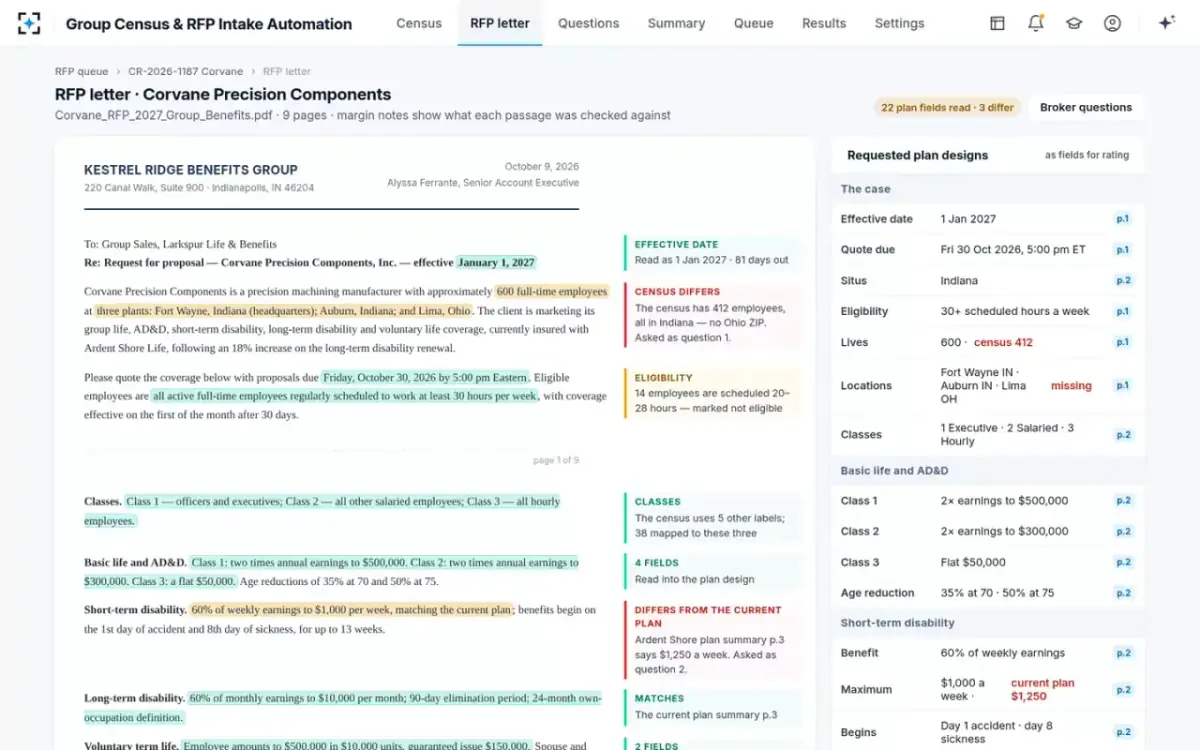
Take the fictional sample letter in Botminds' solution: nine pages from a broker, Kestrel Ridge Benefits Group, for a manufacturer, Corvane Precision Components, effective 1 January 2027 and due Friday 30 October 2026. It asks for basic life and AD&D at two times earnings to $500,000 for executives and to $300,000 for other salaried staff, a flat $50,000 for hourly staff, age reductions of 35% at 70 and 50% at 75, short-term disability at 60% of weekly earnings, long-term disability at 60% to $10,000 a month after 90 days with a 24-month own-occupation period, and voluntary term life, with rate guarantees of three years on life and two on disability. The RFP reader turns that into 22 plan fields, each tied to its page.
The letter, read into plan fields, with what each passage was checked against
Which RFP intake tasks an agent can do, with a source
An agent can do a task when its output can be checked against a source and undone. Reading a letter into fields qualifies: each field points to its passage, and a person can see in a second whether the passage says what the field says. Finding a header row qualifies, and so does mapping "DOB", "Birth Date" and "Date of Birth" to one field. Annualising an hourly rate qualifies, because the arithmetic is shown: in the sample file, an employee whose salary cell said $27.00 and whose schedule said 40 hours becomes $27.00 × 40 × 52 = $56,160, with the rule named.
Filling a blank qualifies only when a trusted second source holds the value. In the solution, the current carrier's billing roster is that source, and the roster matcher uses it only when two of three keys agree: employee ID, name and birth date. In the sample case it matched 398 of 412 employees and offered 57 values, 50 birth dates, five salaries that had been $1 placeholders and two hire dates. None of them changes the file until a person accepts it.
What stays with the analyst and the underwriter
Anything that is a rating factor without a trusted source stays with people, and so does anything that commits the carrier. Sex is the clearest case: it is a rating factor for group life and disability, and no rule can infer it from a name. Coverage amounts and plan designs the letter does not state are the same; guessing them prices a plan nobody asked for. Eligibility at the margin is a judgement, too: whether 14 employees scheduled 20 to 28 hours a week fall outside the letter's 30-hour eligibility wording is a question to confirm with the broker, not an inference.
The message to the broker is sent by a person, because it speaks for the carrier, and the census is signed quote-ready by a named underwriter, with the meaning of the signature recorded and a co-signature above a size the carrier sets. Sales support keeps its own columns: in the sample case the analyst accepted the class and state columns before the underwriter opened the file.
The test for handing a task to an agent is not whether it is hard. It is whether a person can check the result against its source in seconds, and undo it.
Who checks the census against the RFP?
In most intake processes, nobody does it systematically until the quote is built, because the comparison needs the letter, the census and the current plan open together. The census-vs-RFP comparison asks four questions: are there as many lives as the letter says, is every location in the letter on the file, do the classes on the file match the classes in the letter, and do the plan designs in the letter match what the employer has today?
Public procurements show each of those failing. Bidders on Clark County, Washington's 2023 group life and LTD RFP found "difference between the certificates and the plan summaries, such as basic life benefit for class 3, age reductions for basic life, and LTD contribution structure for classes 3,4, and 5", and the county answered that "the certificates were not the most current version" (Clark County RFP 868 questions and answers). On Indiana's 2019 group life RFP, a bidder noticed that the basic life volume in the cost proposal, $1,232,225,647.84, did not match the $1,817,691,000 in the historical exhibit; the state explained that the first was summed from the census salaries of enrolled employees (Indiana RFP 19-112, questions and answers). In the fictional sample case, the reconciler found three differences in the first nine minutes: 600 lives in the letter against 412 on the file, a plant in Lima, Ohio with no Ohio ZIP on the census, and a short-term disability maximum of $1,000 a week in the letter against $1,250 in the current plan summary.
What questions do carriers send back to brokers?
The questions fall into four groups: the missing (a location, a class, a column), the contradictory (letter against file, letter against current plan), the blank rating factors (sex, a birth date with no second source) and the marginal eligibility calls. Where the process goes wrong is not the content but the rhythm: a question per problem, sent as each is found, over a week. Each round trip with the broker adds its own wait.
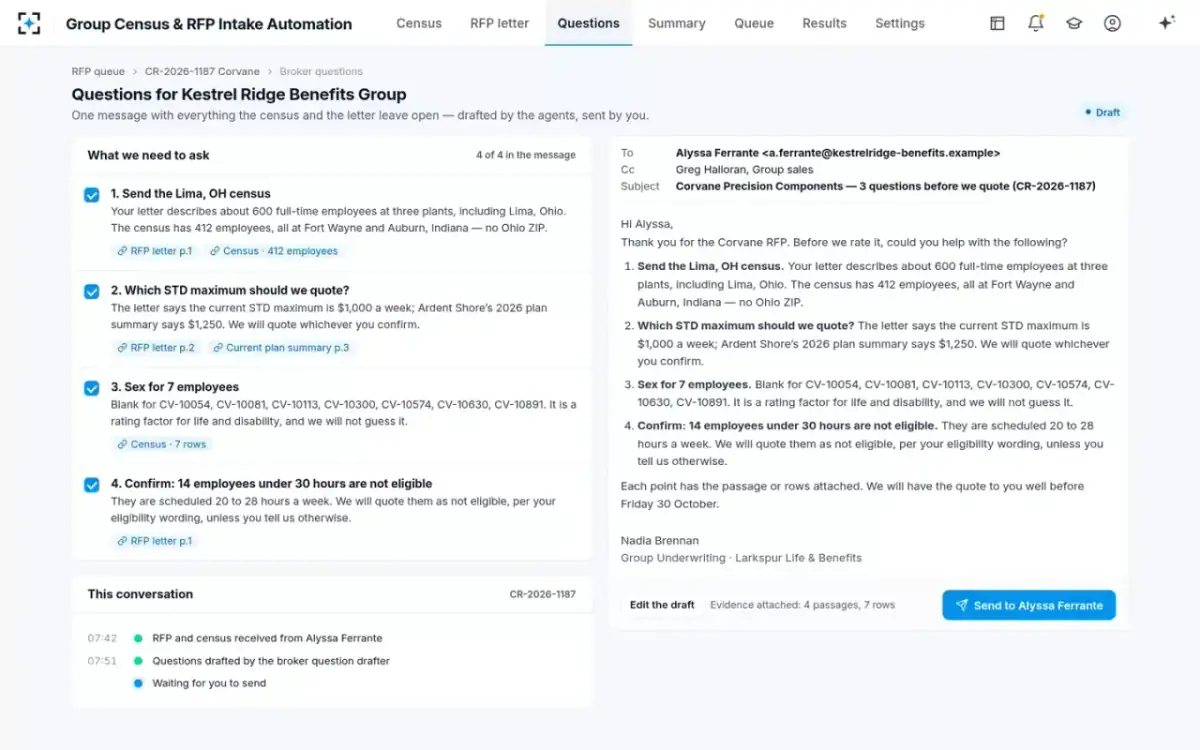
The fix is one message per case with every point and its evidence. In the sample case the question drafter wrote four points at 07:51, nine minutes after the RFP arrived: send the Lima census; which STD maximum to quote; sex for seven employees; confirm that 14 employees under 30 scheduled hours are not eligible. The underwriter sent it at 10:34. The broker answered everything at 13:05, with a 188-row file for the missing plant and the news that the letter's STD figure was a typo.
One message, with everything the file and the letter leave open
How long does it take to quote a group RFP?
There is no public benchmark, so measure two intervals separately: arrival to quote-ready census, and quote-ready to proposal. Intake is the first, and it is dominated by two kinds of waiting, for a person to reach the file and for the broker to answer. The sample day below shows the shape once agents read the file on arrival: of six hours and 38 minutes from arrival to signature, two and a half hours were the broker's.
The sample RFP, from the broker’s email to a signed quote-ready census
- Read, accept dates, send2 h 52
- Broker answers2 h 31
- Accept and sign1 h 15
The interval that disappears is the hand work, not the judgement. In the sample day the underwriter's decisions fell in two short spells: 13 minutes to accept the birth dates and send one message, and 75 minutes after the reply to accept the remaining columns and sign. Neither spell was spent retyping. What a carrier should measure on its own cases is set out in AI in group insurance: a six-week go-live, and the checks behind the cell fixes in census data cleaning.
Where this RFP intake process fits, and where it does not
The fourteen tasks end at a quote-ready census and a case summary; they do not price the case, write the proposal, or decide whether to bid. The carrier's rating engine still applies the manual, and the underwriter still owns the assumptions. Nor does the process replace the broker's work: a census missing a plant can only be fixed by the employer's payroll, and the drafter's job is to ask for it precisely.
It also handles employee data the carrier must protect. Identifiers the quote does not need are dropped on arrival, and what is kept is retained for a period the carrier sets, in line with the retention schedule state insurance data-security laws based on the NAIC model expect (NAIC Insurance Data Security Model Law, #668). For commercial property and casualty submissions, whose intake follows different documents and clearance rules, see submission intake automation for commercial lines.
Five tests of an RFP intake process
- Does every plan field point to its page in the letter?
A field without a passage cannot be checked by the underwriter or defended later.
- Is the broker’s census kept as sent, beside the fixes?
A file overwritten by hand loses the evidence of what the broker actually sent.
- Is the file compared with the letter and the current plan before pricing?
Lives, locations, classes and plan designs: four questions, asked on arrival.
- Do the questions go in one message, with evidence?
Each extra round trip with the broker adds its own wait.
- Does a named underwriter sign the census quote-ready?
With what was signed stated: lives, eligible lives, locations, plan fields, changes.
Questions people ask
What does RFP mean in group insurance?
A request for proposal: the broker's invitation to carriers to quote an employer's group cover. It usually comes as a letter describing the cover wanted, an employee census, and the current carrier's plan documents. Public employers publish theirs with written questions and answers, which is why their RFP files are a good public view of the process.
Can AI read a group insurance RFP letter?
Yes, if each field it reads is tied to the passage it came from so a person can check it. In the sample case the RFP reader turned a nine-page letter into 22 plan fields, each cited to its page. It never fills in a design the letter does not state; a missing design becomes a question.
What is a rate guarantee in a group RFP?
It is the period for which the carrier promises not to change the quoted rates, commonly asked for in years per line. The sample letter asked for three years on life and AD&D and two on disability. A census error priced into a guaranteed rate stays in the price for the whole guarantee.
What is situs in a group insurance RFP?
Situs is the state where the group policy is issued and whose insurance law governs it, usually the employer's headquarters state. The sample letter named Indiana. Employees in other states, such as the sample's Ohio plant, may still bring their own state's rules for some benefits.
Who sends questions to the broker during RFP intake?
In most carriers, sales support or the underwriter, often copying the group sales representative. In the solution, the agents draft one message per case with the evidence attached, and only the underwriter can send it; a reminder follows after a period the carrier sets, 24 hours in the sample settings.
Is the Form 5500 part of RFP intake?
It can be. Insured welfare plans that file a Form 5500 attach a Schedule A, which reports premiums and the commissions and fees paid on each contract, and the filings are public (2025 instructions). Fully insured plans with fewer than 100 participants are generally exempt, so small cases rarely have one; a Form 5500 search shows how to find and read the filing.