AI in group insurance is most useful, and easiest to govern, in the work that comes before a rate: reading the broker's RFP letter, mapping and checking the employee census, comparing the two with the employer's current plan, and drafting the questions the file leaves open. It should not set rates, fill in rating factors it cannot source, or send anything to a broker on its own. Botminds' Group Census & RFP Intake Automation is built on that line: six agents do the reading, checking and drafting, each with a cited source, and the underwriter accepts fixes and signs. This page is the plan for putting it live in six weeks, and the measures that should decide whether it goes live at all.
The plan starts with evidence the carrier already owns: last season's closed RFPs, with the census as the broker sent it and the file rating actually priced. Agents are scored against those first, then run beside sales support on live cases for one quoting cycle, and only then prepare quote-ready files on their own, with people still deciding every change.
Six weeks from signed scope to live census intake
- Layout and rulesWk 1
- Share closed RFPsWk 2
- Review back-testWk 3
- Live cases side by sideWk 4–5
- Go-live sign-offWk 6
- ConfiguredWk 1
- Read closed RFPsWk 2–3
- Shadow live RFPsWk 4–5
- Prepare live filesWk 6
- Baseline hoursWk 1–2
- Found, missed, wrongWk 3
- Hours and broker roundsWk 4–5
- DecisionWk 6
How is AI used in group insurance today?
Mostly in places where an application form already exists. The Bureau of Labor Statistics expects insurance underwriting employment to fall 4 percent between 2025 and 2035 and puts it down to automated underwriting software that processes applications faster (BLS Occupational Outlook Handbook; group benefits underwriting sets out who does the work today). Group quoting has been slower to change because its input is not a form. It is whatever the broker's payroll export produced: a merged title over the top rows, two-digit birth years, hourly pay in the salary column, spouses on employee rows, and a letter whose plan designs are written in prose.
That is precisely the kind of input modern agents read well, and it is also where the governance questions are easiest. A census check that says why it suggests a fix, and cites the roster line or the arithmetic, can be reviewed in seconds. Pricing models that score a group's risk raise harder questions. New York's Department of Financial Services, finalising its 2024 circular on AI in underwriting and pricing, noted "that in certain circumstances commercial property/casualty and group life insurance may not have a direct consumer impact, and in other cases it could" (NY DFS Circular Letter No. 7, July 2024). Intake that only prepares a file for a human decision sits at the low-risk end of that range.
Can AI clean an employee census?
Yes, if every change is a suggestion with a reason and a source, and a person accepts it. Agents can find the header row under merged titles, map "DOB", "Birth Date" and "Date of Birth" to one field, flag two-digit years and placeholder dates, annualise hourly pay with the arithmetic shown, move dependents to their own list, and propose duplicates for merge. They can fill a missing birth date or a $1 salary from the current carrier's billing roster when an employee matches on two of three keys. What they must not do is impute what has no source. The federal statistical agencies' data quality framework lists "data entry, coding, editing, imputation" among the causes of processing error (FCSM, A Framework for Data Quality, 2020): cleaning is itself a source of error unless each edit can be traced.
So the limits are written into the agents. Sex is never suggested, because it is a rating factor and no rule can infer it. Coverage amounts and plan designs the letter does not state become questions. A column the mapper cannot place is asked about, never dropped. The broker's file is never overwritten, and it can always be shown as sent. The checks themselves, and why a valid census can still misprice, are covered in census data cleaning.
Who does what once intake goes live
Agent
RFP reader and census mapperRead the letter into plan fields, each cited to its page; find the census table and map it to your rating layout.
Never: infers a design the letter does not state
Agent
Data-quality checker and roster matcherSuggest a fix for every cell that would break the rating, with its reason and source.
Never: fills sex or coverage amounts
Agent
Census-vs-RFP reconcilerCompare lives, locations, classes and plan designs with the letter and the current plan.
Never: resolves a difference itself
Agent
Broker question drafterWrite one message with every open point and its evidence.
A person decides
Group underwriterAccepts or keeps fixes, sends the message, signs the census quote-ready.
A person decides
VP, group underwritingOwns the rules as versioned settings; co-signs cases above a size the carrier sets.
What data does an AI quoting tool need?
Less than most carriers expect, and none of it new. The agents need the carrier's rating layout, its class definitions and eligibility conventions, the thresholds it wants checked, and a set of past RFP packages to learn the brokers' habits and to be scored against. The table lists what to gather in week one and what each item is for.
What to gather in week one, and what it is for
| Item | What it is used for |
|---|---|
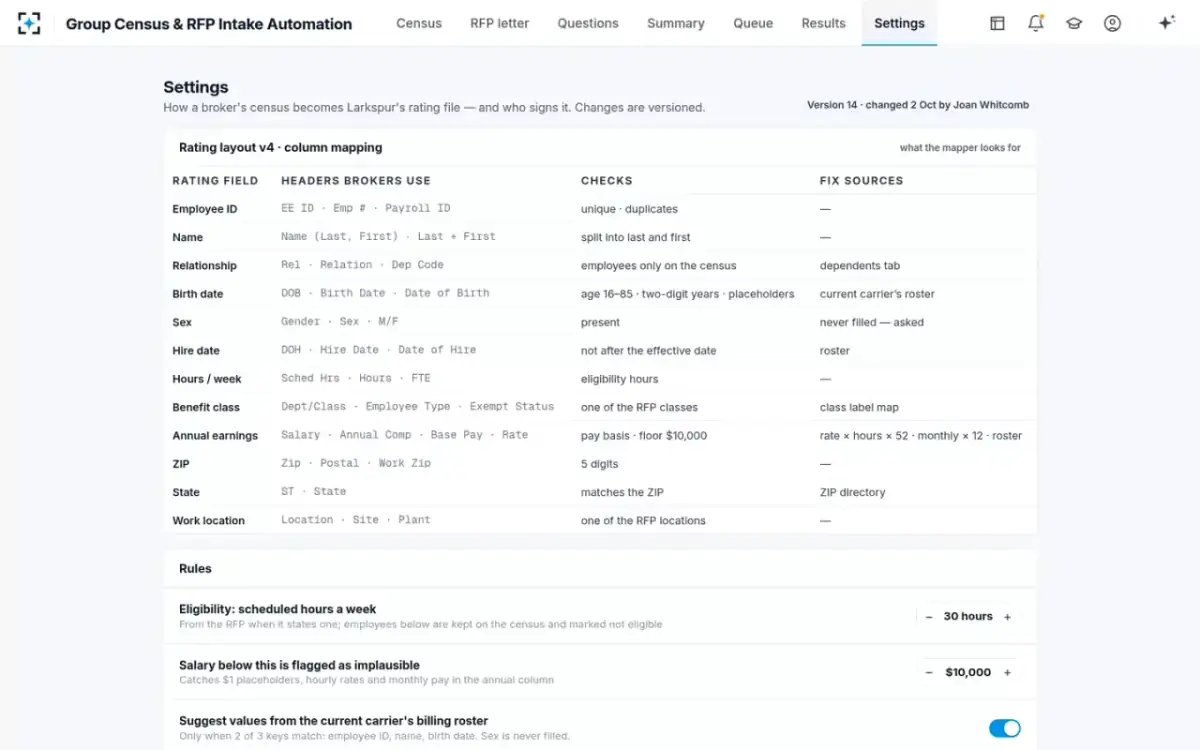
| Your rating layout and field definitions | The target every census column is mapped to |
| Class definitions and eligibility conventions | Mapping the employer’s labels to the letter’s classes; applying hours and status rules |
| Check thresholds: salary floor, age range, co-sign size, retention | The carrier’s own rules, held as versioned settings |
| 30 to 50 closed RFPs: letter, census as sent, census as rated | The back-test: what your team changed is the answer key |
| Current carriers’ plan summaries and billing rosters, where held | The second source for comparisons and missing values |
| The questions your team sent brokers on those cases | Scoring whether the drafted message asks what your people asked |
The six-week plan, week by week
Each week ends with an output someone signs, so the plan cannot drift. Weeks one and two configure the rating layout, the class map and the rules, and load the closed RFPs. Week three is the back-test: the agents read last season's files as the brokers sent them, and their suggested fixes, differences and broker questions are compared with what your team actually did. Weeks four and five are the parallel run: live RFPs go to sales support as usual, and the agents prepare the same files alongside, so the two can be compared case by case. Week six is the decision.
The decision is made on numbers, not impressions, and the VP of group underwriting owns it. If the back-test shows the agents missing a class of error your team catches, the rule is added and the back-test re-run before the parallel run starts. If the parallel run shows brokers answering one message more slowly than several, the reminder setting changes. In the sample settings, a reminder follows after 24 hours.
Your rules, as settings that are versioned
What should a pilot for census automation measure?
It should measure the agents on your files, in conditions like production, and write the results down. That is also what the NIST AI Risk Management Framework asks: "AI system performance or assurance criteria are measured qualitatively or quantitatively and demonstrated for conditions similar to deployment setting(s). Measures are documented." It adds that the system "is demonstrated to be valid and reliable" and that "Limitations of the generalizability beyond the conditions under which the technology was developed are documented" (NIST AI RMF 1.0, January 2023). For census intake, that becomes eight measures.
Eight measures for a census automation pilot
- Fixes found that your team also made
From the back-test: the share of your team’s changes the agents suggested.
- Fixes your team made that the agents missed
Each one becomes a rule or a documented limitation.
- Suggestions your team would not accept
A false fix costs review time and trust; count it by kind.
- Differences from the letter caught on arrival
Lives, locations, classes and plan designs, against what was found later by hand.
- Broker rounds per case
One message with evidence should replace a week of single questions.
- Hours from arrival to a signed quote-ready census
Against the baseline timed in weeks one and two.
- Rating factors filled without a source
Must be zero: sex, coverage amounts and unstated designs are asked, never filled.
- Changes traceable to a source and a person
Every change on the log with from, to, source, who and when.
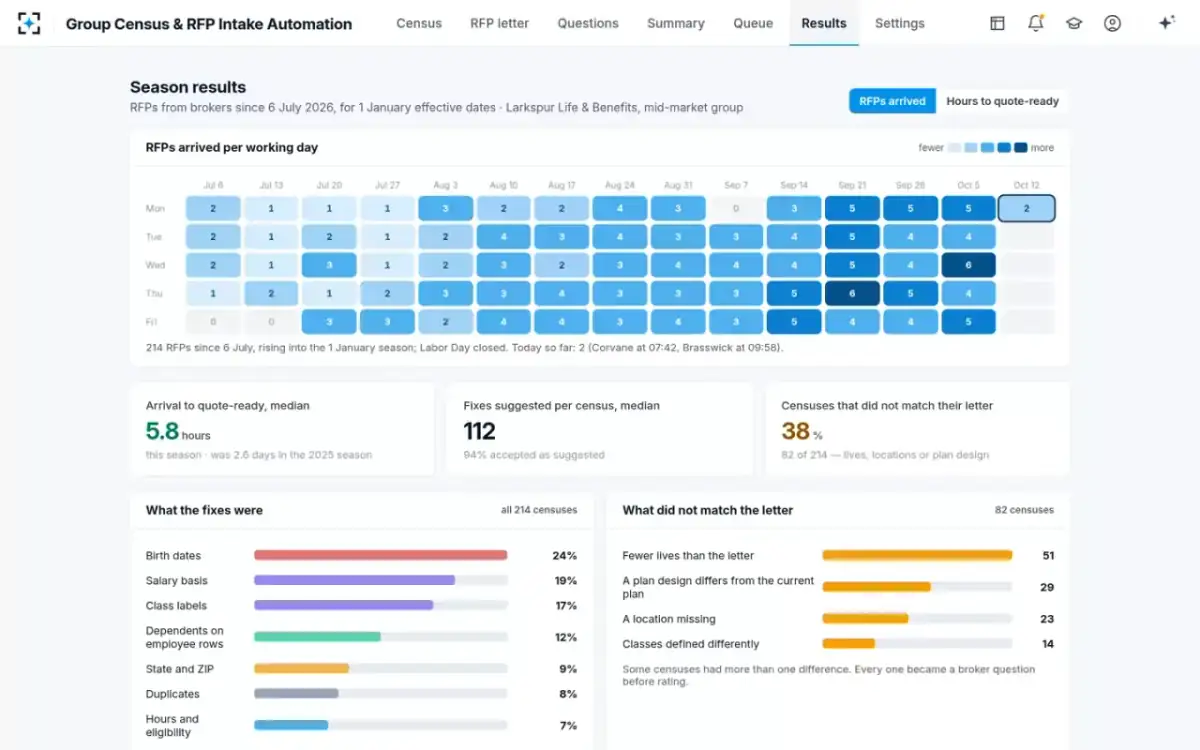
For a sense of what good looks like, the solution's fictional sample season recorded 94% of suggested fixes accepted as suggested and a median of 5.8 hours from arrival to quote-ready, against 2.6 days in the previous season. Those are sample figures, not a customer's results; the design target for a live deployment is a quote-ready census within one day of the RFP arriving, against Botminds' estimate of two to three days of sales-support time by hand.
A season’s results: arrivals, hours to quote-ready, and what did not match
Is employee census data covered by HIPAA?
For group life and disability quoting, generally not. HIPAA's privacy rules bind covered entities such as health plans, which the rule defines as plans that provide "or pays the cost of, medical care" (45 CFR 160.103); a carrier quoting life or disability cover is not acting as one. Life and disability carriers are governed instead by state insurance privacy and data-security law, much of it built on the NAIC's Insurance Data Security Model Law, which expects a licensee to choose its service providers with care and to require them to put administrative, technical and physical safeguards in place (NAIC Model Law #668; the Insurance Data Security Model Law guide covers it in full). Any AI vendor that touches a census is such a provider. What a census needs and what it can leave out is the subject of the blinded employee census.
Who approves AI output in group underwriting?
A named person, for every change and for the file as a whole. In the solution, the underwriter accepts or keeps each fix, sends the broker message and signs the census quote-ready with the meaning of the signature recorded; cases above a size the carrier sets need a second signature. The NIST framework asks the same of any deployment: "Processes for human oversight are defined, assessed, and documented". Regulators' expectations for AI governance at insurers, including the NAIC's model bulletin and the states that have adopted it, are set out in the NAIC AI bulletin requirements for insurers.
The question to ask of AI in group insurance is not how much it automates. It is whether every change it proposes can be traced to a source and a person in the time it takes to read it.
What to look for in AI for group insurance
Look for evidence on your own files, and for limits written into the product rather than promised in a meeting. A vendor should be able to show, on a census you choose, each suggested fix with its reason and source; the file as sent beside the fixes; a refusal to fill sex, coverage amounts or unstated designs; one message to the broker with evidence attached; your rating layout and rules as settings you own; identifiers such as SSNs dropped on arrival; and a retention period you set. Ask to run the back-test yourself.
Know where intake automation does not fit. It does not price the case, decide whether to bid, underwrite evidence of insurability for amounts above guaranteed issue, or administer claims. It sits in front of the rating engine and the underwriting platform, not in place of them; how it compares with each is worked through in group underwriting platform or agents.
Questions people ask
How long does it take to implement AI in group underwriting?
For census and RFP intake, Botminds plans six weeks: two to configure the rating layout and rules and load closed RFPs, one to back-test, two to run beside sales support on live cases, and one to decide. The length depends mostly on how quickly the carrier can share its rating layout and last season's files.
Does AI replace sales support in group insurance?
It replaces the retyping, not the analyst. In the solution, sales support starts from a file already mapped and checked and accepts the columns it owns; the judgement on an employer's own codes and the chase for what only the broker can supply stay with people.
Can AI decide who is eligible for group cover?
It can apply the letter's eligibility wording and flag the people it puts in doubt, such as employees scheduled below the hours the letter names. Whether they are in or out is confirmed with the broker and decided by the underwriter, because eligibility changes who the carrier is pricing.
How should the cost of AI for census intake be judged?
Against your own hours. Botminds estimates about 20 working hours of handling for a mid-market census by hand and about 2.6 with agents. Price the difference at your own wage rates; for reference, the BLS median for all insurance underwriters was $39.12 an hour in May 2025.
Is AI in group insurance regulated?
Insurers' use of AI is addressed by state insurance regulators, many through the NAIC's model bulletin on AI systems, and New York's 2024 circular covers AI and external data in underwriting and pricing. A tool that prepares a census for a human decision is lower-risk than one that prices, but it still needs documented oversight.