Group benefits underwriting is the work of deciding whether, and at what rate, a carrier will cover an employer's whole workforce for group life, AD&D, short-term and long-term disability. Unlike individual underwriting, the underwriter rarely sees a single applicant: the risk is the group, and the evidence is an employee census and an RFP letter sent by the employer's broker. Before any rate exists, that census passes through five or six seats at the carrier, and each one checks a different slice of it. Botminds' Group Census & RFP Intake Automation exists because the slices do not add up to a checked file: agents map and check every cell and compare the census with the letter on arrival, and the underwriter decides and signs.
The seats are easy to name and hard to coordinate. A group sales representative owns the broker relationship. Sales support opens the file and retypes it into the rating layout. The underwriter decides eligibility, classes and assumptions. Rating, or a pricing actuary, applies the manual and the experience. A VP of group underwriting owns the rules and signs the large cases. And the broker, outside the building, owns the answers to every question the file leaves open.
The seats around one group quote, and what each keeps
Today
Learns that a plant is missing from the census when the quote is already late, and chases the broker for it by phone.
With agents
Is copied on one message to the broker with every open point, and sees each case’s status in the queue.
Still theirs: The broker relationship and the decision to push for a date.
Today
Opens every RFP, finds the table under merged titles, retypes columns and fixes dates and salaries for two or three days.
With agents
Starts from a file already mapped, with each problem cell marked and a fix suggested with its source; accepts the columns they own.
Still theirs: Judgement on the broker’s own codes, and the columns assigned to them.
Today
Receives the census days after the RFP, still carrying assumptions nobody agreed with the broker.
With agents
Reads the three differences between file and letter at once, sends one message and signs the file quote-ready.
Still theirs: Eligibility, classes, every fix to a rating factor, and the signature.
Today
Prices whatever arrives, and learns of a wrong age mix only when the case runs badly.
With agents
Receives the clean file with lives by class and location, volumes and every assumption written down.
Still theirs: The manual rate, the credibility given to experience, and the margin.
Today
Cannot show, after a case is audited or lost, what was changed in the broker’s file and by whom.
With agents
Reads each change with who accepted it, owns the rules as versioned settings and co-signs large cases.
Still theirs: The rules themselves and the large-case co-signature.
What does a group benefits underwriter do?
A group benefits underwriter decides whether the carrier will offer cover to an employer's group, on what terms and with what assumptions, and hands rating a file it can price. The job is less about medical risk than in individual lines: for most employees in a group life or disability plan there is no health question at all below the guaranteed issue amount. What the underwriter weighs instead is the group itself: its industry, its size, how many eligible employees will take the cover, its age and salary mix, its locations and its claims history.
That makes the census the underwriter's main evidence, and the RFP letter the specification. The underwriter checks that the eligibility the letter describes (for example "all active full-time employees regularly scheduled to work at least 30 hours per week") matches the people on the file, sets the classes the plan designs are priced on, decides what to assume where the file is silent, and confirms that the requested benefits match what the employer has today. Every one of those decisions changes the rate, and none of them is a calculation a rating engine can make.
The Bureau of Labor Statistics counts 125,600 insurance underwriters across all lines in 2025, with a median pay of $81,370, and projects the occupation to shrink 4 percent from 2025 to 2035 (BLS Occupational Outlook Handbook). Its reason is automation: "Automated underwriting software allows workers to process applications quickly, reducing the need for underwriters." Group underwriting is the part of that job where automation has arrived last, because its input is not an application form but whatever spreadsheet the broker sends.
Six seats touch one RFP before a rate exists
A group RFP crosses at least six seats, and each was designed to check something different. The broker assembles the census from the employer's payroll or HR system and writes the letter. Sales receives it and decides whether to bid. Sales support makes the file usable. The underwriter decides what it means. Rating prices it. A senior underwriter or VP signs the large ones. Nobody in that chain owns the whole file, and the census is the one artefact all of them touch.
The market is large enough that the relay runs all season. The Department of Labor counted, from 2014 Form 5500 Schedule A filings, "39,135 plans reporting a code indicating they provide temporary disability benefits covering 40.1 million participants, and 26,171 plans reporting a code indicating they provide long-term disability benefits covering 22.4 million participants" (DOL disability claims rule, Federal Register, December 2016). Those are only the insured plans that file: Schedule A goes with the return whenever an insurer provides any of the plan's benefits, and fully insured welfare plans with fewer than 100 participants are generally exempt from filing at all (2025 Form 5500 instructions); a Form 5500 search shows what the filings reveal about an incumbent. Every one of those plans is re-marketed, sooner or later, through an RFP and a census.
Who has group life cover depends on hours and employer size
Who reviews an employee census before a quote?
Everyone reviews it, and each reviewer looks at different columns. Sales support looks at format: whether the header is found, whether dates are dates, whether salaries are numbers. The underwriter looks at meaning: whether a class label matches a class in the letter, whether a person scheduled 24 hours belongs on the file, whether the count of lives matches the count the broker quoted. Rating looks at totals: lives, volume and the age distribution. The table below sets out who usually owns which check, and which decision rides on it.
Who checks which part of the census, and what rides on it
| Census field or check | Usually checked by | What it decides |
|---|---|---|
| Header row, column mapping, file layout | Sales support | Whether the file can be read at all |
| Date of birth and two-digit years | Sales support, then rating | Age bands, and with them every age-rated premium |
| Sex | Underwriter (asked of the broker when blank) | A rating factor for group life and disability |
| Annual earnings and pay basis | Sales support, then underwriter | Benefit amounts, covered payroll and volume |
| Scheduled hours and employment status | Underwriter | Who is eligible on the effective date |
| Class or department label | Underwriter | Which plan design each person is priced on |
| Relationship (employee, spouse, child) | Sales support | Whether dependents are counted as lives |
| Work location and ZIP | Underwriter | Situs, state rules and whether every location is on the file |
| Lives, locations and plan designs against the letter | Often nobody, until the quote | Whether the case being priced is the case being bid |
The last row is the one that slips. Checking the census against the letter, and the letter against the employer's current plan, belongs to no single seat: it needs the letter open beside the file and someone with the authority to ask the broker. Public procurements show how often it is left to the bidder. When Clark County, Washington put its group life, AD&D and LTD cover out to bid in 2023, carriers asked in writing why the census listed retirees who did not appear to have coverage, and why, per the census, "40 employees in classes 03 – 05 are electing buy up coverage, but this is not offered for these classes" (Clark County RFP 868 questions and answers, August 2023). Each was a difference between file and plan that someone had to find by hand.
Group benefits underwriting starts with who is eligible
Before price, the underwriter decides who is in the group, and the census is usually where eligibility goes wrong. The letter states the rule; the file is supposed to list the people who meet it. But payroll exports carry everyone on payroll: part-timers, seasonal staff, retirees still on a deduction, employees on leave. The BLS figures above show why the line matters. In March 2026, 74% of full-time private industry workers had access to life insurance against 14% of part-time workers (BLS). An eligibility rule drawn at 30 scheduled hours a week moves a large share of a workforce in or out of the priced group.
Eligibility also has a date. A group life or disability policy usually covers an eligible employee only if they are actively at work on the effective date, and few censuses carry a column saying who is on leave, disabled or off work that day. The State of Indiana, answering bidders on its group life RFP in 2019, admitted that employees on its disability program were in the census with nothing to mark them (Indiana RFP 19-112, questions and answers). How that one field decides day-one cover, and what the NAIC's takeover rules say about it, is the subject of the actively at work clause as a census field.
What does a group underwriter need from the broker?
A group underwriter needs five things from the broker: a census of eligible employees, the RFP letter with the requested plan designs, the current carrier's certificates or plan summary, the current rates and a recent bill, and claims experience where the group is large enough for it to count. The census needs, at minimum, date of birth, sex, earnings, class, hours, location and status. Missing any one of them turns into a question.
The public RFPs of cities and counties are a rare place to see those questions in writing, because procurement rules make bidders ask them in public. Bidders on the City of Providence's life insurance RFP in 2024 asked for a census with status, salary, coverage and a key to its abbreviations (the employee census template lists their request field by field), and pointed out that the census carried no lives in a class the certificates covered, the superintendents (City of Providence, responses to life insurance RFP questions; census data cleaning follows that gap). The same bidders asked how age was defined for the premium age bracket. The city's answer was "July 1st of each year", a fact no census carries and every age-rated price depends on.
Every seat checks the columns it understands. The comparison that decides whether the right case is being priced, file against letter against current plan, belongs to nobody until the quote is wrong.
Where one bad field slips between seats
A single wrong value can pass every seat because each seat's test is satisfied. Take a census row where the broker's export wrote a birth year as two digits, "68". Sales support's tools read it as a date; a spreadsheet may even turn it into 2068 or 1968 depending on its settings. The value is valid. Whether it is accurate is a different test, and only someone comparing it with another source can run it.
One two-digit birth year on its way through the seats
A person decides
BrokerExports the census from the employer’s payroll system; the birth year column carries two digits for some rows.
A person decides
Sales support, by handConverts the column to dates; the spreadsheet expands 68 to 1968 for most rows and to 2068 for a few, which still look like dates.
Agent
Data-quality checkerFlags every two-digit year and every age outside 16 to 85, and suggests the expanded year with its reason.
Never: accepts a fix itself
Agent
Roster matcherFinds the same employee on the current carrier’s billing roster when two of three keys match and offers the birth date billed there.
Never: fills sex or coverage amounts
A person decides
Group underwriterAccepts the column of fixes, or keeps a value as sent, with the source of each in view.
A person decides
RatingReceives ages at the effective date with every assumption written down.
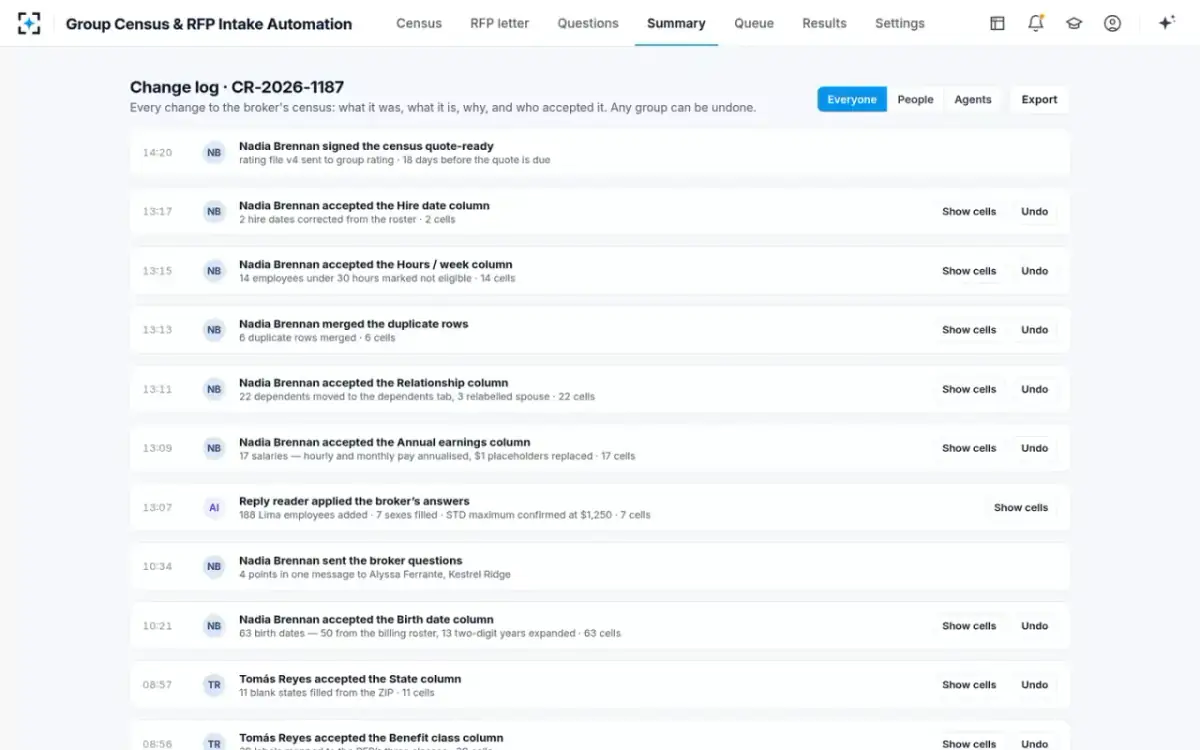
In Botminds' fictional sample case, the Corvane Precision Components RFP sent by a broker on a Monday at 07:42, the birth-date column carried 63 problems: 13 two-digit years and 50 missing or implausible dates that the current carrier's billing roster could supply. The underwriter accepted the whole column at 10:21, and every change went on the change log with its source. Which checks catch which errors, and why a file can pass every format test and still price the wrong group, is set out in census data cleaning: why a valid census can still misprice.
Age is an underwriting question, and a legal one
Age is where group benefits underwriting meets employment law. Group life and disability premiums rise steeply with age, so many plans reduce benefits at older ages. The Age Discrimination in Employment Act allows that only when the reduction is cost-justified, and the EEOC's rule sets the unit: cost comparisons may use age brackets of up to five years (29 CFR 1625.10), which is why age-banded rates come in five-year steps. The same rule's own example is the one the industry follows: higher group term life costs for older workers can justify less cover for them.
An age-reduction schedule in an RFP letter, such as the sample letter's reductions of 35% at 70 and 50% at 75, is therefore only as sound as the ages on the file. A census with placeholder birth dates misplaces people across the five-year brackets that both the price and the reduction schedule are built on. How those brackets turn into an age-banded or a composite rate is worked line by line in age banded rates vs composite rates.
The season’s RFPs, read on arrival
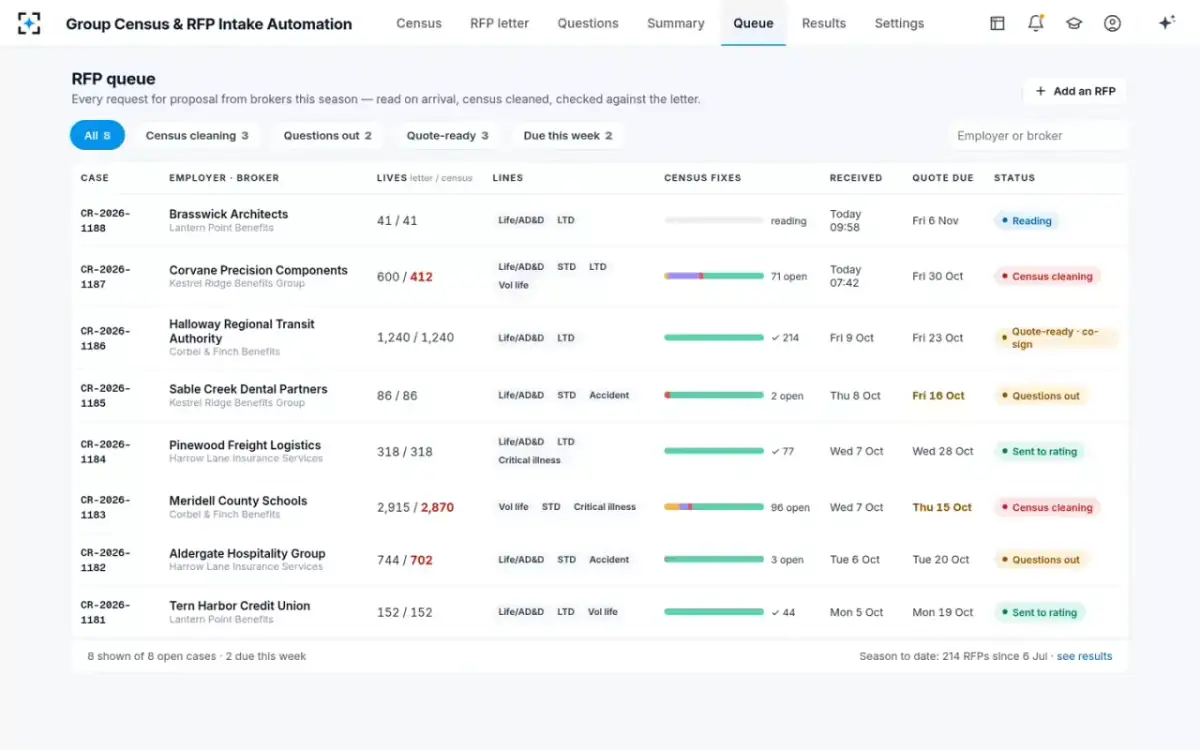
How long does group underwriting take?
No public source measures how long carriers take to turn an RFP into a quote, so the useful answer is a method: time each case from the moment the RFP arrives to the moment the underwriter signs the census quote-ready, and separately from that point to the quote. The first interval is intake; the second is pricing and proposal. Most of the variance sits in the first, and most of the first is waiting: for sales support to reach the file, and then for the broker to answer questions sent one at a time.
Botminds' own estimate, from carrier sales-support practice, is two to three days of sales-support time to clean one mid-market census by hand, before any broker wait. In the fictional sample season, with the agents doing the mapping and checking, the median from arrival to quote-ready was 5.8 hours, against 2.6 days in the season before; the design target for a live deployment is a quote-ready census within one day. Measure your own baseline before you believe anyone's number, including ours: the steps for a back-test on last season's RFPs are in AI in group insurance: a six-week go-live.
Group benefits underwriting with Group Census & RFP Intake Automation
The solution does not underwrite; it gives the underwriter a file worth underwriting. Six agents divide the mechanical work. An RFP reader turns the letter into plan designs, each field cited to its page. A census mapper finds the table and maps every column to the carrier's rating layout, dropping any SSN column on arrival. A data-quality checker suggests a fix for every cell that would break the rating, with its reason. A roster matcher offers missing values from the current carrier's billing roster. A reconciler compares the file with the letter and the current plan. A question drafter writes one message to the broker with the evidence attached.
What stays with people is everything that carries judgement or a signature. Sex, coverage amounts and plan designs are never filled in by the agents; a blank becomes a question. The underwriter accepts fixes a column at a time, sends the broker message, and signs the census quote-ready with the meaning of the signature recorded. Cases over a size the carrier sets, 1,000 lives in the sample settings, need the VP's co-signature. Every change is reversible and visible to the next seat.
Every change to the broker’s file, with who accepted it
Questions people ask
What is group underwriting in insurance?
Group underwriting assesses a whole group, usually an employer's workforce, rather than each person in it. The underwriter weighs the group's size, industry, participation, age and salary mix, locations and claims experience, and most members are covered without individual health questions up to a guaranteed issue amount. The employee census is the main evidence.
What is the difference between sales support and underwriting?
Sales support makes the broker's file usable: it finds the census table, maps the columns, fixes formats and chases missing data. Underwriting decides what the file means for risk: who is eligible, which class each person belongs to, what to assume where the file is silent, and whether to offer cover. Underwriting signs; sales support prepares.
Who sets the rate for a group life quote?
The rate comes from the carrier's rating manual applied to the census, adjusted by the underwriter for the group's risk and, for larger groups, blended with the group's own claims experience by a pricing actuary or rating unit. The underwriter owns the assumptions; rating owns the arithmetic. A wrong age or salary on the census changes the arithmetic without anyone noticing.
How much does a group benefits underwriter earn?
The BLS does not publish a separate figure for group benefits. For all insurance underwriters, median pay was $81,370 in May 2025, across 125,600 jobs, and employment is projected to fall 4 percent between 2025 and 2035 as automated underwriting spreads.
How many employers offer group life and disability insurance?
In March 2026, 59% of private industry workers had access to employer life insurance, 44% to short-term disability and 37% to long-term disability, according to the BLS. Access ran from 40% in establishments with fewer than 50 workers to 86% in those with 500 or more.
Does group life insurance need medical underwriting?
Usually not for most members. Amounts up to the guaranteed issue limit are issued without health questions, which is why the group's census carries the weight. Amounts above that limit, late entrants and some voluntary elections need evidence of insurability, which is underwritten person by person.