A disability claims examiner decides whether a short-term (STD) or long-term disability (LTD) claim meets the definition of disability in the employer's group policy, and writes the letter that says why. In practice the job is mostly evidence work: asking a surgeon's office for the attending physician statement, asking the employer for a job description and payroll, reading what comes back, and lining it up against the certificate before the federal clock runs out. For a plan covered by ERISA, a denial must be sent within 45 days of the claim, with two 30-day extensions allowed only for matters beyond the plan's control. Botminds' Disability Claims Adjudication exists because that reading and chasing crowds out the judgement: seven agents gather and read the file and lay the plan's definition out as elements, and the examiner decides each one.
The week below is built on the solution's sample desk: a fictional senior LTD examiner, Renata Voss, at a fictional carrier, Halberd Mutual Life, with fictional claimants. The hours are our estimate of a typical LTD desk, not a time study. The rules, wages and survey figures are quoted from the Department of Labor, the Bureau of Labor Statistics and the eCFR.
An LTD examiner's week: most hours go to evidence, not to deciding
- Triage the claims due1.5 h
- Read new records3 h
- Decide one claim1 h
- Letter1.5 h
- Calls1 h
- Day-7 and day-14 chases2.5 h
- Read APS and notes3 h
- Job demands vs restrictions2 h
- Calls0.5 h
- Read nurse and vocational answers1.5 h
- Read records2.5 h
- Benefit and offsets1.5 h
- Decide0.5 h
- Letters2 h
- Requests for new claims2.5 h
- Read records2.5 h
- Plan definition and job1.5 h
- Letters1.5 h
- Extension notices1.5 h
- Chases1.5 h
- Read records2 h
- Decide0.5 h
- Referrals and calls2.5 h
What does a disability claims examiner do?
A disability claims examiner decides benefit claims under a group STD or LTD policy: whether the claimant meets each part of the policy's definition of disability, what the benefit is, and when it starts and ends. The Bureau of Labor Statistics files the job with claims adjusters, appraisers and investigators, and describes examiners as the people who "authorize appropriate payment, deny the claim, or refer the claim to an investigator" (BLS Occupational Outlook Handbook). On a disability desk the investigating is mostly done on paper. The evidence comes from at least four parties: the claimant's statement, the employer's statement and job description, the treating doctor's attending physician statement and records, and the plan's own certificate.
The decision has a legal shape. Under the Department of Labor's claims rule, a denial letter must give "the specific reason or reasons", refer to "the specific plan provisions" relied on, and, for a disability claim, explain "the basis for disagreeing with or not following" the views of the claimant's treating and vocational professionals, of the plan's own experts and of any Social Security disability decision the claimant sent in (29 CFR 2560.503-1(g)). An examiner's week is organised around being able to write that letter honestly by the deadline.
The clock every disability claims examiner works to
The examiner's calendar is set by federal rule, not by the carrier. For a plan subject to ERISA, a denial must reach the claimant within a reasonable time and no later than 45 days after the plan receives the claim. The plan may add 30 days only for matters beyond its control, and only by telling the claimant before the first 45 days end; a second 30-day extension follows the same test (29 CFR 2560.503-1(f)(3)). The extension notice must explain the standards, name the open issues and the information that would settle them, and give the claimant at least 45 days to provide it. The disability claims process quotes the rule and lays the clock out step by step.
Two details shape the week. The clock starts when the claim is filed under the plan's procedures, "without regard to whether all the information necessary to make a benefit determination accompanies the filing", so a slow doctor's office spends the examiner's days, not the claimant's. And if the extension is needed because the claimant has not sent something, the clock is tolled from the notice until the claimant responds (29 CFR 2560.503-1(f)(4)). Waiting on the treating doctor is not the claimant's failure, so it tolls nothing.
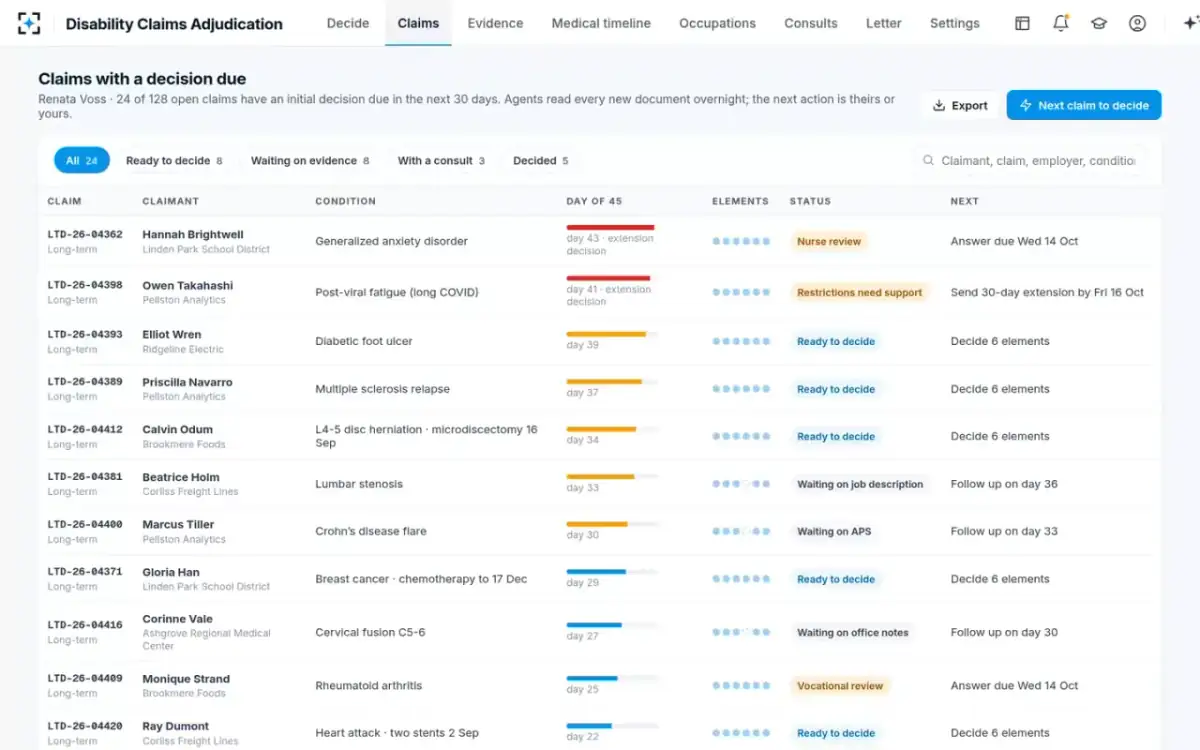
Monday: the claims with a decision due, by day of 45
Monday to Friday on a sample LTD desk
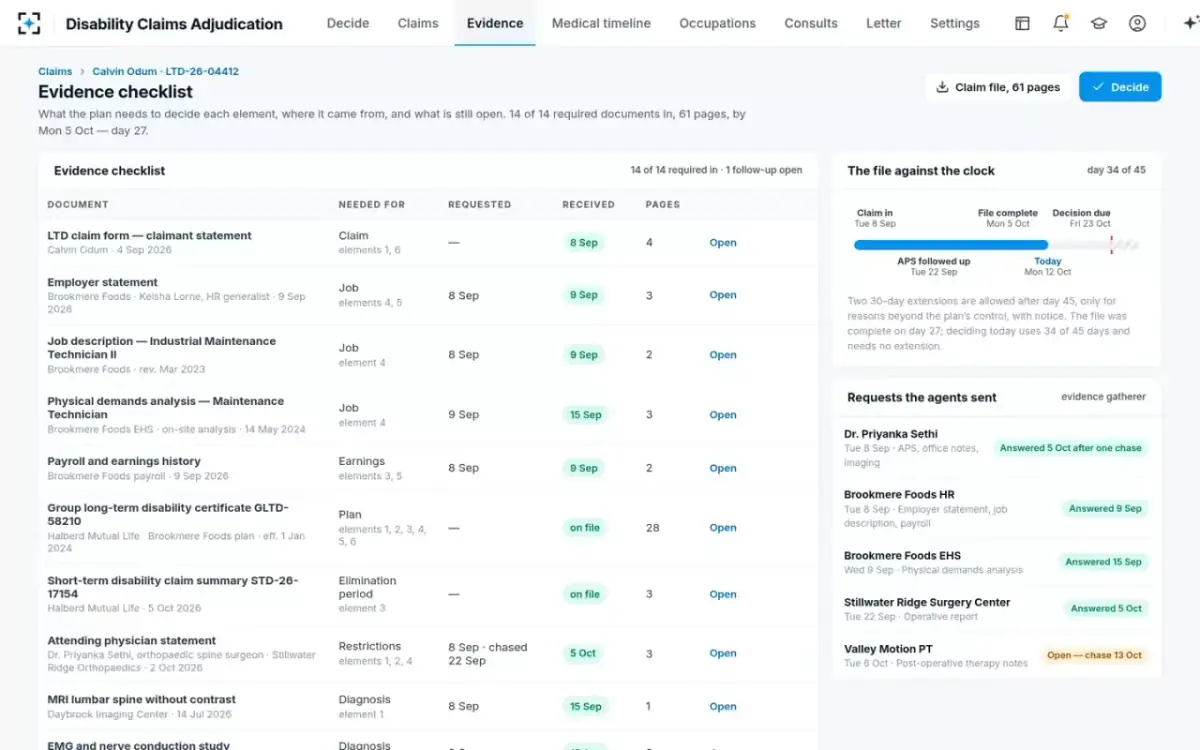
Monday starts with triage. Renata carries 128 open claims; 24 have an initial decision due in the next 30 days. The useful sort is not by claim number but by what each claim is waiting for: a decision, a document, a consultant's answer or an extension notice. On the sample desk, eight are ready to decide, eight are waiting on evidence and three are with a consultant. One is decided before lunch: Calvin Odum, 52, an industrial maintenance technician who had back surgery on 16 September, whose file has been complete since day 27.
Tuesday is the chase. Requests go out to treating doctors, employers and claimants as new claims arrive, and the desk follows up on day 7 and day 14 after each request. In Calvin's case the surgeon's statement was requested on 8 September, chased on 22 September and arrived on 5 October. The rest of the day is reading: an attending physician statement, office notes, an operative report, a job description and a physical demands analysis, side by side with the certificate.
Wednesday brings answers from the nurse and the vocational consultant, and the arithmetic: the gross benefit, the offsets, the start date after the elimination period. Thursday is requests for the week's new claims and letters. Friday is the extension notices that cannot wait. Owen Takahashi's claim rests on restrictions his doctor based on reported symptoms, with neuropsychological testing booked after his 45th day. If the testing is the missing piece, the extension notice has to go out by Friday and name it.
Where a disability claims examiner's 40 hours go
How many claims does a disability examiner handle?
There is no public benchmark for disability caseloads, and the federal regulator says so: in its 2016 rulemaking the Department of Labor admitted it lacked data on how many disability claims are filed or denied (81 FR 92316). It modelled the volume instead: LTD claims at two percent of covered workers a year, borrowed from Social Security's claim rate, STD at six percent, with 39 and 33 percent of 122 million private-sector employees in STD and LTD programs. On those assumptions, our arithmetic gives roughly 2.9 million STD and 0.8 million LTD claims a year. They are the Department's working assumptions, not measured claims.
Coverage has not shrunk since. In March 2026, 44 percent of private industry workers had access to short-term disability plans and 37 percent to long-term disability plans (BLS, Employee Benefits in the United States, March 2026). A desk's real caseload is easier to measure from inside: open claims, new claims a month, and the share that need a decision in the next 30 days. On the sample desk that is 128 open and 24 due. Whatever the count, the number that matters is how many of the 24 are decided on a complete file before day 45 without an extension the plan cannot justify.
STD and LTD examiners: what is the difference?
STD examiners decide short claims fast: elimination periods are measured in days (seven on the sample STD plan) and benefits in weeks, so the work is a high volume of simpler files. LTD examiners decide fewer claims with more at stake, because an approved LTD claim can run for years and the policy's definition usually changes after an own-occupation period, often 24 months on the sample plans. LTD files carry more vocational evidence and more second reviews.
There is also a legal difference. An employer that pays an employee's "normal compensation, out of the employer's general assets" while the employee is unable to work is running a payroll practice, not an ERISA welfare plan (29 CFR 2510.3-1(b)(2)). Insured STD is usually a plan; salary continuation paid from payroll often is not, and then the federal claims rule and its clocks may not apply. Insured group LTD for a private employer is usually an ERISA plan. An examiner who moves between the two learns to check which rulebook a claim is under before counting days.
The four people around one LTD decision in Disability Claims Adjudication
Today
Requests, chases and reads the file, then lays it against the certificate once it is finally complete.
With agents
Opens each claim on the plan’s definition with the agents’ reading of every element; confirms the routine ones and spends the time on the contested one.
Still theirs: Every element decision and the signature on the letter.
Today
Receives a referral and has to find the restriction in the record first.
With agents
Gets the question drafted from the record, the pages it rests on and what her answer will change.
Still theirs: The clinical judgement on whether restrictions are supported.
Today
Starts each any-occupation study from scratch, years after the claim.
With agents
Starts from occupations already tested against the restrictions and the plan’s gainful wage.
Still theirs: The decision on employability, and the signature on the study.
Today
Second-reviews denials whose reasons were written from memory.
With agents
Reviews letters where each reason cites the page it rests on.
Still theirs: The second review on every denial and on large benefits.
How much does a disability claims examiner make?
The Bureau of Labor Statistics does not publish a separate figure for disability examiners. For claims adjusters, examiners and investigators together, the median annual wage was $78,000 in May 2025; the lowest tenth earned less than $48,850 and the highest tenth more than $117,040. In insurance carriers, where the group's largest share works, the median was $79,200 (BLS Occupational Outlook Handbook).
Pay for claims adjusters, examiners and investigators, May 2025
The outlook is flat. BLS projects employment in the occupation group to fall 6 percent from 2025 to 2035, with about 21,600 openings a year from people leaving and retiring. That is one reason carriers look hard at what an examiner's hours are spent on: the work that requires an examiner is not shrinking, and the reading that surrounds it is the part that can move.
What skills does a disability claims examiner need?
The skills that matter are the ones the letter tests: reading a policy definition precisely, reading medical records well enough to find the restriction a doctor actually wrote, and turning a job into measurable demands. BLS lists analytical, communication, detail and interpersonal skills for the whole occupation; on a disability desk they turn into the specific abilities below.
Skills a disability claims examiner uses every week
- Read a certificate as elements
Sickness or injury, physician care, the elimination period, the occupation test, the earnings test, the exclusions: each needs its own evidence.
- Find the restriction, not the diagnosis
A diagnosis does not decide a disability claim. A written limit such as “10 lb occasionally” does.
- Turn a job into demands
Weights, frequencies and hours from the job description, the employer statement and any physical demands analysis.
- Run the clock
Know which delays justify an extension, and send the notice before day 45 with what is missing.
- Write reasons a claimant can follow
The rule asks for reasons “in a manner calculated to be understood by the claimant”.
- Know when to refer
Restrictions missing, conflicting or based only on reported symptoms go to the nurse; borderline demands go to the vocational consultant.
Is disability claims examining a stressful job?
It is a deadline job with incomplete information, which is the usual recipe. No allowed public survey measures examiner stress, but the structure is plain: the clock runs from receipt, the evidence belongs to other people, and every denial can end up in front of a judge, who will usually read only the file the examiner built. When the Department of Labor rewrote the disability rules in 2016, it said disability cases had come to dominate ERISA litigation (81 FR 92316), a point what to look for in long term disability insurance quotes for buyers.
The rule also protects the examiner's judgement. A plan may not hire, pay, promote or dismiss an examiner, or a medical or vocational expert, on how likely that person is to support a denial (29 CFR 2560.503-1(b)(7)), and the Department's own example was a bonus counted in denials. Examiners are measured on timeliness and quality, not on outcomes. The rule's words, and how they bear on software, are the subject of AI in disability insurance claims.
Where Disability Claims Adjudication takes the hours
The agents take the amber part of the week. The evidence gatherer builds the checklist each plan and claim type needs, sends the standard requests within the claimant's signed authorization and chases on day 7 and day 14. The medical record reader reads statements, notes, imaging and operative reports and lifts each restriction with its page and author. The job demands analyst sets each demand from the employer's documents and flags conflicts, such as a 2025 job posting that says "lift up to 75 lbs" against a 2024 demands analysis that says 50. When the examiner opens the claim, the definition is already laid out as elements, each with the agents' reading and its sources.
What stays with the examiner is the green part: confirming the routine elements and deciding the contested one. On Calvin's claim the five routine elements were confirmed in one step, each citing a page; own occupation, where five of eight job demands exceed his surgeon's restrictions, was the one Renata decided. How one restriction travels from the doctor's form to that decision is traced in the attending physician statement form guide.
The file against the clock: complete on day 27, decided on day 34
Questions people ask
What does a disability claims examiner do day to day?
Most days go on evidence: requesting attending physician statements, records, job descriptions and payroll, chasing them, and reading what arrives against the policy's definition of disability. The rest goes on benefit arithmetic, letters and extension notices. On our estimate for a sample LTD desk, deciding itself is about two hours of a 40-hour week.
How long does a disability examiner have to decide a claim?
Under the Department of Labor's rule for ERISA plans, a denial must be sent within 45 days of receiving the claim. The plan may extend twice by 30 days, but only for matters beyond its control and only with a notice sent before the current period ends, naming what is missing and giving the claimant at least 45 days to supply it.
Do disability claims examiners need a license?
It depends on the state. BLS notes that licensing requirements for claims adjusters and examiners vary by state, and that in some states adjusters employed by insurance companies can work under the company's license rather than holding their own. Check the rules in each state where you will decide claims.
Is a disability claims examiner the same as a Social Security disability examiner?
No. A carrier's examiner decides claims under a private group policy and the ERISA claims rule. Social Security sends the medical part of its disability claims to a state Disability Determination Services office, which decides under SSA's own rules. The two meet on the file: a denial of a private claim must explain any disagreement with a Social Security decision the claimant sends.
Can an examiner's pay depend on how many claims they deny?
Not for ERISA disability plans. For claims filed after 1 April 2018, when the 2016 rule began to apply, decisions on hiring, pay, promotion or termination of claims adjudicators and medical or vocational experts must not be based on the likelihood that they will support a denial. The Department's own example is a bonus tied to the number of denials.
What is the hardest part of an LTD decision?
Usually the occupation element: whether the claimant can do the material duties of their own occupation, measured against restrictions a doctor wrote for a different purpose. In the sample claim it was the one element of six the examiner had to decide herself; the other five were confirmed from the pages that support them. The words in that test are unpacked in material and substantial duties.