An attending physician statement form (APS) is the disability carrier's questionnaire for the claimant's treating doctor: diagnosis, dates of treatment, the findings behind it, and above all the restrictions and limitations, such as a lifting limit of 10 pounds occasionally or two hours a day on the feet. In a short- or long-term disability claim those restrictions are what the examiner sets against the demands of the claimant's job, so a single line on the form can decide the claim. Botminds' Disability Claims Adjudication was built around that line: its agents lift every restriction from the statement with its page and author, draw it against the job, and keep the citation attached all the way into the letter the examiner signs.
The restriction followed here comes from the solution's sample claim: a fictional claimant, Calvin Odum, an industrial maintenance technician recovering from back surgery, and his fictional surgeon, Dr. Priyanka Sethi. The rules quoted are the Department of Labor's ERISA claims rule, the HIPAA privacy rule and the Department's own occupational definitions. In life insurance underwriting "APS" names a different document; this guide is about the disability claim form.
One restriction, from the attending physician statement form to the letter
| Step | What it says at this step | Where the meaning can slip | The citation that must stay attached |
|---|---|---|---|
| The APS, 2 Oct, page 2 | Lift/carry: “10 lbs occasionally; no frequent lifting”. Valid until re-evaluation on 13 Nov. | Frequency words mean different things on different forms; the end date is easy to drop. | APS, Dr. Sethi, 2 Oct 2026, p.2 |
| The medical timeline | Lift limit 10 lb from 2 Oct, after 5 lb for two weeks after surgery on 16 Sep. | An older, stricter limit can be quoted as if it were current. | Op report p.1; APS p.2; office notes |
| Nurse review (when needed) | Not referred: the limit rests on surgery and imaging, not only on reported symptoms. | A limit based only on what the patient reports needs a clinical opinion before it carries weight. | MRI p.1; op report p.1 |
| The job match | The job needs 50 lb occasionally and 25 lb frequently; both exceed the limit. | A 2025 job posting says 75 lb; the 2024 demands analysis governs, and either figure is above 10. | Demands analysis p.2; employer statement p.3 |
| The element decision | Own occupation: not able. 5 of 8 demands exceed the restrictions. | A decision written from memory loses which page carried it. | Recorded with 2 sources: APS p.2, demands analysis p.2 |
| The letter | “Dr. Sethi’s statement of October 2 limits you to lifting 10 lb occasionally, no frequent lifting …” | A reason without its source is hard to defend on appeal. | APS p.2, shown beside the sentence |
What is an attending physician statement?
It is the treating doctor's written account of the claimant's condition, completed on the carrier's form or in a letter answering the carrier's questions. Each carrier writes its own form, so the layout varies. Whatever the layout, an examiner needs five things from it: the diagnosis, the dates of treatment and the next visit, the objective findings behind the diagnosis (imaging, tests, examination), a grid of restrictions and limitations (lifting and carrying, standing, walking, sitting, bending, climbing, reaching, fine manipulation), each with an amount and a frequency, and how long the limits are expected to last.
The grid is where a disability claim is won or lost, because group policies rarely pay on a diagnosis. They pay when the claimant cannot do the duties of an occupation. That is why claims with physical restrictions dominate the examiner's desk: in the joint group long-term disability study by the SOA Research Institute and LIMRA, an industry research group funded by insurers, back conditions made up 15 percent of the 2015–2024 exposure and other musculoskeletal conditions another 13 percent (SOA Research Institute and LIMRA, 2026). Those are shares of open-claim months studied, not of new claims.
Who fills out an attending physician statement?
The treating doctor, or the doctor's office on the doctor's signature, after the claimant authorizes the release. The doctor's office is a HIPAA covered entity, so it needs a valid authorization before it sends records to a disability carrier. That authorization must contain, among other things, "a description of the information to be used or disclosed", the person authorized to receive it, "a description of each purpose", "an expiration date or an expiration event" and the claimant's signature and date (45 CFR 164.508(c)).
The carrier itself sits outside HIPAA for this coverage. HIPAA's definition of a health plan excludes excepted benefits, and "disability income coverage" is excepted in all circumstances (45 CFR 160.103, 45 CFR 146.145). State insurance privacy law governs the carrier's handling instead. In practice the authorization the claimant signed is the boundary of what the carrier may ask for, and the sample solution's evidence gatherer is held to it: it requests nothing beyond the signed authorization and never asks the employer about the diagnosis.
What restrictions go on an attending physician statement?
Restrictions should be written as amounts and frequencies the examiner can set against a job: pounds and how often, hours and at a time, never or occasionally. The trap is the frequency words. "Occasionally" sounds precise and is not; three common definitions differ, and a restriction read under one and a job described under another can disagree without anyone noticing. The Department of Labor's own wording sits inside its strength ratings, which the sedentary work definition quotes in full.
“Occasionally” does not mean the same thing on every form
The Department of Labor's occupational definitions: DOT: up to a third of the time.
Other definitions an examiner meets: BLS Occupational Requirements Survey: "2 percent and up to 1/3 of the workday". One physician form in a 2010 court case: "less than 2.5 hours".
The Department of Labor's occupational definitions: DOT: from a third to two thirds of the time.
Other definitions an examiner meets: ORS: "1/3 up to 2/3 of the workday". The same physician form: "2.5 to 5.5 hours".
The Department of Labor's occupational definitions: DOT: two thirds of the time or more.
Other definitions an examiner meets: ORS: "2/3 or more of the workday". The physician form: "continuously", "more than 5.5 hours each day".
The Department of Labor's occupational definitions: DOT has no separate level.
Other definitions an examiner meets: ORS adds "Seldom": "Up to 2 percent of the workday".
The court case is a useful warning. In Darvell, the claimant's own doctor completed a "physical ability assessment" stating he could lift up to ten pounds "continuously" and up to 20 pounds "frequently", on a form that defined its own terms, and the insurer compared it with the Dictionary of Occupational Titles description of his occupation as light work (Darvell, 8th Cir. 2010). The court upheld the denial. Whatever one makes of the outcome, the file shows two vocabularies meeting on one claim. A reader that quotes the restriction without the form's definition of its words passes on an ambiguity the doctor never intended.
Following one restriction: “10 lbs occasionally; no frequent lifting”
Dr. Sethi's statement of 2 October, page 2 of 3, lists seven restrictions. Four are highlighted because the agents used them: lift and carry "10 lbs occasionally; no frequent lifting", stand and walk "20 minutes at a time, 2 hours total per day", bend, stoop and twist "occasionally; no repetitive bending or twisting", and climb "no ladders; stairs occasionally". Sitting is limited to "30 minutes at a time with position change, 6 hours per day"; reaching overhead and fine manipulation carry no restriction. The heading carries a date range: from 10/02/2026 until re-evaluation on 11/13/2026.
The restriction, on its page, with the lines the agents used
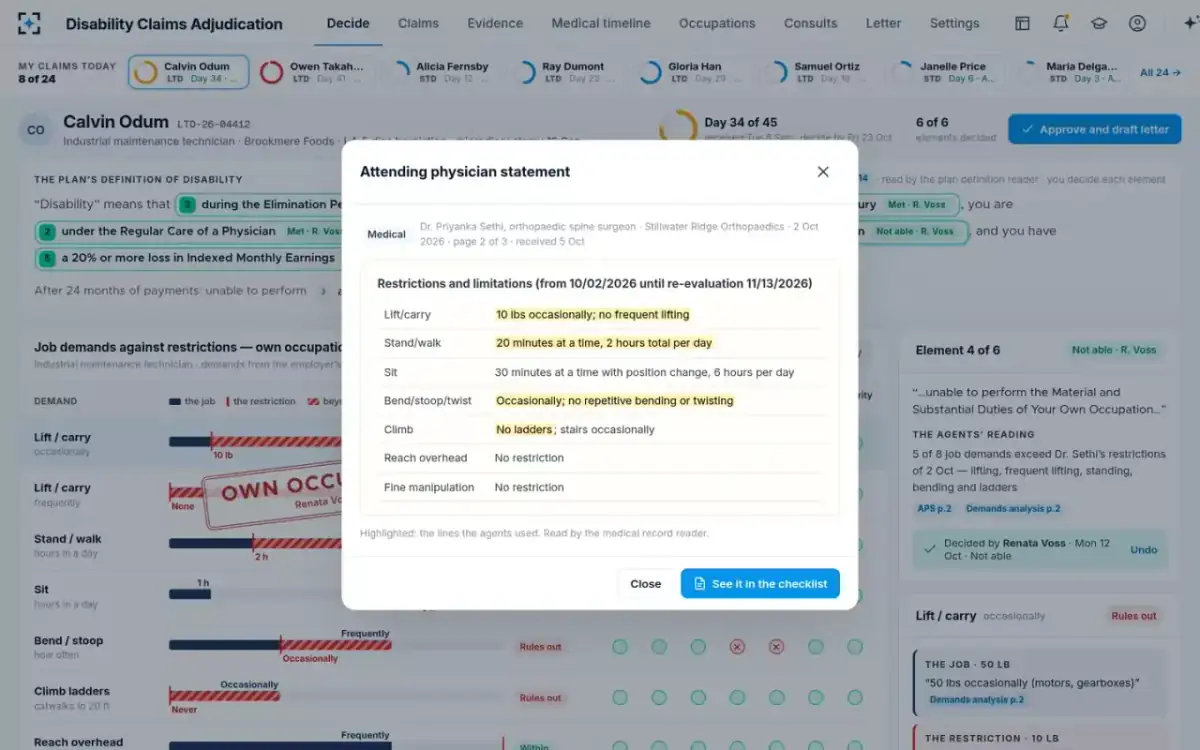
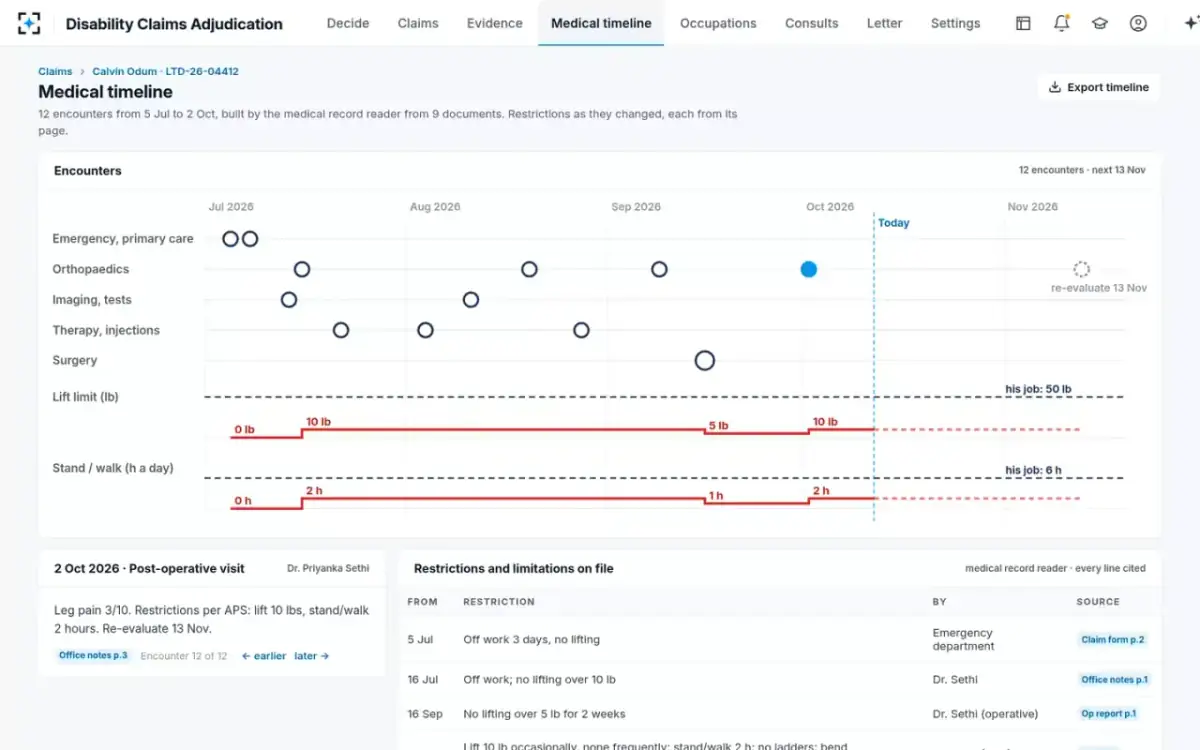
Three things happen to that line before it reaches a letter. First, it joins a timeline. The medical record reader builds twelve encounters from nine documents, from the emergency visit on 5 July to the post-operative visit on 2 October, and draws the lift limit as a step line: zero, then 10 pounds from 16 July, 5 pounds for two weeks after surgery on 16 September, then 10 again. An examiner who quoted the operative report's "no lifting over 5 lb" in October would be quoting a limit that had expired.
Second, it meets the job. The 2024 physical demands analysis puts Calvin's job at 50 pounds occasionally ("motors, gearboxes") and 25 pounds frequently. A 2025 job posting says "lift up to 75 lbs". The job demands analyst flags the conflict rather than choosing silently; the solution's setting ranks the demands analysis above a posting, and either figure is far above 10. Third, it becomes a decision: five of the eight demands exceed the restrictions, the examiner marks own occupation "not able", and the decision is recorded with its two sources.
Restrictions as they changed, each one cited to its page
Does the insurer have to follow my doctor?
No, but it has to explain why it does not. The Supreme Court held in Nord that ERISA and its regulations "do not command plan administrators to credit the opinions of treating physicians over other evidence relevant to the claimant's medical condition" (Black & Decker v. Nord, 2003). Since the 2016 rule, though, a disability denial must explain why the plan disagrees with, or does not follow, the views of the claimant's treating health care professionals (29 CFR 2560.503-1(g)(1)(vii)(A)), and the Department said that merely stating that a reviewing physician disagrees does not satisfy it. AI in disability insurance claims quotes the full paragraph, which also reaches the plan's own experts and Social Security.
Departmental investigators reviewing disability claims report that if the plan deviates from an attending physician's recommendation, a review is conducted by a supervisor, nurse, medical director or a consultant.
Department of Labor, 2016 final rule on disability claims
That is why the restriction's basis matters as much as its number. In the sample solution, restrictions that are missing, that conflict, or that rest only on reported symptoms go to the nurse clinical consultant before anyone relies on them or departs from them. Calvin's did not need to: it rests on an MRI, a nerve study and an operation. Another sample claimant's restrictions, based on reported fatigue with no testing on file, did.
How long does a doctor have to complete an APS?
The ERISA claims rule sets no deadline for the doctor. It sets one for the plan: for an ERISA disability plan, a denial must be sent within 45 days of receiving the claim, and the clock starts when the claim is filed even if the information needed to decide it has not arrived (29 CFR 2560.503-1(f); the examiner's week shows what that does to a desk). A late APS can justify an extension, because a doctor's office is a matter beyond the plan's control, but the extension must be noticed before day 45 and must name what is missing.
Calvin's APS against the 45-day clock: one chase, no extension
- Requested 8 Sepday 0–14
- Chased 22 Sepday 14–27
- File complete 5 Octday 27
- Decided 12 Oct+7 days
- Margin to 23 Oct11 days
What happens if the APS is incomplete?
The plan has to say what is missing and why it matters. A denial must describe any further material the claimant needs to complete the claim and explain why it is needed (29 CFR 2560.503-1(g)(1)(iii)), the same paragraph health plans answer to, as the insufficient documentation denial shows for prior authorization. In its 2016 rulemaking the Department added that "claims administrators working with an apparently deficient administrative record must inform claimants of the alleged deficiency and provide them with an opportunity to resolve the stated problem by furnishing missing information" (81 FR 92316).
An incomplete statement is therefore a prompt to ask a precise question, not grounds for a vague denial. The useful follow-up names the field: a lifting limit without a frequency, a restriction without an end date, a diagnosis without the findings behind it. The extension notice, if one is needed, must give the claimant at least 45 days to supply it. What a claim costs when the chase drags on is priced in the disability claims process, step by step.
Eight checks on every attending physician statement before you rely on it
- Signed, dated and attributable
Who wrote it, in what specialty, and on what date.
- The period it covers
A restriction “until re-evaluation 11/13” expires; note the date and diary it.
- Amounts and frequencies
Pounds and how often, hours and at a time. “Light duty” alone is not a restriction.
- The form’s own definitions
If the form defines “occasionally”, carry its definition with the restriction.
- The basis
Examination, imaging, surgery or testing, or reported symptoms only. The last goes to the nurse.
- Consistency with the notes
The APS should match the office notes of the same visit; differences need a question, not a guess.
- Coverage of the job’s demands
If the job requires climbing and the APS is silent on climbing, ask.
- The current limit, not the oldest
Read the restriction in date order; a post-operative limit may already have changed.
How Disability Claims Adjudication keeps the citation attached
Every element reading, restriction, job demand and reason in the letter cites the document and page it came from, and any citation opens the page with the lines used highlighted. The medical record reader may not infer a restriction a provider did not write, and it flags restrictions that rest only on reported symptoms. The letter drafter writes the approval or denial from the decided elements; in Calvin's approval, the restriction sentence sits beside its source, "APS p.2". The design target is that every reason in the letter is tied to a page.
The restriction's last stop is the comparison with the job, and that comparison depends on what "the job" means under the policy: the claimant's position at his employer, or his occupation as it is performed across the economy. Material and substantial duties works through which test applies.
Questions people ask
Is the attending physician statement the same for short-term and long-term disability?
The questions are much the same: diagnosis, treatment, restrictions and expected duration. The difference is how often they are asked. An STD claim runs for weeks (the sample STD plan has a seven-day elimination period and a weekly benefit), so one statement and a return-to-work date may settle it; an LTD claim can run for years, so the restrictions are asked for again at each re-evaluation.
What does “occasionally” mean on an attending physician statement?
Under the Department of Labor's Dictionary of Occupational Titles it means up to one third of the time. The BLS Occupational Requirements Survey uses 2 percent up to one third of the workday, and some forms define their own terms in hours. Read the form's definition before comparing a restriction with a job.
Can the insurer call my doctor directly?
Only within the authorization you signed, and HIPAA requires that authorization to say what may be disclosed, to whom, for what purpose and until when. In the sample solution no agent contacts a doctor beyond a standard request; clinical conversations are for the nurse or a physician consultant.
What if my doctor says I am disabled but the APS shows light restrictions?
The plan will weigh the specific restrictions more than the conclusion, because the policy asks whether you can do the duties of an occupation. The 2016 rule requires a denial to explain any disagreement with your treating doctor's views, so a conclusion the plan rejects must still be addressed in the letter.
Does a functional capacity evaluation replace the APS?
No, it adds to it. An evaluation measures what the claimant did on test day; the APS records the treating doctor's view over time. In Halloran (8th Cir. 2026), an occupational therapist's evaluation concluding the claimant could not work was weighed against his surgeon's sedentary-work restrictions over the previous two years, and the court affirmed the finding that he could do sedentary work.