Material and substantial duties, in a group disability policy, are the core duties of the claimant's occupation: the ones that define the work, as opposed to tasks that can be dropped or done another way. An own-occupation or regular-occupation definition pays when sickness or injury leaves the claimant unable, or limited, in performing them. The definition that applies is the one in the certificate, and two of its words decide most disputes: whether "occupation" means the claimant's own position or the occupation as it is generally performed, and whether "the" or "all" the duties must be beyond reach. Botminds' Disability Claims Adjudication starts every claim from that wording: its plan definition reader splits the certificate's definition into elements with the page, passes any ambiguity to the examiner, and its job demands analyst sets each duty from the employer's documents.
The policy wordings quoted below are as federal appeals courts quoted them in their opinions; the sample claim, with a fictional claimant and carrier, comes from the solution. Nothing here is legal advice on a particular claim.
Five ways a policy words the occupation test, and what each points to
| Policy wording | Where it was quoted | What it points the examiner to |
|---|---|---|
| “limited from performing the material and substantial duties of your regular occupation”, changing after 24 months to “any gainful occupation for which you are reasonably fitted by education, training or experience” | Halloran, 8th Cir. 2026 | A limitation test, not an inability test, for the first 24 months |
| “unable to perform all the material duties of his or her regular occupation”, with regular occupation undefined | Darvell, 8th Cir. 2010 | An open question: the claimant’s job or the occupation in general; and “all” |
| “unable to perform the material duties of his or her Regular Occupation”, where Regular Occupation is the occupation “as it is normally performed in the general labor market in the national economy. It is not work tasks that are performed for a specific employer or at a specific location.” | Crowell, 5th Cir. 2011 | The occupation as performed nationally, by the policy’s own words |
| “unable to perform all of the material and substantial duties of his occupation” | Kalish, 6th Cir. 2005, as summarised in a 2006 magistrate judge’s report (W.D. Pa.) | Whether “all” means each and every duty, or that losing one duty is enough |
| “unable to perform the Material and Substantial Duties of Your Own Occupation”, for 24 months | The fictional sample certificate GLTD-58210, page 14 | The element the examiner decides; the job’s demands against the restrictions |
What are material and substantial duties?
They are the duties that make an occupation what it is. Where the certificate defines the phrase, that definition controls, and an examiner reads it before anything else. Where it does not, courts read the phrase with the rest of the definition and the plan's grant of discretion, if any. In practice, material duties are established from documents: the job description, a physical demands analysis, the employer's statement, and occupational data on how the work is done elsewhere. A duty that appears in none of them is hard to call material.
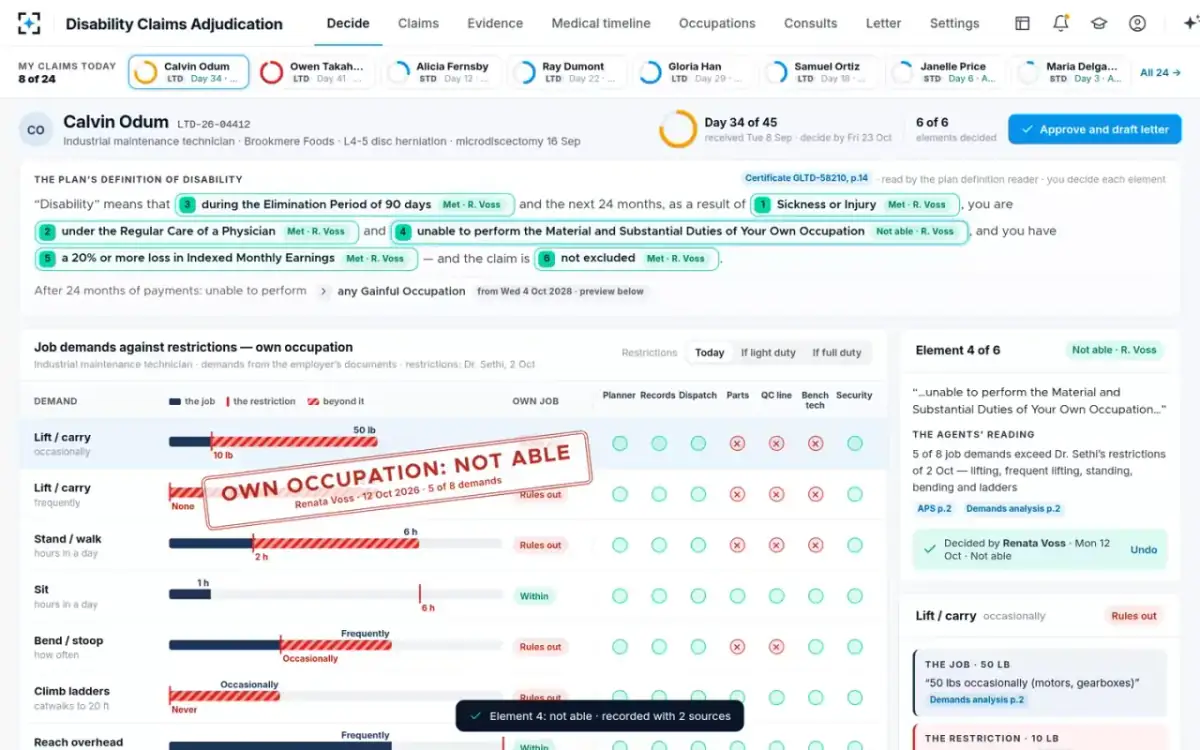
"Substantial" adds weight rather than a separate test. The question is not whether a claimant can do any task the occupation involves, but whether the restrictions rule out the core of it. In the sample claim the job demands analyst set eight demands from the employer's 2024 physical demands analysis: lifting 50 pounds occasionally and 25 frequently, six hours on his feet, frequent bending, climbing ladders, reaching overhead, fine manipulation and an hour of sitting. Five of the eight exceeded the claimant's restrictions.
Is own occupation my job or my occupation?
It depends on the words, and where the words are silent the federal courts of appeals have disagreed. The Eighth Circuit set out the choice in 2010: "material duties of his … regular occupation" can refer to "the duties that are commonly performed by those who hold the same occupation as defined by the DOT (a 'generic' approach), or the duties that the specific claimant actually performed for his employer (a 'claimant-specific' approach)", and "the circuits are split" on it under abuse-of-discretion review (Darvell, 8th Cir. 2010).
The court listed the split. The Sixth Circuit had held an insurer reasonably read "regular occupation" as the occupation "as it is performed in a typical work setting in the general economy"; the Tenth Circuit had required the insurer to consider the claimant's actual job duties; and the Third Circuit, in Lasser, had read "regular occupation" as "the usual work that the employee is actually performing immediately before the onset of disability". Those are the Eighth Circuit's summaries of the other courts' holdings. Under its own deferential review, the court held that applying the DOT description was reasonable, noting that it was "largely consistent with evidence of the duties that Darvell actually performed".
“Occupation” is a more general term that seemingly refers to categories of work than narrower employment terms like “position,” “job,” or “work,” which are more related to a particular employee's individual duties.
Osborne v. Hartford (6th Cir.), as quoted by the Eighth Circuit in Darvell (2010)
Which test applies? Start from the certificate
The answer follows from three questions, asked in order. The first two decide whose duties are tested; the third decides how many of them must be out of reach. Each answer points to different evidence.
Which material and substantial duties test applies
Does the certificate define the occupation? Read the definitions section, not only the definition of disability.
Test the occupation as generally performed. Evidence: occupational data for the right occupation, and the job file to classify it correctly.
Test the job as performed. Evidence: job description, physical demands analysis, employer statement.
Go to question 2.
Does the plan give the administrator discretion to construe its terms? Under Firestone this sets the court’s standard of review.
A reasonable reading of “occupation” is likely to stand; the generic reading has been upheld. Gather both, and say which reading was applied and why.
The court reads the words itself, and circuits differ. Gather both: the job as performed and the occupation as generally performed.
Must the claimant be unable to perform “all” the material duties, or “the” duties, or be “limited” in them?
Courts have divided on whether one lost duty is enough. Test every material duty and record which ones the restrictions rule out.
Read as the core duties; still test each, since the letter must give specific reasons.
A lower bar than “unable to”. Record the degree of limitation as well as the yes or no.
All the material duties, or any one?
"All" sounds strict, and courts have read it both ways. A magistrate judge's 2006 report in the Western District of Pennsylvania catalogued the split: the Sixth Circuit in Kalish held that the ability to do sedentary work could not support a denial under a plan requiring inability "to perform all of the material and substantial duties of his occupation" where the job was not exclusively sedentary; the Eighth Circuit in Seitz found an employee disabled who "was physically unable to fulfill at least one material aspect of his job"; and the Fifth Circuit in Ellis read the same kind of wording as requiring an inability to perform "each and every job duty" (Schwarzwaelder, W.D. Pa. 2006, summarising those decisions).
The practical lesson for an examiner is to decide each material duty separately and write down which the restrictions rule out. A letter that says "you can perform the material duties of your occupation" without saying which duties were tested, against which restrictions, invites exactly the argument these cases record. The rule requires "the specific reason or reasons" for a denial and "reference to the specific plan provisions" relied on.
Each job demand against the restriction, element 4 decided with two sources
How do insurers decide material duties?
From documents, and increasingly with a vocational consultant. In Crowell, the insurer's appeal review used a vocational rehabilitation counselor "who reviewed descriptions of Crowell’s original and new positions with ABX, and the relevant job descriptions in the Department of Labor’s Dictionary of Titles", and found that his occupation, "as defined in the national economy", would not require him to work sixty hours a week; his doctor had written that he could not work long shifts (Crowell, 5th Cir. 2011). The court upheld the denial under the plan's definition, which itself said the test was the occupation "as it is normally performed in the general labor market".
The evidence an examiner needs is the same whichever reading applies; only its weight changes. The sample solution sets each demand from the documents in a fixed order of preference, a physical demands analysis first, then the job description, the employer statement and any job posting, and flags conflicts between them. It refers the claim to the vocational consultant when a job demand is within 20 percent of a restriction, where the classification of the occupation can change the answer. The occupational data that a generic reading relies on is changing too: the DOT has not been updated since 1991, and the BLS Occupational Requirements Survey is replacing it at Social Security.
What if my job is heavier than the DOT says?
Then the reading of "occupation" decides the claim. Darvell is the clearest example: the claimant sold advertising and said his job meant carrying a book of advertising and account information "that weighed about 35 pounds"; the insurer classified his occupation under the DOT as light work; and the employer's own job description said the job required carrying "ten pounds occasionally".
Darvell: one job, three accounts of its demands
The job as the claimant described it: Carrying a book of advertising and account information “that weighed about 35 pounds”.
The occupation as the insurer applied it: DOT light work: “lifting, carrying, pushing, pulling 20 pounds occasionally, frequently up to 10 pounds”.
The job as the claimant described it: In-person sales calls; the claimant said his conditions prevented “the driving, walking, and carrying involved in his job”.
The occupation as the insurer applied it: DOT: “walking and/or standing frequently even though weight is negligible”.
The job as the claimant described it: Not the claimant’s account.
The occupation as the insurer applied it: An account executive “needs to carry ten pounds occasionally and is not required to stand or walk for prolonged periods”.
The job as the claimant described it: The claimant argued for his actual duties.
The occupation as the insurer applied it: Applying the DOT description was reasonable under deferential review; the denial stood.
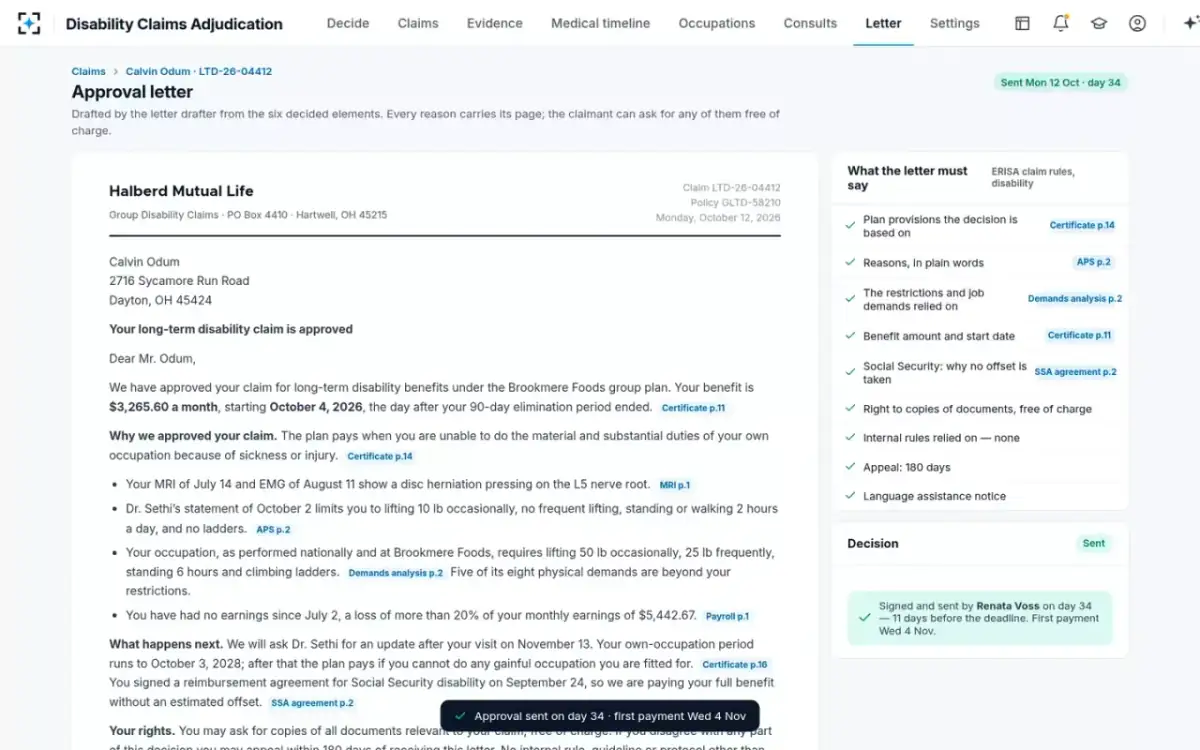
The lesson cuts both ways. A claimant whose job is heavier than the national version may lose under a generic reading, as the court allowed here; a plan whose wording is claimant-specific must test the heavier job. The examiner's protection is a file that shows both, says which reading the certificate requires, and explains the choice. In the sample claim the letter does exactly that: "Your occupation, as performed nationally and at Brookmere Foods, requires lifting 50 lb occasionally, 25 lb frequently, standing 6 hours and climbing ladders."
What is regular occupation in disability insurance?
"Regular occupation" and "own occupation" are the two common names for the first-stage test in group LTD, the one that applies before the definition changes to any occupation. Some policies define it, as in Crowell, to mean the occupation as normally performed in the national economy, expressly "not work tasks that are performed for a specific employer". Others leave it undefined, and the reading then depends on the circuit and the standard of review. A few word it as the claimant's own job.
The test has a time limit on most group LTD certificates. In Halloran, decided in August 2026, the definition changed after 24 months from "limited from performing the material and substantial duties of your regular occupation" to "unable to perform the duties of any gainful occupation for which you are reasonably fitted by education, training or experience" (Halloran, 8th Cir. 2026). On the sample certificate the own-occupation period ends on 3 October 2028; what the paying carrier has to do before that date is the subject of own occupation vs any occupation.
The occupation test written into the letter, with its sources
What is a job description used for in a disability claim?
It is the employer's account of the duties, and it does three jobs. It identifies the occupation, so the right occupational data is used under a generic reading. It sets the demands, with amounts and frequencies, under a claimant-specific reading. And it is the check on the other sources: in Darvell the court relied on the employer's job description to find the DOT account "largely consistent" with the duties actually performed. A job description without weights and frequencies does little of this, which is why a physical demands analysis, where one exists, ranks first. How "sedentary" and "light" are defined when a job is classified is set out in the sedentary work definition guide.
What the file should show on the material and substantial duties test
- The wording, with its page
The definition of disability and any definition of occupation, quoted from the certificate.
- Which reading was applied, and why
The job as performed, the occupation as generally performed, or both; and the reason the certificate requires it.
- Each material duty, with its source
Amount and frequency from the demands analysis, job description, employer statement or occupational data.
- Conflicts between sources
Flagged and resolved by a person, with the reason one source governs.
- Each restriction, with its page and dates
From the attending physician statement or records, current on the decision date.
- Duty by duty, the result
Which duties the restrictions rule out and which they do not; for “all”, every duty is decided.
- The vocational view, if one was sought
Named and addressed in any denial, as the rule requires for plan experts.
Questions people ask
Is “material and substantial duties” the same as “essential functions” under the ADA?
No. Essential functions belong to employment law and the employer's duty to accommodate; material and substantial duties belong to the insurance contract and decide benefits. The same job description may inform both, but the tests and the decision-makers differ.
Can an insurer ignore my employer's job description?
Under a generic reading it may rely on occupational data instead, as in Darvell, but the job description is still evidence and the letter must give specific reasons. Under a claimant-specific reading the job description and any demands analysis are central.
What does “limited from performing” mean compared with “unable to perform”?
"Limited from" is a lower bar: the claimant need not be wholly unable to do a duty, only restricted in it. The policy in Halloran used "limited from" for the first 24 months and "unable to perform" for any gainful occupation afterwards.
Does working part time mean I can perform my material duties?
Not necessarily. If the occupation requires full-time hours, or a duty cannot be done for the time the job needs it, part-time capacity can leave a material duty out of reach. In Crowell the dispute was over hours: the insurer's vocational counselor found the occupation as performed nationally would not require sixty-hour weeks, and the court upheld the denial as supported by substantial evidence.
Who decides which reading of “occupation” applies?
The plan's fiduciary, applying the certificate, and in the end a court. That is why the plan definition reader in the sample solution never reads past the wording: where the certificate is ambiguous, the question goes to the examiner, and the letter says which reading was applied.