Own occupation vs any occupation is the difference between two definitions of disability in a long-term disability policy: under own occupation, a claimant is disabled if she cannot perform the material duties of her own occupation; under any occupation, only if she cannot perform any gainful occupation she is reasonably fitted for by education, training and experience. Group LTD policies commonly pay under the own-occupation test for a set period, 24 months of benefits in the sample policy on this page, and then switch, so the end of the own-occupation period is the single date most likely to end a claim. Botminds' LTD Claim Monitoring diaries that date for every open claim and opens the any-occupation review 120 days ahead, with the restrictions, job demands and any Social Security decision gathered for the examiner.
The claims used as examples belong to the fictional carrier Larkspur Mutual, sample data as they run through the solution. The claims data come from the Society of Actuaries Research Institute and LIMRA's joint study; the rules from the Department of Labor, the Social Security Act and the Supreme Court, linked where they appear.
One claim's first three years: elimination period, own occupation, the review window and any occupation
- Elimination period3 mo
- Own occupation20 mo
- Review window120 d
- Any occupationto 2041
What is the difference between own occupation and any occupation?
The difference is which work the claimant is measured against. Own occupation compares her restrictions with her own occupation, as it is generally performed; any occupation compares them with every occupation that fits her education, training and experience, usually at a minimum level of earnings. A warehouse operations supervisor who cannot stand, walk or lift for a shift is disabled from her own occupation. Whether she is disabled from any occupation depends on whether there are seated jobs she could learn, at the pay the policy calls gainful, within her restrictions.
Own occupation vs any occupation in a group LTD policy, test by test
Own occupation: Can she perform the material duties of her regular occupation?
Any occupation: Can she perform any gainful occupation she is reasonably fitted for?
Own occupation: Her occupation as generally performed, not only her employer's version of it
Any occupation: Every occupation that fits her education, training and experience
Own occupation: Restrictions and the duties of one occupation
Any occupation: Restrictions, a transferable-skills analysis, labour-market and earnings information
Own occupation: Examiner and clinical consultant
Any occupation: Examiner, clinical and vocational consultants
Own occupation: Social Security does not use an own-occupation test
Any occupation: Closer to Social Security's test, which looks at any substantial gainful activity
The words that carry the weight are defined in the policy, not in law: "material duties", "regular occupation", "reasonably fitted", "gainful". Which duties count as material is its own question, and one that belongs to claim decisions, covered by material and substantial duties in Disability Claims Adjudication. What matters for monitoring is that the test changes on a known date, and the evidence needed for the second test takes months to gather.
What happens after 24 months of long term disability?
Under a policy with a 24-month own-occupation period, the definition changes at the end of 24 months of benefits: from then on, the claimant must be unable to perform any gainful occupation she is fitted for, and the plan reviews the claim against that test. Benefits continue if she meets it, end if she does not, and may continue under a separate limitation if one applies. The change is written in the policy, so it can be diaried from the day the claim is approved.
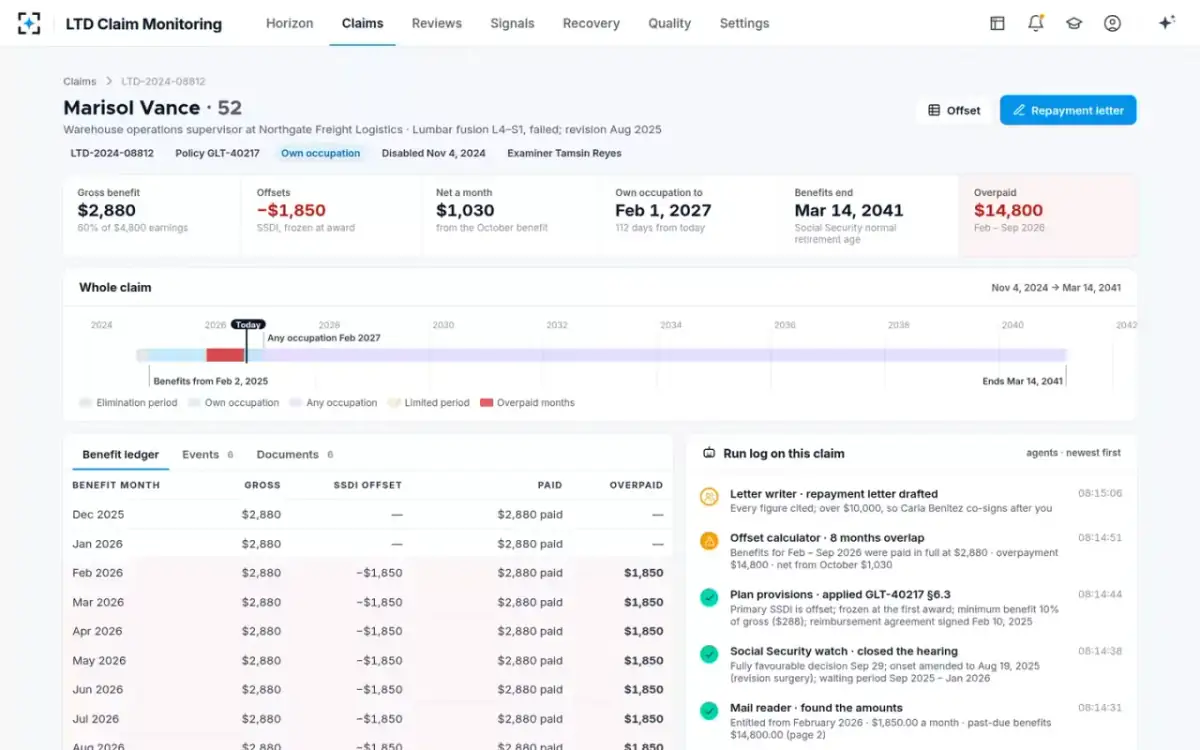
In the sample, Marisol Vance became disabled on November 4, 2024, after a failed lumbar fusion. Her 90-day elimination period ended and benefits began on February 2, 2025; her own-occupation period ends on February 1, 2027; and from February 2 she must meet the any-occupation test. Her review opened on October 5, 2026, 120 days before the change, and the decision is due on January 15.
The whole claim in LTD Claim Monitoring: own occupation to February 1, 2027, any occupation after
What is a change in definition in LTD?
A change in definition is the date a policy stops measuring disability against the claimant's own occupation and starts measuring it against any occupation. Actuaries sometimes call it the transition, and it shows clearly in claims data. The Society of Actuaries' 2016 report on 2004–2012 experience noted that the 2008 experience table "includes monthly expected terminations for claims with limited own occupations periods from the month of the change in definition through 8 months after the transition month" (SOA 2016 Group LTD Experience Study): the table itself expects claims to end around the change.
The same report warns that "a one day difference in the coding of the effective date of termination can alter the indicated transition termination month". For a claims team the lesson is practical. The date of change is a policy term that should be on every claim from approval, coded once and correctly, so that the review, the letter and the experience data all agree.
How do insurers decide any occupation?
Insurers decide any occupation by comparing the claimant's current restrictions with the demands of occupations she could do, given her education, training and experience, and the policy's earnings level. The usual steps are a current physician statement or functional assessment, a transferable-skills analysis by a vocational consultant, a check of each candidate occupation's physical and mental demands, and a check that it pays at the gainful level. Social Security's own rules grade work by exertion, with sedentary work involving lifting no more than 10 pounds at a time (20 CFR 404.1567), and many vocational reviews borrow that vocabulary even where the plan is not bound by it.
What the review needs most is time. A vocational consultant asked two weeks before the change cannot obtain a current restriction, run a skills analysis and test the occupations properly. In the sample, the any-occupation review opens 120 days ahead, and the fictional vocational consultant's words in the solution are "Give me 120 days before the definition changes, not two weeks."
What is gainful occupation in LTD?
A gainful occupation is one that pays at least the earnings level the policy sets for the any-occupation test, often written as a share of the claimant's pre-disability earnings. It stops the any-occupation test from being met by jobs the claimant could do but that would pay a fraction of what she earned. The level is a priced feature of the policy, and two policies with the same 24-month own-occupation period can produce different outcomes for the same claimant because of it.
For the review, gainful turns a list of possible occupations into a shorter one. A seated dispatcher job that fits a warehouse supervisor's restrictions may or may not be gainful for her; the vocational report should show the wage source and the policy's level side by side, so the examiner can see the test applied rather than assumed.
Why so many claims end around the change: the 2015–2024 data
Claims end around the change because the any-occupation test is harder to meet, and the latest industry study finds the effect stronger than the old table assumed. The Society of Actuaries Research Institute and LIMRA studied group LTD claim terminations from 2015 to 2024, with 18 companies covering about 82% of the US group LTD market and over 43 million life-months of exposure (2015–2024 Group LTD Termination Study, September 2026). One of its notable findings is about this very date:
"The effect of the ending of Own Occupation periods on recoveries appears to be more pronounced than that estimated by the 2008 Table."
Society of Actuaries Research Institute and LIMRA, 2015–2024 Group Long-Term Disability Termination Study (2026)
Recoveries against the 2008 table, by quarter since disability: the peak falls in months 25 to 30
Two cautions keep the chart honest. First, these are ratios to a table, not recovery rates: 236% means more than twice as many recoveries as the 2008 table expected for that quarter, not that 236% of anything recovered. Second, the industry counts the end of an own-occupation period as a recovery. The 2016 report says so plainly: "terminations due to the change in definition from own-occupation to anyoccupation are counted as recoveries." The spike is the date working, whether the claimant went back to work or no longer met the test.
Overall, the 2015–2024 study found recoveries at about 150% of the 2008 table's expectation, up from 125% in its 2019 study, and rising year by year from 122% in 2015 to 178% in 2024. Whatever the causes, a book's results depend more than they used to on what happens at this date.
Why the any-occupation review must answer Social Security
Because a Social Security award finds the claimant unable to do any substantial gainful work, a plan that finds her able to do another occupation has to say why it disagrees. Social Security's test is "inability to engage in any substantial gainful activity" lasting or expected to last at least 12 months (42 U.S.C. 423(d)), and the Department of Labor described it in 2016 as "a standard for disability determinations that is stricter than the standard used in many long-term disability plans offered by private employers" (81 FR 92316).
For claims filed after April 1, 2018, a denial must explain the basis for disagreeing with a Social Security disability determination the claimant presented to the plan. The Supreme Court had already pointed at the problem in 2008, when it noted that the lower court relied in part on "MetLife's failure to reconcile its own conclusion that Glenn could work in other jobs with the Social Security Administration's conclusion that she could not" (Metropolitan Life v. Glenn). An any-occupation review that ignores an award is a weak decision before anyone reads the medical file.
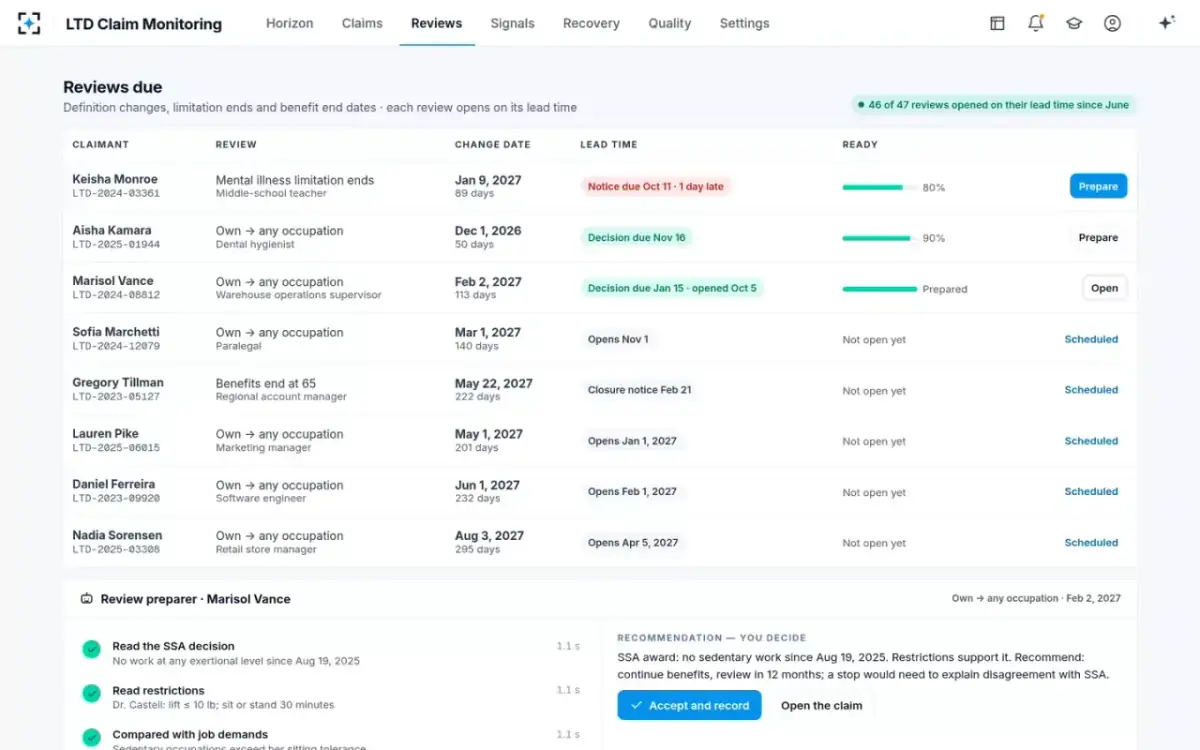
Marisol's case shows the timing. Her award arrived on October 12, a week after her review opened, with a judge's finding that she could do no work at any exertional level since August 19, 2025. The review preparer read it, compared it with her surgeon's restrictions, which agree, and recommended continuing benefits with a further review in 12 months. Its note says: "a stop would need to explain disagreement with SSA." The decision is the examiner's.
LTD Claim Monitoring's reviews: each own-to-any change on its lead time, with the evidence gathered
A 120-day review, step by step
A well-run any-occupation review is a sequence of evidence steps, each with its own lead time, finishing before the date rather than on it. In the sample settings it opens 120 days ahead; the steps below are the review preparer's, with the decision left to the examiner.
- Day 120 before the change. Open the review; request a current physician statement if the last one is older than the plan's interval; notify the vocational consultant.
- Days 120 to 75. Gather restrictions and their dates, the claimant's education, training and work history, and any Social Security decision or pending hearing.
- Days 75 to 45. Vocational consultant runs a transferable-skills analysis and tests candidate occupations against restrictions and the policy's gainful level.
- Days 45 to 20. Review note drafted, with a recommendation that addresses treating views, plan experts and any Social Security decision.
- Day 20. Examiner decides. If benefits will end, the letter goes with full reasons, the claimant's review rights and a second signature from the quality reviewer.
The 20-day margin is there for the claimant as much as the plan: a decision delivered on the day of change leaves no time to respond before a payment is missed. How the decision then sits beside the appeal deadlines and the policy's limitations clause is set out in the limitations clock written into the policy.
Can my LTD be cut off at 24 months?
Yes, if your policy's own-occupation period is 24 months and the plan decides you can do another gainful occupation, or if a mental illness or self-reported limitation of 24 months applies. Neither is automatic. A change of definition requires a decision on the evidence, with a letter that gives reasons and appeal rights; a limitation ending is a fixed period, and the Department of Labor treats benefits ending at a pre-set date as not an adverse benefit determination, so the notice beforehand matters more.
If you are approaching the date, ask your examiner which test applies next, whether a limitation applies, and what evidence the review will need. If you have a Social Security award, make sure the plan has it. Returning to work part time before the change has its own rules, which one claim's return to work follows month by month. To see the reviews on their lead time, start from LTD Claim Monitoring.
Questions people ask
What is the difference between own occupation and regular occupation?
Group LTD policies often use "regular occupation" to mean the occupation the claimant routinely performed when disability began, as it is generally performed in the economy rather than in one employer's version. In that sense the own-occupation test is a regular-occupation test. Check the policy's definitions: the wording, not the label, decides.
What is the 24 month own occupation definition?
It is a policy term under which the claimant is measured against her own occupation for the first 24 months of benefits and against any gainful occupation after that. In the sample policy the 24 months run from the end of the elimination period, so on its 90-day elimination period the change falls about 27 months after disability began, inside the two quarters where the 2015–2024 study finds recoveries peak.
Does a Social Security award mean I will pass the any-occupation test?
Not automatically, because the policy's test and Social Security's differ, but it is strong evidence. Social Security's standard looks at any substantial gainful activity, and the Department of Labor has called it stricter than many LTD plans' standards. A plan that disagrees must explain why in its decision.
Is a mental illness limitation the same as the change in definition?
No. A mental illness or self-reported limitation caps how long benefits are paid for those conditions, for example at 24 months, whatever definition is in force; the change in definition alters the test for all conditions. A claim can meet both at once, as the sample claimant Keisha Monroe's limitation, ending on January 9, 2027, shows.
How common is a 24-month own-occupation period?
No public source counts policy designs, so there is no reliable share. What the claims data show is that limited own-occupation periods are common enough for the 2008 experience table to model terminations around the change, and for the 2015–2024 study to report on their effect.