A long term disability overpayment is benefit an LTD plan paid that the policy, read later, says was not due: most often because Social Security awarded disability benefits for months the plan had already paid in full, and sometimes because of a workers' compensation settlement, a pension or earnings reported late. The figure is right only if four things are right, the overlap months, the offset rule, the family benefits and fees, and the amounts actually paid, and an error in any one is repeated in the letter, the repayment plan and any appeal. Botminds' LTD Claim Monitoring calculates each overpayment by the policy's rule with every input cited, so the examiner signing the letter, and the claimant reading it, can check each figure against its source.
The examples come from the fictional carrier Larkspur Mutual and its claimants as they run through the solution; the names and amounts are sample data. The rules are quoted from the Department of Labor's claims regulation, Social Security's regulations, the US Code and the Supreme Court, linked where they appear.
Four tests an LTD overpayment must pass before the letter goes
- The months: does the overlap start at Social Security entitlement, not onset or the notice date?
Entitlement follows a five-month waiting period; the notice arrives months later still. Either mistake moves the figure by thousands.
- The rule: is it the offset clause of the policy in force at the date of disability?
Primary only or family too, frozen or indexed, how a lump sum is spread, and the minimum benefit.
- Family benefits and fees: are they counted and credited exactly as the policy says?
A child's benefit counted under a primary-only clause, or a representative's fee the policy credits but the letter ignores.
- The money: is the paid column what was paid, month by month?
From the payment history, including partial months, earlier estimates and any amount already withheld.
Why do I owe my long term disability insurer money?
You owe money when the plan paid you more than the policy allows for the same months, usually because Social Security later paid you for those months too. Most group LTD plans reduce the benefit by Social Security disability benefits, and a plan may pay the full benefit while the application is pending in return for a signed promise to repay the overlap when the award comes. The overpayment is that promise falling due.
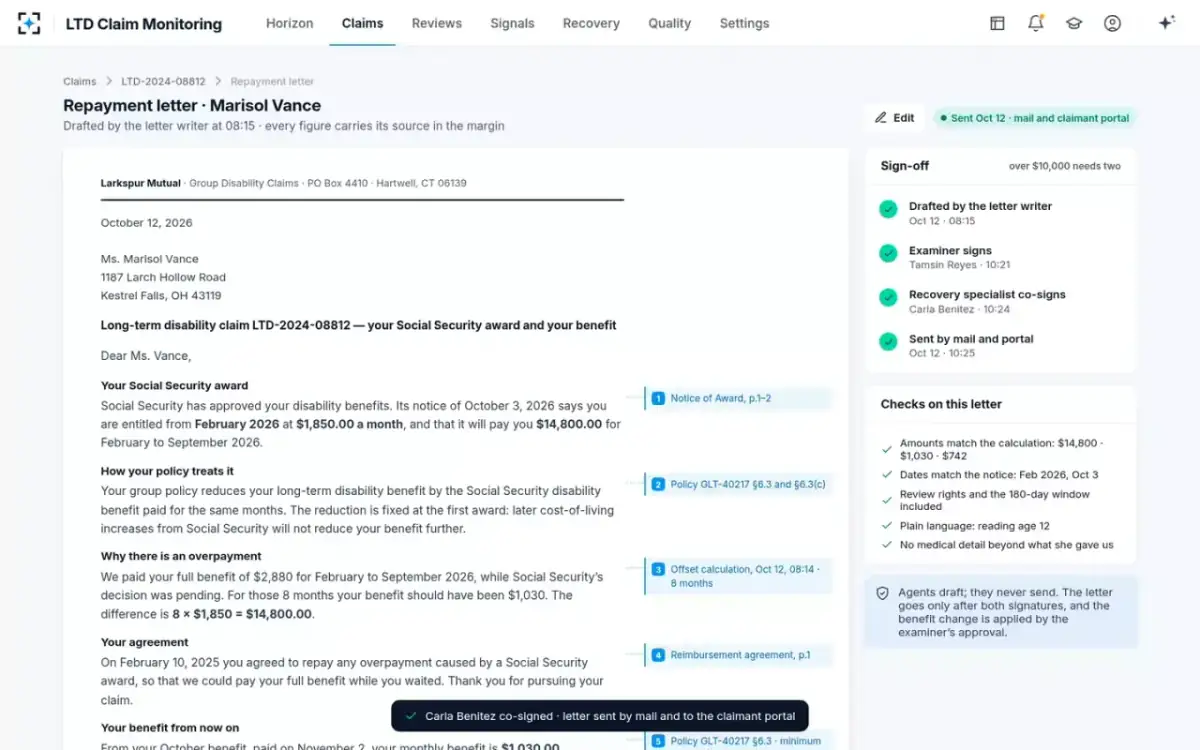
Marisol Vance's case is the common shape. Disabled in November 2024, she received $2,880 a month from Larkspur. On February 10, 2025 she signed a reimbursement agreement, so Larkspur paid in full instead of reducing her benefit by an estimated award. In October 2026, Social Security's notice entitled her to $1,850 a month from February 2026 and paid her $14,800 for the eight months to September. For those eight months her policy says the plan owed $1,030, not $2,880: the difference, eight times $1,850, is $14,800.
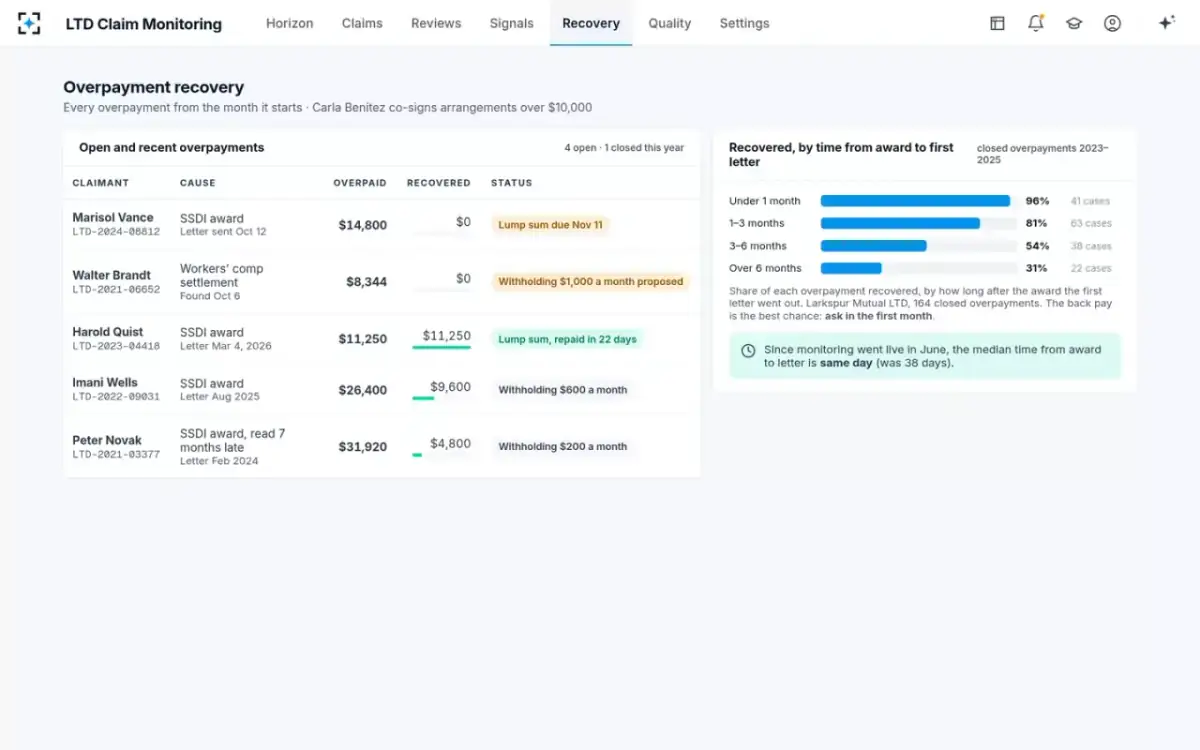
In the sample carrier's recovery list, four of the five open and recent overpayments come from Social Security awards and one from a workers' compensation settlement. Social Security decides last, often years into the claim, so its offset is the one most likely to be applied in arrears.
How is an LTD overpayment calculated?
An LTD overpayment is the sum, over every affected month, of what was paid minus what the policy says was due once the new income is counted. For a Social Security award that means the gross benefit less the Social Security the policy counts for that month, never below the minimum, compared with the payment history. The month-by-month method, with the inputs it needs, is worked line by line in how the SSDI offset is calculated. This page is about testing the result.
Testing matters because the letter is a benefit decision. Under the federal claims rule an adverse benefit determination includes "A denial, reduction, or termination of, or a failure to provide or make payment (in whole or in part) for, a benefit" (29 CFR 2560.503-1). A reduction to collect an overpayment, or a demand that changes the benefit, carries review rights, and a figure that cannot be reproduced from its sources is a weak thing to defend on appeal.
Test one: are the overlap months right?
The overlap starts at the first month of Social Security entitlement, not at the onset date and not at the date of the notice. Social Security pays nothing for the five-month waiting period that follows onset, and it can pay back as far as 12 months before the month of the application (20 CFR 404.621; the SSDI five month waiting period works the 17-month limit that follows). The notice states the entitlement month; a calculator should read it from there.
Marisol's onset was amended on appeal to August 19, 2025. Her waiting period ran from September 2025 to January 2026, so entitlement began in February 2026. An examiner who started the overlap at onset would count 14 months from August 2025, not eight, and demand $25,900; one who started at the notice would find no overpayment at all, because the notice came after the last full month paid. The overlap also ends where it should: from October 2026 her benefit was reduced, so October is not part of it.
One claim, four common mistakes: how far each moves the $14,800
Test two: is the offset rule the claimant's policy?
The rule must be the one in the policy in force at the date of disability, read clause by clause, not a carrier-wide default. Group policies differ in exactly the places an overpayment depends on: whether family benefits count, whether the offset is frozen at the first award or rises with cost-of-living increases, how a lump sum is spread, what the minimum benefit is, and whether an estimated award may be deducted before Social Security decides.
The minimum is the test easiest to skip, because it bites only on large offsets. Take a claimant with a $2,000 gross benefit and a minimum of 10% of gross, $200. With a $1,700 Social Security award the policy owes $300. Add a $400 pension and the arithmetic gives minus $100, but the policy still owes the $200 minimum. A calculation that ignores the floor overstates the overpayment by $200 for every such month. In the sample, the plan provisions agent shows the clause it applied, "GLT-40217 §6.3", and the minimum, "§3.4", beside the result.
Test three: family benefits and representative fees
Family benefits and fees are where a correct calculation under one policy is wrong under another. If the policy offsets only the claimant's own Social Security, a child's or spouse's benefit must stay out, however it appears on the notice. If it offsets family benefits, each family member's start month matters, since a child may become entitled later than the parent.
Fees work the other way. When a claimant has a representative with an approved fee agreement, Social Security pays the fee from the back pay, up to "25 percent of the total amount of such past-due benefits" or a dollar cap the Commissioner raises from time to time (42 U.S.C. 406). The claimant never receives that part. Some policies credit the fee against the overpayment; the sample carrier's setting does. A letter that demands the full overlap from a claimant who received three-quarters of it is wrong under such a policy, and easy to challenge.
Test four: is the paid column what was actually paid?
The paid column must come from the payment history, not from the claim system's view of what the benefit was. Partial first and last months, a month held back while a form was outstanding, an earlier estimated offset later reversed, and any amount already withheld toward another overpayment all change what was paid. A calculation that assumes full payment in every month will overstate the overpayment for each month that was not.
The sample shows the check working. Marisol's claim shows $2,880 paid for each month from February to September 2026, the same amount as her gross benefit, because no estimate was applied while her agreement was in force. The calculation screen prints the eight months paid at $23,040 against $8,240 due, so anyone can see where $14,800 comes from.
Overpayment recovery in LTD Claim Monitoring: every overpayment from the month it starts
Can LTD take my SSDI back pay, and what if it is already spent?
A plan can ask for the back pay under the policy and any reimbursement agreement, and it can reduce future benefits as the policy allows; but once the money is spent on things that cannot be traced, its court remedies narrow sharply. The Supreme Court set the rule in a health plan case, but it turns on the equitable remedies ERISA gives every plan fiduciary, disability plans included:
"When an ERISA-plan participant wholly dissipates a third-party settlement on nontraceable items, the plan fiduciary may not bring suit under §502(a)(3) to attach the participant's separate assets."
Montanile v. Board of Trustees, 577 U.S. 136 (2016), syllabus
For an LTD plan the practical meaning is speed. A lump-sum request made while the back pay is still in the claimant's account can be paid at once, as in the sample: Harold Quist repaid $11,250 in 22 days. After the money is spent, the plan's main tool is withholding from future benefits, within whatever limit the policy sets. The sample carrier withholds no further than the policy minimum, so Marisol can choose a $14,800 lump sum by November 11 or withholding of up to $742 a month, which leaves her $288. What each month of delay costs prices the difference.
What if the LTD overpayment is wrong? Review rights and the letter
If the overpayment is wrong, the claimant can ask the plan to review it, and an ERISA plan must give at least 180 days to appeal an adverse benefit determination and decide a disability appeal within 45 days, with one extension. The letter should say how the figure was reached, which policy clause applied and how to ask for a review. In the sample, the repayment letter explains the award, the policy rule, the overlap and the agreement, and includes the 180-day review right, with each figure's source in the margin.
Federal rules leave the substance of recovery largely to the plan and the courts. When the Department of Labor rewrote the disability claims rule in 2016, commenters raised "substantive limitations on recoupment of benefit overpayments", and the Department did not regulate them in that rule (81 FR 92316). That leaves the policy text, the agreement and the arithmetic to carry the weight, which is one more reason the arithmetic should be checkable.
How to measure overpayment accuracy across a book
Accuracy across a book is measured by replaying closed overpayments against their sources and counting errors by test, not by checking that letters balance. Draw a random sample of closed overpayments, recompute each from the notice, the policy and the payment history, and log any difference by which of the four tests it fails. The table below is a plan a quality team can run in a month.
A one-month accuracy review of closed LTD overpayments
| Step | What to do | What to log |
|---|---|---|
| Sample | About 200 closed overpayments drawn at random. If the true error rate is near 5%, 203 files estimate it within ±3 points at 95% confidence. | Claim, cause, amount demanded |
| Months | Read entitlement month from the notice; compare with the first overlap month used. | Months wrong, dollars moved |
| Rule | Read the offset clause of the policy in force at the date of disability; compare with the rule applied. | Clause misapplied, dollars moved |
| Family and fees | Check each family member's entitlement and any fee withheld against the policy's treatment. | Benefit or fee mis-treated, dollars moved |
| Paid | Rebuild the paid column from the payment history. | Months misstated, dollars moved |
| Result | Error rate by test, total dollars over- and under-stated, and the time from award to letter. | One page for the claims leader |
Two measures are worth tracking every month after that: the share of overpayments whose four tests pass without correction, and the days from award to a calculated overpayment. On the sample carrier's quality page, the second fell from a median of 41 days in November 2025 to 0 in September 2026 after monitoring went live. The clocks that run on recovery claims are covered separately.
A repayment letter with every figure's source in the margin, co-signed and sent
Questions people ask
Do I have to repay an LTD overpayment?
If your policy offsets Social Security and you were paid in full for months Social Security later covered, the policy and any reimbursement agreement you signed usually require repayment. You can ask the plan to show how the figure was reached and appeal it if it is wrong; an ERISA plan must give at least 180 days to appeal an adverse benefit determination.
Can LTD stop payments to recover an overpayment?
If the policy allows it, the plan can reduce or withhold future benefits until the overpayment is repaid, within the limit the policy sets. The sample carrier withholds no further than the policy's minimum, so the claimant always receives at least $288 a month. Read your policy's recovery clause for the exact limit.
Is there a statute of limitations on an LTD overpayment?
ERISA sets no single period for a plan's overpayment claim; the answer depends on the claim the plan brings and where, which makes it a question for counsel. The Supreme Court has held that a plan cannot reach a participant's general assets once the money has been spent on things that cannot be traced. Prompt notice therefore matters more than any deadline.
How long does it take to repay an overpayment by withholding?
It depends on the amount and the monthly cap. In the sample, Imani Wells repays $26,400 at $600 a month, almost four years, and Peter Novak $31,920 at $200 a month, more than thirteen years. A lump sum from the back pay ends it at once, which is why the timing of the first letter matters.
Can an overpayment come from something other than Social Security?
Yes. A workers' compensation settlement, a state disability payment, a pension or earnings above the policy's work incentive can each create one if reported late. In the sample, a $62,000 workers' compensation settlement, spread over the remaining benefit period, produced an $8,344 overpayment for seven months.