An SSDI notice of award letter is the Social Security Administration's written decision that a claimant is entitled to Social Security Disability Insurance: it gives the month entitlement begins, the monthly amount, the past-due benefits being paid and the appeal rights. For a long-term disability plan that offsets SSDI, it is the document that dates the overlap, and every month it sits unread the plan keeps paying a full benefit it will have to ask back, while the claimant's back pay is spent on living. Botminds' LTD Claim Monitoring reads each notice the morning it is scanned, places it on the claimant's timeline, calculates the overpayment by the policy's rule and drafts the letter for the examiner to sign.
The notice and claims on this page are fictional sample data from the fictional carrier Larkspur Mutual, as they run through the solution. The Social Security figures and rules come from the agency's own statistics and the US Code, linked where they appear; where this page prices delay, the estimate is ours and the method is shown.
Each month an award sits unread adds about $1,636 to the overpayment
What is an SSDI notice of award letter?
A notice of award is Social Security's approval letter for disability benefits, sent after an initial decision, a reconsideration or a hearing. It goes to the claimant; the LTD plan sees it only when someone forwards it. For the claimant it is good news and the start of monthly payments. For the plan it is an instruction to recalculate every month since entitlement.
The scale is large. In August 2026, Social Security paid 6,975,000 disabled workers an average of $1,635.90 a month (SSA Monthly Statistical Snapshot, August 2026). Every one of them received a notice of award at some point, and those who also held group LTD coverage became, on that day, an overpayment for their LTD plan, unless the plan was already reducing by an estimate.
What does the notice of award show? A sample notice, line by line
The notice shows when Social Security says the claimant became entitled, how much is paid each month, how much is owed for past months and how the claimant can appeal. Each line has a use for the LTD plan, and the table follows the fictional notice Marisol Vance received, dated October 3, 2026, six pages, forwarded by her advocacy firm.
The sample notice of award, read for an LTD plan
| On the notice | In the sample | What the LTD plan does with it |
|---|---|---|
| Date of the notice | October 3, 2026 | Starts any Social Security appeal clock, and shows how long the notice took to reach the plan: it was scanned on October 12. |
| First month of entitlement | February 2026 (page 1) | Starts the overlap: the first month the policy's offset applies. |
| Monthly amount | $1,850.00 (page 2) | The amount the policy offsets each month, frozen at this figure under the sample policy. |
| Past-due benefits | $14,800.00 for February to September 2026 (page 2) | Confirms the overlap: eight months at $1,850. It is also the money the claimant can repay from. |
| Amounts withheld | None in the sample | A representative's fee paid from the back pay; some policies credit it against the overpayment. |
| Family members | No dependants | Benefits for a spouse or children, counted only if the policy says so. |
| The underlying decision | Fully favourable hearing decision, onset amended to August 19, 2025 | Evidence the plan must answer if it later finds the claimant can work. |
The last row matters beyond the offset. A Social Security finding that the claimant cannot work is evidence, and a plan that later denies benefits must, under the federal claims rule, explain the basis for disagreeing with "A disability determination regarding the claimant presented by the claimant to the plan made by the Social Security Administration" (29 CFR 2560.503-1). Marisol's notice reached her plan less than four months before her own-occupation period ends, and her any-occupation review now has to answer it.
Do I have to send my notice of award to my LTD carrier?
Usually yes, but the duty is written in your policy and in any reimbursement agreement you signed, not in federal law. A plan that offsets Social Security cannot apply the offset without the award, so policies with an offset clause ask the claimant to report it, and an agreement to receive the full benefit while an application is pending is a promise to repay the overlap. Marisol's agreement, signed on February 10, 2025, promised repayment of "any overpayment caused by a Social Security award", in the sample letter's words.
The notice can also arrive by another route. Where a carrier works with an advocacy firm that helps claimants through the Social Security process, the firm's case feed may report a decision before any paper arrives. The sample carrier receives both: mail scanning of its claims mailbox and a daily feed from its advocacy firm. Either way, the plan only knows what it has read.
When does SSDI back pay start, and how far back can it reach?
SSDI back pay starts with the first month of entitlement, which comes after a waiting period of five full calendar months of disability, and it can reach back before the application. The statute says a claimant who would have been entitled for a month "shall be entitled to such benefit for such month if such application is filed before the end of the 12th month immediately succeeding such month" (42 U.S.C. 423(b)). So entitlement can begin up to a year before the application, and the notice can arrive one or two years after that.
For an LTD plan, that is why an award is not one month's adjustment but a block of months. Marisol's onset was August 19, 2025; her waiting period ran from September to January; entitlement began in February 2026; the notice came in October. How the waiting period and the elimination period line up draws the overlap for three elimination periods.
How long is the wait for an SSDI hearing decision?
Many awards arrive only after a hearing, and the wait for one is measured in months. Social Security's own report for August 2026, which gives "the average time (in months) from the hearing request date until a hearing was held" for cases closed that month, shows hearing offices averaging from 7 to 12 months, with a median office at 8 (SSA Average Wait Time Until Hearing Held Report, August 2026; our summary of its 159 rows: the 158 hearing offices, leaving out a special review unit at 24.5 months). The decision and the notice of award come after the hearing.
Every one of those months is a month an LTD plan may be paying in full under a reimbursement agreement, so a hearing win routinely produces an overlap of a year or more. Robert Lindqvist, in the sample, has a hearing on November 18; if it is fully favourable from his alleged onset, his entitlement would start in July 2025 and his overlap would run 17 months, about $36,380. The solution pre-builds that calculation and shows the projection on his lane, waiting for the notice.
How an unread award grows, month by month
An unread award grows by one month of Social Security benefit for every month the plan keeps paying in full. At the August 2026 average for disabled workers, $1,635.90, that is the figure at the top of this page: about $9,800 after six months, about $19,600 after a year. The growth is linear; the damage is not, because recovery gets harder with time.
The reason is where the back pay goes. Social Security pays the past-due amount as a lump sum to the claimant. A plan that asks within weeks is asking for money that is still in the account. A plan that asks a year later is asking a claimant who has lived on a reduced income for years to repay a sum spent on rent and debts, from a benefit that the policy may only allow it to reduce to a minimum.
Why the first month is the best month to ask
The first month is best because the money is still there and the plan's legal position is strongest. In the Supreme Court's leading case on recovering from a participant, the plan had been told the settlement money would be paid out unless it objected within 14 days. It did not object, and the Court noted that it "could have filed suit immediately, rather than waiting half a year" (Montanile v. Board of Trustees, 2016). By then the money was largely spent, and the plan could not reach the participant's other assets.
The sooner the first letter, the more is recovered: 164 closed overpayments
The sample carrier's own history makes the same point in numbers: overpayments first raised within a month were 96% recovered, those raised after six months 31%. Peter Novak's award, read seven months late, became a $31,920 overpayment recovered at $200 a month. How to check that an overpayment figure is right covers what the letter must get right once it goes.
Where the days go between the award and the letter
By hand, most of the delay is waiting, not working. The notice sits in a mail queue, is matched to a claim, read, checked against the policy, calculated, drafted and signed, and each step waits for a person who has 140 other files. Botminds' estimate for one award with an overlap to recover is 22 days by hand, ten of them in the mail queue.
From a scanned notice of award to a signed repayment letter: 22 days by hand, about a day with the solution
- Mail queue10 d
- Match and read2 d
- Policy rule2 d
- Calculate3 d
- Draft letter3 d
- Signatures2 d
- Read, match, rule, calculate, draft
- Signatures
Pricing the delay across a book
Across a book, the cost of delay is the number of awards a year, times the months each waits, times the monthly Social Security amount, discounted by the share that is never recovered. The table works the method with the sample team's volume and Social Security's average benefit. Replace both with your own figures.
The cost of reading awards late, for a book with 212 awards a year
| Step | Calculation | Result |
|---|---|---|
| Awards a year | The sample team of nine examiners read 212 in 12 months | 212 |
| Extra overpayment per month of delay, per award | Social Security average for disabled workers, August 2026 | $1,635.90 |
| Extra overpayment per month of delay, whole book | 212 × $1,635.90 | $346,811 |
| Overpayment at 22 days' delay, whole book | $346,811 × 22 ÷ 30.4 | about $251,000 |
| Recovery lost between the first month and the next two | Sample history: 96% recovered under 1 month, 81% at 1 to 3 months; 15 points on the overpayments that slip | up to 15% of what slips |
The figure is not a loss in itself: most of it is recovered. The loss is the slice that is never repaid, plus the examiner time spent chasing small monthly withholdings for a decade, plus the claimant relations cost of a large, late demand. A claims leader weighing the case should price all three on the book's own history.
What LTD Claim Monitoring changes, and the targets it is held to
LTD Claim Monitoring changes when the plan knows. The mail and document reader reads each notice as it is scanned or reported, matches it to the claim by name, date of birth and Social Security number, and cites each date and amount by page. The Social Security watch tracks pending applications and hearings so that a decision is expected, not discovered. The offset calculator works the overlap by rule, and the letter writer drafts the repayment letter. The examiner signs; over $10,000, the recovery specialist co-signs.
The award placed on Marisol's lane in LTD Claim Monitoring: eight months overlap, $14,800 found
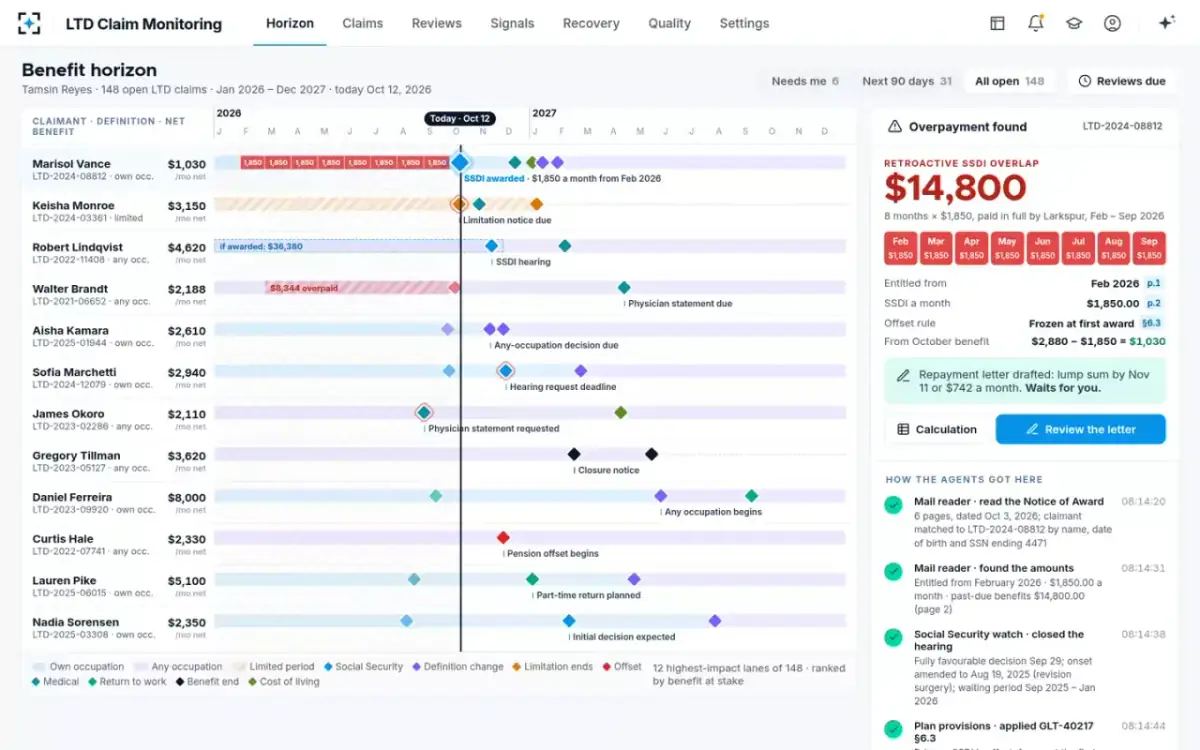
The design targets are the same day from a Social Security award to a calculated overpayment and a drafted letter, and every own-to-any review opened 120 days ahead. On the sample carrier's quality page, the median days from an award to a calculated overpayment fell from 41 in November 2025 to 0 in September 2026 after monitoring went live in June, and of the 212 awards read in the year, every one since June was placed the day it arrived. Those are sample figures; a pilot on a carrier's own closed awards is the way to measure them for real, as the go-live plan sets out. To see the notice, the overlap and the letter together, start from LTD Claim Monitoring.
Questions people ask
How long after the notice of award do you get back pay?
Social Security does not publish a fixed interval for past-due payments, and timing can depend on whether a representative's fee or another benefit must be worked out first. In the fictional sample, the notice is dated October 3 and the $14,800 back pay is paid to the claimant in October. If your LTD plan has asked you to repay an overlap, it will usually want to hear from you as soon as the back pay arrives.
What is the SSDI average benefit?
In August 2026, Social Security's average monthly benefit for disabled workers was $1,635.90, across 6,975,000 people. Spouses of disabled workers averaged $463.94 and children $529.79. Social Security's 3.6% cost-of-living increase applies from the December 2026 benefit, paid in January 2027.
Is there an SSA notice of award sample I can compare mine with?
The sample on this page is fictional and simplified, but the lines an LTD plan reads are the same on any notice: the entitlement month, the monthly amount, the past-due benefits, any amounts withheld, family benefits and appeal rights. If your notice is unclear, Social Security can explain it, and your LTD plan should show you how it used each line.
Does a notice of award end my LTD claim?
No. It reduces the LTD benefit by the Social Security amount the policy counts, from the entitlement month, and the claim continues. The award is also evidence of disability that the plan must address if it later decides you can work.
What if the notice of award is wrong?
You can ask Social Security for the next level of review, reconsideration, a hearing or Appeals Council review, within 60 days of receiving the notice, and receipt is presumed five days after its date unless you show otherwise. If Social Security later changes the amount or the entitlement month, the LTD plan's overpayment must be recalculated from the new notice.