The SSDI five month waiting period is the stretch of five full, consecutive calendar months of disability that must pass before Social Security Disability Insurance becomes payable: benefits start with the first month after it, and Social Security pays nothing for the waiting months themselves. A group long-term disability policy runs its own clock, an elimination period the policy sets in days, 90 in the sample policy, and then pays; so from two dates, the onset Social Security accepts and the policy's elimination period, a claims team can predict which months both programs will pay and how large the overlap will be when the award arrives in arrears. Botminds' LTD Claim Monitoring reads the entitlement month from each Notice of Award, places the overlap on the claimant's timeline and calculates it by the policy's rule.
Examples use the fictional carrier Larkspur Mutual and its claimant Marisol Vance, sample data as they run through the solution, plus illustrative arithmetic marked as ours. The rules come from the Social Security Act and Social Security's regulations, linked where they appear.
Two clocks from one disability: the LTD elimination period and the SSDI waiting period
- Elimination period3 mo
- LTD pays alone3 mo
- Both pay: the overlapevery month after
- Partial onset month1
- Five-month waiting period5 full mo
- SSDI entitledevery month after
What is the SSDI five month waiting period?
The SSDI waiting period is defined in the Social Security Act as "the earliest period of five consecutive calendar months" throughout which the person "has been under a disability" (42 U.S.C. 423(c)(2)). The regulation puts it in plainer words: you must have "been disabled for 5 full consecutive months or no waiting period is required" (20 CFR 404.315). Benefits are then payable "for each month beginning with the first month after his waiting period".
Three details decide the dates in practice. The months are calendar months, and each must be a full month of disability, so the month disability begins counts only if it begins on the first. The waiting period "can begin no earlier than the 17th month before the month you apply". And there are two exceptions with no waiting period at all: a person who was entitled to disability benefits within five years before becoming disabled again, and a person medically determined to have amyotrophic lateral sclerosis whose application was approved on or after July 23, 2020.
The Social Security clock in four numbers
5
full, consecutive calendar months of disability before benefits are payable
17th
month before the application: the earliest a waiting period can begin
12
months of benefits before the application month that can be paid in arrears
0
months of waiting for ALS, or for re-entitlement within five years
Does SSDI pay for the waiting period?
No. The five waiting months are never paid, even when the award comes years later and the back pay reaches as far as the law allows. Entitlement begins with the sixth month: the first month after five full months of disability. That is why an award dated from an onset in August starts paying in February of the next year, not in August.
For a claimant, the waiting period is a gap in Social Security income that group LTD often fills. For an LTD plan, it is good news hidden in the arithmetic: the plan pays alone during the waiting months, and the offset can only ever apply from the entitlement month onward. A plan that starts its overlap at onset counts five or six months it never overpaid, the largest of the four errors worked through in how to check an LTD overpayment.
What is the SSDI onset date, and why one day moves a month
The onset date is the date Social Security finds disability began. It starts the waiting period, which starts entitlement, so a change to onset moves every date after it. And because the waiting months must be full calendar months, a single day can move entitlement by a whole month: an onset on August 1 makes August the first waiting month and January the first paid month; an onset on August 2 makes September the first waiting month and February the first paid month.
Onsets also change on appeal. Marisol Vance stopped work on November 4, 2024, but the judge who granted her claim found her disabled from August 19, 2025, the date of her revision surgery. Her waiting period ran from September 2025 to January 2026, and entitlement began in February 2026. Had Social Security accepted her November 2024 date, entitlement would have begun in May 2025; at the same $1,850 a month, her overlap through September 2026 would have been 17 months, $31,450, instead of eight months, $14,800. Same claimant, same plan, a different onset: $16,650 less to recover.
How far back does SSDI back pay go?
SSDI back pay goes back to the first month of entitlement, and that month can be up to 12 months before the month of the application: Social Security's rule is that "you may receive benefits for up to 12 months immediately before the month in which your application is filed" (20 CFR 404.621). Add the five waiting months and the 17-month limit above follows: the waiting period can start no more than 17 months before the application.
For an LTD plan, the useful number is not the back pay itself but the months of it that coincide with LTD payments. Back pay for months before LTD began, during the policy's elimination period, does not overlap anything. Back pay for months after LTD began is exactly the overpayment, month for month, under a policy that offsets the claimant's own SSDI. Reading the notice of award shows where each of these figures appears.
Two clocks: the LTD elimination period beside the SSDI waiting period
The LTD elimination period is a term of the policy: the number of days of disability before benefits begin. Social Security's waiting period is a term of federal law. They start from the same disability but run separately, and the overlap depends on which ends first. In the Society of Actuaries Research Institute and LIMRA's 2015–2024 study of group LTD claims, the elimination periods reported fall into groups of 1, 2, 3, 4–5, 6 and 12 months (2015–2024 Group LTD Termination Study), and the study excluded groups with an elimination period under 30 days.
One onset date, three elimination periods: when LTD starts, when SSDI starts and what overlaps
| Elimination period | LTD benefits begin | SSDI entitled from | LTD pays alone | Overlap |
|---|---|---|---|---|
| 90 days | February 2, 2025 | May 2025 | February to April 2025, 3 months | Every month from May 2025 |
| 180 days | May 3, 2025 | May 2025 | Two days of May | Almost all months from May 2025 |
| 12 months | November 4, 2025 | May 2025 | None: SSDI starts six months before LTD | Every month from November 2025; SSDI for May to October 2025 overlaps nothing |
The table shows why the elimination period sets the shape of the overlap. With 90 days, LTD has three months alone and then pays alongside Social Security for every month after. With 180 days, the two clocks end within days of each other. With a year, Social Security starts first, and only the months after LTD begins can be offset. Research on one large LTD insurer's data found that the elimination period also changes who claims: a shorter wait, like a higher replacement rate, made workers significantly more likely to claim (Autor, Duggan and Gruber, NBER Working Paper 18172), which is one reason LTD rates are priced by elimination period.
Recoveries against the 2008 table rise with the elimination period, up to six months
When does LTD require me to apply for SSDI?
When the policy says so: the requirement is contractual, and its timing is in the policy and in any letter the plan sends. The Department of Labor described the practice in 2016, writing that most employer plans require claimants to file for SSDI as a condition of receiving benefits, because they offset the plan's benefit by the SSDI amount (81 FR 92316). A policy may also require the claimant to appeal a Social Security denial, and may let the plan reduce the benefit by an estimated award if the claimant does not apply or sign a reimbursement agreement; the sample carrier estimates only where no agreement is signed.
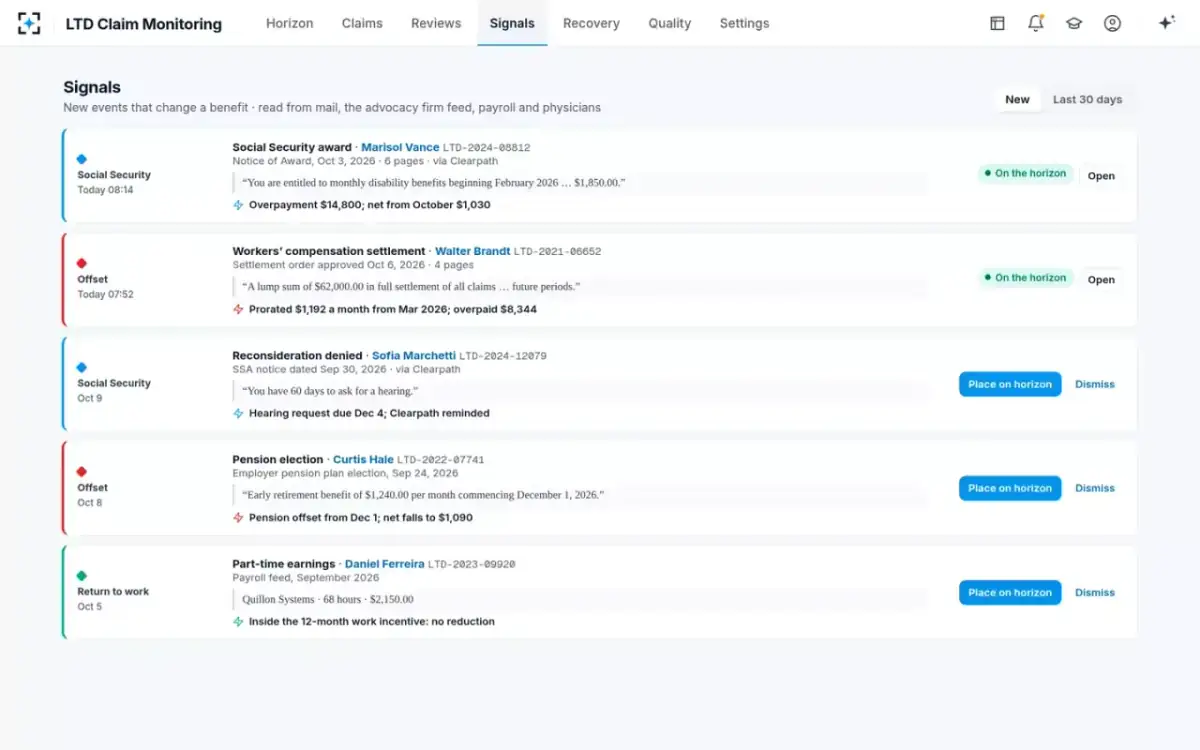
Applying early helps both sides. Because entitlement can reach back only 12 months before the application, a late application can lose Social Security months that would otherwise have been paid. In the sample, the Social Security watch tracks each application, reconsideration and hearing, and works out appeal deadlines as 60 days from receipt of the notice, with receipt presumed five days after its date.
Signals in LTD Claim Monitoring: a reconsideration denied, and the hearing request date worked out
Does LTD pay during the SSDI waiting period?
Yes, once the LTD elimination period has ended: the SSDI waiting period is Social Security's, and it does not delay the LTD benefit. The LTD plan pays its benefit, subject to its other offsets, for any month Social Security does not pay, including the five waiting months, and offsets only months for which Social Security pays. That is the reason an LTD claim on a 90-day elimination period pays alone for about three months before the overlap begins.
Whether the plan pays in full or reduces by an estimate while the application is pending is a separate question, answered by the policy and by whether the claimant signed a reimbursement agreement. The sample carrier pays in full where an agreement is signed, which is why Marisol's eight overlap months became a $14,800 overpayment rather than a series of smaller monthly reductions. The month-by-month calculation is in how the SSDI offset is calculated.
What a claim should hold from day one
From the day an LTD claim is approved, it should hold every date the overlap will later depend on, so that the award, when it comes, is a matter of reading one month off a notice. In LTD Claim Monitoring, the plan provisions agent builds the claim's dates from the policy in force at the date of disability, and the Social Security watch adds each application, decision and appeal deadline as it happens.
- The date of disability and the LTD start date, from the claim and the policy's elimination period.
- The Social Security application date, which caps how far back entitlement can reach.
- Each Social Security decision and its appeal deadline, with the presumed receipt date.
- The alleged onset and, when it comes, the onset Social Security finds, since an amended onset moves the overlap.
- The projected entitlement month and amount, labelled as a projection until the notice arrives.
- The reimbursement agreement and its date, which decides whether the plan pays in full while it waits.
With those dates in place, the overlap is predictable months ahead. For the sample claimant Robert Lindqvist, whose hearing is on November 18, the solution projects entitlement from July 2025 at about $2,140 a month if the decision is fully favourable from his alleged onset, a 17-month overlap of about $36,380, shown on his lane and waiting for the notice. To see the dates and the overlap on sample claims, start from LTD Claim Monitoring.
Questions people ask
Why is there a 5 month waiting period for SSDI?
Congress wrote it into the Social Security Act, which defines disability benefits as payable only from the first month after five consecutive months of disability. The statute does not state a reason in its text. Its effect is that short disabilities are never paid by the program, and longer ones are paid from the sixth full month.
Do you get back pay for the 5 month waiting period for SSDI?
No. Back pay covers months of entitlement, which begin after the waiting period; the five waiting months are never paid. Back pay can reach up to 12 months before the month of application, but always starting after a completed waiting period.
Is there a waiting period for SSDI with ALS?
No, for applications approved on or after July 23, 2020. Social Security's regulation lists two cases with no waiting period: a person medically determined to have amyotrophic lateral sclerosis, and a person previously entitled to disability benefits within five years of becoming disabled again.
Does the SSDI waiting period count toward the LTD elimination period?
They are separate clocks that start from the same disability and run at the same time. The LTD elimination period is set by the policy in days; the SSDI waiting period is five full calendar months set by federal law. Neither waits for the other.
What happens to the overlap if Social Security changes my onset date?
The overlap moves with it. A later onset moves the waiting period and the first month of entitlement later, which shortens the overlap and the overpayment; an earlier onset lengthens both. The LTD plan should recalculate from the onset and entitlement month on the final notice.