A return to work after LTD usually happens in steps, not all at once: a claimant goes back part time, often under a work incentive that lets her keep most of her benefit for a set period, then increases her hours, and the benefit is reduced by a formula based on her lost earnings until she earns enough that the claim ends. Each step is a date an examiner must catch, and Social Security runs its own work rules alongside, so a claimant who also receives SSDI can see one benefit fall while the other rises. Botminds' LTD Claim Monitoring reads monthly payroll earnings and Social Security notices as they arrive and places each on the claimant's timeline against the policy's rules, so the examiner sees what changes, and when, before the payment goes out.
The claim on this page is a fictional case built to show the dates: Ines Calloway, a hospital pharmacy technician, and her carrier Ashgrove Life are invented, and the policy terms, a 12-month work incentive and a residual benefit formula, are illustrative, since policies differ. The screens show LTD Claim Monitoring's own fictional sample claims. Social Security's rules and thresholds come from the agency and the Social Security Act; the research from the NBER and the Society of Actuaries Research Institute with LIMRA.
Thirty months of one claim: work, LTD and Social Security, side by side
- Off workJan 2024 – Jun 2025
- 20 hours a week9 mo
- 30 hours3
- Elimination period3
- Benefit, own occupation15 mo
- 12-month work incentive12 mo
- Onset month and waiting period6
- SSDI paid12 mo
- Trial work period9 mo
- Grace3
Can I return to work while on long term disability?
Yes, within the policy's terms. A policy with a work incentive or a residual, or partial, benefit is written for exactly this: the claimant works within her restrictions, reports her earnings, and the benefit is adjusted by the policy's formula. Returning is common enough to shape the claims data. Economists studying one large LTD insurer found that "LTD claims rates are much lower than claims rates on the public analogue to LTD, the Social Security Disability Insurance program, yet LTD policies have a much higher return-to-work rate among initial claimants" (Autor, Duggan and Gruber, NBER Working Paper 18172, 2012).
The cost of getting it wrong falls on both sides. A plan that misses reported earnings overpays and later asks for money back; a plan that misses a Social Security benefit stopping can underpay, sometimes by more. The case below shows both risks in one claim.
Five people move Ines's benefit over 30 months; two of them work for the carrier
Today
Reports her hours by phone when she remembers; does not know the work incentive has an end date.
With agents
Gets a letter at each change saying what her benefit is and why, with the date the incentive ends.
Still theirs: The choice of when and how much to work.
Today
Releases her to 20 hours in July 2025 and 30 hours in April 2026, in notes that reach the carrier weeks later.
With agents
Each release is read on arrival and its hours dated on the claim.
Still theirs: The restrictions.
Today
Agrees light duty; payroll sends a monthly file nobody at the carrier opens until a review.
With agents
The monthly earnings feed is read against the policy's incentive and residual rules.
Still theirs: The job and the accommodation.
Today
Hears about the return when the own-occupation review opens.
With agents
Plans the increase in hours with the claimant and employer, ahead of the definition change.
Still theirs: The return-to-work plan.
Today
Finds the earnings at the next review and the Social Security stop when the claimant phones.
With agents
Sees each change on the claim the month it arrives, with the benefit recalculated for approval.
Still theirs: Every benefit change and its signature.
Months 0 to 13: the elimination period, Social Security and the first overpayment
Ines stops work on January 8, 2024, after cervical spine surgery that leaves her unable to stand at a dispensing bench. Her pre-disability earnings are $5,000 a month and her policy pays 60%, $3,000, after a 90-day elimination period, so benefits start in April 2024. She applies for Social Security in April and signs Ashgrove's reimbursement agreement, so Ashgrove pays in full while she waits.
Social Security's five full waiting months run from February to June 2024, so she is entitled from July. The notice of award arrives in February 2025, month 13: $1,700 a month from July 2024. Seven months overlap, July 2024 to January 2025, and Ashgrove has overpaid $11,900, which she repays from the back pay. From February 2025 her LTD benefit is $1,300, the $3,000 gross less the $1,700 offset, frozen at the first award under her policy. Where that overlap comes from is drawn for three elimination periods on its own page.
What happens to LTD if I go back to work part time?
Under a policy with a work incentive and a residual benefit, your benefit continues: for an initial period perhaps not reduced at all, then reduced by a formula. Those two clauses decide which. You must report earnings, and the plan applies the rule month by month. In July 2025, month 18, Ines's surgeon releases her to 20 hours a week at the bench, seated where possible, and her employer agrees. She earns $1,500 a month.
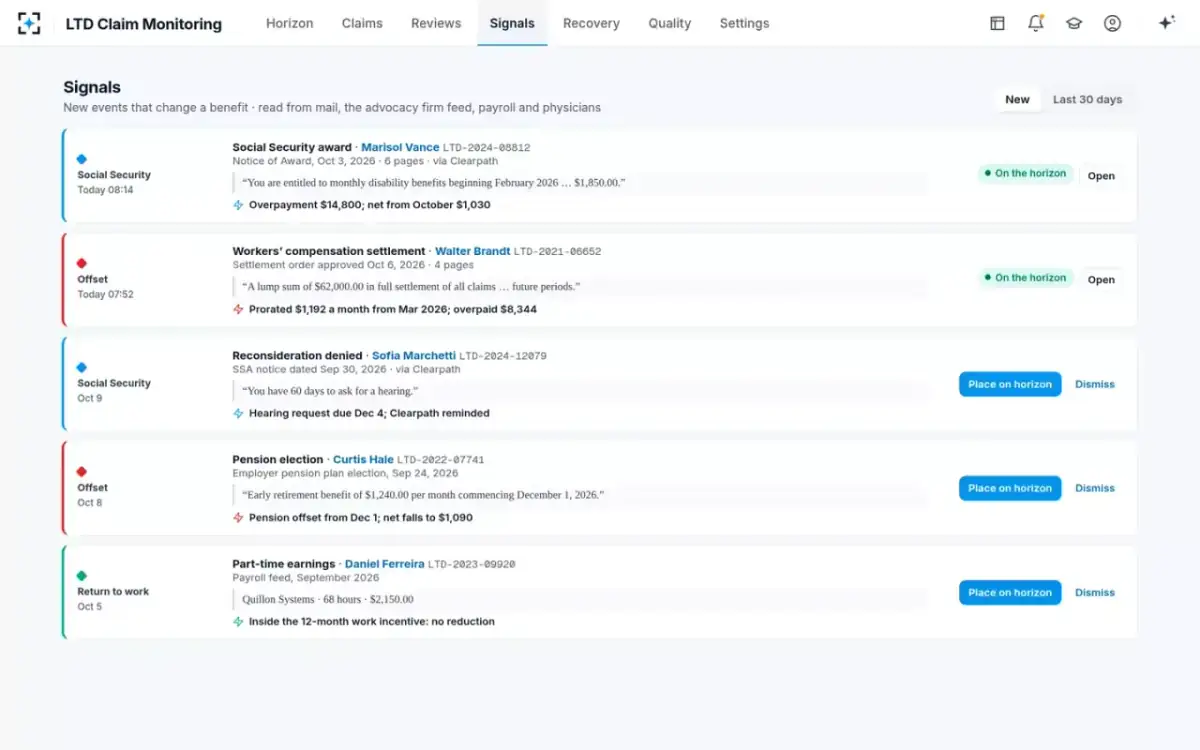
Under her illustrative policy's 12-month work incentive, the LTD benefit is not reduced by earnings so long as LTD, Social Security and earnings together stay at or below 100% of pre-disability earnings. Her total is $1,300 plus $1,700 plus $1,500, or $4,500, under the $5,000 cap, so nothing changes. That is the same treatment the sample screens show for Daniel Ferreira, whose September earnings of $2,150 fall "inside the 12-month work incentive: no reduction". The work incentive is generous by design: it makes trying to work cheaper than not trying.
LTD Claim Monitoring's signals: part-time earnings read from payroll and checked against the work incentive
What is a return to work incentive?
A return to work incentive is a policy clause that lets a claimant earn without losing benefit, or while losing less of it, for a set period after going back to work. One shape, used in this case: for 12 months, the benefit is reduced only if benefit, other income and earnings together exceed pre-disability earnings. The policy text decides the details.
The incentive has an end date, and that date is the one most likely to be missed: it is set by the month work began, not by any date on the original claim. Ines's incentive runs from July 2025 to June 2026. If nobody diaries it, the residual formula never starts, and the plan keeps paying the incentive's higher amount until a review notices.
What is residual disability, and how does LTD treat part-time earnings after the incentive?
Residual disability is the partial disability of a claimant who can work, but not fully: fewer hours, lower pay or reduced duties because of the condition. A residual benefit pays a share of the full benefit in proportion to the earnings lost. The formula in this case multiplies the full benefit by the claimant's earnings loss, divided by her pre-disability earnings, and then applies the policy's other offsets; policies vary in the detail.
Ines's benefit as she returns: illustrative policy, month by month
| Period | Earnings | Social Security | LTD benefit | Total |
|---|---|---|---|---|
| Apr – Jun 2024 | — | — (waiting period) | $3,000 | $3,000 |
| Jul 2024 – Jan 2025 | — | $1,700, paid later in arrears | $3,000 paid; $1,300 due | $4,700 paid; $11,900 overpaid |
| Feb – Jun 2025 | — | $1,700 | $1,300 | $3,000 |
| Jul 2025 – Mar 2026, 20 hours | $1,500 | $1,700 | $1,300: inside the incentive cap | $4,500 |
| Apr – Jun 2026, 30 hours | $2,250 | $1,700: grace months | $1,050: incentive cap bites by $250 | $5,000 |
| Jul 2026, 30 hours | $2,250 | Not payable | $1,650: residual, no offset | $3,900 |
The table shows why a return to work cannot be handled at the annual review. The benefit changes four times in 30 months, once because of the claimant's hours, once because the incentive ended, and once because Social Security stopped paying, and the last change is an increase.
Social Security's own work rules run alongside
Social Security runs its own clock when a beneficiary works, separate from the LTD policy. First comes a trial work period: Social Security does not treat work as ending disability "until services have been performed in at least 9 months (not necessarily consecutive) in a rolling 60-month period", and "In 2026, any month in which earnings exceed $1,210 is considered a month of services" (SSA, Trial Work Period; $1,160 in 2025, $1,270 in 2027). Ines's $1,500 counts in every month from July 2025, so her nine months run to March 2026.
Then comes a 36-month extended period. Social Security pays for any month in it unless the beneficiary engages in substantial gainful activity, and the statute stops payment "for any month, after the third month, in which he engages in substantial gainful activity during the 36-month period following the end of his trial work period" (42 U.S.C. 423(e)). For 2026, substantial gainful activity means earnings over $1,690 a month for non-blind beneficiaries, rising to $1,770 in 2027 (SSA, Substantial Gainful Activity). At 20 hours, Ines earns $1,500, under the line: Social Security keeps paying.
Month 27: more hours, the definition changes, and Social Security's grace months
In April 2026, month 27, three things happen at once. Ines's surgeon releases her to 30 hours, and she earns $2,250. Her 24-month own-occupation period ends, because benefits began in April 2024. And her earnings cross Social Security's $1,690 line in the first month of her extended period.
Each needs its own response. The higher earnings push her total to $5,250 inside the incentive, over the $5,000 cap, so the LTD benefit falls by $250 to $1,050 for April to June. The definition change means the plan must decide whether she is disabled from any gainful occupation; working 30 hours under a 30-hour restriction, she remains partially disabled under her policy's residual terms, and the review, opened 120 days ahead, says so. And Social Security pays its three grace months, April to June, then stops. The review at the change of definition sets out the any-occupation test in full.
Month 30: the benefit that goes up
In July 2026 the incentive has ended and Social Security has stopped paying. Under the residual formula, Ines's LTD benefit is $3,000 times $2,750 lost, divided by $5,000: $1,650. With no Social Security to offset, the plan owes $1,650, up from $1,050. A plan that misses the Social Security stop keeps deducting $1,700 that Ines no longer receives, and under-pays her by the difference down to its minimum benefit every month until someone notices.
The overpayment risk ran the other way three months earlier: a plan that missed the April payroll file would have paid $1,300 instead of $1,050 for three months, $750 to recover later. Both errors come from the same cause, a document that changes the benefit arriving somewhere nobody is watching. In LTD Claim Monitoring, payroll earnings arrive by monthly feed, Social Security notices by mail scanning or the advocacy firm's feed, and each is read, matched and placed on the claim the day it arrives, with the recalculated benefit waiting for the examiner's signature.
Claims that came through insured short-term disability recovered faster than the 2008 table expected
The claims data hint at where return to work starts. In the Society of Actuaries Research Institute and LIMRA's study of 2015 to 2024 group LTD terminations, "claims with fully-insured short-term disability (STD) claim accompaniment tended to have recovery A/E ratios substantially higher than those with no STD accompaniment" (2015–2024 Group LTD Termination Study), most of all in the first nine quarters. Claims that arrive through an insured short-term disability claim tend to end sooner than the table expects; the study does not say why.
What the employer owes: accommodation, not "100% healed"
Ines's return depended on her employer agreeing to reduced hours and a seated bench, and in the United States that is not only a kindness. The Equal Employment Opportunity Commission's guidance is direct: "An employer will violate the ADA if it requires an employee with a disability to have no medical restrictions -- that is, be "100%" healed or recovered -- if the employee can perform her job with or without reasonable accommodation unless the employer can show providing the needed accommodations would cause an undue hardship" (EEOC, Employer-Provided Leave and the ADA).
For the LTD plan, the employer's response is evidence. A release to 20 hours means little if no job with 20 hours exists; a documented accommodation makes the return, and the residual benefit, real. A vocational consultant who brings the plan, the claimant and the employer together before the definition changes, rather than after, gives the return the best chance.
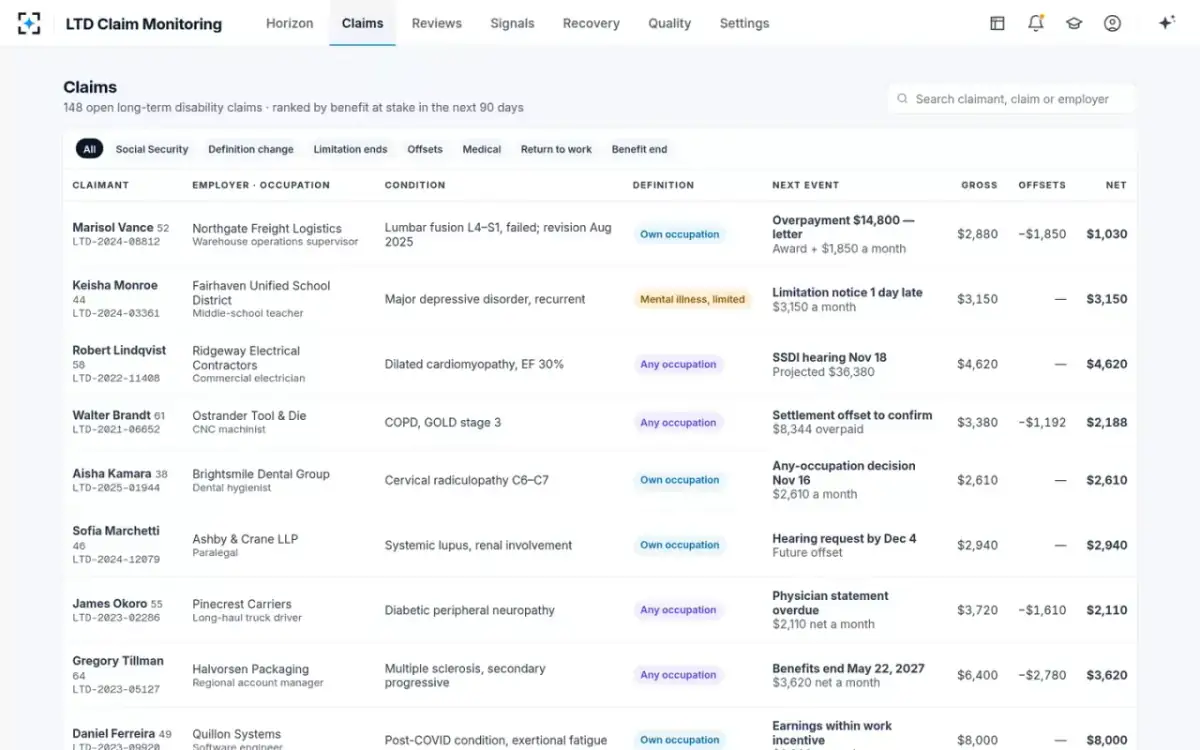
Every open claim in LTD Claim Monitoring, with the next event that changes its benefit
Do LTD benefits stop when you return to work?
Not immediately, and not necessarily at all. Under a policy with a residual benefit they continue, reduced or not, while you work part time within your restrictions; they end when your earnings, hours or recovery mean you no longer meet the policy's definition of disability, or when you return to full earnings. The end is usually recorded as a recovery, and the industry's claims studies count it that way.
Two protections are worth knowing. Where a policy has a recurrent disability clause, a relapse within a set period after return is treated as the same claim, without a new elimination period. And Social Security keeps a 36-month extended period after the trial work period, in which benefits can be paid again for any month earnings fall back below the substantial gainful activity line. To see earnings, offsets and reviews on sample claims, start from LTD Claim Monitoring.
Questions people ask
What is an LTD gradual return to work?
It is a planned increase in hours or duties over weeks or months, agreed between the claimant, the treating physician, the employer and the plan's vocational consultant. Benefits are adjusted at each step under the policy's work incentive or residual clause. In the case above, hours went from none to 20 to 30 over nine months.
Can you return to work after long term disability has ended?
Yes. If the claim ended because of a return to work, check the policy for a recurrent disability clause before it closes: where there is one, a relapse within a set period reopens the same claim without a new elimination period, and the period runs from a date the clause names.
Do I have to tell my LTD carrier about part-time earnings?
Yes. A policy that reduces benefits for earnings requires them to be reported, and benefits paid without them can be recovered as an overpayment. Reporting promptly also starts any work incentive on the right date, which can only help you.
Does working part time affect my SSDI?
It can. Months in which you earn over the trial work amount, $1,210 in 2026, count toward a nine-month trial work period; after it, Social Security stops payment for months over the substantial gainful activity amount, $1,690 in 2026 for non-blind beneficiaries, after a three-month grace. If your SSDI stops, tell your LTD carrier, since its offset should stop too.
Will my LTD benefit go up if my SSDI stops?
If your policy offsets SSDI and Social Security stops paying because of your work, the offset should stop for the same months, so the LTD benefit can rise even as you earn more. Whether and by how much depends on your policy's residual formula and other offsets; in the case above it rose from $1,050 to $1,650.