An SSDI offset calculator for long-term disability reduces the gross LTD benefit by the Social Security Disability Insurance the policy counts, month by month, never below the policy's minimum benefit, and compares the result with what was actually paid: the difference over the months Social Security paid in arrears is the overpayment. The arithmetic is simple; getting it right is not, because every input comes from a different document and every policy words its offset differently. Botminds' LTD Claim Monitoring reads the Notice of Award and the policy, and its offset calculator applies the policy's rule by rule, not by a model, with every input cited, for the examiner to approve.
The worked example is Marisol Vance, a fictional claimant of the fictional carrier Larkspur Mutual, as her Social Security award runs through the solution; all names and figures in the example are sample data. Rules and statistics come from the Social Security Administration, the Department of Labor and the US Code, linked where they appear.
The LTD offset in one line: gross, less what the policy counts, never below the minimum
Gross benefit
Benefit % × pre-disability earnings
Sample: 60% × $4,800 = $2,880 a month
The policy, §3.1
Social Security the policy counts
Claimant's SSDI ± family SSDI
Sample: $1,850 from February 2026, no dependants
The Notice of Award
Other income benefits
Workers' comp + pension + state disability + earnings over the work incentive
None for this claimant in the overlap months
Settlement orders, employers, payroll
Net benefit
max(gross − offsets, minimum benefit)
$2,880 − $1,850 = $1,030, above the $288 minimum
The policy, §6.3 and §3.4
How is the SSDI offset calculated for LTD?
The SSDI offset is calculated by finding, for each benefit month, the Social Security amount the policy says to count, subtracting it from the gross LTD benefit and applying the minimum. The offset exists because group plans are designed to pay alongside Social Security, not on top of it. The Department of Labor described the arrangement in its 2016 rule: "most employer plans require claimants to file with the SSDI as a condition of receiving benefits from the plan as they offset the benefits paid by plan with the amount received from SSDI" (81 FR 92316).
Because Social Security decides months or years after the LTD claim starts, the calculation is almost always made twice. First, while the application is pending, the plan pays the full benefit or reduces it by an estimate. Then the Notice of Award arrives, entitlement is dated back, and every month of overlap has to be recalculated. Marisol's notice, dated October 3, 2026, entitles her from February 2026 at $1,850.00 a month; Larkspur had paid her full $2,880 for February to September.
Marisol's eight overlap months: what was paid, what was due and how the overpayment builds
| Benefit month | Paid | SSDI for the month | Due under the policy | Overpaid to date |
|---|---|---|---|---|
| Feb 2026 | $2,880 | $1,850 | $1,030 | $1,850 |
| Mar 2026 | $2,880 | $1,850 | $1,030 | $3,700 |
| Apr 2026 | $2,880 | $1,850 | $1,030 | $5,550 |
| May 2026 | $2,880 | $1,850 | $1,030 | $7,400 |
| Jun 2026 | $2,880 | $1,850 | $1,030 | $9,250 |
| Jul 2026 | $2,880 | $1,850 | $1,030 | $11,100 |
| Aug 2026 | $2,880 | $1,850 | $1,030 | $12,950 |
| Sep 2026 | $2,880 | $1,850 | $1,030 | $14,800 |
| 8 months | $23,040 | $14,800 | $8,240 | $14,800 |
Two details in that table are easy to get wrong by hand. The entitlement month is not the onset date: Social Security's five-month waiting period sits between them, which the five-month waiting period works through for three elimination periods. And the paid column must be what was actually paid, not what the claim system says was due, because a partial payment, a missed month or an earlier estimate all change the overlap.
The five inputs every SSDI offset calculation needs
A correct offset needs five inputs, and each lives in a different document. A calculator that asks a person to type them is a spreadsheet with a form on top; the work, and the risk, is in finding them.
- The policy in force at the date of disability. Its benefit percentage, earnings definition, offset clause, family-benefit rule, cost-of-living rule and minimum benefit. A policy amended since may not apply to this claim.
- Social Security entitlement month and amount. From the Notice of Award, including any later notice that changes the amount; not from the claimant's estimate or the advocate's projection.
- Family benefits. Whether a spouse or children are entitled on the claimant's record, from what month and at what amount, if the policy counts them.
- Other income. Workers' compensation, state disability, pensions and earnings, each with its own start date and the policy's rule for spreading a lump sum.
- What was paid. Month by month from the payment history, plus any reimbursement agreement the claimant signed and its date.
Two more are often forgotten. The rule version, so that the same inputs give the same answer next year when an auditor asks. And the source of each value, page and section, so that the examiner, the claimant and, if it comes to it, a court can check it. In the sample, every input on the calculation screen carries its page or section, and the result carries "rule version 2024.2".
Does LTD reduce for SSDI dependent benefits?
It depends on the policy: some group LTD policies offset only the claimant's own SSDI, and others also count benefits paid to a spouse or children on the claimant's earnings record. The difference is material. In August 2026 Social Security paid 893,000 children of disabled workers an average of $529.79 a month, and 87,000 spouses an average of $463.94, beside 6,975,000 disabled workers averaging $1,635.90 (SSA Monthly Statistical Snapshot, August 2026).
For one claimant with one child at the average, a policy that counts family benefits takes about $530 a month more than one that does not, and over an eight-month overlap that is about $4,240 of additional overpayment. The calculator has to know which rule the claimant's policy uses and read each family member's amount and start month from Social Security's notices. The sample carrier's setting is "Family benefits: offset", and Marisol has no dependants, so her figure is the primary benefit alone.
Frozen or indexed: what a cost-of-living increase does to the offset
A frozen offset stays at the Social Security amount first awarded, so later cost-of-living increases go to the claimant; an indexed offset rises with them, so each increase reduces the LTD benefit. Social Security's latest increase is 3.6 percent, "beginning with the December 2026 benefits, which are payable in January 2027" (SSA, Latest Cost-of-Living Adjustment).
One cost-of-living increase, two offset rules: Marisol's benefit in January 2027
Offset frozen at first award: $1,850, the amount first awarded
Offset indexed with cost of living: About $1,917, after the 3.6% increase
Offset frozen at first award: $2,880 − $1,850 = $1,030
Offset indexed with cost of living: About $2,880 − $1,917 = $963
Offset frozen at first award: None: the increase does not touch the LTD benefit
Offset indexed with cost of living: A recalculation and a benefit-change notice every January
Offset frozen at first award: The claimant
Offset indexed with cost of living: The plan
Most errors here are not arithmetic but rule errors: a calculator that indexes by default on a policy that freezes, or the reverse. Because the increase is annual, an error repeats every January on every affected claim, and the claimant notices.
SSDI offset and workers' compensation: two offsets, one claimant
When a claimant receives both workers' compensation and SSDI, Social Security may reduce the SSDI first, and the LTD policy then offsets both. Federal law reduces SSDI when it and periodic workers' compensation together exceed the higher of "80 per centum of his 'average current earnings'" or the Social Security benefit itself before reduction (42 U.S.C. 424a). The Notice of Award will then show a reduced SSDI amount.
The trap for an LTD calculator is double counting. If it offsets the unreduced SSDI and the full workers' compensation, it takes more than the claimant receives. It must use the SSDI actually payable after Social Security's own reduction, plus the workers' compensation the policy counts. A lump-sum settlement adds another rule: the sample policy spreads it over the remaining benefit period, which is how Walter Brandt's $62,000 settlement becomes $1,192 a month from March 2026 and $8,344 overpaid by October.
What is an estimated SSDI offset?
An estimated offset is a reduction the plan applies before Social Security decides, using a projected SSDI amount, usually when the claimant has not applied, has not signed a reimbursement agreement or has not appealed a denial as the policy requires. It trades a smaller overpayment later for a smaller benefit now. Whether a plan may estimate, and when, is set by the policy, not by federal law.
The sample carrier estimates only where no reimbursement agreement is signed. Marisol signed hers on February 10, 2025, so Larkspur paid her full benefit while she waited and recovers the overlap from the back pay. For Robert Lindqvist, whose hearing is on November 18, the solution projects the award without applying it: if fully favourable from his alleged onset, about $2,140 a month from July 2025, a 17-month overlap of about $36,380, shown on his lane and pre-calculated, waiting for the notice.
The offset calculator in LTD Claim Monitoring: cited inputs, month by month, and the repayment options
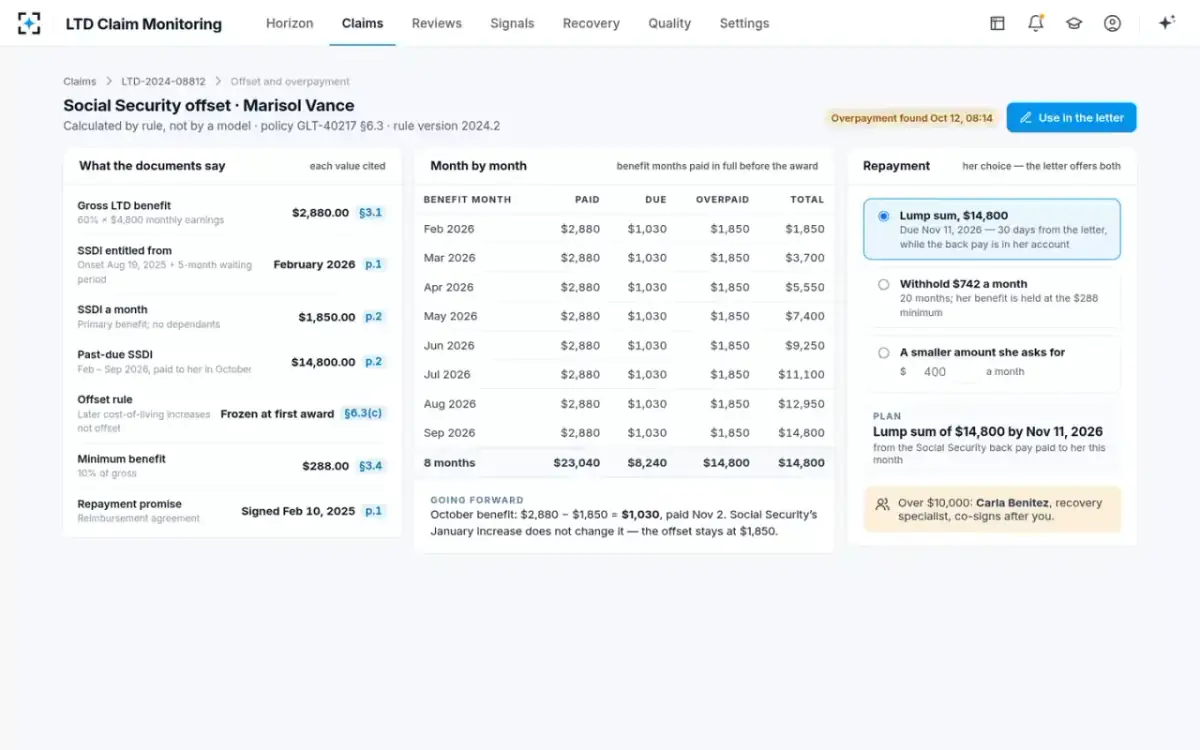
Inside LTD Claim Monitoring's offset calculator: what it reads, what it computes and what it never does
The offset is the last step of a chain, and each step is a different agent with a narrow job. The calculator itself is deterministic: no model computes money, the same inputs give the same answer, and the rule version is stored with the result. The agents before it find and cite the inputs; the people after it decide.
One Notice of Award to a signed benefit change: five agent steps, two signatures
Agent
Mail and document readerReads the six-page notice at 08:14, matches it to the claim by name, date of birth and Social Security number, and extracts entitlement month, monthly amount and past-due benefits with their pages.
Never: Guesses a low-confidence value; it goes to the examiner.
Agent
Social Security watchCloses the pending hearing: fully favourable decision, onset amended to August 19, 2025, waiting period September 2025 to January 2026.
Never: Contacts Social Security or the claimant.
Agent
Plan provisions agentReads policy GLT-40217 as in force at the date of disability: primary SSDI offset, frozen at first award, minimum benefit 10% of gross, reimbursement agreement signed.
Never: Interprets ambiguous wording; it flags it.
Agent
Offset calculatorWorks the eight overlap months, the $14,800 overpayment, the $1,030 benefit from October and the repayment options, with every input cited.
Never: Decides the recovery method.
Agent
Letter writerDrafts the repayment letter at 08:15, every figure cited in the margin, review rights included.
Never: Sends a letter.
A person decides
ExaminerChecks the calculation and signs with the meaning "Approved: benefit change and repayment letter". The benefit change takes effect only on this signature.
A person decides
Recovery specialistCo-signs because the overpayment is over $10,000; the letter goes by mail and to the claimant portal at 10:25.
The design choice that matters most to a buyer is the split between reading and calculating. Reading a scanned notice is a language task, and it can be wrong, which is why every value carries its page and a low-confidence value goes to a person. Calculating money is not a language task. A calculator that lets a model produce the overpayment cannot promise the same answer twice, and an examiner cannot sign what she cannot reproduce.
What to look for in an SSDI offset calculator
Public SSDI calculators estimate what Social Security might pay; they do not apply a group policy's offset. A carrier or administrator evaluating an offset calculator for LTD claims should test it on its own closed overpayments, with the policies, notices and payment histories behind them. These are the questions to ask.
Twelve questions for any LTD offset calculator
- Does it read the Notice of Award itself?
Or does someone type the amount? Typing is where the entitlement month slips by one.
- Does it apply the policy in force at the date of disability?
Not the current certificate, which may have changed since the claim began.
- Does every input show its source?
Page of the notice, section of the policy, date of the agreement.
- Is the money calculated by rule, with a rule version?
The same inputs must give the same answer at audit or in court.
- Does it handle frozen and indexed offsets per policy?
An indexing error repeats every January.
- Does it count family benefits only where the policy does?
And read their start months, which can differ from the claimant's.
- Does it use SSDI after Social Security's own workers' comp reduction?
Otherwise it double counts.
- Does it spread lump sums by the policy's method?
Over the remaining benefit period, life expectancy or another rule.
- Does it respect the minimum benefit in every month?
Including in the repayment options it offers.
- Can it credit representative fees where the policy allows?
Social Security may withhold part of the back pay to pay the claimant's representative.
- Does it use what was actually paid?
From the payment history, not from what the system thinks was due.
- Who approves the result?
A named examiner should sign the benefit change; the tool should never post it.
Where LTD Claim Monitoring fits, and where it does not
LTD Claim Monitoring fits a carrier or administrator with open group LTD claims, Social Security notices arriving by mail or an advocacy firm's feed, and offsets worked out in spreadsheets today. It sits beside the claim system: it reads the claim files, policies, notices and payroll feeds, calculates the offset and drafts the letter, and the examiner's signature makes the change. In the sample, the notice went from the scanner to a drafted letter in 46 seconds; the design target is the same day from any award to a calculated overpayment and a drafted letter.
It is not a claimant's calculator, and it does not estimate what Social Security will award from earnings history; the projections it shows come from the advocacy firm's case data and are labelled as projections. It does not replace the claim system's payment engine, decide how an overpayment is recovered, or contact Social Security or the claimant. And it is only as good as the policy text it is given: a carrier whose older certificates exist only as scans should expect to confirm the offset clause for each policy form before trusting the results. How to check that an overpayment figure is right sets out the four tests, and the sources a monitoring desk reads shows where each input comes from.
Questions people ask
Is there an SSDI offset calculator I can use myself?
Social Security's own tools estimate the Social Security benefit, not a private plan's offset. To work out your LTD offset you need your policy's offset clause, your Notice of Award and your payment history, and then the arithmetic on this page: gross benefit, less the Social Security amounts your policy counts, not below the minimum. Your carrier must explain its figures if you ask.
What happens to LTD when SSDI is approved?
The LTD benefit is reduced by the SSDI the policy counts, from the month Social Security says you are entitled. If the plan paid the full benefit while you waited, the months of overlap become an overpayment, usually repaid from the Social Security back pay. Going forward you receive two payments: in the sample, $1,850 from Social Security and $1,030 from the plan, which add up to the $2,880 the plan paid alone.
Does the offset include SSDI back pay?
The back pay is Social Security's payment for past months, so the policy offsets it month by month for the same months the LTD plan paid. That is why the overpayment often equals the overlap months times the monthly SSDI, as in the sample: eight months at $1,850 is $14,800. Months before the LTD benefit began are not part of the overlap.
Is an SSA offset calculator the same as an SSDI offset calculator?
Not usually. "SSA offset" more often means Social Security reducing its own benefit, for example for workers' compensation under 42 U.S.C. 424a. An LTD SSDI offset is the private plan reducing its benefit for Social Security, under the policy's terms.
Can the offset leave me with nothing from LTD?
Not if the policy sets a minimum benefit, which keeps the LTD payment above zero however large the offsets; check yours for the clause. In the sample policy the minimum is 10% of the gross benefit, $288 a month, and the withholding option for repaying an overpayment is capped so that the benefit stays at that minimum.