An LTD claim management system is the software a disability carrier or administrator uses to hold each long-term disability claim and pay it: the claimant, the policy, the benefit calculation, the payment schedule, the diary and the correspondence. For claims that stay open for years, though, the system is only as current as the documents fed into it, and most of the events that change a benefit, a Social Security award, a workers' compensation settlement, a pension, part-time pay, a new restriction, arrive from outside it, by mail or another party's feed, and wait for someone to key them in. Botminds' LTD Claim Monitoring sits beside the claim system: its agents read those sources as they arrive, place each event on the claimant's timeline against the policy's rules, and prepare the calculation, review or letter for the examiner to sign in the system of record.
The examples come from the fictional carrier Larkspur Mutual, sample data as it runs through the solution. Market and program figures come from the Bureau of Labor Statistics, the Social Security Administration and the Department of Labor, linked where they appear.
One morning's benefit-changing events, by what they change and how they arrived
What each changes
- Social Security · 40%
- Other offsets · 40%
- Return to work · 20%
How each arrived
- Advocacy firm feed · 40%
- Employer: pension, payroll · 40%
- Claims mailbox · 20%
What is an LTD claim management system?
It is the system of record for long-term disability claims: intake, the decision, the benefit amount and its offsets, payments and tax reporting, the diary, notes and letters. It answers the questions a claims operation must be able to answer at any moment: who is on claim, under which policy, at what benefit, paid to when. Claim systems are built around that claim file and the payments that flow from it.
The market it serves is large and spread thin. In the Department of Labor's count from 2014 Form 5500 filings, 26,171 plans reported providing long-term disability benefits, covering 22.4 million participants (81 FR 92316). In March 2026, 37 percent of private industry workers had access to long-term disability plans (BLS, Employee Benefits in the United States, March 2026). Each covered employer brings its own policy wording, payroll and pension arrangements, which is why the sources behind a benefit are more varied than the claim record suggests.
What systems do LTD claims teams use?
An LTD desk works across five kinds of system: the claim administration system that holds and pays the claim; a document or imaging system for scanned mail; the policy administration system or policy library that holds the group contracts; email and portals through which employers, physicians and advocacy firms send information; and spreadsheets, which fill every gap between them. Offsets and overpayments are where spreadsheets live longest, because the calculation needs inputs from four of the other systems at once.
The sources behind an LTD benefit: what each changes, how often, and who reads it
| Source | What it changes | How often it arrives | Read today by |
|---|---|---|---|
| Claim system and payment history | Nothing by itself; it is where the change is made | Continuous | Everyone |
| Group policy in force at the date of disability | Every date and rule: own-occupation end, limitations, offsets, minimum benefit, benefit end | Once, then on every review | Examiner, when a question arises |
| Social Security notices, by mail | Offset from the entitlement month; evidence for reviews; appeal deadlines | Irregular, months or years into the claim | Mailroom, then examiner |
| Advocacy firm feed | Applications, hearing dates, decisions, projected awards | Daily, in the sample | Examiner, if anyone opens it |
| Payroll earnings from employers | Work incentive and residual benefit | Monthly, in the sample | Examiner, at review |
| Pension elections, settlements, state disability | Other income offsets, including lump sums | Irregular | Whoever receives the document |
| Physician statements and vocational reports | Restrictions, the any-occupation test, return-to-work steps | On a six-month cycle in the sample settings, plus when requested | Examiner, clinical and vocational consultants |
How do LTD carriers track SSDI awards?
Carriers track SSDI awards from three directions: the claimant's own report, required by the policy or a reimbursement agreement; the mail, when the claimant or a representative forwards the notice; and, where the carrier works with an advocacy firm, the firm's case status. Each is late in its own way, and an award that arrives through none of them is found at the next review, as an overpayment months old.
The volume makes this a system question. Social Security made 594,749 awards to disabled workers in 2024 (SSA Annual Statistical Report on the SSDI Program, 2024), and the Department of Labor described most employer plans as requiring claimants to file for SSDI precisely because they offset it. Tracking awards is not only about money. The Department noted in 2016 that "Courts have criticized the failure to consider the SSA determination, especially if a plan's administrator operates under a conflict of interest and if the plan requires or encourages claimants to pursue SSA decisions in order to offset any SSA award against the amount they pay in disability benefits" (81 FR 92316). A plan that collects the award's money must also read the award's findings.
How do LTD teams receive Social Security letters?
Mostly on paper, second-hand. Social Security writes to the claimant; the claimant, her representative or an advocacy firm passes the letter on, and it lands in the carrier's claims mailbox to be scanned, indexed to a claim and read. In the sample, the Notice of Award for Marisol Vance is dated October 3, 2026 and scanned on October 12, nine days later; by hand, Botminds estimates a further ten days in the mail queue before anyone reads it.
A monitoring desk needs two things from that path: matching and reading. Matching ties the letter to the right claim by name, date of birth and Social Security number, and sends any doubt to a person. Reading extracts the dates and amounts with their page, so the examiner can check them in seconds. What the notice of award shows, line by line covers what to read.
One document from the mailbox to the claim: four agent steps, one signature
Agent
Horizon orchestratorPicks up the newly scanned document at 08:14 and routes it; every night at 06:00 it also hands each approaching date to the right agent.
Never: Changes a benefit amount or a claim status.
Agent
Mail and document readerReads the notice, matches it to LTD-2024-08812 by name, date of birth and Social Security number, and extracts the entitlement month, the amount and the past-due benefits with their pages.
Never: Places a low-confidence value; it goes to the examiner.
Agent
Plan provisions agentReads the policy in force at the date of disability for the offset rule, the minimum benefit and the agreement.
Never: Interprets ambiguous wording; it flags it.
Agent
Offset calculator and letter writerCalculate the overpayment by rule and draft the letter, every figure cited.
Never: Sends a letter or decides the recovery method.
A person decides
ExaminerChecks the cited values and signs; the benefit change is then made in the claim system.
Can a claim system diary own occupation dates?
Yes, if someone enters them, and that is the weakness. A claim system diary holds the dates it is given; it does not read the policy to find them. An own-occupation end, a mental illness limitation or a benefit end at 65 has to be worked out from the policy in force at the date of disability and the claim's own dates, entered by hand at approval, and changed by hand if the claim's dates change. A diary entered wrong is worse than none, because it is trusted.
In LTD Claim Monitoring the plan provisions agent builds each claim's dates from the policy, with section numbers, and the review preparer opens each review on its lead time: 120 days before a definition change and 90 days before a limitation or benefit end, by the sample settings. On the sample carrier's quality page, 14 own-to-any reviews were missed in the seven months before monitoring went live and none after. The review at month 24 explains what the date sets off.
The policy is a source, not a PDF
The group policy is the most-read and least-structured source on an LTD desk. Its definitions, limitations, offset clause, cost-of-living rule, lump-sum method, minimum benefit and recovery clause decide every calculation, yet it can sit as a scanned contract that an examiner opens when a question comes up, and the answer lives in that examiner's notes.
Treating the policy as a source means reading it once, per policy form, into the rules the claim uses, each with its section, and checking that reading with a person before it carries weight. It also means knowing which version applies: the one in force at the date of disability, not the one renewed last year. Where wording is ambiguous, the sample's plan provisions agent flags it rather than choosing a meaning, because a choice made silently becomes a pattern across every claim on that form.
Payroll, pensions and settlements: the offsets nobody sends
The offsets most likely to be missed are the ones no party is obliged to send promptly. A payroll department reports earnings because the claimant has returned to work, not because the carrier asked this month. A pension plan pays an early retirement benefit without telling the disability carrier. A workers' compensation settlement is approved by a state board and arrives, if it arrives, as a court order in the mail.
LTD Claim Monitoring's benefit horizon: the morning's mail and feeds beside every claim
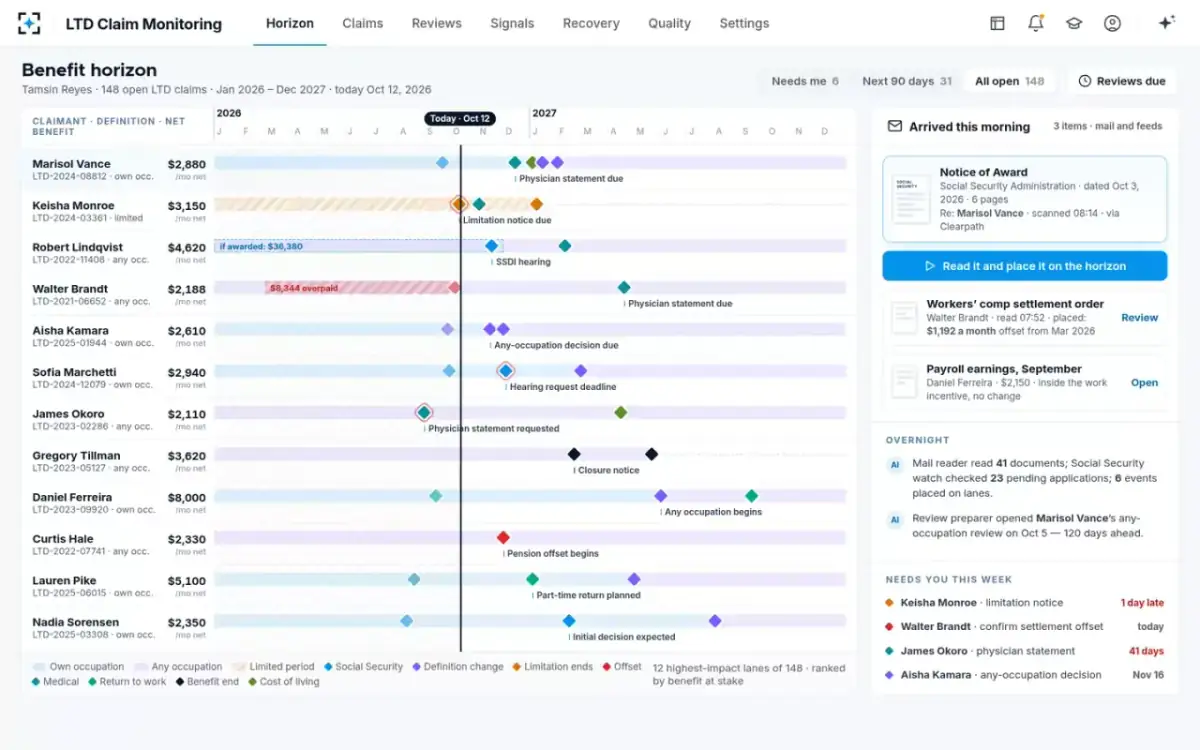
Each has a rule in the policy, and each changes the benefit on its own schedule. In the sample, Walter Brandt's $62,000 settlement, spread over his remaining benefit period, is $1,192 a month from March 2026, $8,344 overpaid by October; Curtis Hale's $1,240 pension cuts his net benefit to $1,090 from December 1; and Daniel Ferreira's $2,150 in September changes nothing because it falls inside his 12-month work incentive. One claim's return to work follows earnings and Social Security's work rules for 30 months.
Where agents read across the sources
Agents add most where a decision needs two or more sources at once: an offset needs the notice, the policy and the payment history; an any-occupation review needs the policy's date, the restrictions, the vocational report and any Social Security decision; a work-incentive check needs payroll and the policy. By hand, each of those is a search across systems. In the sample, the overnight run read 41 documents, checked 23 pending Social Security applications and placed six events on lanes before the examiner arrived.
The same cross-reading supports the federal content rules. A denial of disability benefits must discuss treating and plan experts' views and any Social Security determination the claimant presented (29 CFR 2560.503-1), which is only possible if the review gathers all three. In the sample, the review preparer must address any Social Security decision, and adverse decisions take a second signature from the claims quality reviewer.
What should an LTD claims system track?
Whether the answer is a new claim system, a monitoring layer beside the current one, or both, the questions below separate a tool that holds claims from one that keeps them current. Ask each on your own closed claims.
Twelve things an LTD claims system should track, and how to test each
- Every date the policy sets, built from the policy
Own-occupation end, limitations, benefit end. Test: rebuild them for 50 open claims and compare with the diary.
- Social Security status for every claim
Application, reconsideration, hearing, decision, with appeal deadlines. Test: how many hearings are pending today?
- Each notice's entitlement month and amount, with its page
Test: open a closed overpayment and find the page the figure came from.
- Family benefits, where the policy counts them
Each member's start month and amount.
- Other income by source
Workers' compensation, pensions, state disability, earnings, each with its policy rule.
- Lump sums and how they are spread
By the policy's method, from the date the policy names.
- Earnings against the work incentive and residual rule
Including the incentive's end date.
- The minimum benefit in every month
In calculations and in repayment options.
- Overpayments from the month they start
Not from the month someone finds them.
- Reviews on their lead time
With the share opened on time, by month.
- Letters with their sources and review rights
And, for final denials, the limitations date the regulation requires.
- Who signed every change, and what the signature meant
People and tools alike, in order.
Where LTD Claim Monitoring fits beside your claim system, and where it does not
LTD Claim Monitoring fits beside a working claim system, not in place of it. It reads the open claim files and payment history, the group policies, Social Security letters from mail scanning and the advocacy firm feed, payroll earnings from employer feeds, and medical and vocational reports; it keeps every claim on one benefit horizon; and it prepares offsets, reviews and letters. The examiner signs, and the change is made in the system of record. The design targets are every own-to-any review opened 120 days ahead and the same day from a Social Security award to a calculated overpayment and a drafted letter.
It does not take new claims or decide them, which Disability Claims Adjudication covers, together with the systems behind a new claim; it does not pay benefits or produce tax forms; and it does not contact Social Security or claimants. Its output is only as good as its sources: a carrier whose older policy forms exist only as poor scans should expect to confirm each form's rules before the dates and offsets carry weight, and one without a payroll feed will see earnings only when they are mailed. The offset calculator shows one calculation end to end, and LTD Claim Monitoring shows the whole solution on sample claims.
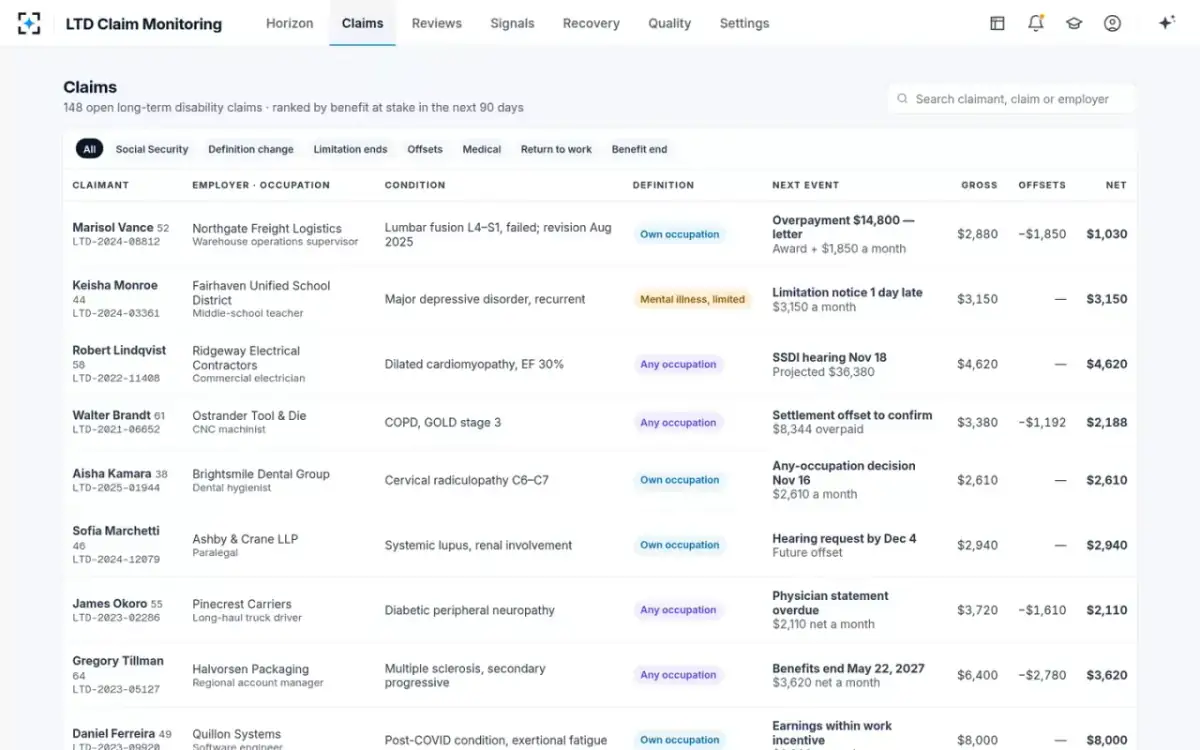
Every open claim, ranked by benefit at stake in the next 90 days
Questions people ask
What is LTD claim management?
It is the ongoing handling of open long-term disability claims between approval and close: keeping the benefit right as dates arrive and income changes, gathering evidence for reviews, recovering overpayments and writing the letters. Most of the work is triggered by documents from outside the claim system, which is why monitoring is a large share of it.
Do I need a new claim system to monitor LTD claims better?
Not necessarily. The gaps are usually in reading the sources and keeping the dates, not in holding the claim file or paying the claim. A monitoring layer that reads the documents and prepares the work, with changes made in the existing system, can be piloted on closed claims without a migration.
Can a monitoring tool connect to an advocacy firm's feed?
If the firm provides one, yes. In the sample, a daily feed from the carrier's advocacy firm reports applications, hearings and decisions, and the Social Security watch uses it to expect a decision before the paper notice arrives. Each source can be switched on separately.
How do LTD teams know when a claimant starts working?
From the claimant's own report, which a policy that reduces benefits for earnings requires, from the employer's payroll if the carrier receives it, and from physician releases. A monthly payroll feed is the most reliable of the three; in the sample, earnings are read monthly and checked against the work incentive automatically.
What reports should an LTD claims leader see each month?
At least: days from a Social Security award to a calculated overpayment, reviews opened on their lead time, overpayments found and recovered, and adverse decisions that address the Social Security decision. These are the measures on the sample carrier's quality page, and each depends on the sources being read on time.