A long term disability claim manager, also called an LTD claims examiner or case manager, runs approved claims for the years they stay open: watching the dates that change a benefit, such as the end of the own-occupation period, a mental illness limitation or age 65, and reading the mail that changes it, such as a Social Security award, a workers' compensation settlement, a pension or a pay slip. The hard part is not any one decision but the timing, because these events arrive slowly and out of order across well over a hundred files. Botminds' LTD Claim Monitoring puts every open claim on one benefit horizon, reads the mail and the policy, and prepares each review, calculation and letter for the manager to decide and sign.
The month on this page belongs to Tamsin Reyes, a fictional senior examiner at the fictional carrier Larkspur Mutual; her 148 open claims are sample data as they run through the solution. The rules and research come from the Department of Labor, the Social Security Administration, the Bureau of Labor Statistics and the joint study by the Society of Actuaries Research Institute and LIMRA, linked where they appear.
Six parties write to an LTD claim manager in a month, and only two of them work for the carrier
Today
Sends forms when asked, sometimes months late; a part-time pay slip or a Social Security letter may never be sent at all.
With agents
Gets plain-language letters that name every figure and its source, with review rights included.
Still theirs: Her own appeal and her right to see the claim file.
Today
Returns attending physician statements on a six-month cycle, if chased; restrictions change between visits.
With agents
Each statement is read on arrival and its restrictions are dated on the claim.
Still theirs: The medical opinion.
Today
Notices of award, denials and hearing dates arrive by mail or in the firm's feed, months apart and in no fixed order.
With agents
Each notice is matched to the claim, its dates and amounts cited by page, and its appeal deadline worked out.
Still theirs: Its own decision, which the plan must then answer.
Today
Payroll reports earnings for a return to work; a pension election goes to a different department.
With agents
Monthly earnings feeds are read against the policy's work-incentive rules.
Still theirs: The job, and any accommodation.
Today
Asked for a review two weeks before the definition changes.
With agents
Get the review 120 days ahead, with restrictions, job demands and any Social Security decision gathered.
Still theirs: The vocational and clinical judgement.
Today
Hear about an overpayment after the back pay is spent; review adverse letters after they are drafted by hand.
With agents
See every overpayment from the month it starts; co-sign arrangements over $10,000 and adverse decisions.
Still theirs: The second signature.
What does a long term disability claim manager do?
A long term disability claim manager keeps an approved claim paying the right amount, to the right person, under the right definition, until it ends. The Bureau of Labor Statistics describes the wider occupation in one line: "Claims examiners review claims after they are submitted to make sure claimants and adjusters followed proper guidelines" (BLS Occupational Outlook Handbook). In long-term disability the review never really stops, because the claim is paid monthly for years and its amount depends on events that have not happened yet.
The work falls into four kinds. Dates: the elimination period ending, the own-occupation period ending, a mental illness or self-reported limitation ending, the maximum benefit period or age 65. Offsets: Social Security Disability Insurance for the claimant and family, workers' compensation, state disability, pensions and earnings, each reducing the benefit by the policy's own rule. Evidence: attending physician statements, restrictions, vocational assessments and the Social Security file. Letters: requests, limitation notices, offset and repayment letters, review decisions and, where the answer is no, a denial that meets the federal content rules.
BLS counts 389,700 jobs across claims adjusters, appraisers, examiners and investigators in 2025, at a median of $78,020 a year, and projects about 21,600 openings a year, almost all of them to replace people who leave. The figures cover every line of insurance, not LTD alone. What they say for a disability desk is that experience walks out every year, and the diary in a departing examiner's head walks out with it.
Who manages my long term disability claim, and who else is involved?
The claim is managed by an examiner at the insurer, or at the administrator the plan uses, with clinical, vocational and recovery specialists behind them; at the sample carrier each claim has one named examiner. The figure above shows the six parties who write to that person in a month. Only the consultants and the recovery and quality staff work for the carrier; the claimant, the physician, Social Security and the employer each run on their own calendar.
That is why an LTD claim manager's month is set by other people's mail. A Social Security award can arrive two years after the claim was approved. A pension election can be made in September for December. A physician statement can come back with a new restriction that changes next quarter's vocational review. None of these arrives with a note saying which of the 148 files it belongs to, or what it changes.
How many claims does an LTD case manager handle?
There is no public benchmark for an LTD caseload. The Department of Labor said as much when it rewrote the disability claims rules, conceding it had no data on how many disability claims are filed or denied (81 FR 92316, December 2016; quoted in the disability claims process). It had to model claim volumes instead, assuming that about 33 percent of private-sector employees participate in long-term disability plans and that LTD claims run at the rate at which covered people file for Social Security Disability Insurance.
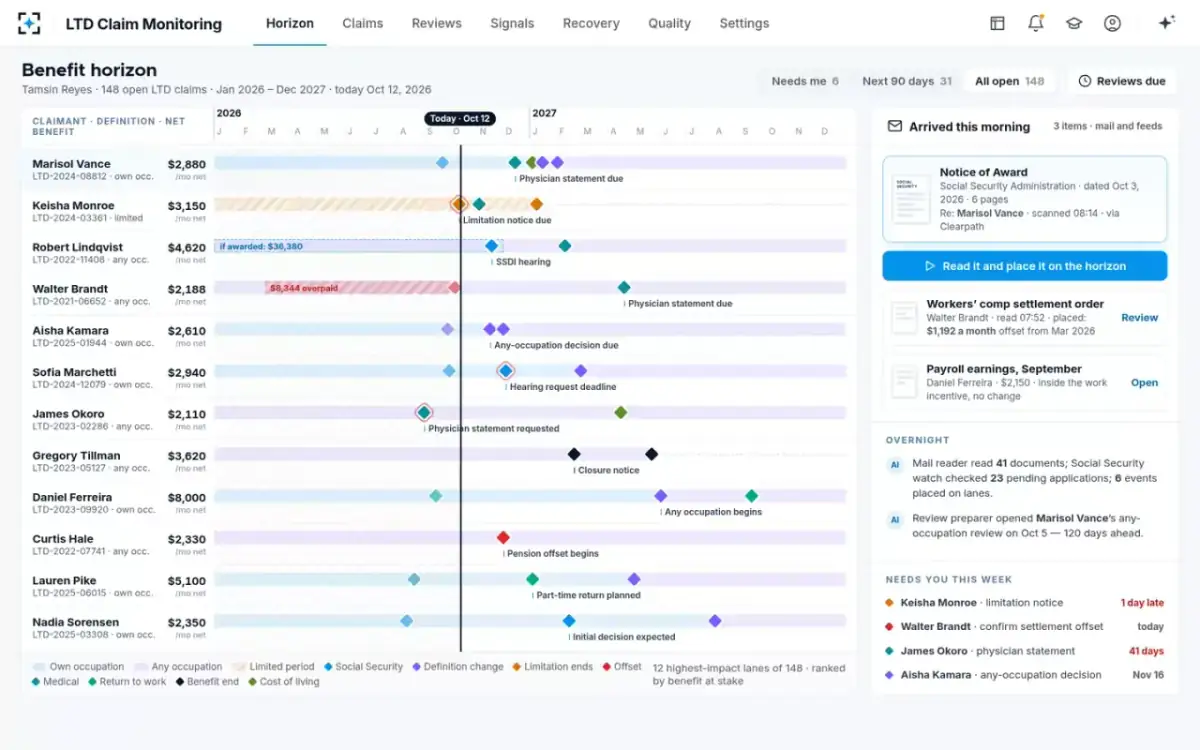
Carriers set caseloads by claim mix rather than by a single number: a file in its first year, with medical evidence still arriving, takes more work than one in its eighth year at any occupation with Social Security already offset. The sample examiner carries 148 open claims, and her team of nine carries 1,284, so the figure is plausible for a mixed caseload but should not be read as a standard. What matters more than the count is how many files have an event coming: in the sample, 31 of her 148 claims have one in the next 90 days and six need her this week.
LTD Claim Monitoring's benefit horizon: 148 claims, one lane each, a line for today
How often does LTD review a claim?
An LTD claim is reviewed whenever the policy, the evidence or a date says so: on a fixed medical cycle, at each change of definition or limitation, and whenever new information arrives that could change eligibility or the amount. There is no federal schedule for ongoing reviews. The federal clocks in 29 CFR 2560.503-1 run from a claim or an appeal, not from the calendar, so the review rhythm is the plan's own. The table below lists the dates a claim manager diaries and what sets each one.
The dates an LTD claim manager diaries, and what sets each one
| Date | What sets it | Why it cannot slip |
|---|---|---|
| End of the own-occupation period | The policy: in the sample policy, 24 months after benefits begin | After it, the claimant must be unable to do any suitable occupation; a late review either pays a claim the policy no longer covers or rushes the decision. |
| End of a mental illness or self-reported limitation | The policy's limitation clause | The Department of Labor treats benefits ending at a fixed, pre-set date as not an adverse benefit determination, so the notice is the claimant's main warning. |
| Physician statement due | Plan practice: every six months in the sample settings, overdue after 30 days | Restrictions are the evidence for every later review. |
| Social Security appeal deadline | 60 days from receipt of the notice, with receipt presumed 5 days after its date (20 CFR 404.933 and 404.901) | A missed request ends the Social Security claim the plan's offset depends on. |
| Social Security hearing | Social Security's hearing office | A fully favourable decision creates an overpayment back to the entitlement month. |
| Age 65 or the maximum benefit period | The policy's benefit schedule; one cost-justified pattern pays to 65, or five years if disabled after 60 | A closure notice is due before the last payment. |
The limitation row deserves its own sentence. In its 2016 preamble the Department of Labor repeated its earlier view that where "a plan provides for the payment of disability benefits for a pre-determined, fixed period", the termination at the end of that period "would not constitute an adverse benefit determination", and that a request to be paid beyond it "would constitute a new claim" (81 FR 92316). The plan does not owe a denial letter at a mental illness limitation's end. It owes the claimant a clear, early notice, and a claim manager who sends it a day late has given her one day less to gather the evidence for a new claim.
Week one: the mail that changes a benefit
The first week of the sample month is mail. On Monday, October 12, a Social Security Notice of Award for Marisol Vance, a warehouse operations supervisor with a failed lumbar fusion, is scanned at 08:14. A workers' compensation settlement order for Walter Brandt arrived the same morning, an employer pension election for Curtis Hale on Thursday, and a payroll file showing part-time earnings for Daniel Ferreira the week before. Each changes what the plan owes, and each reached a different inbox.
By hand, each document has to be matched to a claim, read for its dates and amounts, checked against the policy and diarised. The award is the costly one. Marisol's notice entitles her to $1,850 a month from February 2026, and Larkspur paid her full $2,880 benefit for the eight months since, so the plan has overpaid $14,800 that it can most easily ask for while the back pay is still in her account. What each unread month of an award costs is priced on its own page.
"I find out about the award when the overpayment is already eight months old."
Tamsin Reyes, the fictional sample examiner, describing her desk before the solution
The settlement and the pension are quieter but no smaller. Walter's $62,000 lump sum, spread over his remaining benefit period under the sample policy, comes to $1,192 a month from March 2026, so seven months were overpaid by $8,344. Curtis's $1,240 early retirement pension starts on December 1 and, under the sample policy's offset, cuts his net benefit to $1,090. Daniel's $2,150 in September falls inside the policy's 12-month work incentive, so nothing changes, but someone has to know that.
Week two: the dates that cannot slip
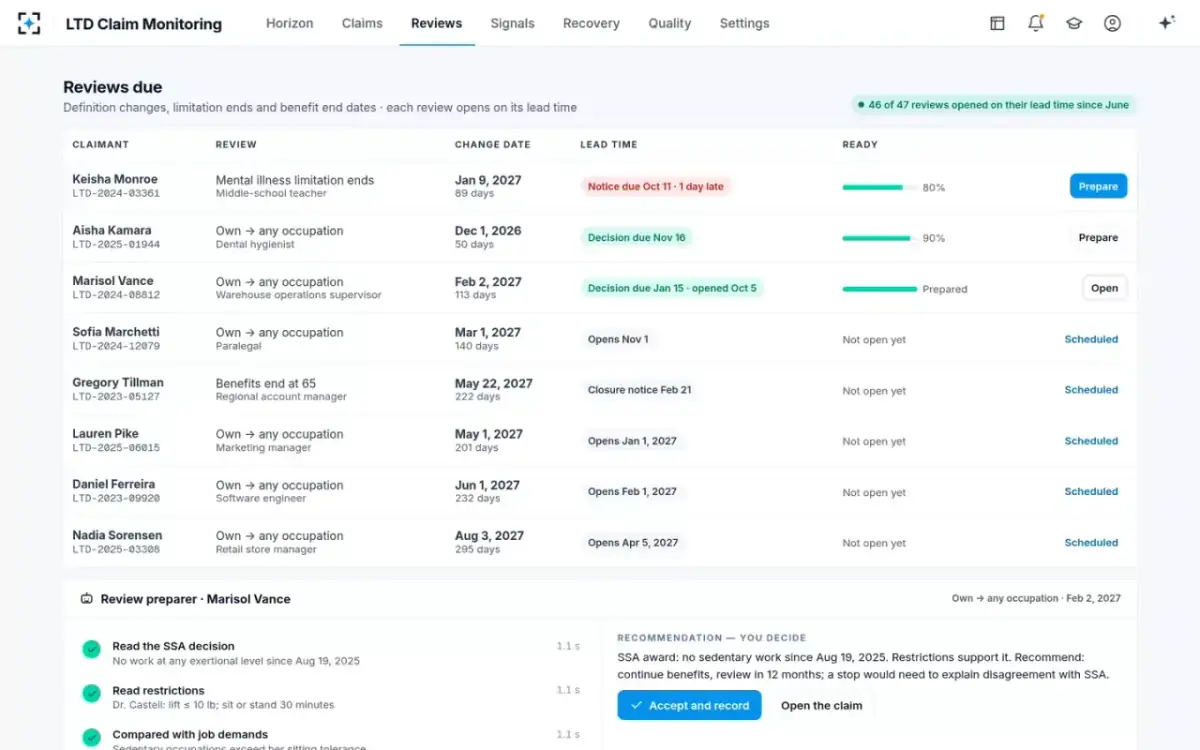
The second week belongs to the diary. Four reviews fall due in the sample month: Keisha Monroe's mental illness limitation ends on January 9, Aisha Kamara's own-occupation period ends on December 1, Marisol's on February 2, and Gregory Tillman's benefits end at 65 in May. Each needs a different kind of work, and each lead time starts months before the date itself.
Four claims, the next 120 days: how much of each lead time is already gone
- To the decision35 d
- Decision to change15 d
- Notice out, one day late1 d
- Notice to last payment88 d
- Review open, prepared95 d to decision
- Decision to change18 d
- Before the closure notice132 d
Aisha's is the urgent one. Her own-occupation period ends on December 1, her any-occupation decision is due on November 16, and the review needs her restrictions, a skills analysis and the demands of the occupations she might do. A vocational consultant asked two weeks before the date cannot do that work properly; one asked 120 days before can. How the own-to-any review works, and why the claims data show so many claims ending at it, has its own page.
The research shows why these dates carry so much weight. The Society of Actuaries Research Institute and LIMRA, in a joint study of 2015 to 2024 claims from 18 companies, found recoveries running at about 150% of the 2008 table's expectation and deaths at about 81% (2015–2024 Group LTD Termination Study, September 2026). Claims are ending faster than the old table assumed, and much of the movement happens at dates the claim manager diaries.
Weeks three and four: decisions, letters and the second signature
The back half of the month is decisions. A benefit change needs a signature; at the sample carrier, a repayment arrangement over $10,000 needs a recovery specialist's too, and an adverse decision needs the claims quality reviewer's. Letters have to carry the policy section, the figures and the claimant's review rights, and a denial at review has to describe any contractual limitations period, including the calendar date it expires, which the limitations clock written into the policy explains.
Marisol's case shows how one event touches several decisions. Her award changes her benefit to $1,030 a month from October, creates the $14,800 repayment, and changes her own-to-any review: the judge found she could not do even sedentary work since August 19, 2025. A plan that decides she can do another occupation from February 2 would, under the federal rule, have to explain why it disagrees with a Social Security determination she presents to it. The review preparer in the sample recommends continuing benefits with a further review in 12 months; the decision stays with the examiner.
Reviews due: each opens on its lead time, with the recommendation left to the examiner
Which events arrive late, and what each one costs
The events that arrive late are the ones nobody sends on purpose. A diaried date is late only if the diary is wrong or ignored. A Social Security award is late because it goes to the claimant first, then perhaps to her advocate, and reaches the plan by mail or a feed whenever someone forwards it. Earnings are late because they come from payroll. A pension is late because the employer's retirement plan has no reason to tell the disability carrier.
Each kind of lateness has a different price. A late award grows an overpayment by the full Social Security amount every month, and recovery gets harder once the back pay is spent. A late own-to-any review risks paying a claim the policy no longer covers, or a rushed decision that does not answer the evidence. A late limitation notice shortens the claimant's warning. A missed Social Security appeal deadline can end the very award the plan's offset assumes.
Reviews opened on their lead time, by month, before and after monitoring went live
What LTD Claim Monitoring takes off the month, and what stays with the manager
LTD Claim Monitoring takes the watching and the arithmetic. Seven agents keep each claim's dates, read Social Security notices, settlement orders, physician statements and payroll files, match each to the claimant by name, date of birth and Social Security number, calculate offsets by the policy's rule, open each review on its lead time and draft the letters. In the sample, the Notice of Award went from the scanner to a drafted repayment letter in 46 seconds. The design targets are every own-to-any review opened 120 days ahead, and the same day from a Social Security award to a calculated overpayment and a drafted letter.
What stays with the manager is everything that is a decision. The agents never change a benefit, close a claim or send a letter, and never contact Social Security or the claimant; a benefit change takes effect on the examiner's signature. That boundary matters beyond good practice: the federal rule requires that decisions be made in a way designed to ensure the independence and impartiality of the people making them, and a tool that prepares rather than decides keeps the person who decides in view. How to put such a tool live safely is set out phase by phase on its own page.
Claim decisions and appeals at the front of the claim are a different job, the disability claims examiner's week in Disability Claims Adjudication. LTD Claim Monitoring starts once a claim is paying and stays with it until it closes. To see the horizon, the offset calculation and the letters on sample claims, start from LTD Claim Monitoring.
Questions people ask
What is an LTD claim review?
It is a planned check of whether an open claim still meets the policy's definition of disability and is paid the right amount. Reviews fall at fixed points, such as the end of the own-occupation period or a limitation, and whenever new evidence arrives. A review that ends or reduces benefits is an adverse benefit determination under 29 CFR 2560.503-1, with the letter content and appeal rights that rule requires.
What does an LTD claims specialist do differently from an examiner?
Titles vary by carrier, and the work overlaps. Where both exist, the examiner usually owns the decision and the claim, while specialists own a function across many claims: overpayment recovery, vocational assessment, clinical review or Social Security advocacy. In the sample carrier, the recovery specialist co-signs repayment arrangements over $10,000 and the quality reviewer co-signs adverse decisions.
Does my LTD claim manager have to consider my Social Security decision?
Yes, if you give it to the plan. Under the Department of Labor's disability claims rule, which applies to claims filed after April 1, 2018, a denial of disability benefits under an ERISA plan must explain the basis for disagreeing with a Social Security disability determination the claimant presented to the plan. A plan that finds you can work when Social Security found you cannot must say why.
What happens when my claim manager changes?
The claim stays the same, but what the previous manager knew informally may not travel. Diaried dates, a pending Social Security hearing or an agreed repayment plan should all be on the claim itself. It is worth asking the new manager to confirm the next review date and any offset in force.
How long does a long term disability claim stay open?
As long as the claimant stays disabled under the policy, up to its maximum benefit period; the sample policy pays to Social Security normal retirement age. The sample claim on this page runs from a disability date in November 2024 to March 2041. Along the way it passes an own-occupation end, a Social Security award and several reviews, each a point where it could close.