AI in disability management, for long-term disability claims, means software that reads the documents a claim depends on, keeps its dates, calculates offsets by the policy's rules and drafts the reviews and letters, while examiners make and sign every decision. It is safest to put live in three phases, each run beside examiners for at least one cycle before it carries weight: first the diary of dates, then the reading of Social Security mail, then offset proposals and draft letters. Botminds' LTD Claim Monitoring is built that way, with seven agents reading the mail and the policy and preparing the work for the examiner, who decides and signs.
The examples use the fictional carrier Larkspur Mutual and its claims, sample data as they run through the solution. The rules come from the Department of Labor's claims regulation and the Supreme Court; the phases and exit tests are our recommendation.
Exit tests: what each phase must show before the next one starts
- Phase one, the diary: every date in the sample matches the policy
Own-occupation ends, limitation ends, benefit ends and Social Security deadlines, rebuilt from the policy and the claim, agree with the examiners' own diary on a full sample of open claims, and every difference is explained.
- Phase one: reviews open on their lead time for a full month
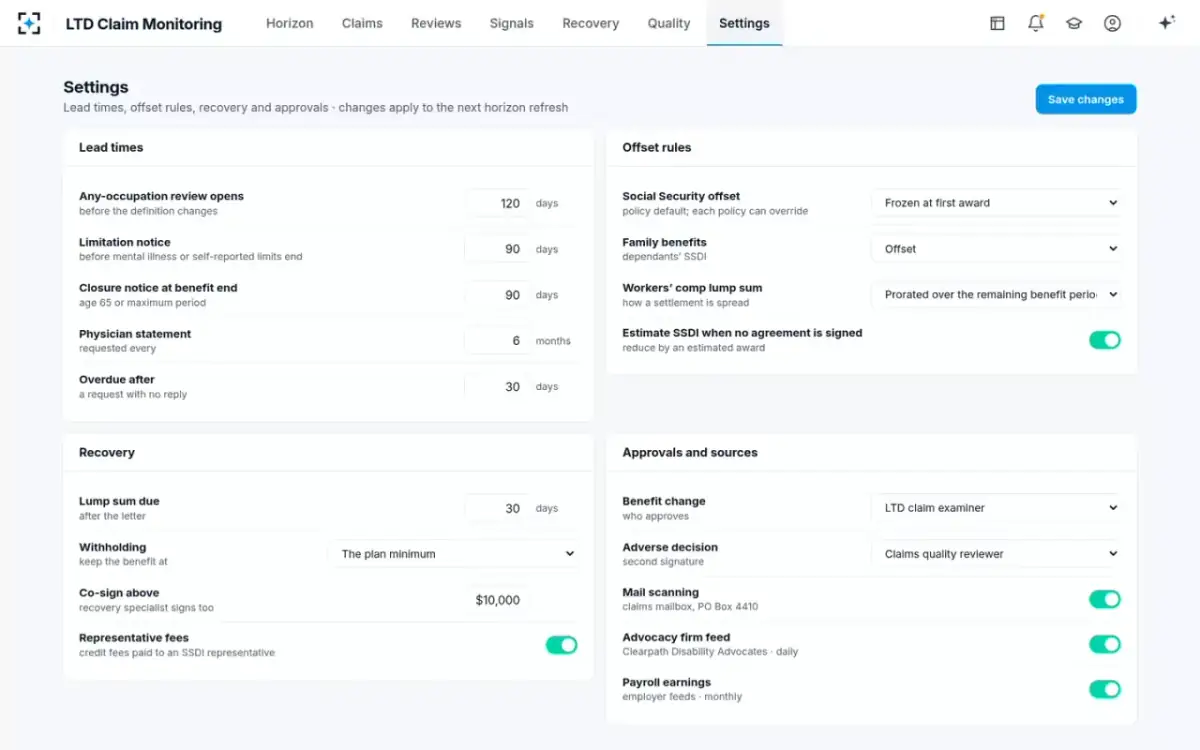
At the chosen lead time (120 days before a definition change in the sample settings), with no review found late by an examiner first.
- Phase two, the mail: every Social Security notice matched to the right claim
Name, date of birth and Social Security number all agree; any mismatch goes to a person, and none is placed on the wrong claim.
- Phase two: every date and amount carries its page
Entitlement month, monthly amount, past-due benefits and appeal deadlines, checked against the notice by an examiner on every document in the run.
- Phase three, the money: replayed overpayments agree with the examiners' figures
On closed overpayments, each difference is traced to one of four causes: months, rule, family benefits and fees, or paid amounts.
- Phase three: letters need no change to figures or rights
Edits for tone are fine; a changed figure, a missing review right or a wrong policy section sends the phase back.
How is AI used in disability management today?
AI in disability management covers a handful of jobs. Reading: pulling dates, restrictions and amounts out of physician statements, Social Security notices and settlement orders, summarising medical files and sorting mail. Tracking: keeping each claim's diary. Drafting: reviews and letters. And scoring: ranking claims for attention. The uses that stay out of trouble share one property: a person can see what the tool read, where it read it, and decide what to do about it.
Insurance regulators have taken a general position rather than a disability-specific one. The NAIC's model bulletin on insurers' use of artificial intelligence systems was "Adopted by Executive (EX) Committee and Plenary, December 4, 2023" (NAIC Model Bulletin), and each state's adoption governs; the NAIC AI bulletin adoption map tracks where it applies. For an ERISA plan, the sharper rules are federal and much older than any AI tool, and they decide what an AI-assisted desk may and may not do.
The rules an AI-assisted LTD desk has to respect
Four parts of the federal disability claims rule, 29 CFR 2560.503-1, set the boundaries. They were written for people, and they apply to whatever tools those people use.
Independence. Claims must be decided in a way designed to keep the people deciding them independent and impartial, and no adjudicator or expert may be hired, paid, promoted or let go on how likely they are to support a denial; AI in disability insurance claims quotes the rule and the Department's own examples. A tool that scores examiners or consultants by their denial rates and feeds that into pay or promotion walks straight into it.
Answering the evidence. A denial must discuss and explain disagreement with treating professionals, the plan's own experts and any Social Security disability determination the claimant presented. A tool that drafts a denial without those discussions produces a defective letter.
Strict adherence. If a plan does not follow the rule strictly on a disability claim, the claimant may go to court as if the internal process were finished, and the claim counts as denied on review with no fiduciary discretion exercised (the ERISA appeals process for disability quotes the paragraph). A plan that loses discretion loses the deferential review that, under Firestone, only a grant of discretion earns. There is an exception for minor slips, but it is narrow, and it ends where automation begins:
"This exception is not available if the violation is part of a pattern or practice of violations by the plan."
29 CFR 2560.503-1(l)(2)(ii), on the exception for minor violations
A person who sends one letter a day late makes a slip. A tool that computes every limitation notice one day late makes a pattern. That is the strongest argument for phasing: an error a tool makes, it makes on every claim, so each phase has to be proved before it carries weight.
Content and language. Disability denials must state the internal rules relied on, the claimant's right to the file and, at review, the contractual limitations period with its calendar date, and must be provided in a culturally and linguistically appropriate manner where the rule requires it. A letter writer agent has to carry all of that, every time.
Can AI monitor long term disability claims without changing benefits?
Yes, and that is the right design. Monitoring is reading, tracking and calculating; changing a benefit is a decision with appeal rights attached. In LTD Claim Monitoring the agents never change a benefit, close a claim or send a letter, and never contact Social Security or the claimant. They place events on the claimant's lane, open reviews, calculate offsets and draft letters; a benefit change takes effect only on the examiner's signature, recorded with its meaning.
The split also answers a common objection from examiners, which is that a tool will be wrong and they will carry the blame. If the tool's work is a draft with every value cited, the examiner can check it in the time it took to find the document before. If it is a silent change in the payment system, nobody can.
A go-live plan in three phases, each running beside examiners before it carries weight
- Load policies and open claims2 wk
- Parallel diary, compared weekly4 wk
- Connect mail scanning and the advocacy feed2 wk
- Every notice read twice: agent and examiner6 wk
- Replay closed overpayments4 wk
- Live drafts, examiner signs every one6 wk
Phase one: the diary of dates
Start with dates because they are deterministic, valuable and easy to check. The policy says when the own-occupation period ends, when a mental illness or self-reported limitation ends and when benefits stop; the claim says when disability began and benefits started. A tool that reads both should produce the same diary an excellent examiner keeps, for every open claim, and open each review on its lead time.
The value shows quickly. On the sample carrier's quality page, the share of reviews opened on their lead time ran at 55% to 64% a month before monitoring and 92% to 100% after it went live in June 2026; 14 own-to-any reviews had been missed in the seven months before, and none since. Those are sample figures, but the test is cheap to run on a carrier's own book: rebuild the diary for every open claim and compare it with the examiners'. Every difference is either a tool error, a policy-reading question or an examiner's missed date, and all three are worth finding.
LTD Claim Monitoring's settings: lead times, offset rules, recovery and approvals
Phase two: reading Social Security mail
Phase two adds reading: Social Security notices from scanned mail and the advocacy firm's feed, matched to the claim and placed on the timeline with every date and amount cited by page. This is a language task, so it can be wrong, and the go-live test is whether every value can be checked and every low-confidence value goes to a person. In the sample, the mail and document reader matches by name, date of birth and Social Security number and sends anything uncertain to the examiner.
Run it with every notice read twice for six weeks: by the agent and by the examiner, independently. Measure three things: wrong-claim matches, which must be zero; values that differ from the notice, by field; and time from scan to placement. Only when the agent's reading agrees with the examiner's on every notice should the examiner stop reading the notice in full and start checking the cited values instead.
Phase three: offset proposals and draft letters
Phase three is money, and it starts on closed claims. Replay the carrier's closed overpayments through the calculator, compare each with the figure the examiner sent, and trace every difference to its cause. Some will be tool errors. Some will be the examiner's, which is uncomfortable and useful: a replay is the cheapest accuracy review a recovery team will ever run. The four tests an overpayment must pass give the categories.
Then go live with drafts. In the sample, an award scanned at 08:14 had a calculated overpayment and a drafted repayment letter by 08:15, with every figure cited in the margin, and the examiner and the recovery specialist signed by 10:24. The offset calculator is deterministic, so the same inputs always give the same answer and the rule version is stored with the result; how the offset agent works follows one calculation step by step.
What should an AI pilot for LTD claims measure?
A pilot should measure accuracy, timeliness and how much examiner checking the output needs, on the carrier's own claims, against a baseline taken before it starts. Volume metrics such as documents read are not outcomes. The table lists the measures we would hold a pilot to.
What to measure in an LTD monitoring pilot, and the bar to clear
| Measure | How to take it | Bar to clear |
|---|---|---|
| Diary accuracy | Dates rebuilt for every open claim vs the examiners' diary | Every difference explained; tool errors fixed before phase two |
| Reviews on lead time | Share opened at the set lead time, by month | Above the pre-pilot baseline every month |
| Notice matching | Wrong-claim placements in the double-read period | Zero |
| Extraction accuracy | Fields that differ from the notice, by field | Zero unflagged differences in money and dates |
| Overpayment agreement | Replayed closed overpayments vs the examiner's figure | Every difference traced to a cause |
| Award to calculated overpayment | Days, median, by month | Same day is the design target |
| Letter edits | Share of drafts whose figures, sections or rights were changed | Near zero; tone edits counted separately |
Who signs off AI-prepared benefit changes?
A named examiner signs every benefit change, and a second person signs where the stakes justify it. In the sample, the examiner signs with her password and the meaning of the signature, "Approved — benefit change and repayment letter"; a repayment arrangement over $10,000 needs the recovery specialist's co-signature, and an adverse decision needs the claims quality reviewer's. Both thresholds are settings.
The examiner's signature: a password and the meaning of what she approves
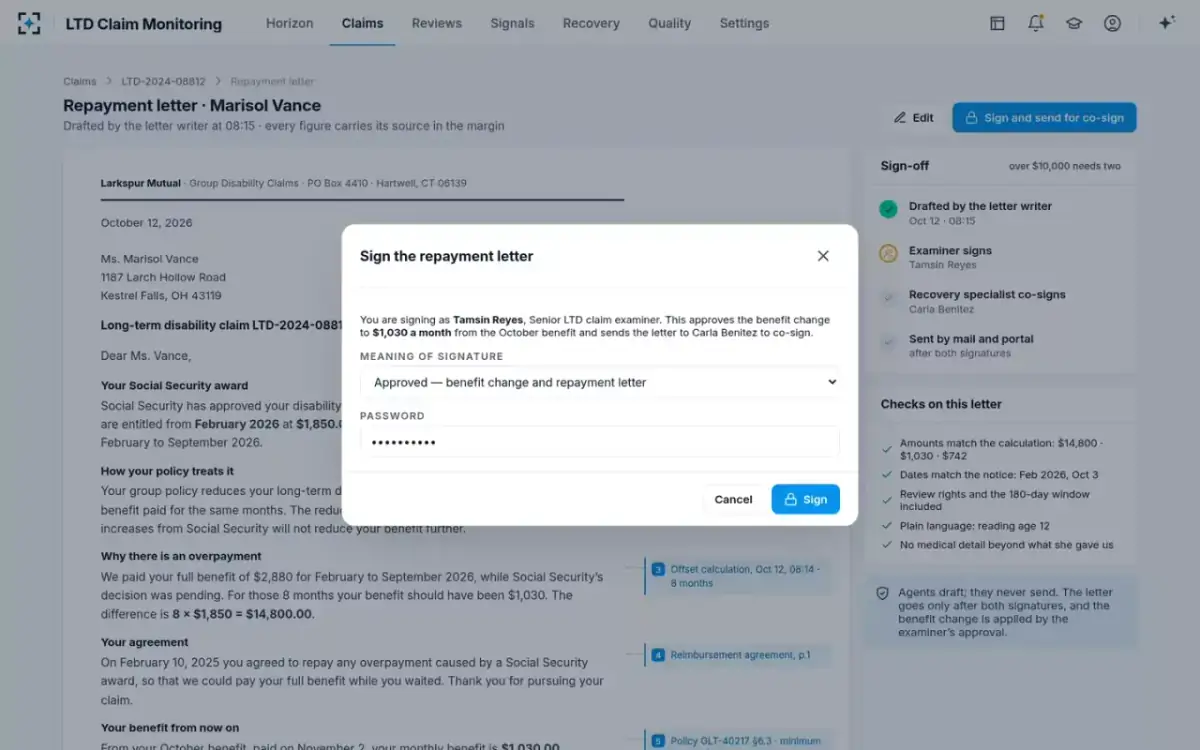
The signature is not ceremony. It puts a person's judgement in writing at the point the federal rule cares about, it keeps the independence rule's focus on people, and it is what a claimant, an auditor or a court will ask about first.
How long does it take to implement AI in LTD claims?
For monitoring, months rather than years, because nothing in the claim system has to be replaced: the tool reads the claim files, policies and mail the carrier already has and returns drafts for people to sign. Our plan puts all three phases in about six months for a team of around ten examiners, with the diary useful within weeks. The real constraints are elsewhere: how many policy forms must be read and checked, whether Social Security mail arrives as scans or a feed, and how quickly the examiners' own diary can be gathered for the comparison.
The labour market argues for starting. The Bureau of Labor Statistics projects employment of claims adjusters, appraisers, examiners and investigators "to decline 6 percent from 2025 to 2035" (BLS Occupational Outlook Handbook), across every line of insurance. A disability desk that loses experienced examiners loses the diary they kept in their heads; a monitoring tool keeps it on the claim.
What to ask any vendor before you start
Ask questions whose answers can be checked on your own claims. The comparison below sets a good answer beside the answer that should worry a buyer.
Questions for any AI in disability management vendor: the good answer and the warning sign
A good answer: Only a named examiner's signature; the tool drafts.
A warning sign: The tool posts changes and the examiner can reverse them.
A good answer: By the policy's rule, deterministically, with a rule version.
A warning sign: A model estimates the overpayment.
A good answer: Page of the notice, section of the policy, on screen and in the letter margin.
A warning sign: A confidence score, without the source.
A good answer: They go to a person, unplaced.
A warning sign: They are placed and flagged.
A good answer: Replay our closed claims and double-read live mail.
A warning sign: A demonstration on the vendor's data.
A good answer: It measures timeliness and accuracy of work, not denial rates.
A warning sign: It ranks examiners by outcomes.
Botminds' LTD Claim Monitoring is built to the left-hand column: seven agents, every value cited, money by rule, and every benefit change, letter and decision signed by a person. It fits carriers and administrators with open group LTD claims and offsets worked by hand today; it does not adjudicate new claims, which Disability Claims Adjudication covers, as AI in disability insurance claims describes, and it does not replace the claim system. To see the phases on sample claims, start from LTD Claim Monitoring.
Questions people ask
Does AI change LTD benefits?
It should not. In a sound design the tool reads, calculates and drafts, and a named examiner approves any change. In LTD Claim Monitoring the agents never change a benefit, close a claim or send a letter; the change takes effect on the examiner's signature.
Can an AI tool decide a disability claim under ERISA?
The federal rule does not mention AI, but it requires decisions designed to ensure the independence and impartiality of the people involved, and denials that discuss treating, plan and Social Security views. A tool that prepares the file and the draft for a person to decide fits that rule far more easily than one that decides.
What data does an LTD monitoring tool need?
The open claim files and payment history, the group policies, Social Security notices from the mailroom or an advocacy firm, payroll earnings and pension information from employers, and medical and vocational reports. Each source can be connected in its own phase, which is how the plan above starts with policies and claims alone.
Will AI reduce the number of examiners needed?
Monitoring takes the searching, keying and arithmetic, not the decisions, so its first effect is on timeliness and accuracy rather than headcount. With claims examiner employment projected to fall, the more practical question for most desks is how to keep reviews on time with fewer experienced people.
Does the NAIC AI bulletin apply to disability claims?
The NAIC model bulletin addresses insurers' use of AI systems generally, and it applies where a state has adopted it. For ERISA plans, the Department of Labor's claims rule applies alongside, and its independence, content and strict-adherence requirements are the ones a monitoring design meets first.