The Occupational Requirements Survey (ORS) is a Bureau of Labor Statistics survey of the requirements of jobs in the US economy: physical demands, environmental conditions, education, training and experience, and cognitive and mental requirements. BLS developed it with the Social Security Administration, which is building a new occupational information system on it to replace the Dictionary of Occupational Titles (DOT), the Department of Labor reference that disability adjudication has leaned on for decades and that was last updated in 1991. For private disability claims the change matters wherever a plan tests the claimant's occupation as it is performed in the national economy. Botminds' Disability Claims Adjudication uses occupational data in exactly that place: its occupation matcher tests occupations that use the claimant's skills against his restrictions and the plan's gainful wage, and the vocational consultant decides.
The figures below are from BLS, SSA and the Department of Labor's own pages. The occupation study shown is from the solution's sample claim, with a fictional claimant and fictional wages.
From the DOT to the Occupational Requirements Survey: 88 years, three phases
- Developed 1938; updated until 199153 years
- No updates; still SSA’s main source21 years
- BLS–SSA agreement 2012; production from FY 2015; Wave 1 published FY 2019; Wave 2 February 2024; 2025 estimates January 202614 years
What is the Occupational Requirements Survey?
ORS is a nationally representative survey of establishments, run by BLS field economists through the National Compensation Survey. It measures four types of requirement: "physical demands; environmental conditions; education, training, and experience; as well as cognitive and mental requirements" (BLS Handbook of Methods). It measures what the job requires, not what the person in it can do: "the objective of the survey is to measure job requirements, not the characteristics of the workers". And it measures them without accommodations, "because not all employers can offer the same accommodations".
The survey's origin is Social Security. In July 2012 SSA signed an interagency agreement with BLS "to test the feasibility of using their National Compensation Survey (NCS) to collect new occupational data for use in our disability adjudication process", and production data collection began in fiscal year 2015 (SSA). BLS lists insurance companies, the disability community and vocational experts among the survey's users (BLS ORS questions and answers).
Is the Dictionary of Occupational Titles still used?
Yes, mainly in Social Security disability decisions, and in private disability claims that borrow its definitions. The Department of Labor's own page is blunt: the DOT "was last updated in 1991", it "was replaced by the O*Net", and the Employment and Training Administration "no longer supports the DOT". It stays on the Office of Administrative Law Judges' website "because the DOT is still used in Social Security disability adjudications" (DOL, OALJ). The same page still says SSA intended to have its new system operational "by 2020"; SSA's own page now lists what it still needs, including new regulations.
The DOT's influence runs deeper than its job descriptions. Its strength categories, sedentary, light, medium, heavy and very heavy, are the vocabulary of disability claims, and Social Security's medical-vocational rules took "administrative notice" that at the unskilled level there were "approximately 200 sedentary occupations; approximately 1,600 sedentary and light occupations; and approximately 2,500 sedentary, light and medium occupations" (SSR 83-10). Those counts come from the DOT era and have not been re-derived from current data.
When was the DOT last updated, and why does it matter?
1991. Since then whole occupations have appeared and others have changed out of recognition, and the DOT's classification does not match the one every other federal statistic uses. SSA notes that the DOT's system "includes about 12,000 detailed occupations but is not used by any other Federal agencies", while BLS classifies by the Standard Occupational Classification: the second ORS wave uses the 2018 SOC, "which contains 867 occupations" (SSA). An occupation in the DOT cannot simply be looked up in ORS; it has to be mapped, and broader categories mean wider ranges within each.
The DOT and the ORS, field by field
Dictionary of Occupational Titles: Department of Labor; Fourth Edition, Revised 1991. No longer supported by ETA.
Occupational Requirements Survey: Bureau of Labor Statistics, with SSA; estimates published each year.
Dictionary of Occupational Titles: About 12,000 detailed occupations, in a classification no other federal agency uses.
Occupational Requirements Survey: The 2018 Standard Occupational Classification, 867 occupations in Wave 2.
Dictionary of Occupational Titles: Job analyses by occupational analysts.
Occupational Requirements Survey: Interviews with sampled establishments by BLS field economists; nationally representative.
Dictionary of Occupational Titles: Strength rating, sedentary to very heavy, and frequency in thirds of the day.
Occupational Requirements Survey: Strength level derived from lifting, carrying and standing; durations including “seldom”, up to 2 percent of the day.
Dictionary of Occupational Titles: No mental and cognitive requirements, as SSA notes.
Occupational Requirements Survey: Collected since Wave 2 (2018): pace, pause control, people skills, work review and more.
Dictionary of Occupational Titles: Not addressed as a measurement rule.
Occupational Requirements Survey: Measured without accommodations.
Dictionary of Occupational Titles: Still SSA’s primary source until its new system is in place; cited in private claims.
Occupational Requirements Survey: The primary source of SSA’s planned Occupational Information System.
What replaced the Dictionary of Occupational Titles?
Two things, for two purposes. For career and workforce use, the Department of Labor replaced it with O*NET. For disability adjudication, SSA is building an Occupational Information System whose "primary source of information on the work requirements of various occupations" will be ORS data, combined with other sources in a web-based Vocational Information Tool (SSA). SSA lists three things it needs before adjudicators can use the system: the Wave 2 data published in February 2024, the completed tool, and "new regulations and revised sub-regulatory guidance". Until those are in place, the DOT remains SSA's main source.
SSA has already narrowed how far back the past-work question reaches. Its 2024 rule reduced the relevant work period "from 15 to 5 years" and excluded work that "started and stopped in fewer than 30 calendar days" (89 FR 27653), effective 22 June 2024 after a short deferral (89 FR 48138). In the comments on that rule, SSA reported, some representatives said they "already reference" ORS "when questioning vocational experts during hearings".
What does ORS say about the strength of US jobs?
That most jobs are not sedentary. For 2025, BLS estimates that 30.3 percent of civilian workers were in jobs at the sedentary strength level, 33.7 percent light, 29.1 percent medium, 6.2 percent heavy and 0.7 percent very heavy (BLS ORS). A claimant limited to sedentary work is, on these figures, looking at under a third of jobs before skills, education and wages are considered.
Strength level of civilian jobs, 2025 (Occupational Requirements Survey)
The thresholds behind those levels are not the DOT's. ORS derives strength from how much weight is lifted or carried, how often, and how much of the day is spent standing, and its light level reaches 25 pounds where the DOT's stops at 20 (BLS Handbook of Methods). A job requiring 22 pounds occasionally is light in ORS and medium in the DOT. Anyone comparing a restriction with an occupation should know which table the occupation's level came from.
How the DOT and ORS set the strength levels
| Level | DOT: occasionally / frequently / constantly | ORS: occasionally / frequently / constantly | ORS standing rule |
|---|---|---|---|
| Sedentary | Up to 10 lb / negligible / – | Up to 10 lb / negligible (under 1 lb) / no weight | Standing no more than 1/3 of the day |
| Light | Up to 20 lb / up to 10 lb / negligible | 11–25 lb / 1–10 lb / negligible | Sedentary lifting with more than 1/3 standing is light |
| Medium | 20–50 lb / 10–25 lb / up to 10 lb | 26–50 lb / 11–25 lb / 1–10 lb | – |
| Heavy | 50–100 lb / 25–50 lb / 10–20 lb | 51–100 lb / 26–50 lb / 11–25 lb | – |
| Very heavy | Over 100 lb / over 50 lb / over 20 lb | Over 100 lb / over 50 lb / over 25 lb | – |
Does ORS data cover mental demands?
Yes, which is new. SSA notes that "the DOT contains discrete and well-established descriptions of the physical demands of occupations, it does not provide information on the mental and cognitive requirements". ORS added mental-cognitive questions in its second wave, collected from 2018 (SSA). The 2025 estimates include, for example, the ability to pause work, present for 53.5 percent of workers; a self-paced workload, 18.5 percent; and work schedule variability, 48.3 percent (BLS, January 2026).
For disability claims these are the measures that were missing when the restriction is not about weight. A restriction limiting concentration to three hours a day, like one in the solution's sample long-COVID claim, cannot be set against a DOT strength level at all. It can be set against how much of an occupation's day requires sustained pace, or whether the worker can pause, once those measures are in the file.
Sitting and standing in the workday, 2025
All workers
- Sitting · 44.9%
- Standing · 55.1%
Civil engineers
- Sitting · 76.6%
- Standing · 23.4%
Dental assistants
- Sitting · 49.6%
- Standing · 50.4%
Pharmacists
- Sitting · 27.7%
- Standing · 72.3%
Can private disability insurers use ORS data?
Yes. The estimates are public, and BLS names insurance companies and vocational experts among their users. Whether a plan may rely on them for a given claim is a question of the policy's wording: where "occupation" means the occupation as performed in the national economy, current national data are the natural evidence, and a decision resting on a 1991 description is open to the obvious objection. Material and substantial duties explains how the wording decides whether the job or the occupation is tested.
The practical cautions are about fit. ORS estimates are for SOC occupations, which are broader than DOT titles, so an occupation's estimate is a distribution, not one number; BLS publishes percentiles for continuous measures such as hours of sitting. To find an occupation, BLS suggests searching the job title in O*NET, whose code's first six digits give the 2018 SOC code (BLS ORS questions and answers). And ORS excludes some workers, including the self-employed and "individuals receiving long-term disability compensation".
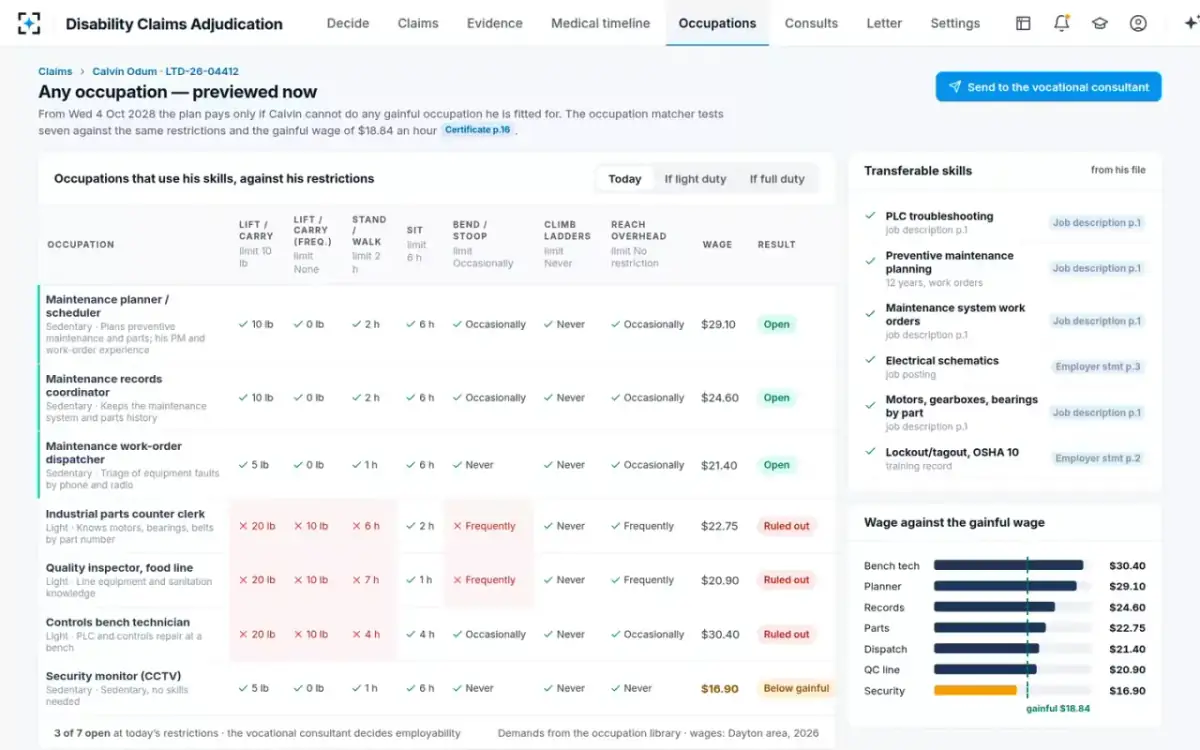
Seven occupations that use his skills, tested against the restrictions and the gainful wage
What ORS changes for an any-occupation review
It changes the evidence, not the question. At the end of an own-occupation period, a plan like the sample one, or the one in the Eighth Circuit's 2026 Halloran decision, pays only if the claimant cannot do any gainful occupation for which education, training or experience fit them. The vocational consultant still has to identify occupations, test them against the restrictions and check the wage. What ORS adds is current, national, distribution-level data on the demands of those occupations, including mental ones, in the classification wage data also uses.
The sample claim shows the shape of the work. Seven occupations that use the claimant's skills, from maintenance planner to security monitor, are tested against the same restrictions as his own job and a gainful wage of $18.84 an hour, 60 percent of his indexed earnings. Three stay open; three fail on lifting, standing or bending; one fits the restrictions but pays $16.90. The study is made at the first decision, two years before the plan's definition changes, so the consultant starts from a cited file rather than from scratch. How "sedentary" is defined in such a study is covered in the sedentary work definition guide.
Questions people ask
Is the Dictionary of Occupational Titles available online?
Yes. The Department of Labor's Office of Administrative Law Judges keeps the Fourth Edition, Revised 1991, online, with its appendices, because it is still cited in Social Security disability cases. The Department itself points readers who want current occupational information to O*NET.
How often is ORS data published?
BLS publishes estimates each year; the 2025 estimates came out on 16 January 2026 and the 2026 estimates are scheduled for early 2027. Collection runs in waves: Wave 2 took five years, and Wave 3, begun in 2024, is on an eight-year cycle.
Does ORS measure the job or the worker?
The job. BLS describes the objective as measuring "job requirements, not the characteristics of the workers", and it records requirements without accommodations.
Has Social Security stopped using the DOT?
Not yet. SSA says its new Occupational Information System needs the Wave 2 data, a completed Vocational Information Tool, and new regulations and guidance before adjudicators use it. In 2024 it did shorten the past-work period it considers from 15 years to 5.
Why do strength levels differ between ORS and the DOT?
They are derived differently. ORS's light level covers 11 to 25 pounds occasionally, the DOT's up to 20, and ORS counts standing for more than a third of the day as light work even when lifting is sedentary. Check which source a vocational report used before comparing it with a restriction.