Claims adjudication systems apply a plan's terms to a claim and record the decision. In medical and pharmacy claims much of that is often automatic: a code, a fee schedule, a payment. Disability claims are different, because each one turns on whether a particular person's restrictions rule out a particular occupation, and the federal claims rule requires a written explanation of that judgement. A disability adjudication system therefore succeeds only if examiners trust what it prepares, and they trust it when every reading points to a page and every mistake is visible. Botminds'Disability Claims Adjudication is built that way: agents gather and read the file and lay the plan's definition out as elements with their sources, and the examiner decides. This guide sets out how to bring such a system in over 90 days, and how to measure whether the trust it asks for is earned.
Examples come from the solution's sample desk at a fictional carrier, Halberd Mutual Life, with fictional people. The adoption plan is ours. The legal standards are quoted from the Department of Labor's rule and the Supreme Court.
What each seat needs to see before trusting a claims adjudication system
Today
Distrusts any summary she cannot check; re-reads the file anyway, so the tool saves nothing.
With agents
Every element reading opens the page it rests on; the routine five are confirmed in one step, the contested one is hers.
Still theirs: The decision on every element and the signature.
Today
Gets referrals that ask “is this supported?” with no page.
With agents
Gets the question, the pages it rests on and what her answer will change.
Still theirs: Whether a restriction is clinically supported.
Today
Sees job demands paraphrased from a phone call.
With agents
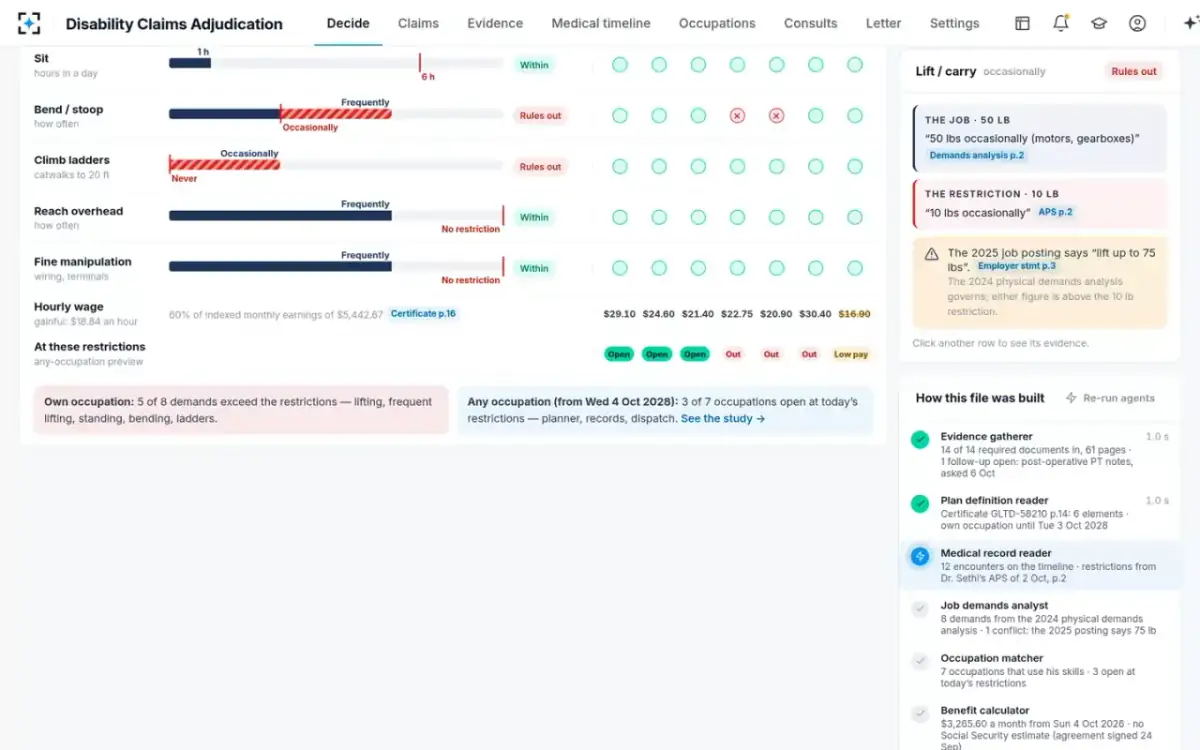
Sees each demand with its document, and conflicts between documents flagged, not resolved silently.
Still theirs: Employability and the any-occupation study.
Today
Cannot tell which parts of a denial the examiner checked.
With agents
Sees who confirmed or decided each element, when, and on which sources.
Still theirs: The second review on denials and large benefits; the authority settings.
What is claims adjudication software?
Claims adjudication software decides, or helps a person decide, whether a claim is payable under a plan's terms and for how much, and records why. The phrase covers two very different things. In high-volume medical and pharmacy claims it usually means rules engines that pay or deny automatically when codes, eligibility and prices line up. In disability, life and other judgement-heavy lines it means decision support: assembling the evidence, applying the definitions and drafting the decision for an examiner to make.
For STD and LTD claims, only the second is realistic. A disability denial must contain "a discussion of the decision", including the basis for disagreeing with the claimant's treating and vocational professionals, the plan's own experts and any Social Security decision the claimant sent (29 CFR 2560.503-1(g)(1)(vii)). A rules engine can check whether the elimination period has run; it cannot write why a surgeon's 10-pound limit rules out a 50-pound job, or why it does not.
What is the difference between claims processing and claims adjudication?
Claims processing moves a claim through its stages; claims adjudication decides it. Processing is intake, indexing, data entry, requests, payments and correspondence. Adjudication is reading the evidence against the plan and deciding entitlement, with reasons. A system built for processing tracks the claim well and leaves the second job to the examiner's reading, which is where the hours go.
Processing moves the claim; adjudication decides it
Claims processing: Where is this claim, and what is missing?
Claims adjudication: Does the evidence meet each element of the plan’s definition?
Claims processing: A status, a task, a payment, a letter from a template.
Claims adjudication: An element-by-element decision with reasons and sources.
Claims processing: Operations, for timeliness and accuracy of handling.
Claims adjudication: The examiner and the plan’s fiduciary, for the decision.
Claims processing: Clocks and notices: 45 days, extensions, appeal rights.
Claims adjudication: Specific reasons, plan provisions, discussion of disagreement, consistency.
Claims processing: Routing, indexing, chasing.
Claims adjudication: Reading, citing, drafting — with a person deciding.
Can adjudication software decide a disability claim?
It should not, and the law makes the reasons concrete. Under Firestone, a court looks at a denial afresh unless the plan expressly grants the administrator discretion, and only then defers (Firestone v. Bruch, 1989). Discretion is exercised by a fiduciary, and the claims rule adds that a plan which does not follow it strictly on a disability claim has its claim treated as denied on review with no fiduciary discretion exercised at all (29 CFR 2560.503-1(l)(2)). The ERISA appeals process for disability quotes both rules and what they do in court. A decision no person really made is a weak thing to defend.
What the software can do is make each human decision faster and better documented. The useful boundary, and the one the sample solution enforces, is that agents may read, cite, compute and draft, while an examiner confirms or decides every element, and denials go to a second reviewer. The full reasoning is in AI in disability insurance claims.
How do you get claims staff to trust AI?
By making its errors cheap to find and by measuring them in both directions. Examiners do not distrust software because it is new; they distrust a summary that might be wrong in a way they cannot see without re-reading the file. A reading that opens the page it came from, with the lines used highlighted, takes seconds to check. A paraphrase takes an hour.
The Supreme Court described the kind of process that earns a plan the benefit of the doubt. In Glenn, it held that an insurer that both decides claims and pays them has a conflict a court must weigh, and said how much it should weigh depends on what the insurer does about it.
It should prove less important (perhaps to the vanishing point) where the administrator has taken active steps to reduce potential bias and to promote accuracy, for example, by walling off claims administrators from those interested in firm finances, or by imposing management checks that penalize inaccurate decisionmaking irrespective of whom the inaccuracy benefits.
Metropolitan Life Ins. Co. v. Glenn, 554 U.S. 105 (2008)
"Irrespective of whom the inaccuracy benefits" is the design principle for measuring a claims adjudication system. An agreement rate that counts only the claims the system would have denied, or only the ones it would have approved, is not a measure of accuracy. The Eighth Circuit, applying Glenn in 2010, gave the conflict "some weight" because the record held "little evidence" of the insurer's efforts to keep it from affecting decisions (Darvell, 8th Cir. 2010). A disagreement log that shows errors caught in both directions is that evidence.
A 90-day plan for adopting a claims adjudication system
Adoption takes about a quarter when it is staged so that trust is earned before it is asked for. The plan below has three phases, each with an exit test; a phase that fails its test repeats rather than moving on.
Ninety days from closed claims to live decisions
- Closed claims, agents read, examiners compare3 wk
- Live claims, examiners decide as today, then see the agents’ reading5 wk
- Confirm routine elements, decide contested, second review on denials5 wk
Replay, weeks 1 to 3. Take 50 to 100 closed STD and LTD claims with the decisions held back, chosen to include approvals, denials, extensions and appeals. Let the agents build each file and read each element. Examiners then compare element by element: which readings matched the decision, which did not, and why. The exit test is not a target agreement rate; it is that every disagreement has been read and explained, and that no restriction or job demand was cited to the wrong page.
Shadow, weeks 4 to 8. On live claims, examiners decide exactly as they do today, and only then see the agents' readings. This order matters: an examiner who sees the agents' answer first anchors on it, and the shadow period stops measuring anything. The disagreement log runs weekly, with the claims manager reading every entry.
Live with checks, weeks 9 to 13. Examiners open claims on the plan's definition with the agents' readings, confirm the routine elements in one step and decide the contested ones. Denials and benefits above the examiner's authority still go to the claims manager. The log continues, now with a sample of confirmed elements re-checked each week, so that "confirmed in one step" never becomes "never looked at".
How the file was built, step by step, with a conflict flagged
Trust measures for a claims adjudication system
The measures that matter are about checkability and symmetry, not speed. Speed follows when examiners stop re-reading what they can verify in seconds.
Eight measures that show examiner trust is earned
- Citation coverage
The share of readings and letter reasons that carry a page. The sample solution’s design target is every reason in the letter.
- Citation accuracy
Of a weekly sample of citations, the share where the page says what the reading says.
- Element agreement, both directions
Readings the examiner overturned towards approval and towards denial, counted separately.
- Restrictions missed
Restrictions in the record the medical record reader did not lift, found on re-check.
- Conflicts flagged
Conflicting job documents or restrictions raised to a person, not resolved by the system.
- Extension notices on time
Notices sent before day 45 that name what is missing, as the rule requires.
- Letter completeness
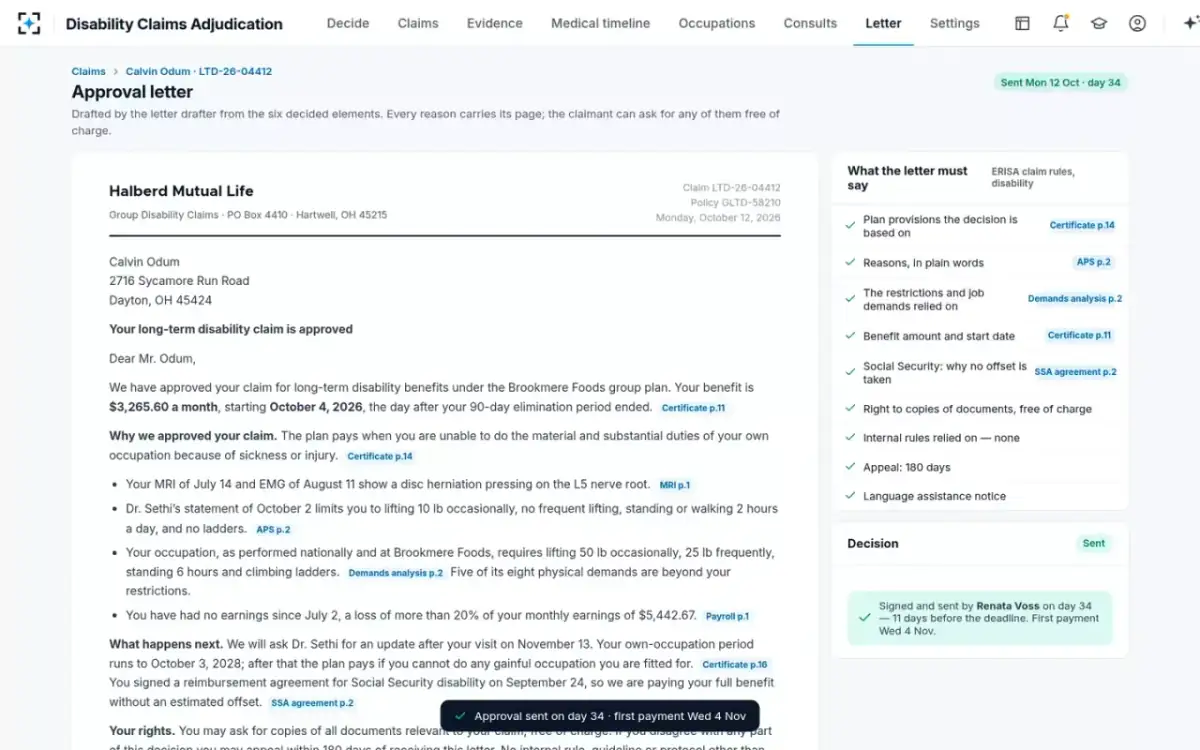
Letters with every required item present: reasons, provisions, discussion of disagreement, rights, appeal time.
- Disagreements read
Every entry in the disagreement log read and explained by a named person, weekly.
What should claims software log?
Enough to show that the plan's process works as written. The rule asks every plan for safeguards that make sure, and let it check, that each decision follows the plan documents and that like claimants are treated alike (29 CFR 2560.503-1(b)(5)); how a health plan tests that consistency with two reviewers on the same cases is shown in coverage criteria, read twice. Documents that show those safeguards at work are themselves relevant to the claim, so the claimant may obtain them free of charge ((m)(8)(iii)).
In practice that means four things on every claim: each agent step with its inputs, output and the pages cited; each human confirmation or decision with who, when and on which sources; each setting that shaped the claim (authority limits, routing rules, follow-up days), versioned; and each document sent and received with its date. The sample solution keeps all four on the claim's activity trail. A log designed to be handed to a claimant is also the log a court will read, which the ERISA appeals process for disability takes up.
The letter, with a checklist of what it must say
How long does adoption of claims adjudication software take?
Plan on a quarter for one claims team, longer if the replay shows systematic disagreements. The time goes on three things, none of them software installation. Plan definitions must be read from each certificate and confirmed by plan administration, because the elements are only as good as the wording they come from. Routing and authority settings must be agreed: when the nurse is involved, when the vocational consultant is, who second-reviews what. And examiners need the shadow weeks to learn where the agents are reliable and where they are not.
The clocks do not pause for adoption. Throughout the 90 days, every claim still runs to the 45-day limit, and the extension rules apply as usual. That is another reason to run the replay on closed claims first: it is the only phase in which a mistake costs nothing but time.
Questions to ask in a claims adjudication platform demonstration
Ask to see a claim of yours, not a sample, and ask the vendor to show three things on it: an element reading opened to its page, an overturned reading in the log with the examiner's reason, and a letter whose every reason carries a source. Then ask what the system was measured on in testing. If the answer is approval or denial rates, or processing time alone, the measure is the wrong one. Disability case management software covers the systems the platform will have to read across.
Where Disability Claims Adjudication fits
Disability Claims Adjudication is decision support for the initial STD or LTD decision, running beside the claim system you already have. Its agents gather and read the evidence, set the job against the restrictions, read the plan's definition as elements, preview the any-occupation question and draft the letter; the examiner confirms or decides each element; and denials and large benefits go to a second reviewer. On appeal the rule requires a reviewer who neither made the first decision nor is that person's subordinate. Authority limits, routing and clocks are settings, and every change to them is versioned. It does not pay benefits or send letters, and it does not replace your system of record.
Questions people ask
How do examiners use adjudication software day to day?
They open each claim on the plan's definition with the system's reading of every element, check the cited pages, confirm the routine elements and decide the contested one. In the sample claim, five of six elements were confirmed in one step; own occupation, where five of eight job demands exceeded the restrictions, was decided by the examiner.
Should the system's accuracy target be a single agreement rate?
No. Count disagreements towards approval and towards denial separately and read each one. A system that agrees with examiners 95 percent of the time but errs only one way is biased, and Glenn ties the weight of an insurer's conflict to checks that penalise inaccuracy "irrespective of whom the inaccuracy benefits".
Does adopting a claims adjudication system change the standard of review?
Not by itself. The standard depends on whether the plan grants discretion, under Firestone. But a process that fails to follow the claims rule strictly can let a claimant go to court without an internal appeal and can weaken the deference a plan would otherwise receive.
Who should own the disagreement log?
The claims manager who second-reviews denials, with examiners writing the reason for each overturned reading. It is evidence of the "management checks" Glenn describes, and it is the quickest way to find a systematic error before it reaches a letter.
What if examiners stop checking the cited pages?
Then the system has become an approver, not a reader. Re-check a weekly sample of confirmed elements against their pages and report citation accuracy to the team; in the sample design, routine elements can be confirmed in one step only when each cites at least one page.