An insufficient documentation denial is a decision that the records sent with a request, or with a claim, do not show what the coverage rules require, so the plan will not approve or pay. It is the right decision when the evidence does not exist. It is a wrong decision, and a common one, when the evidence exists and nobody found it: a therapy note on page 140 of a 180-page fax, a lab result filed under another document's date, a test the surgeon's letter mentions and the radiology report proves. OIG found exactly that in Medicare Advantage: plans said requests lacked documentation when the records already in the case file supported approval. Botminds' Prior Authorization Automation is built so that "not found" means "searched for and absent": its criteria matcher marks a criterion open only after listing what it searched, where the chart mentions the subject and what record would close it, and the nurse decides from that list.
The scale of the documentation problem is visible in Medicare's own payment measurement. In fiscal 2025, insufficient documentation accounted for 53.0% of the improper payments CMS's Comprehensive Error Rate Testing program found in traditional Medicare, more than every other category combined.
Insufficient documentation is the largest cause of Medicare's measured payment errors
Medicare fee-for-service improper payments, fiscal 2025
- Insufficient documentation · 53%
- Medical necessity · 15.3%
- No documentation · 12%
- Incorrect coding · 11.1%
- Other · 8.5%
What is an insufficient documentation denial?
The clearest public definition is Medicare's own. CMS's improper payment program places a claim in the insufficient documentation category "when the medical documentation submitted is inadequate to support payment for the services billed", meaning reviewers "could not conclude that the billed services were actually provided, were provided at the level billed, and/or were medically necessary", or when "a specific documentation element that is required as a condition of payment is missing, such as a physician signature on an order" (CMS, CERT error categories). CMS keeps it separate from "No Documentation", where the provider sends nothing, and from "Medical Necessity", where the records are adequate and show the service was not needed.
That three-way split is the useful one for a prior authorization desk. No documentation calls for a records request. Medical necessity calls for a physician's judgement. Insufficient documentation sits between them and is the category most open to error, because it depends on how thoroughly the reviewer searched what was sent.
Why do insurers deny for insufficient documentation?
Because the clock forces a decision before the record is complete or fully read. CMS's own list of the reasons payers deny prior authorizations includes documentation "missing or inadequate", alongside medical necessity and benefit limits. A Medicare Advantage plan must decide a standard request within 7 calendar days and an expedited one within 72 hours; if a criterion has no evidence on day six, the reviewer's choices are an extension the rules may not allow, an approval the record does not support, or a denial for insufficient documentation.
The third choice is the easy one, and it is defensible only if the evidence really is absent. When it is present but unfound, the denial creates work for everyone: a resubmission or appeal from the provider, a reconsideration for the plan, a delay for the member, and an overturn that will appear in the plan's published approved-after-appeal percentage. Prior authorization denial rates sets out how those overturns add up.
When the page was already in the file: what OIG found
OIG's 2022 study is the direct evidence. Its physicians and coding experts re-reviewed a stratified random sample of 250 prior authorization denials issued by 15 of the largest Medicare Advantage organizations in the first week of June 2019, and named insufficient documentation claims as one of two common causes of denials that met Medicare coverage rules:
“MAOs indicated that some prior authorization requests did not have enough documentation to support approval, yet our reviewers found that the beneficiary medical records already in the case file were sufficient to support the medical necessity of the services.”
HHS-OIG, OEI-09-18-00260 (April 2022)
The cases are specific. In one, a plan denied Botox for a member with urge incontinence (estimated cost $3,674), saying there was "a lack of clinical information about the beneficiary’s previous use of the medication", and asked for more records; the records of previous use had arrived with the request. The plan reversed the denial after OIG asked for the file. In others, plans asked providers for documentation the case file already held, or for additional test results OIG's physicians judged unnecessary, and then denied the request when the provider did not answer.
OIG's recommendations point at the same fix. It suggested CMS "could also direct MAOs to consider additional staff training on documentation that should be verified before issuing a denial", and that CMS "could add a question for auditors examining whether MAOs requested unnecessary documentation" (OEI-09-18-00260). The sample predates the 2024 rules, but nothing in those rules changes the mechanics of a reviewer missing a page.
Where a missing page hides in a long record
Supporting pages go unfound for ordinary reasons, and each has a typical hiding place. Knowing them is most of the cure.
Five ways a page that exists becomes 'insufficient documentation'
How the page hides: The criterion says "supervised physical therapy"; the page is a "PT daily note", a "visit log" or a "home exercise program".
What finds it: Searching each criterion under every name a clinician would use, and listing the names searched.
How the page hides: A consultation letter says "completed a course of PT"; the reviewer takes the mention as absence or as proof.
What finds it: Treating a mention as a pointer: it says which record to look for, and from whom.
How the page hides: A fax batch puts the imaging report after 120 pages of nursing notes, dated a year earlier than its neighbours.
What finds it: Naming and dating every document as received, so the report is findable by type and date.
How the page hides: The provider faxes the notes on day three; they are filed to the member, not to the open request.
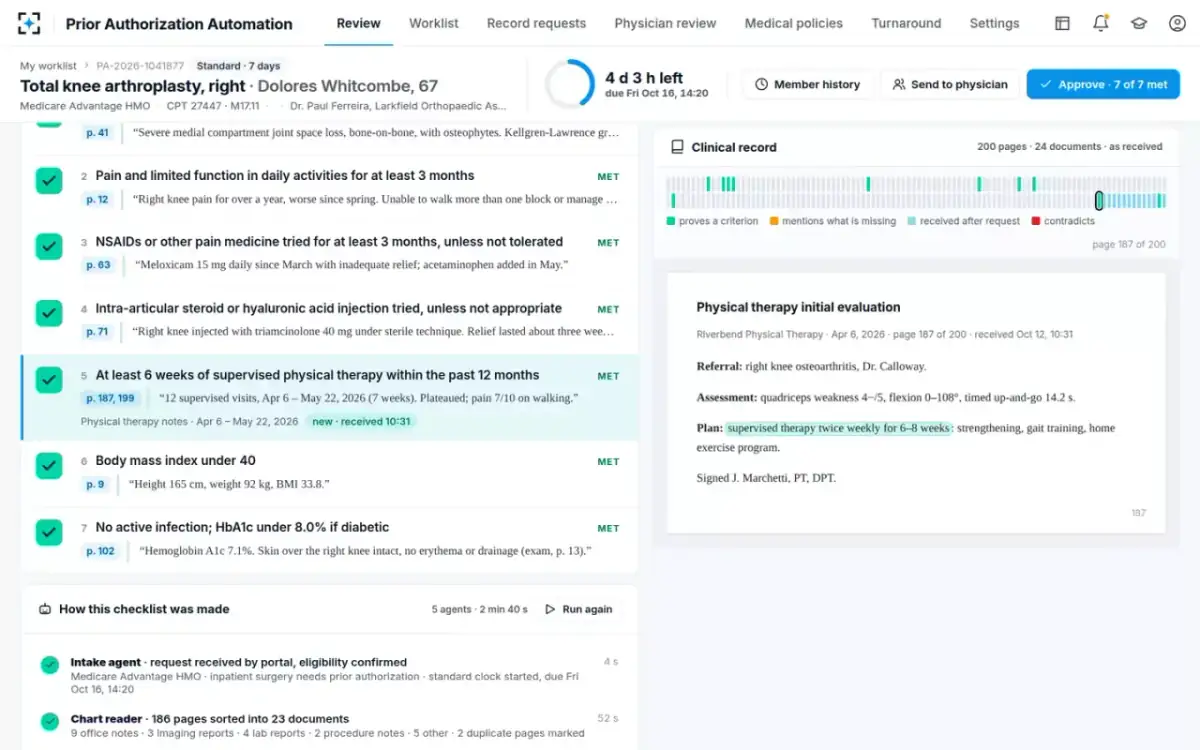
What finds it: Matching each reply to its request by request number and member, and marking the pages new.
How the page hides: The therapy was authorized and paid by the same plan months earlier.
What finds it: Checking the member’s past requests and paid claims, which corroborate that the treatment happened.
The fifth row deserves emphasis because it is the plan's own data. A paid claim for twelve therapy visits proves the therapy happened, though not what the notes say. A plan that denies a knee replacement for "no evidence of physical therapy" while its own claims system shows the therapy it paid for has a weak denial, even if the criterion still needs the notes. The right response is a records request for the named notes, not a denial.
Proving a page is truly absent before anyone writes "insufficient"
A denial for insufficient documentation is a claim about a negative: the evidence is not in the file. A negative can be shown only by describing the search. The checklist below is the minimum a reviewer should be able to state before that word goes into a notice.
Before an insufficient documentation denial: the proof of absence
- Every page received is counted and accounted for
Including faxes and portal uploads that arrived after the request, matched to it, with their arrival times.
- The criterion was searched under every name it goes by
And the names searched are written down, so a second reviewer can repeat the search.
- Every mention of the subject is listed
A note that refers to the missing record says it exists and where it might be.
- The member’s history at the plan was checked
Past authorizations and paid claims that corroborate the treatment the criterion asks about.
- A named records request went out inside the clock
Naming the document, the facility and the dates, with a reply-by time that leaves room to decide.
- The reply, if any, was read against the criterion
A reply that brings the wrong pages is answered with a second, narrower request, not a denial.
In the solution this is what an open criterion shows. The request screen lists the terms searched ("therapy notes, PT evaluation, visit logs, home exercise plans"), the page where the chart mentions therapy, the paid claims for the visits, and what would close the criterion. A nurse reading that row knows the difference between "the notes are not here" and "nobody looked".
What should a plan request when documentation is missing?
The specific document that would close the open criterion, and nothing more. Two federal rules point the same way. For employer plans, the denial notice has to name what extra material would complete the claim and say why the plan needs it (29 CFR 2560.503-1(g)(1)(iii)), the same duty a disability insurer meets when it asks for an attending physician statement. And HIPAA's minimum necessary standard applies to asking, not only to disclosing:
“When using or disclosing protected health information or when requesting protected health information from another covered entity or business associate, a covered entity or business associate must make reasonable efforts to limit protected health information to the minimum necessary to accomplish the intended purpose of the use, disclosure, or request.”
45 CFR 164.502(b), HIPAA minimum necessary standard
"Please send all supporting documentation" fails both tests. It does not say what would perfect the request, and it asks for more than the purpose needs. It also tends to bring back the same pages the plan already has. A named request ("the initial physical therapy evaluation from the named clinic, April 2026, and visit notes covering at least six weeks between 6 April and 22 May") tells the provider's records clerk exactly which file to pull.
A records request that names the document, the facility, the dates and the reply-by time
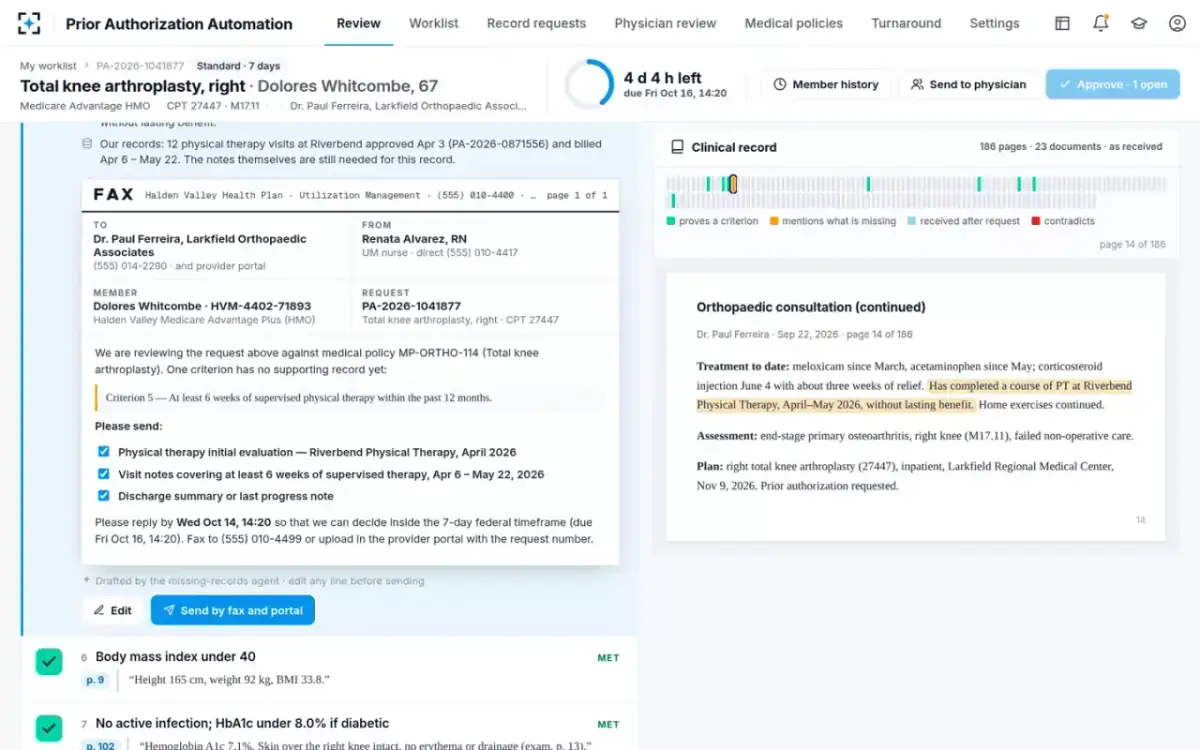
The clock matters as much as the wording. In Medicare Advantage the plan may extend a standard decision by up to 14 days only when the member asks or when it needs more medical evidence from a non-contracted provider that could change a decision to deny, and it must tell the member in writing why (422.568(b)(2); every appeal and decision clock is set out in how long a Medicare appeal takes). Evidence from a contracted provider does not fit that ground, so for most requests a plan should plan on asking for and receiving the records inside the 7 days. Medicaid managed care allows an extension where the plan justifies a need for additional information to the state (438.210(d)). CMS's 2025 auditors found that "Extension notices failed to explain the reason for extending a decision timeframe" (CMS). Asking on day zero avoids most extensions altogether.
The reply is matched, read, and the open criterion closes on the new pages
What is the denial code for insufficient documentation?
It depends on the transaction. On claims, payers explain denials on the remittance advice with Claim Adjustment Reason Codes maintained by X12, and two of them concern documentation. Prior authorization decisions sent by the X12 278 use a separate list of service decision reason codes, which CMS said payers must use for denials sent that way (CMS-0057-F preamble).
Claim Adjustment Reason Codes a provider is likely to see for documentation and authorization problems
| Code | X12 wording | What it usually signals |
|---|---|---|
| 16 | Claim/service lacks information or has submission/billing error(s). | Something on the claim itself is missing or wrong; X12 says not to use it for attachments or other documentation. |
| 252 | An attachment/other documentation is required to adjudicate this claim/service. | The payer needs a document it does not have: the claims-side form of an insufficient documentation finding. |
| 50 | These are non-covered services because this is not deemed a 'medical necessity' by the payer. | The documentation was read and judged; the service was found not medically necessary. |
| 197 | Precertification/authorization/notification/pre-treatment absent. | No prior authorization on file for a service that needed one. |
A provider searching for the code usually wants to know what to send. The plan can save that search by putting the answer in the reason itself: which criterion lacked evidence and which named document would supply it. Writing the specific reason covers the wording.
How to prevent insufficient documentation denials, from both sides of the fax
On the plan's side, three practices remove most of the avoidable ones. Read every page against every criterion before declaring anything missing, and record the search. Use the plan's own claims and authorization history as corroboration and as a guide to what to request. And ask for the named document on the day the gap is found, with a reply-by time that leaves a day to decide. Each is a discipline a team can adopt by hand; the solution makes them the default for every request.
On the provider's side, the fix is the same information earlier. From 1 January 2027 the Prior Authorization API that Medicare Advantage and the other covered payers must run has to be able to identify all documentation the plan requires for approval of each item or service that needs prior authorization. When a plan publishes, criterion by criterion, which record proves each one, providers can send it with the request and the plan never has to ask. The plan's medical policies, read as a file that holds up, are where that list starts.
Questions people ask
How often are insufficient documentation denials overturned?
No public data reports overturn rates by denial reason. KFF reports that 80.7% of appealed Medicare Advantage prior authorization denials were overturned in 2024, and notes that some overturns may reflect documentation missing from the first request. OIG's 2022 re-review found denials for insufficient documentation among those that met Medicare coverage rules, where the records in the case file already supported approval.
How do you prove documentation was in the record?
By page: identify the document, its date and its page number in the record as the plan received it, and the time it arrived. A record numbered as received, with late pages marked, lets a provider or appeal reviewer point to the exact page. Prior Authorization Automation numbers every page on arrival and never reorders or drops one, so a citation always points at a real page.
Is insufficient documentation the same as no documentation?
No. In CMS's own error categories, no documentation means the provider sent nothing or said it had nothing; insufficient documentation means records were sent but did not support the service as billed, or lacked a required element such as a signature on an order. The responses differ: a request in the first case, a reading and possibly a narrower request in the second.
Can a plan deny a request because the provider did not answer a records request?
A plan has to decide inside its clock, and if the evidence is truly absent it may deny. OIG found Medicare Advantage denials where plans had asked for documentation that was unnecessary or already in the file and then denied when providers did not respond, and it suggested CMS auditors check for unnecessary documentation requests. Asking only for what the open criterion needs avoids that finding.
What documentation do insurers most often say is missing?
No public dataset ranks it. In the solution's fictional sample data, the documents most often requested from providers are therapy notes, dates of conservative care, imaging reports and sleep test reports, which matches the criteria that require treatment over time. A plan can produce its own ranking from the criteria its reviewers most often leave open.