A prior authorization nurse, sometimes titled a clinical review nurse or prior authorization nurse reviewer, works for a health plan or its delegated reviewer and checks each request for a service against the plan's medical policy, criterion by criterion, then approves it or sends it to a physician. The clinical judgement is the visible part of the job. The larger part is finding the page in the request's records that proves each criterion, in a stack of faxed and scanned notes that arrived in no particular order, while a decision clock runs: in Medicare Advantage, from 2026, 7 calendar days for a standard request and 72 hours for an expedited one. Botminds' Prior Authorization Automation exists for that larger part. Its agents read every page as it arrives and lay out each criterion as met, open or contradicted, with the quoted passage and its page, so the nurse starts at the decision instead of at page one.
The volume is large. Medicare Advantage insurers made 52.8 million prior authorization determinations in 2024, about 1.7 per enrollee, and KFF reports that 99% of Medicare Advantage enrollees must obtain prior authorization for some services. This page describes the plan-side seat, not the staff in a hospital or physician office who prepare and submit requests; that is a different job with a different employer.
Where one standard request's days go, by hand and with Prior Authorization Automation
- Intake and policy0.5 d
- Reading the record1 d
- Asking for records1.5 d
- Waiting for pages2.5 d
- Decision, notice0.5 d
- Intake, reading, asking0.4 d
- Waiting for pages1 d
- Decision, notice (0.2 d)
What does a prior authorization nurse do at a health plan?
A prior authorization nurse decides, for each request assigned to them, whether the clinical records show that the requested service meets each criterion in the medical policy that applies, and records the evidence for that conclusion. In practice the day divides into four kinds of work: triage by clock, reading the record against the criteria, chasing what is missing, and deciding or routing. Only the last needs a licence. The first three take most of the hours.
The policy is the starting point. A knee replacement request is read against the plan's knee replacement policy or, for a Medicare Advantage member, Medicare's own coverage rules first. An inpatient rehabilitation request is read against the inpatient rehabilitation criteria. Each policy breaks into criteria: a diagnosis confirmed by imaging, conservative treatment tried for a stated period, a functional limitation documented, a contraindication ruled out. The nurse's question for each one is narrow: which page shows this, and does it say so in writing?
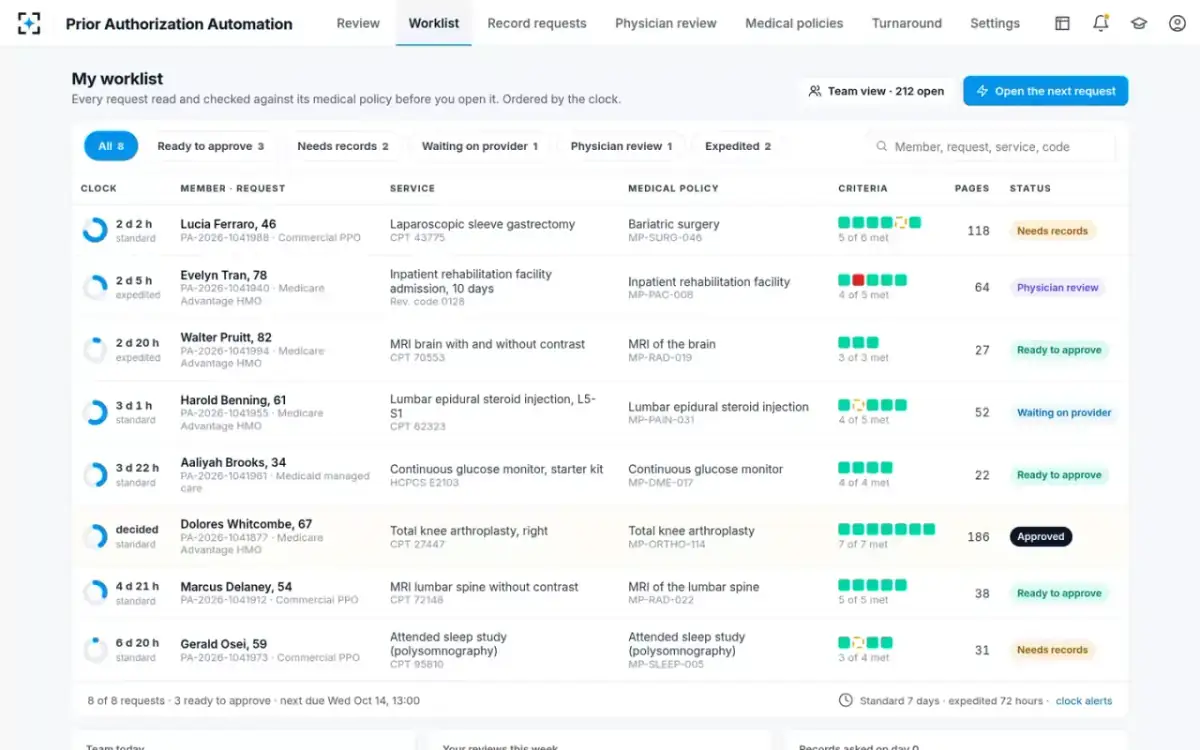
The records are where the time goes. A request can arrive with a one-page order or with a chart of several hundred pages, faxed in batches, scanned sideways, with the office note that matters on page 140 and three copies of the same lab report. In the solution's fictional sample worklist, the eight requests carry between 22 and 186 pages each. The nurse reads for a specific sentence, not for the story of the patient.
The clocks every prior authorization review runs against in 2026
A prior authorization nurse works to the shortest clock that applies to the member's coverage, and in 2026 those clocks got shorter. For Medicare Advantage, a standard decision on an item or service subject to prior authorization is due, under 42 CFR 422.568, "7 calendar days after receiving the request for the standard organization determination", beginning on or after 1 January 2026; it was 14. An expedited decision is due within 72 hours (42 CFR 422.572). The clocks come from the 2024 interoperability and prior authorization final rule, CMS-0057-F.
The decision clock depends on who covers the member
| Coverage | Standard request | Expedited request | Where the rule sits |
|---|---|---|---|
| Medicare Advantage | 7 calendar days (from 1 Jan 2026) | 72 hours | 42 CFR 422.568, 422.572 |
| Medicaid managed care | State limit, no more than 7 calendar days, for rating periods starting on or after 1 Jan 2026 | 72 hours | 42 CFR 438.210(d) |
| Marketplace plans (FFE issuers) | Not set by CMS-0057-F | Not set by CMS-0057-F | CMS-0057-F excludes these issuers from the new clocks |
| Employer plans under ERISA | 15 days for a pre-service claim | 72 hours for an urgent care claim | 29 CFR 2560.503-1 |
The rules differ in ways a nurse feels. CMS-0057-F gives the 72-hour and 7-day clocks to Medicare Advantage, Medicaid and CHIP, but its own fact sheet says the timeframe requirement excludes "QHP issuers on the FFEs". Employer plans run on the Labor Department's claims rule: "not later than 15 days after receipt of the claim by the plan" for a pre-service claim and "not later than 72 hours after receipt of the claim by the plan" for an urgent one (29 CFR 2560.503-1). A plan that serves all four markets runs four sets of clocks on one worklist.
Missing the clock is not a delay; it is a decision. If a Medicare Advantage plan fails to give timely notice, "this failure itself constitutes an adverse organization determination and may be appealed" (422.568(f)). That is why a nurse's first act each morning is to sort the worklist by time left, not by page count or by when the request arrived.
A prior authorization nurse's day, hour by hour
The composite day below is an illustration built from the rules above and the solution's sample worklist, not a time study. Its point is the shape: the nurse's licence is needed in short bursts, and the hours between are spent finding, asking and waiting.
A composite day for a prior authorization nurse, and the rule behind each hour
| When | What the nurse does | Why it is done this way |
|---|---|---|
| 08:00 | Sorts the worklist by time left; expedited requests first, then standard requests due within a day. | A late notice is itself an adverse decision in Medicare Advantage (422.568(f)). |
| 08:30 | Opens the oldest standard request; confirms the policy and edition in force for the service and date. | The criteria come from the policy; for Medicare Advantage, Medicare coverage rules come first. |
| 09:00 | Reads the record against criterion 1, then 2, then 3, noting the page for each one met. | The decision and any appeal will be judged on what the file shows, not on what the nurse remembers. |
| 10:30 | One criterion has no page. Searches again under other names: therapy notes, PT, home exercise plan. | A criterion that is documented but not found becomes a wrong denial if it reaches a physician as unmet. |
| 11:00 | Writes to the provider for the missing document, naming what is needed and by when. | A vague request for “supporting documentation” brings back the wrong pages, and the clock does not stop. |
| 13:00 | Approves two requests where every criterion is shown, with the pages noted. | Under plan policy a nurse may approve; adverse decisions go to a physician or other qualified professional. |
| 14:00 | Routes a request where the chart contradicts a criterion to the physician reviewer, with both passages. | The nurse prepares the denial; she does not issue it. |
| 15:30 | Matches faxed replies to open requests and re-reads the new pages. | Replies arrive by fax and portal, often without the request number on the cover sheet. |
| 16:30 | Checks tomorrow’s due list and the expedited requests that arrived after noon. | The 72-hour clock runs through nights and weekends. |
Read the middle column for verbs. Sorts, confirms, reads, searches, writes, matches, re-reads: most of the day is clerical in form even though it needs clinical knowledge to do well, because only a clinician recognises that "has completed a course of PT … without lasting benefit" in a surgeon's consultation note is a mention of therapy, not proof of it. Approves and routes take minutes. That proportion is the whole case for putting software on the finding and keeping the nurse on the deciding.
The searching is also where errors start. OIG, describing the manual reviews behind wrongly denied Medicare Advantage payment requests, wrote that "these manual reviews are susceptible to human error, such as a reviewer’s overlooking a document in the case file or inaccurately interpreting CMS or MAO coverage rules" (OEI-09-18-00260). That finding was about payment reviews, not prior authorization, but the mechanism is the same: a page that exists and is not seen. The insufficient documentation denial is where that mechanism does most harm before a service is delivered.
Can a nurse deny prior authorization?
In Medicare Advantage a nurse may prepare an adverse medical necessity decision but may not issue it without review by a qualified professional, and most plans reserve that review for physicians. The rule is 42 CFR 422.566(d):
“If the MA organization expects to issue a partially or fully adverse medical necessity … decision based on the initial review of the request, the organization determination must be reviewed by a physician or other appropriate health care professional with expertise in the field of medicine or health care that is appropriate for the services at issue, including knowledge of Medicare coverage criteria, before the MA organization issues the organization determination decision.”
42 CFR 422.566(d), Medicare Advantage organization determinations
Two details in that text matter to a nurse. The reviewer need not be the same specialty as the treating physician; the rule says so in the next sentence. And the reviewer must hold "a current and unrestricted license to practice within the scope of his or her profession". Federal Medicare Advantage rules do not say "physician only"; plan policy, accreditation standards and state law often do. Medicaid managed care uses a different form of words: any decision to deny or reduce a requested service must "be made by an individual who has appropriate expertise in addressing the enrollee's medical, behavioral health, or long-term services and supports needs" (42 CFR 438.210(b)(3)), and the plan must consult the requesting provider when appropriate.
So the honest answer to "can a nurse deny prior authorization" is: a nurse can find that a criterion is not met and draft the denial, and under some plans' rules a nurse with the right expertise could sign one, but the practice at most plans, and the setting in the solution, is that only a physician reviewer signs. In June 2025 insurers covering most Americans pledged, in a voluntary commitment announced by CMS, that medical professionals would review all clinical denials. A nurse's approval needs no such second signature. That asymmetry, approve alone and deny only with a physician, is built into the solution's settings and into its agents' limits, which the guide to the six agents sets out one by one.
The prior authorization nurse beside the utilization review nurse, the physician reviewer and the intake coordinator
The prior authorization nurse decides before the service; a utilization review nurse is the broader title and also covers concurrent review during an inpatient stay and retrospective review after it. Many plans use the titles interchangeably, and job postings for "clinical review nurse" usually mean one of the two. Around the nurse sit three other seats, and the request passes through each of them; the whole utilization management team, seat by seat, is mapped in its own guide.
Four seats around one prior authorization request, before and after the agents read the chart
Today
Reads dozens to hundreds of pages per request to find the sentence that proves each criterion, then writes to the provider for whatever is missing.
With agents
Opens each request as the policy’s checklist with passages already quoted and pages linked; checks the evidence, approves or routes.
Still theirs: Every approval, every judgement about what a passage means.
Today
Receives proposed denials with a nurse’s summary and, often, the whole chart.
With agents
Receives only contradicted criteria, with the passages for and against quoted in full and a draft notice naming the criterion and page.
Still theirs: Every adverse decision and every peer-to-peer call.
Today
Matches faxes and portal uploads to requests by hand; many replies lack the request number.
With agents
Sees each records request by document, facility and dates, and replies matched to requests by request number and member.
Still theirs: Exceptions: a reply that matches no request, a member who cannot be identified.
Today
Watches open requests against their clocks from a spreadsheet or a queue report.
With agents
Is alerted before expedited requests fall due and sees every decision against its clock.
Still theirs: Staffing, escalations and the plan’s published prior authorization metrics.
The handoffs are where time disappears. A request bounces from intake to nurse when the policy is unclear, from nurse to provider when a record is missing, from nurse to physician when a criterion is contradicted, and back. Each handoff with a vague message ("please review", "please send supporting documentation") costs a day the clock does not give back.
What changes when Prior Authorization Automation reads the chart first
The nurse's first screen changes from a pile of pages to a list of criteria. In the solution, every request on the worklist has already been read and checked against its medical policy before the nurse opens it, and the worklist is ordered by the clock, not by arrival.
The worklist is sorted by the clock, and every request has been read before the nurse opens it
Inside a request, each criterion shows one of three states. Met means a passage in the record proves it; the passage is quoted and the page number opens the chart at the highlighted sentence. Open means the agents searched and found no proof; the screen lists what they searched for, where the chart mentions the subject, and what document would close it. Contradicted means a passage says the opposite; both passages are shown and the request goes to a physician. The criteria matcher never ticks a criterion without a quoted passage, and never recommends a denial.
One request as its policy's checklist: six criteria cited to a page, one open with the reason
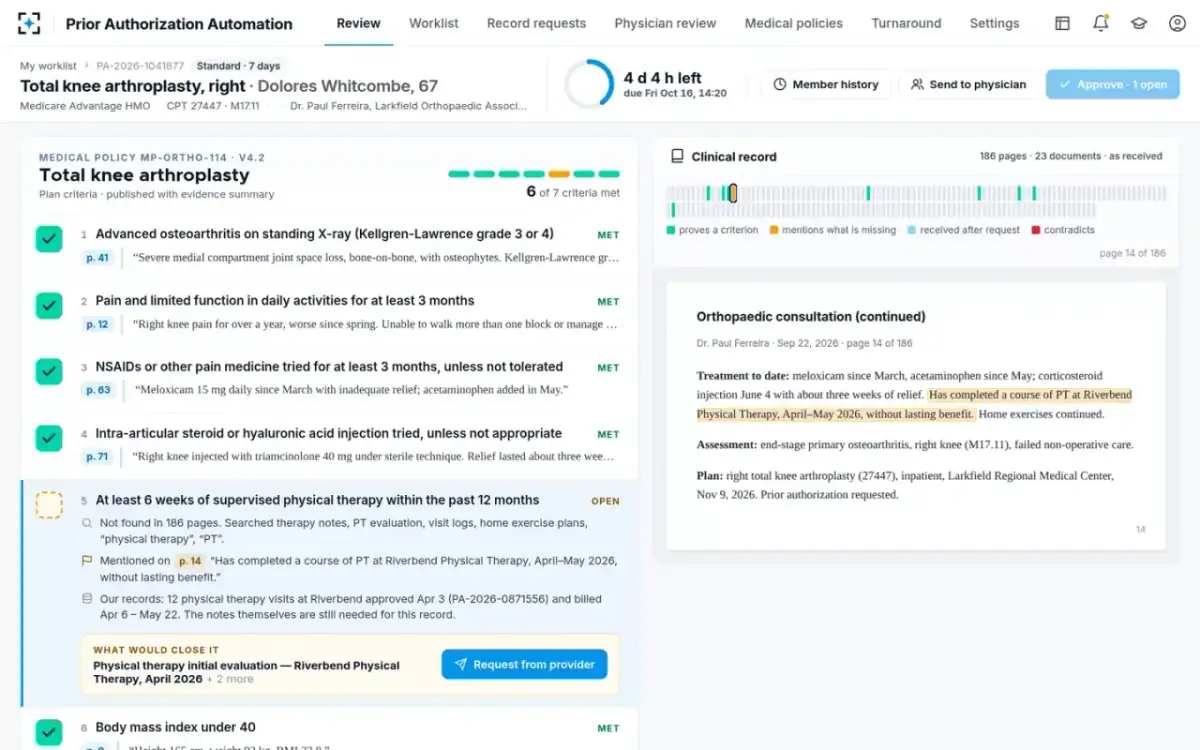
What the nurse no longer does is page through 186 pages hoping the sentence is there. What she still does is everything that needs judgement: deciding whether a quoted passage really meets the criterion as the policy intends, whether an open criterion warrants a records request or a physician, and whether to approve. The approve button in the solution reads "Approve · 1 open" until the last criterion has evidence, and a nurse may approve only when every criterion is met, unless the plan changes that setting. When she does approve, the decision notice lists every criterion and the page that proves it.
When a criterion is open, and when the chart contradicts it
An open criterion and a contradicted one lead to different people, and the difference decides whether the request ends in a records request or a physician's review. When a criterion is open, the missing-records agent drafts the request to the provider naming the exact documents, facility and dates, with a reply-by time set before the request falls due. The nurse edits and sends it. Nothing goes to a provider without her. And when a criterion is contradicted, the denial notice that reaches the physician already names the criterion and quotes the page, which is the kind of specific reason prior authorization denial reasons must now carry.
What a prior authorization nurse should see before deciding any request
- The policy and edition in force for the service and date
For Medicare Advantage, whether the criteria are Medicare’s own or the plan’s published internal criteria.
- Each criterion with its evidence, or the reason it has none
A quoted passage and a page for each one met; what was searched for each one open.
- The clock, in hours left, not days since receipt
72 hours for expedited Medicare Advantage and Medicaid requests runs through weekends.
- Pages that arrived after the request, marked as new
A reply that closes a criterion should be visible as the source of that tick.
- The member’s past requests and paid claims
Therapy that was billed is evidence the therapy happened, though not of what the notes say.
- Who may sign what
Whether this request can be approved by a nurse or must go to a physician or other qualified reviewer.
How many prior authorizations can a nurse review in a day?
No public benchmark measures it, and a number quoted without its mix of services and record sizes is meaningless. A nurse who reviews outpatient imaging requests with three-page orders and a nurse who reviews inpatient rehabilitation admissions with 60-page hospital charts are doing different jobs under one title. The useful number is a plan's own: decisions per nurse per day, split by service line and by record size, measured from its own queue.
The arithmetic is simple once the inputs are measured. If a nurse has about six hours a day for reviews after calls, peer-to-peer scheduling and meetings, that is 360 minutes. At, say, 45 minutes a request, about eight reviews fit. The solution's design target is 12 minutes of nurse time for a request that arrives as a cited checklist, which on the same six hours would be about 30. That is a target, measured in the live solution, not a promise, and the true gain depends on how much of a plan's current review time is reading versus judging. A pilot on the plan's own closed requests, as the four-week pilot guide describes, measures it before anyone plans staffing around it.
The ceiling is set by the waiting, not the reading. Requests that need records from a provider cannot be decided faster than the provider replies, which is why the clearest gain from automation is asking for the right document on the day the request arrives, not on day four.
Questions people ask
Do prior authorization nurses work for insurance companies?
The plan-side role does: prior authorization nurses work for health plans, for the Medicaid and Medicare Advantage plans those companies run, or for utilization review organizations a plan delegates to. Hospitals and physician offices also employ nurses and staff who prepare and submit prior authorization requests, but that is the requesting side of the same transaction, with a different employer and different goals.
What is a prior authorization nurse reviewer?
It is another title for the plan-side prior authorization nurse: a licensed nurse who reviews requests against medical policy. Plans also use "clinical review nurse" and "utilization review nurse". The duties are the same core task: read the record against each criterion, approve where the evidence is complete, and route the rest.
Who signs a prior authorization denial?
In Medicare Advantage, an adverse medical necessity decision must be reviewed by a physician or other appropriate health care professional with the right expertise before it is issued, under 42 CFR 422.566(d). In practice most plans have a physician reviewer sign. If the member asks for a reconsideration, a medical necessity denial must then be reconsidered by a physician with appropriate expertise.
What happens if a plan misses the prior authorization deadline?
In Medicare Advantage, failing to give timely notice of a decision counts as an adverse decision that the member may appeal, under 42 CFR 422.568(f). The plan cannot treat a late request as still pending. That is why the clock, not the order of arrival, sets the nurse's queue.
Is the 7-day prior authorization clock calendar days or business days?
Calendar days. The Medicare Advantage rule says 7 calendar days after receiving the request for items and services subject to prior authorization, beginning on or after 1 January 2026, and the Medicaid managed care limit is also 7 calendar days for rating periods starting on or after that date. The expedited clock is 72 hours in both programs.
How does software change a prior authorization nurse's job?
It moves the finding off the nurse's desk and leaves the deciding on it. In Prior Authorization Automation, agents read every page, quote the passage for each criterion met and list what they searched for each one open; the nurse checks the evidence and approves, and a physician signs any denial. A systematic review published in 2026 found only 16 studies of AI in prior authorization and few that measured operational gains, so a plan should test any such tool on its own requests.