A medical necessity review is the clinical test at the centre of prior authorization: a nurse or physician at the health plan reads the member's records against the coverage criteria for the requested service and decides whether the service is reasonable and necessary for this member. A review holds up when someone else can read the file and reach the same conclusion, criterion by criterion, without asking the reviewer what they meant. That someone is not hypothetical. In Medicare Advantage an upheld denial goes to a physician on reconsideration and then to an independent review entity, and CMS auditors sample decisions. Botminds' Prior Authorization Automation was built around that reader: its agents attach to every criterion the quoted passage, the document, the date and the page, or the searches they ran when nothing was found, so the file is written while the review happens rather than reconstructed afterwards.
The example used on this page is invented: an illustrative lumbar spine MRI request for a fictional Medicare Advantage member, read against an illustrative plan policy. The rules quoted are real.
Anatomy of one criterion in a medical necessity file that holds up
- Criterion
- Six weeks of physician-directed conservative care in the past six months, unless a red-flag sign is documented
- Quoted from the policy, with its number
- Policy and edition
- Illustrative policy MP-SPINE-007, edition 3.1, effective 1 Jan 2026; plan criteria, published with evidence summary
- The edition in force on the request date, and whether it is Medicare’s or the plan’s
- Evidence
- “Physical therapy twice weekly since 2 Aug; home program daily; naproxen 500 mg twice daily since July. Pain unchanged.”
- The passage itself, not a summary of it
- Where it is
- Office note, Dr. Alvarado-Kim, 19 Sep 2026 · page 23 of 71 · received with the request
- Document, author, date, page, and when the page arrived
- Finding
- Met: seven weeks of documented therapy and medication
- Met, open or contradicted, in the reviewer’s words
- Searched, if open
- —
- For an open criterion: the terms searched and where the chart mentions the subject
- Reviewed by
- UM nurse, 7 Oct 2026 10:12, from the cited page
- Who accepted the finding, and when
What is a medical necessity review?
It is the determination that a requested item or service is needed for this member's diagnosis or treatment under the plan's coverage rules, made from the member's own records. In Medicare Advantage the rule is explicit about what the review must use. Under 42 CFR 422.101(c)(1)(i), plans must make medical necessity determinations based on the coverage and benefit criteria, on "Whether the provision of items or services is reasonable and necessary under section 1862(a)(1) of the Act", where appropriate on the involvement of the plan's medical director, and on:
“The enrollee's medical history (for example, diagnoses, conditions, functional status), physician recommendations, and clinical notes.”
42 CFR 422.101(c)(1)(i)(C), Medicare Advantage medical necessity determinations
Read as a records rule, that sentence says the file must contain the history, the recommendation and the notes the decision rested on, and the decision must be traceable to them. A review that applies the right criteria to a summary of the chart rather than the chart itself has not met it.
How is medical necessity determined for a Medicare Advantage request?
In three layers, in a fixed order. First come Medicare's own coverage rules: statutes, regulations, national coverage determinations and the local coverage determinations of the contractor for the area. Second, only where those criteria are "not fully established", a plan may use internal coverage criteria based on current evidence in widely used treatment guidelines or clinical literature (422.101(b)(6)). Third, the reviewer applies whichever criteria govern to this member's records.
The second layer carries its own paperwork. A plan using internal criteria must make public "The internal coverage criteria in use and a summary of evidence that was considered", "A list of the sources of such evidence" and "An explanation of the rationale that supports the adoption of the coverage criteria". So a file that holds up names not just the criterion but its origin: an NCD or LCD, or a published internal policy with its edition. A reviewer who applies a stricter internal criterion where Medicare's is fully established has made an error no amount of documentation will fix.
That error has a documented history. When OIG re-reviewed a sample of Medicare Advantage prior authorization denials from 2019, it found that plans had "used clinical criteria that are not contained in Medicare coverage rules (e.g., requiring an x-ray before approving more advanced imaging)" and denied services its physician reviewers judged medically necessary (OEI-09-18-00260). That sample predates the 2024 rules on internal criteria, but the failure it describes is the one a criterion-by-criterion file is designed to expose.
Medical necessity review vs prior authorization: the test and the timing
Prior authorization is a moment and a process; medical necessity review is the clinical test usually applied in it. Medicare Advantage rules say prior authorization may only be used to confirm diagnoses or other medical criteria that are the basis for coverage, or, for basic benefits, to ensure a service is medically necessary (42 CFR 422.138(b)). The same test also runs during an inpatient stay (concurrent review) and after the service (retrospective or payment review), with different clocks and different consequences.
Prior authorization and medical necessity review are not the same thing
Prior authorization: A process: approval required before a listed service is furnished.
Medical necessity review: A test: does this member’s record meet the coverage criteria for this service?
Prior authorization: Before the service.
Medical necessity review: Before, during or after the service, inside prior authorization, concurrent review or payment review.
Prior authorization: Not a separate question: a prior authorization denial on medical grounds is a medical necessity decision.
Medical necessity review: In Medicare Advantage, adverse decisions need review by a physician or other appropriate professional (422.566(d)).
Prior authorization: Administrative grounds too: no eligibility, service not covered, request incomplete.
Medical necessity review: Only the clinical criteria applied to the member’s records.
Prior authorization: In Medicare Advantage the approval binds the plan on medical necessity (422.138(c)).
Medical necessity review: The file that supported the approval is the plan’s evidence if the claim is later questioned.
Who decides medical necessity for a health plan, and who reads the file after them
The plan's reviewer decides, but four other readers may judge the decision later, each from the file alone. A nurse may approve; an adverse decision in Medicare Advantage must first be reviewed by a physician or other appropriate health care professional with the right expertise (422.566(d)). If the member asks for a reconsideration, the rule tightens: a denial for lack of medical necessity must be reconsidered by a physician with expertise suited to the service (422.590(h)(2)), someone who took no part in the first decision; the guide to AI appeals automation sets out what that leaves for software.
Five readers of a medical necessity file, and what each looks for
| Reader | When | What they look for | Rule |
|---|---|---|---|
| Physician reviewer | Before any adverse decision issues | The criterion not met, and the passage that shows it | 422.566(d) |
| Reconsideration physician | If the member asks, within 60 days of receiving the notice | Whether the original file supported the denial, and any new evidence | 422.582, 422.590(h)(2) |
| Independent review entity | Automatically, when the plan upholds its denial | The case file the plan sends, with its written explanation | 422.590, 422.592 |
| CMS program auditors | In a program audit | Timeliness, and whether decisions followed Subpart M and considered all clinical documentation | CMS ODAG audit protocol |
| The provider and member | When the notice arrives | The specific reason, in words they can act on | 422.122(a), 422.568(e) |
The independent review entity is the reader that makes the file matter most. When a Medicare Advantage plan affirms its own denial on reconsideration, it must write an explanation and send the case file to CMS's independent review entity (422.590), on a deadline the appeals and grievances coordinator runs. The plan does not get to explain the decision in person. Whatever the file shows is the plan's case.
What CMS auditors found when decisions rested on less than the record
CMS's own auditors have named incomplete records as a cause of wrong coverage decisions. In its report on 2025 program audits, CMS's Medicare Parts C and D oversight group listed as a lesson that "Coverage decisions are only as effective as the information used to make them", and found "situations where relevant clinical documentation or enrollee-specific information was not fully considered" (CMS, CY 2025 audit report). Its advice to plans was specific:
“Ensure reviewers have complete clinical documentation relevant to the request so decisions aren’t made to deny necessary services based only on abbreviated summaries of medical records.”
CMS, CY 2025 Part C and Part D Program Audit and Enforcement Report, sponsor tips
An abbreviated summary is the natural product of a reviewer under time pressure: an intake note that says "conservative care tried" instead of the therapy notes that show it. The summary may be right. The file still fails the auditor's test, because it does not show the reviewer saw the record. The same report's tips include "Review denial trends" and "Audit medical necessity decisions", which are only possible if each decision recorded what it relied on.
Approvals need a file too: in Medicare Advantage, an approval is final on medical necessity
A plan cannot treat approvals as the easy half. Under 42 CFR 422.138(c), once a Medicare Advantage plan approves a service through prior authorization, "it may not deny coverage later on the basis of lack of medical necessity and may not reopen such a decision for any reason except for good cause" or reliable evidence of fraud or similar fault. An approval made on an unread chart cannot be corrected at the claim stage.
That cuts both ways for the file. An approval with every criterion cited protects the plan if a payment reviewer later questions the claim; it shows the approval was earned. And it protects the member and provider, who were told yes on evidence that existed. In the solution, the approval notice itself lists each criterion with the page that proves it, so the approval file and the member's notice say the same thing.
Each criterion is tied to its page, and the page opens with the sentence highlighted
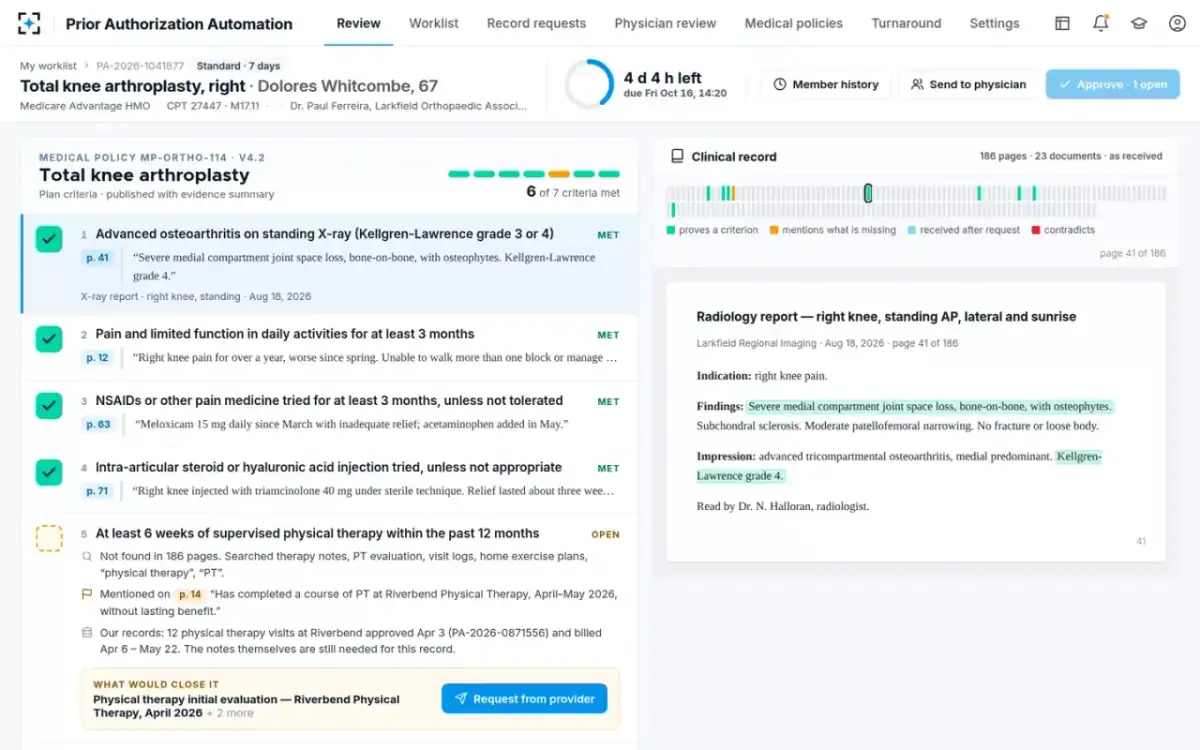
What documentation supports medical necessity, criterion by criterion
Documentation supports medical necessity when it states, in the clinician's words and in a dated document, the fact the criterion asks for. A diagnosis criterion needs the report or note that makes the diagnosis, not the problem list that repeats it. A duration criterion ("at least six weeks") needs dated entries at both ends. A failed-treatment criterion needs the treatment and its result. A contraindication criterion needs either the finding or its documented absence.
Two kinds of page cause trouble. Mentions look like evidence and are not: a surgeon's consultation that says the patient "completed a course of PT" mentions therapy without documenting it, and a criterion asking for supervised therapy is not met by the mention. Contradictions are evidence on both sides: one note records three hours of therapy tolerated, another records thirty minutes before fatigue. A reviewer who sees only one has not reviewed the criterion. In the solution, the criteria matcher marks the first kind as open, with the mention shown, and the second as contradicted, with both passages quoted, and a contradicted criterion goes to a physician.
A contradicted criterion reaches the physician with both passages, not one
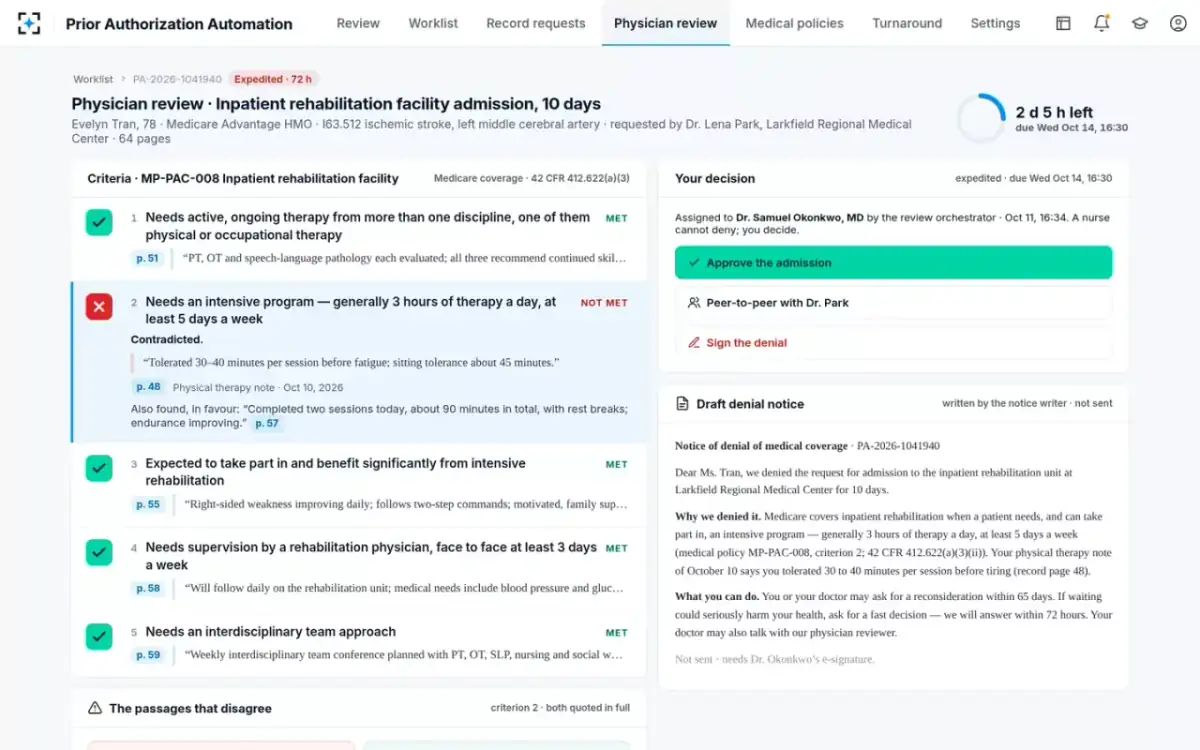
What happens if medical necessity is not met?
The request is denied in whole or part, and the denial starts its own chain of rules. In Medicare Advantage a qualified professional must review it before it issues; the notice must state the specific reasons and the member's reconsideration rights; and from 2026 the response to the provider must carry a specific reason whatever channel the request came in. A denial that cannot point to the criterion and the page is weak at every later step. The parts of that reason are set out in writing the specific denial reason.
Before a denial on missing evidence, there is a prior question: is the evidence missing, or unfound? OIG found Medicare Advantage denials for lack of documentation where the records already in the case file supported approval. The insufficient documentation guide sets out the check that separates the two, and the overturn figures in prior authorization denial rates show how often appeals find the answer was yes.
A medical necessity file that holds up: the check before signing
- The criteria and their source are named
NCD, LCD or published internal policy, with the edition in force on the request date.
- Every criterion has a finding
Met, open or contradicted. None left blank, none decided by the overall impression.
- Every finding has its passage
Quoted, with document, author, date and page. A summary is not a passage.
- Every open criterion shows its search
What was looked for, under which names, and where the chart mentions the subject.
- Every contradiction shows both sides
Both passages quoted; the weighing is the physician’s, in writing.
- Pages that arrived late are marked
With the time received, so the file shows what the reviewer could have seen and when.
- The signer and time are recorded
Who accepted each finding, who signed the decision, and when, inside the clock.
Questions people ask
How do auditors review medical necessity decisions?
CMS program auditors sample organization determinations and check timeliness and whether each followed 42 CFR 422 Subpart M; in the 2025 audit cycle they cited decisions made without considering all enrollee information or clinical documentation. They read the case file, so what the reviewer saw but did not record does not count.
Who decides medical necessity for a health plan?
A clinical reviewer employed or delegated by the plan: a nurse can approve, and in Medicare Advantage an adverse decision must be reviewed by a physician or other appropriate health care professional before it issues. On reconsideration of a medical necessity denial, the decision must be made by a physician with appropriate expertise.
Can a health plan use its own medical necessity criteria for Medicare Advantage members?
Only where Medicare's criteria are not fully established, and then only criteria based on current evidence in widely used treatment guidelines or clinical literature, made public with an evidence summary, sources and rationale under 42 CFR 422.101(b)(6). Where an NCD or LCD sets the criteria, the plan applies those.
What is the difference between medical necessity and medically appropriate?
Plans often use the terms together, and Medicare Advantage rules treat "any substantively equivalent term" for medical necessity the same way when deciding who must review an adverse decision. What matters on file is not the label but which criterion was applied and what evidence met or failed it.
Does a medical necessity review look at the whole medical record?
It should consider all relevant documentation submitted with the request. CMS's 2025 audit report told plans to ensure reviewers have complete clinical documentation, not abbreviated summaries. Reading the whole record is a different thing from citing it; a file that holds up cites the pages each criterion rests on.