An appeals and grievances coordinator is the person at a health plan who receives every appeal and complaint, decides whether each is an appeal, a grievance or both, starts the regulatory clock that applies, gathers the original file and makes sure each case reaches the nurse, the physician reviewer and, when the plan upholds a denial, the independent review entity on time. The nurse and the physician get the attention, but most missed deadlines are decided at the coordinator's desk in the first hour: a letter logged a day late, a grievance read as an appeal, a payment dispute put on the wrong clock. Botminds' Appeals & Grievances Management is an agentic case management solution for health plans built around that seat: its agents sort each letter, start each clock and rebuild each file, and the coordinator confirms what they propose.
The rules below are federal: Medicare Advantage's Subpart M of 42 CFR Part 422 and Medicaid managed care's Subpart F of Part 438, as current on eCFR in October 2026, and CMS's own appeals guidance, effective 6 July 2026. Examples are illustrative, and the screens show the solution running on a fictional sample health plan.
Five seats carry an appeal; the coordinator's is the one that starts the clock
Today
Logs every letter, call and portal message by hand, decides what each one is, sets the clock, chases the original file from claims and utilization management, and watches the forwarding deadline to the independent review entity.
With agents
Confirms the classification an agent proposes, with the sentence it rests on quoted, and works one queue in which every case already carries its clock and its file.
Still theirs: The call on what a letter is, every dismissal, every extension and every notice that leaves the building.
Today
Rebuilds the first decision from four systems and reads the new records against it before the physician sees anything.
With agents
Starts from a timeline of the case with each event tied to its source page, and checks what the agents marked as new.
Still theirs: The clinical summary the physician relies on.
Today
Receives a stack of PDFs in arrival order, close to the deadline.
With agents
Receives a case in chapters with a cited draft, early enough to ask for more.
Still theirs: The reconsidered decision on medical necessity, and the signature.
Today
Finds that some of what lands as a grievance is really an appeal, and the reverse, after days have passed.
With agents
Receives grievances already split out of appeal letters, each on its own clock, with the call history attached.
Still theirs: The investigation and the answer to the member.
Today
Rebuilds audit universes from logs that were never designed to answer an auditor.
With agents
Pulls receipt dates, clocks, classifications and notices from the same cases the team works.
Still theirs: The program: what is tested, sampled and fixed.
What does an appeals and grievances coordinator do?
A coordinator classifies, clocks, assembles, routes and closes. Classifying means deciding whether a contact is an inquiry, a grievance, a coverage request, an appeal or a mix. Clocking means fixing the receipt date and the deadline that follows from it. Assembling means pulling the original determination, the denial notice, the reviewer's notes and the records into one case. Routing means sending it to the right nurse and to a physician who was not involved in the first decision. Closing means the notice, the effectuation and, when the plan upholds its denial, the case file to the independent review entity.
Each of those steps is written into the regulations. Medicare Advantage plans must, on receiving a complaint, "promptly determine and inform the enrollee whether the complaint is subject to its grievance procedures or its appeal procedures" (42 CFR 422.564(b)). A reconsideration must be conducted by someone who took no part in the original decision (422.590(h)). Medicaid managed care plans must "acknowledge receipt of each grievance and appeal" (42 CFR 438.406(b)(1)) and treat oral inquiries seeking to appeal as appeals. None of these is the physician's job. All of them are someone's, and at most plans that someone is the coordinator.
The job titles vary: appeals and grievances coordinator, specialist, analyst, case coordinator. So does the split with intake staff and customer service. What does not vary is that the clock starts before anyone has decided what the letter is. Under CMS guidance, a standard request counts as received when any unit of the plan or any delegated entity receives it, even one not responsible for processing it (CMS appeals guidance, §10.5.2). A letter that sits in a vendor's mailroom for two days has already used two days.
The first hour: five decisions that set every deadline
Five decisions made at intake fix everything that follows: when the request was received, what it is, which product and clock it falls under, whether it is expedited, and who may file it. Get any one wrong and the rest of the team works to the wrong date.
Receipt. CMS counts the day after receipt as day one, in calendar days including weekends and holidays, while hour-based clocks run from the hour of receipt. Mail is received when the plan first stamps it or when a tracked carrier delivers it; a fax when the transmission report says it arrived; a call when the member speaks to a representative. The coordinator's log must hold the earliest of those times, not the time the case was opened.
Type. An appeal disputes an organization determination: a denial of a service, a payment, or the amount the member must pay. A grievance is any other complaint about how the plan or a provider operates or behaves (422.561). One letter often carries both, and splitting a letter into a grievance and an appeal is a skill of its own.
Product and clock. The same request runs on different clocks in Medicare Advantage, Medicaid managed care, an integrated dual plan or an employer plan, and within Medicare Advantage it matters whether the item has been furnished (payment, 60 days), is a Part B drug (7 days) or is still to be provided (30 days).
Expedited or standard. If a physician indicates that the standard timeframe could put the enrollee's life, health or ability to regain maximum function at serious risk, the plan must expedite (422.584(c)). If an enrollee asks without a physician's support, the plan decides, and a refusal triggers a letter within three calendar days and a right to an expedited grievance.
Standing. Is the requester the enrollee, an appointed representative, a treating physician, or a non-contract provider who has signed a waiver of liability? A request from someone who claims to represent the member but sends no valid appointment is not simply dismissed: CMS's guidance has the plan tell both, in writing, that the request is not valid until the documentation arrives, try to obtain it, and start the clock when it comes (§20.2.1).
In a 72-hour expedited appeal, the coordinator's hours decide how many the physician gets
- Mailbox, logging13 h
- Waiting on outside records30 h
- File assembled12 h
- Review, notice11 h
- Spare6 h
- Sorted, records requested at once, waiting27 h
- Review, notice9 h
- Spare36 h
Who decides if a complaint is a grievance or an appeal?
The plan does, and in practice the coordinator does it for the plan: the member does not have to use the right word. CMS's guidance is explicit that "the enrollee is not required to use any specific language to indicate what they are requesting", and gives the example of a member who says they want to file a grievance about a denied service. That is an appeal, because the dispute is about an organization determination (CMS appeals guidance, §30.1).
Classification is therefore a judgement, and it is tested. In a program audit, CMS selects up to 15 grievance cases and reviews whether each "was appropriately classified or whether it should have been treated as a coverage request or appeal", under the revised Part C protocol in CMS's October 2026 information-collection package (CMS program audits). A misclassified case can also come back on its own: when a grievance is wrongly sent to the independent review entity as an appeal, CMS says "the IRE will dismiss the appeal and return the case to the plan for proper processing". How auditors sample appeals and grievances sets out the rest of that test.
Plans should ensure that customer service representatives are trained to distinguish between coverage requests, appeals, and grievances.
CMS, Parts C & D Enrollee Grievances, Organization/Coverage Determinations, and Appeals Guidance, §30.1
The coordinator is usually the person who writes that training, and the person who catches the cases it misses. The hardest ones are the mixed calls: a member who complains about waiting for a covered service and says the delay is hurting them is, by CMS's own example, both a coverage request and a quality of care grievance.
The clocks one coordinator carries at the same time
A coordinator at a plan with Medicare Advantage and Medicaid business works at least eight clocks, and the differences between them are where errors start. The table sets them side by side; a state may set Medicaid timeframes shorter than the federal ceilings.
The federal clocks an appeals and grievances coordinator works to, October 2026
| Case type | Decide within | Extension | If the plan upholds or misses |
|---|---|---|---|
| Medicare Advantage expedited reconsideration | 72 hours | Up to 14 days, listed reasons only | Case file to the IRE within 24 hours |
| Medicare Advantage standard pre-service reconsideration | 30 calendar days | Up to 14 days, listed reasons only | Case file to the IRE by the deadline; a miss counts as an affirmation |
| Medicare Advantage Part B drug reconsideration | 7 calendar days | None | Case file to the IRE within 7 days |
| Medicare Advantage payment reconsideration | 60 calendar days | None | Case file to the IRE within 60 days |
| Medicare Advantage grievance | 30 days | Up to 14 days, with written reasons | Not appealable; the member is told the outcome |
| Medicare Advantage expedited grievance | 24 hours | None | Applies when the plan extends a decision or refuses to expedite |
| Medicaid managed care appeal | State-set, at most 30 calendar days (72 hours expedited) | Up to 14 days | Member may request a state fair hearing; a miss is deemed exhaustion |
| Medicaid managed care grievance | State-set, at most 90 calendar days | Up to 14 days | Resolution notice in the state's format |
Three rows cause most of the trouble. Payment and Part B drug reconsiderations cannot be extended, so a coordinator who waits for records on those cases simply loses days. The expedited grievance applies when the plan extends a decision or refuses to expedite, and the regulation's 24 hours is easy to miss when the complaint arrives as a phone call. And Medicaid's ceilings are only ceilings: 42 CFR 438.408 lets each state set its own, so the coordinator needs the state contract, not just the CFR. How long a Medicare appeal takes works through each clock, and what a missed one costs.
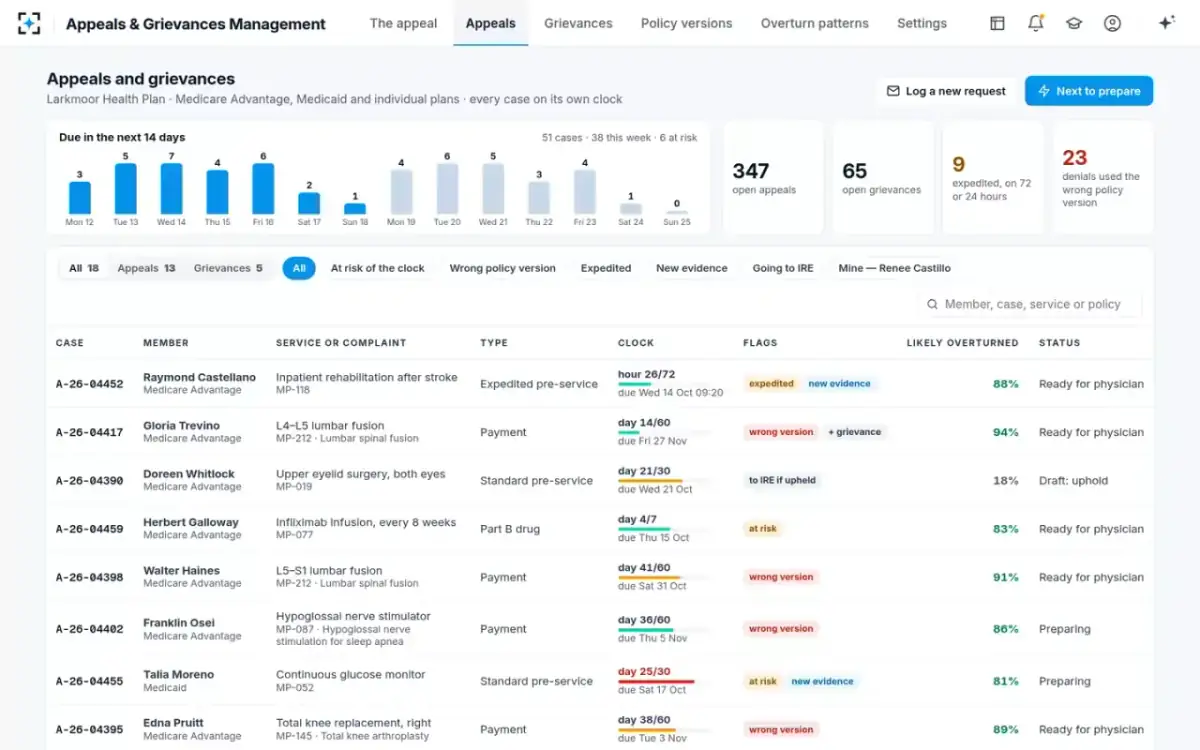
One queue, every case on its own clock
What the coordinator sends to the independent review entity, and when
When a Medicare Advantage plan upholds a denial in whole or in part, the coordinator must "prepare a written explanation and send the case file to the independent entity contracted by CMS" within the same 30, 7 or 60 days, and within 24 hours of affirming an expedited case (422.590). The plan must also make "reasonable and diligent efforts to assist in gathering and forwarding information". There is no option to hold an upheld case back.
The forward is also automatic when the plan is late. Under 422.590(d), failing to decide a standard reconsideration in time counts as upholding the denial. The coordinator then forwards a case nobody decided, and CMS's guidance adds that the plan is not required to tell the member it has done so: the independent review entity will. Since 1 May 2026 that entity for Part C has been C2C Innovative Solutions, which took over from Maximus Federal Services for requests received from that date.
CMS's guidance lists what the case file should contain, starting with a transmittal form and a case narrative. In practice the coordinator's narrative is what the independent reviewer reads first, so a file assembled in arrival order, with the policy the denial relied on missing, costs the plan twice: once in the review and again if the reviewer asks for more.
Appeals coordinator vs appeals nurse: who does what
The coordinator owns the process and the nurse owns the clinical preparation; neither decides a medical necessity appeal. When the issue is a denial for lack of medical necessity, a physician with expertise appropriate to the service must make the reconsidered determination, though not necessarily one of the treating physician's own specialty (422.590(h)(2)).
The split is clean on paper and blurred in practice. Coordinators often draft the decision letter for the physician's signature, and nurses often handle the payment reconsiderations that turn on coding rather than medicine. The line that cannot move is the one the regulation draws: someone not involved in the first decision reconsiders it, and a physician decides medical necessity. Medicaid adds a twist: the decision-maker must not be "a subordinate of any such individual" who was involved earlier (438.406(b)(2)), which a coordinator assigning cases needs to know about the reporting lines of the medical directors.
Where coordinators get audited, and what CMS has found
Coordinators' work is what a CMS program audit of organization determinations, appeals and grievances tests most directly: timeliness across every case in the universe, classification on a sample, and the notices. The 2025 enforcement report gives examples that read like a coordinator's checklist. Among them: "Dismissal notices omitted required language regarding vacating dismissals and requesting reconsideration", grievance letters about quality of care that wrongly offered Medicare appeal rights, and "Extension notices failed to explain the reason for extending a decision timeframe" (CMS, CY 2025 Program Audit and Enforcement Report).
The same report lists a fourth example that is pure coordination: "Required notice updates, such as the new 65-day appeal timeframe, were not implemented consistently across multiple systems and delegated entities." A coordinator who owns the templates and the intake rules owns that risk too, including the copies held by vendors.
How many cases does an appeals and grievances coordinator handle?
No public benchmark exists. The Bureau of Labor Statistics does not count appeals and grievances coordinators as a separate occupation, and CMS publishes case volumes by plan contract, not by staff member. A plan has to work the number out from its own data: open cases by clock, the hours each case type takes at intake, and how many arrive late in the day or through delegated entities.
The ratio that matters is not cases per person but cases per clock. Ten expedited reconsiderations arriving on a Friday afternoon are a different workload from ten payment reconsiderations arriving on a Monday. On the fictional sample plan in the screens, one coordinator's queue holds 347 open appeals and 65 open grievances, nine of them on 72-hour or 24-hour clocks. A team sized for the average week will miss deadlines in the peak one.
What changes when agents do the sorting
In Appeals & Grievances Management the coordinator stops typing and starts confirming. The intake sorter reads every letter, call note and portal message, separates appeals from grievances, sets the case type and starts each clock, quoting the sentence behind each classification. The file rebuilder pulls the claim or prior authorization request, the denial notice, the reviewer notes and the records into one timeline, each event tied to its source page. The clock keeper computes every case's time left each hour, warns the owner and forwards upheld cases to the independent review entity before the deadline.
The limits are as important as the tasks. The intake sorter never dismisses a request or closes a case. The clock keeper never extends a clock without one of the reasons the regulation lists. Every classification, extension and notice stays with a named person, and every step is on the audit trail. The settings below are where a coordinator's manager writes the plan's rules down once, instead of in each coordinator's head.
The plan's clocks and limits, written down once
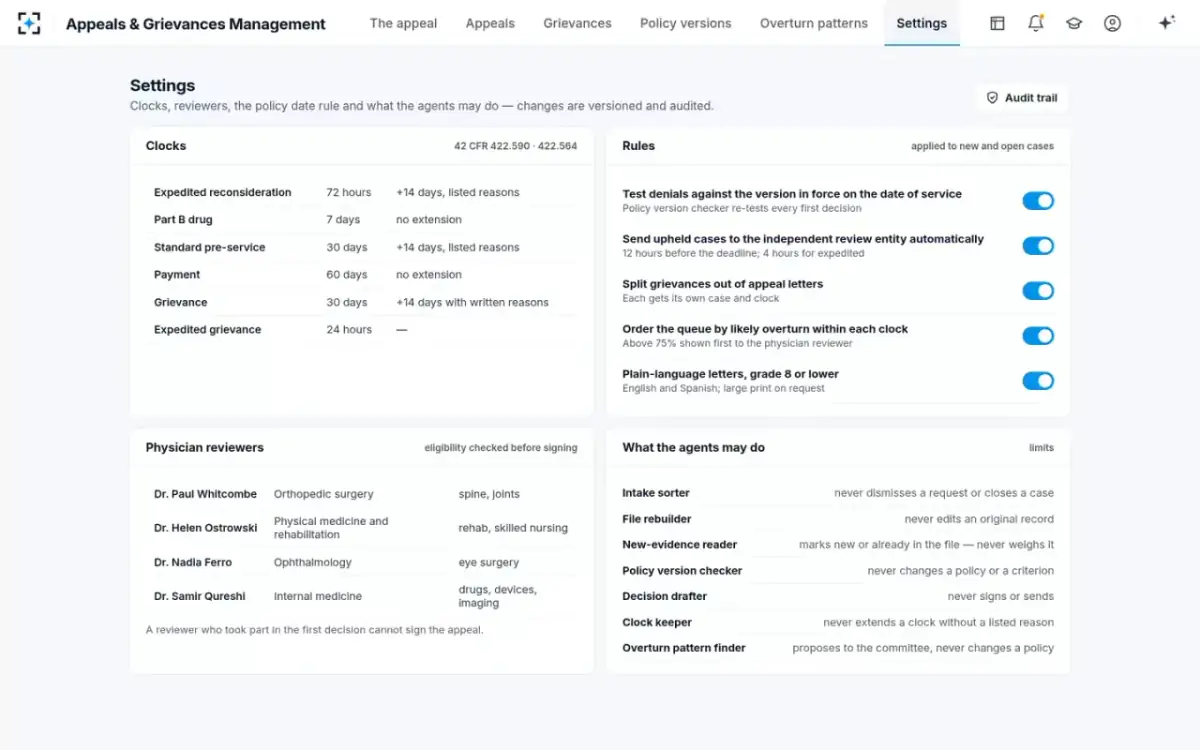
What stays at the desk is the part that needs judgement: the borderline letter, the call where a member says the delay is harming them, the request with a defective representative form. The design aim is that the coordinator spends the day on those, and the target is a case ready for the reviewer about 12 minutes after it opens, against roughly 50 when it is assembled by hand. To see the queue and the intake together, start from Appeals & Grievances Management.
Questions people ask
What skills does an appeals and grievances coordinator need?
Working knowledge of the plan's regulations (42 CFR 422 Subpart M for Medicare Advantage and 438 Subpart F for Medicaid), the ability to read a letter for what the member is actually disputing, and precise record keeping. CMS audits test timeliness on every case in the period under review, so a coordinator who is careful with receipt dates and notices protects the plan more than one who is fast.
What is the difference between an appeals coordinator and an appeals nurse?
The coordinator runs the process: intake, classification, clocks, files, notices and forwarding to the independent review entity. The nurse prepares the clinical case for the physician reviewer. Neither decides a medical necessity appeal; 42 CFR 422.590(h) requires a physician with appropriate expertise who was not involved in the first decision.
What systems do appeals and grievances coordinators use?
Usually a case tracking system plus read access to the claims system, the utilization management system, the medical records received, the medical policy library, the member call log and the independent review entity's portal. The difficulty is that each holds part of the file, which is why the original determination is so often rebuilt by hand.
Can a coordinator dismiss an appeal?
Only for a reason the regulation lists, such as a requester who is not a proper party, a request filed late without good cause, or a withdrawal (42 CFR 422.582(f)). The dismissal notice must explain the right to ask the plan to vacate it and the right to review by the independent review entity, and CMS's 2025 audits found notices that left that language out.
Is appeals and grievances a good career?
It is a regulated, audited function that every Medicare Advantage and Medicaid managed care plan must staff, and the rules grow more detailed each year, from the 2026 decision clocks for prior authorization to the revised audit protocol. Coordinators who understand both the clocks and the clinical file tend to move into appeals management, compliance or audit roles.