The difference between a grievance and an appeal is what the member is disputing. An appeal challenges a health plan's decision about coverage or payment: a denied service, a refused claim, or the amount the member must pay. A grievance is any other expression of dissatisfaction, about service, access, waiting, rudeness or the quality of care, whether or not the member asks for anything to be done. In Medicare Advantage the two run on separate procedures with separate clocks, and a single letter often contains both, which is where plans miss deadlines. Botminds' Appeals & Grievances Management is an agentic case management solution whose intake sorter reads every letter, call note and portal message, separates the appeal from the grievance, and starts each on its own clock.
This guide uses the federal definitions for Medicare Advantage (42 CFR Part 422, Subpart M), Medicaid managed care (Part 438, Subpart F) and integrated dual plans, as current on eCFR in October 2026, and CMS's appeals guidance effective 6 July 2026. The worked example is illustrative.
Grievance vs appeal in Medicare Advantage, side by side
Appeal (reconsideration): An organization determination: a denied or delayed service, a payment, or what the member must pay.
Grievance: Anything else: service, access, waiting, communication, rudeness, quality of care, the appeals process itself.
Appeal (reconsideration): In writing, unless the plan accepts oral requests; expedited requests may be oral.
Grievance: Orally or in writing.
Appeal (reconsideration): 60 days after receiving the plan's notice, presumed 5 days after its date.
Grievance: 60 days after the event; the plan may accept later ones.
Appeal (reconsideration): 72 hours expedited; 7 days for a Part B drug; 30 days for a service; 60 days for a payment.
Grievance: 30 days; 24 hours when the complaint is about an extension or a refusal to expedite.
Appeal (reconsideration): Someone not involved in the first decision; a physician with appropriate expertise for medical necessity.
Grievance: The plan's grievance process; Part 422 sets no reviewer qualification for Medicare Advantage grievances.
Appeal (reconsideration): A written decision; an upheld or late case goes to the independent review entity automatically.
Grievance: In writing if filed in writing or about quality of care; otherwise may be oral.
Appeal (reconsideration): Independent review, then a hearing, the Medicare Appeals Council and court.
Grievance: Nothing: grievance decisions are not appealable. Quality of care complaints may also go to the QIO.
What is the difference between a grievance and an appeal?
An appeal is about a decision; a grievance is about everything else. The Medicare Advantage regulation defines a grievance as "any complaint or dispute, other than one that constitutes an organization determination, expressing dissatisfaction with any aspect of an MA organization's or provider's operations, activities, or behavior, regardless of whether remedial action is requested" (42 CFR 422.561). An appeal is a procedure dealing with the review of adverse organization determinations, starting with the plan's reconsideration and continuing, if necessary, to the independent review entity, a hearing, the Medicare Appeals Council and judicial review.
Medicaid managed care draws the line the same way. An appeal is "a review by an MCO, PIHP, or PAHP of an adverse benefit determination", and a grievance is "an expression of dissatisfaction about any matter other than an adverse benefit determination", including "aspects of interpersonal relationships such as rudeness of a provider or employee" (42 CFR 438.400). The practical consequence is identical in both programs: the same sentence can be either, depending on whether a decision sits behind it.
The procedures are deliberately kept apart. "Grievance procedures are separate and distinct from appeal procedures," 422.564(b) says, and the plan must decide which one applies and tell the member. CMS's guidance adds a point that surprises members and some staff: "Decisions made under the grievance process are not subject to appeal" (CMS appeals guidance, §30).
Is a complaint a grievance or an appeal?
It depends on whether the plan has made a coverage or payment decision the member is disputing, not on the word the member uses. CMS gives the example of a member who calls and says, "I would like to file a grievance. You denied my request for drug X or service Y and I need it." Because an adverse decision exists, "the enrollee's dispute should be treated as an appeal of the denial." The reverse also holds: a member who calls to "appeal" a co-payment they find too high, without disputing the amount charged under the plan's rules, is expressing a grievance.
CMS's guidance lists typical grievances: involuntary disenrollment initiated by the plan, a change in premiums or cost sharing from one year to the next, the quality of care received, the plan's benefit design, difficulty reaching the plan by phone, interpersonal aspects of care, the appeals process, and the plan's decision not to expedite. It lists as appeals a member who disputes a co-pay amount billed as their own responsibility, and anyone disputing an adverse determination. A question about coverage with no request and no complaint is an inquiry, and a request for something not yet decided is a coverage request.
Can a letter be both a grievance and an appeal?
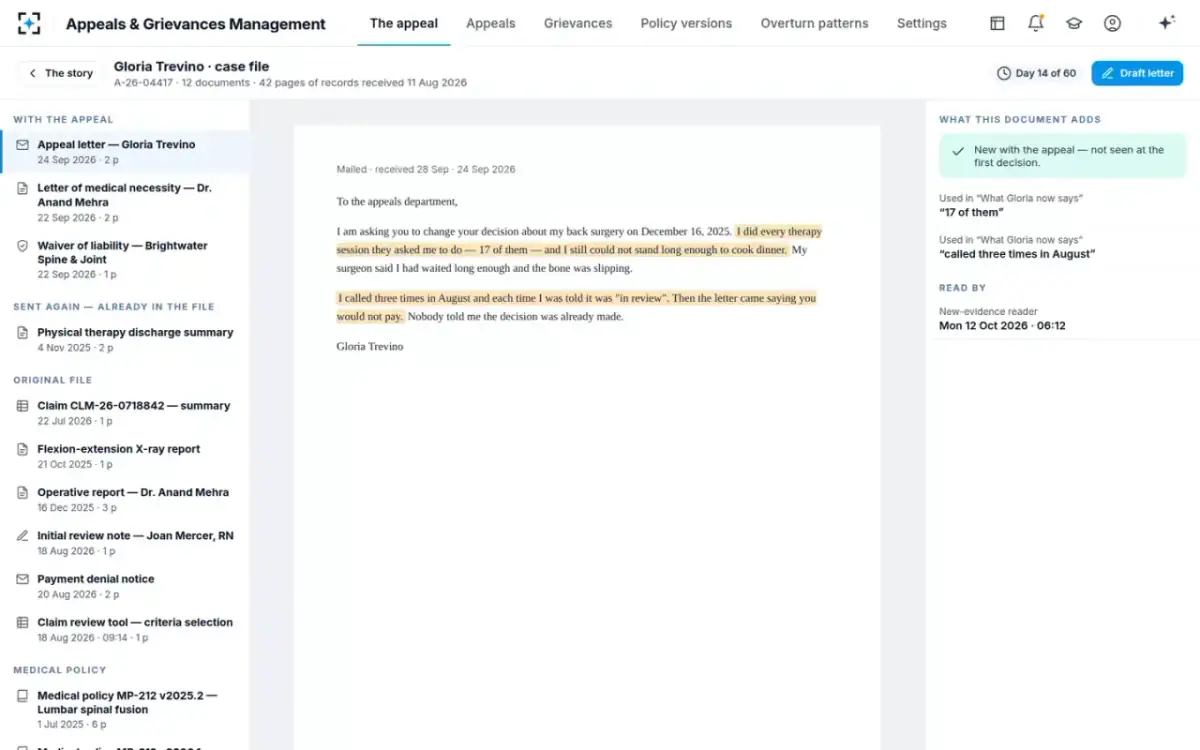
Yes, and it is common: a member writes to dispute a denial and, in the same letter, complains about how they were treated while waiting. CMS's guidance tells the plan what to do with it.
If an enrollee raises two or more issues at the same time, then each issue should be processed separately and simultaneously (to the extent possible) under the appropriate procedure.
CMS, Parts C & D Enrollee Grievances, Organization/Coverage Determinations, and Appeals Guidance, §30.1
Separately means two cases with two clocks, two decision paths and, usually, two responses. Simultaneously means the grievance does not wait for the appeal to be decided. CMS's own examples of combined cases include a member who waited so long for a service that they went out of network, which is both a coverage request for the out-of-network service and a grievance about timeliness, and a member who says a delayed service is hurting their health, which is a coverage request and a quality of care grievance.
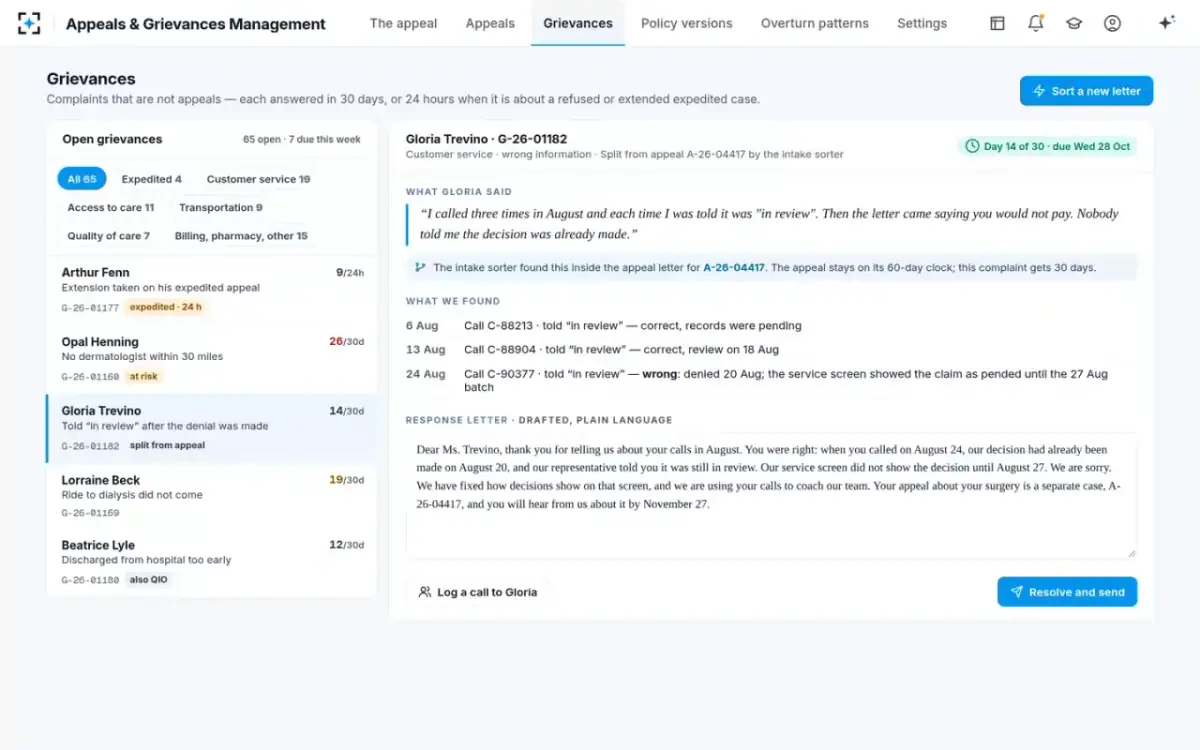
The split is easy to state and hard to do at volume, because the grievance is often one sentence in a three-page letter about a surgery. In Appeals & Grievances Management, the intake sorter quotes the sentence behind each classification, so the person confirming it can see why the letter became two cases.
A grievance found inside an appeal letter, on its own 30-day clock
How long does a plan have to resolve a grievance?
In Medicare Advantage, 30 days from receipt, extendable by up to 14 days if the member asks or if the plan justifies a need for more information and documents why the delay is in the member's interest (422.564(e)). Members must file within 60 days of the event, although CMS's guidance lets a plan accept a later grievance. In Medicaid managed care, the state sets the timeframe, which "may not exceed 90 calendar days" (438.408(b)(1)), and the member may file "at any time" (438.402(c)(2)). Integrated dual plans resolve grievances within 30 calendar days (422.630(e)).
Grievance clocks by program, October 2026
| Program | Filing window | Standard response | Expedited response | How the answer is given |
|---|---|---|---|---|
| Medicare Advantage | 60 days after the event (later at the plan's option) | 30 days, +14 if justified | 24 hours | In writing if filed in writing or about quality of care |
| Medicaid managed care | Any time | State-set, at most 90 calendar days, +14 | No federal expedited timeframe in 438.408 | By the method the state sets |
| Integrated dual plan | Any time | 30 calendar days, +14 if justified | 24 hours | In writing if filed in writing or about quality of care |
What is an expedited grievance?
An expedited grievance is one a Medicare Advantage plan must answer within 24 hours, and the regulation names exactly two triggers: the complaint "involves an MA organization's decision to invoke an extension relating to an organization determination or reconsideration", or it involves the plan's "refusal to grant an enrollee's request for an expedited organization determination" or reconsideration (422.564(f)). The first trigger covers any extension the plan takes on a decision or an appeal, standard or expedited, which is why every extension notice must tell the member they may file one.
Expedited grievances are easy to miss because they usually arrive by phone, in the same call in which the member hears that their decision will take longer. CMS's audit protocol checks for them specifically: in a grievance sample, auditors determine "if Sponsoring organization responded to the enrollee's grievance within 24 hours" when the member filed an expedited grievance (CMS, revised Part C audit protocol, October 2026).
What happens when the grievance hidden in an appeal is missed
The grievance clock keeps running from the day the letter arrived, so a complaint found only when the appeal is decided may already be late. The 30 days in 422.564(e) run from "the date the organization receives the oral or written grievance", which for a mixed letter is the date the letter arrived, not the date someone noticed the second issue. The timeline shows the same illustrative letter handled both ways.
The same mixed letter, split at intake and split late
- Logged as two cases, calls reviewed9 d
- Reply3 d
- Time to spare18 d
- Unnoticed in the appeal file25 d
- Calls and notes reviewed8 d
- Reply3 d
The reverse error is worse. An appeal logged as a grievance loses the appeal's protections: the physician review, the independent review entity and the member's next levels. CMS's rule for that case is strict: when the plan discovers the error it must forward the request for processing as an appeal and tell the member in writing, and "the timeframe for processing the appeal begins on the date the appeal is received by the plan, as opposed to the date the plan discovers its error" (§50.11). If a grievance is wrongly sent to the independent review entity as an appeal, the entity dismisses it and returns it to the plan.
Auditors test classification directly. In a CMS program audit of organization determinations, appeals and grievances, auditors take up to 15 grievance cases and review each case file "to determine if the request was appropriately classified or whether it should have been treated as a coverage request or appeal". What a missed appeal deadline costs applies in full to an appeal that spent its first weeks filed as a grievance.
Quality of care grievances and the QIO
A quality of care grievance is a complaint that care did not meet professionally recognized standards, such as a misdiagnosis or inappropriate treatment, and it carries extra rules. The plan must answer it in writing, however it was filed, and the response "must include a description of the enrollee's right to file a written complaint with the QIO" (422.564(e)(3)(iii)), the Beneficiary and Family Centered Care Quality Improvement Organization. The member may complain to the plan, to the QIO or to both, and the plan must cooperate with the QIO, providing records within 14 days under CMS's guidance.
The letter must also not promise what does not exist. One of CMS's 2025 audit findings was that "Quality-of-care grievance resolution letters incorrectly included Medicare appeal rights" (CMS, CY 2025 Program Audit and Enforcement Report). A grievance has no appeal; telling the member it does sends them into a process that will dismiss their request. Templates for grievance responses and appeal decisions should be separate, and so should the people who approve them.
The appeal letter with the complaint marked, so neither part is lost
Who handles grievances at a health plan?
Usually a grievance specialist or a combined appeals and grievances team, with clinical staff for quality of care complaints and the compliance team watching the trends. The regulations require the function, not the job title: a Medicare Advantage plan must "provide meaningful procedures for timely hearing and resolving grievances" (422.564(a)), and Medicaid managed care plans must acknowledge each grievance and have it decided by someone not involved earlier, with clinical expertise if it involves clinical issues. The appeals and grievances coordinator who classifies the letter is often the first of those people.
Two other complaint routes sit beside the plan's grievance process and should not be confused with it. Medicare members can complain to Medicare itself, and CMS counts those complaints, logged in its Complaints Tracking Module, in the Star Ratings measure "Complaints about the Health Plan". And members of insured commercial plans can complain to their state insurance department, which runs its own process and clock for the insurer's response; the department of insurance complaint response timeline covers that one. Each route has its own deadline, and the same member can use all three at once.
In Appeals & Grievances Management the grievance specialist receives grievances already split out of appeal letters, each on its own clock, with the member's words quoted, the call history attached and a reply drafted in plain language for the specialist to edit and send. To see an appeal and the grievance inside it handled side by side, start from Appeals & Grievances Management.
Questions people ask
What is a grievance in health insurance?
A complaint about the plan or its providers that is not a dispute over a coverage or payment decision: service, access, waiting times, communication, rudeness or quality of care. In Medicare Advantage the plan must answer within 30 days, or 24 hours in the two expedited cases, and the answer cannot be appealed.
Is a denied claim a grievance or an appeal?
An appeal. A denied claim is an organization determination, so a member disputing it is asking for a reconsideration, whatever word they use. In Medicare Advantage a payment reconsideration has 60 calendar days and cannot be extended.
Can a member appeal a grievance decision?
No. CMS's guidance states that decisions made under the grievance process are not subject to appeal. A member unhappy with a grievance response can file a new grievance, complain to CMS or, for quality of care, file a complaint with the QIO.
Is a complaint about the appeals process a grievance?
Yes. CMS lists "the appeals process" among typical grievances, along with the plan's decision not to expedite. A complaint that the plan extended its decision, or refused to expedite, is an expedited grievance with a 24-hour clock.
Do providers file grievances?
Not in Medicare Advantage. CMS's guidance says the grievance process is available only to enrollees or their representatives; providers use the plan's dispute resolution process and, if that fails, may contact CMS.