Improving an appeals and grievances process means fixing three things, in this order: how cases are classified and clocked, why first decisions are overturned, and how the work is measured, and only then choosing tools. Most improvement projects reverse the order and buy software first, which automates a classification rule nobody wrote down and a clock nobody owns. The stakes are concrete. Medicare Advantage insurers overturned 80.7% of the prior authorization denials appealed to them in 2024, according to KFF, so the plan pays for the same review twice while the member waits; a single late case costs the fifth star on CMS's timely appeals measure; and CMS audits test every case in the review period for timeliness. Botminds' Appeals & Grievances Management is an agentic case management solution that rebuilds each appeal as a cited timeline and re-tests each denial against the medical policy in force on the date of service, and it works best after the five decisions below.
Appeals and grievances process improvement: five decisions, then tools
A person decides
1. Classification rulesDecide who classifies each contact, how a mixed letter is split, and how a borderline call is escalated; write it down with CMS's own examples.
A person decides
2. Clock ownershipOne queue for every product line, receipt times from every channel and vendor, one owner per clock, and an extension policy that allows only the listed reasons.
A person decides
3. Policy-version controlDecide which medical policy version applies to a late claim, store every version with its dates, and test the review tools after each change.
A person decides
4. A standing overturn reviewEvery month, overturns by policy, service, reviewer, version and reason, with findings to the medical policy committee and to claims.
A person decides
5. MeasuresThe handful of numbers the department is run on, with definitions that match CMS's and a target for each.
Agent
6. Then toolsAgents for the reading, sorting, drafting and clock-keeping the first five decisions have defined; people for every decision, signature and notice.
Never: Decides, signs, sends, dismisses or extends
How do you improve an appeals and grievances process?
Start with the decisions only a leader can make, because each one changes what any tool must do. A department whose classification rule is "the coordinator knows" cannot be automated or audited. One whose clocks start when the case is opened rather than when any part of the plan received the request is late before it begins. One that treats overturns as the cost of doing business never finds the configuration error behind them. The five decisions in the figure are ordered so that each rests on the one before: classification sets the clock, the clock defines timeliness, the policy rule defines what an avoidable overturn is, the overturn review defines what to measure, and the measures tell you what to automate.
CMS expects this kind of self-scrutiny explicitly. In its appeals guidance, after describing how to handle an appeal misfiled as a grievance, it adds a sentence any improvement program can take as its charter.
Plans are expected to audit their own appeals and grievance for the presence of errors and institute appropriate quality improvement projects as needed.
CMS, Parts C & D Enrollee Grievances, Organization/Coverage Determinations, and Appeals Guidance, §50.11 (effective 6 July 2026)
Decision 1: write down the classification rules
Classification is the first decision because every error after it inherits the wrong clock. The regulation separates the procedures: grievances are "separate and distinct from appeal procedures" (42 CFR 422.564(b)). CMS's guidance supplies a rule a leader can adopt as it stands, that each issue in a mixed letter goes to its own procedure at the same time, and a set of examples for what is an inquiry, a grievance, a coverage request or an appeal. What it cannot supply is the plan's own escalation path for the borderline case.
A written rule needs three parts: the definitions with the plan's own examples, who may classify and who confirms, and what happens when a classification is found wrong, including the date the clock runs from. The evidence to gather first is a sample of last quarter's grievances read for hidden appeals, and of appeal letters read for hidden grievances. How to split a mixed letter sets out the distinctions.
Decision 2: give every clock one owner
Timeliness fails at handoffs, so the decision is about ownership, not effort. The clocks themselves are fixed by regulation, such as 30 days for a standard Medicare Advantage service reconsideration, 60 for a payment and 72 hours expedited (422.590), and by state contract for Medicaid. What the plan decides is where each clock starts, which under CMS's guidance is the moment any part of the plan, including a delegated vendor, receives a standard request; who watches it; and when an extension is allowed, which for Medicare Advantage is only for the reasons the regulation lists.
The evidence to gather is the gap between receipt and case creation, by channel and by delegated entity, for the last three months. Plans that measure it usually find their worst days are not in the appeals team at all but in a mailroom or a vendor. CMS's 2025 enforcement report devotes a whole lesson to delegated entities, and among its sponsor tips lists "Monitor delegated entity performance" (CMS, CY 2025 Program Audit and Enforcement Report).
Decision 3: control the medical policy version
The third decision is which version of a medical policy applies to a case, and how the plan makes sure its systems apply it. No federal regulation spells out whether a claim reviewed months after the service is tested against the policy in force on the date of service or on the date of review; it is plan policy and provider contract language. What the regulations do require is that policies change on a schedule: a Medicare Advantage plan's utilization management committee must review all utilization management policies at least once a year (422.137), and internal coverage criteria must be publicly accessible with a summary of their evidence (422.101(b)(6)). Each annual change creates a window in which claims for services delivered under the old version arrive after the new one takes effect.
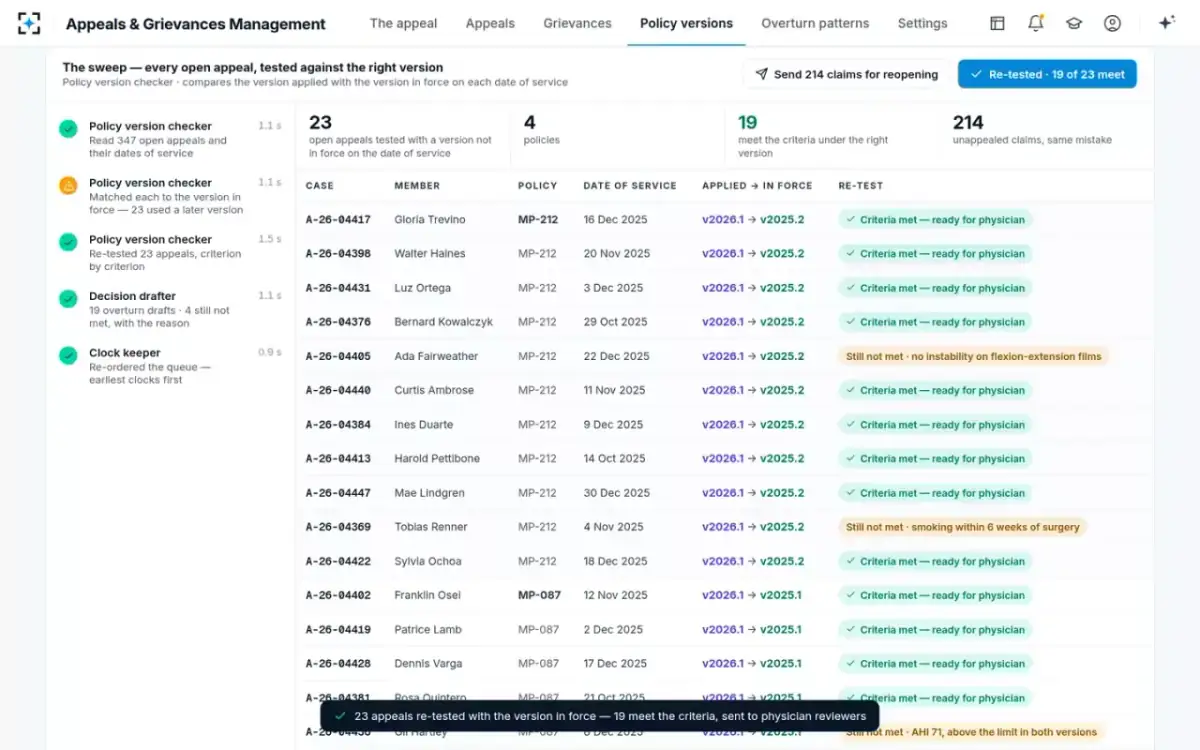
The evidence to gather is simple and often missing: for each policy, every version with its effective dates, and for each denial in the last year, the version the review tool applied. Where the two disagree, the error is systematic and repeats on every similar claim. CMS's 2025 report frames the control in its tips: "Monitor rejected claims, denied requests, and unusual processing trends for signs of underlying system issues."
Every open appeal re-tested against the right policy version
Decision 4: make overturn review a standing loop
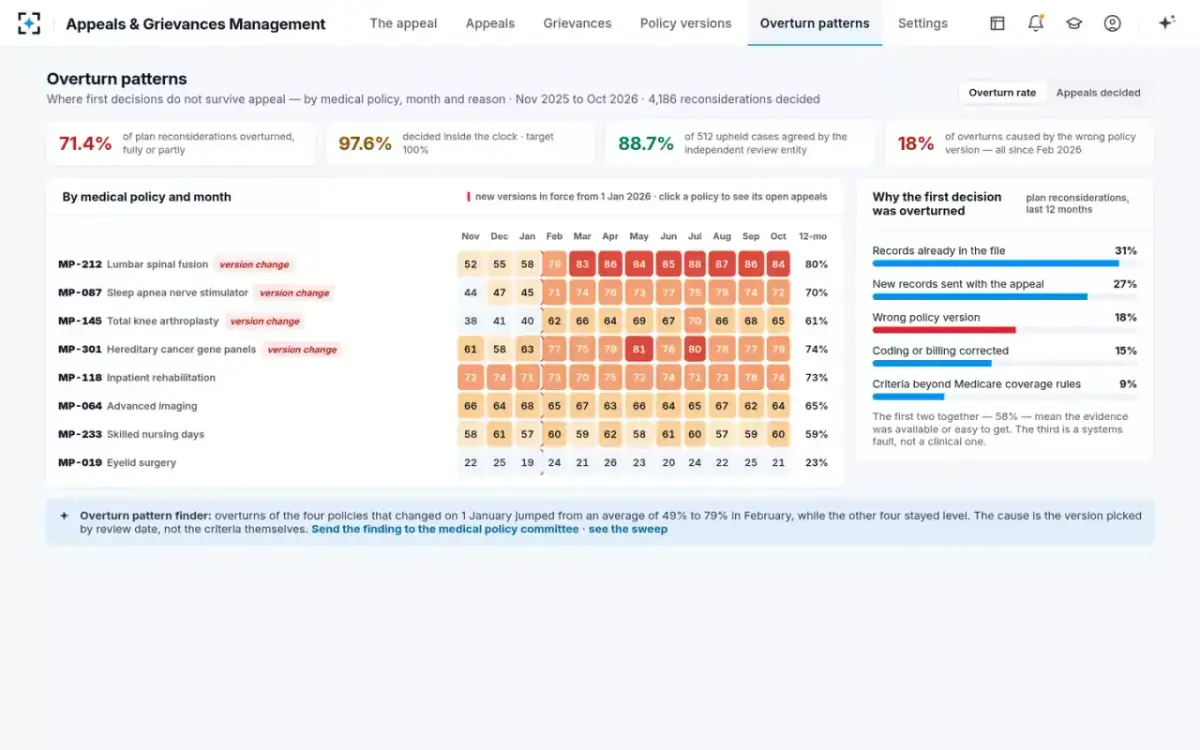
Overturns are the plan's free test set: every one is a first decision that did not survive a second look. The decision is to review them every month, by medical policy, service, reviewer, policy version and reason, and to send the findings to the people who can fix the cause: the medical policy committee, utilization management, claims configuration or a delegated vendor. KFF's data show how much room there is: overturn rates for appealed prior authorization denials ranged from 51.0% to 95.5% across Medicare Advantage insurers in 2024 (KFF, January 2026).
Delegated reviewers belong in the same loop. HHS-OIG's June 2026 report on skilled nursing admissions found that the contractor that processed half of all requests denied 14% of them, and that "MAOs later overturned 97 percent of SNF denials issued by" that contractor when enrollees appealed, which "raises concerns about whether contractors are receiving appropriate training and oversight from MAOs" (OEI-09-24-00331). How to replay a year of overturns gives the method for the first pass.
Overturns by policy and month, with the reasons behind them
What are appeals and grievances KPIs?
A handful, each defined the way CMS defines it so the internal number predicts the external one. Two are CMS's own Star Ratings measures, both weighted 2: "Plan Makes Timely Decisions about Appeals" (C30), the share of the plan's appeals reaching the independent review entity on time, and "Reviewing Appeals Decisions" (C31), the share of them the entity upheld (2027 Star Ratings Technical Notes). The rest are the plan's own leading indicators.
The external thresholds a plan's appeals measures are judged against
100%
timely to the independent reviewer for five stars on C30 (2027 ratings, 2025 data)
98%
upheld by the independent reviewer for four stars on C31
3%
of the IRE's merits decisions reversed the plan in Q2 2026 (3.01%)
80.7%
of appealed MA prior authorization denials overturned by plans, 2024
Appeals and grievances KPIs: what to measure, and how
| Measure | Definition | Why it leads |
|---|---|---|
| Timeliness by clock | Cases decided or forwarded on time ÷ all cases, for each case type separately | Mirrors CMS's universe-level test; an average across clocks hides the Part B drug cases |
| Receipt-to-open gap | Hours between earliest receipt anywhere in the plan and case creation, by channel | The cause of most late cases, invisible in timeliness alone |
| Plan overturn rate, by cause | Fully or partly favorable ÷ decided on the merits, split by the cause of each overturn | Separates avoidable overturns from new evidence |
| Independent reviewer uphold rate | Upheld ÷ upheld, overturned and partly overturned, as in C31 | The Star Ratings view of the plan's upheld denials |
| Misclassification rate | Cases reclassified after intake ÷ cases opened, in each direction | CMS samples grievances for exactly this |
| Extensions without a listed reason | Count, by case type | Should be zero; any one is a finding |
| Notice defects | Sampled notices missing a required element ÷ notices sampled | Dismissal and extension notices were 2025 findings |
What should an appeals and grievances dashboard show?
Today's risk first, then the month's causes. The first screen should show every open case on its own clock with the earliest deadlines on top, because the only number a manager can still change is the one for cases not yet late. The second should show the measures in the table above for the month, and the third the overturns by policy and cause, with the findings sent and their status. A dashboard that leads with last quarter's averages tells the team how it did, not what to do this afternoon.
How do you reduce appeal overturns?
By fixing the first decision, not the appeal. Overturns caused by new evidence the member could only provide later are the process working; the rest are avoidable, and each has an owner outside the appeals team. The checklist is the sequence we would follow.
Seven moves that reduce avoidable overturns
- Replay last year's overturns and classify each by cause
Records already in the file, new records, wrong policy version, coding or billing, criteria beyond Medicare rules.
- Give first reviewers the complete file
CMS's 2025 lesson: decisions must rest on complete information, not summaries.
- Make denial notices say exactly what is missing
So the evidence arrives before the denial, not with the appeal.
- Test denials against the policy version in force on the date of service
And re-test open appeals whenever a version error is found.
- Send unappealed look-alikes to claims
A cause found in appeals sits in the denials nobody appealed.
- Hold delegated reviewers to the same loop
Overturn rates by contractor, reviewed monthly.
- Take criteria findings to the medical policy committee
Internal criteria must meet 422.101(b)(6); the committee decides.
Most of these moves are upstream of appeals, which is why an appeals leader needs a seat at the utilization management and medical policy tables. The appeals team sees the causes first; it rarely owns the fix.
Who should own appeals and grievances, and when should a plan automate?
No regulation names an owner, and plans place the function in operations, clinical services or compliance. What matters more is that the owner can act across the line: change intake rules, require data from delegated entities, and take findings to the medical policy committee. In 2025 CMS piloted, in one program audit, bringing the plan's compliance officer into the review of each program area as it happened, a sign of where it expects accountability to sit.
Automate when the five decisions are made, and automate the parts they define. Reading, sorting, assembling the file, checking the policy version, drafting and keeping clocks are well suited to agents once the rules are written down; deciding, signing, sending, dismissing and extending are not, and in Appeals & Grievances Management agents are prohibited from all five. How the dozen tasks of an appeal divide sets out the split, and what to bring on day one lists the inputs any tool will need.
Where Appeals & Grievances Management fits in the program
The solution is the sixth step, not the first. Once a plan has made the five decisions, it holds them as settings, versioned and audited: the clocks by case type, the date-of-service rule, the reviewer roster and what each agent may do. Seven agents then do the reading and drafting on every case: they sort each letter and start its clock, rebuild the original file, mark what is new, re-test the denial against the right policy version, draft the letter, keep the clock and, monthly, write up the overturn patterns for the committee. The design targets are every case decided inside its clock and a reviewer-ready case about 12 minutes after it opens, against roughly 50 by hand; on the fictional sample plan, 97.6% of reconsiderations over twelve months were decided inside the clock.
It will not make the decisions for the plan, and it should not be bought before they are made. To see it run on a sample of your own decided appeals, start from Appeals & Grievances Management.
Questions people ask
How do you stay compliant with appeal timeframes?
Start each clock at the earliest receipt anywhere in the plan, including delegated entities; give every clock one owner; allow extensions only for the reasons in 42 CFR 422.590(f); and forward upheld Medicare Advantage cases before the deadline rather than on it. Then measure timeliness by case type, the way CMS's audit does.
What is a good timeliness rate for appeals?
For Medicare Advantage cases reaching the independent review entity, 100%: in the 2027 Star Ratings, five stars on measure C30 required every appeal to be timely, and four stars at least 98%. CMS's program audits test every case in the review period, so any late case is visible.
Should appeals and grievances report to compliance?
No regulation requires it. What matters is that compliance can test the process independently and that the function's owner can change intake, configuration and vendor requirements. In 2025 CMS piloted bringing the compliance officer into each program area's review during one of its audits.
How often should overturned appeals be reviewed?
Monthly, by medical policy and cause, because causes cluster in time: a policy change on 1 January or a system update shows up within weeks. A yearly review finds the same cause after it has repeated across thousands of denials, most of them never appealed.
Where should a plan start if everything needs fixing?
With the receipt-to-open gap and a replay of last quarter's overturns. The first shows where clocks are lost, the second where first decisions go wrong, and both need only the plan's own data.