Integrated appeals and grievances are the unified process that "applicable integrated plans" (certain dual eligible special needs plans together with the Medicaid managed care plan that covers the same members) must use for both Medicare and Medicaid benefits, in place of the separate Medicare Advantage and Medicaid rules. Since 1 January 2021 they have been set out in 42 CFR 422.629 to 422.634: one request process, one level of plan reconsideration decided within 30 days or 72 hours, continued benefits while an appeal is pending, and, after an adverse decision, two exits, the independent review entity for Medicare benefits and a state fair hearing for Medicaid ones. An appeals team used to Medicare Advantage gets several of these steps wrong by default. Botminds' Appeals & Grievances Management is an agentic case management solution that holds each product line's clocks and notices as settings, so a dual plan's cases run on the integrated rules rather than the Medicare Advantage ones.
The rules here are current on eCFR in October 2026; CMS's addendum for applicable integrated plans is dated August 2022. States may set timeframes and notices more protective than the federal ones, so each plan's state contract governs the details.
The integrated reconsideration, step by step, with the agents' part and the people's
Agent
Intake sorterLogs the request the moment it arrives, oral or written, and treats an oral inquiry seeking to appeal as a request for an integrated reconsideration, which fixes the earliest filing date.
Never: Dismisses a request
A person decides
Appeals coordinatorSends the written acknowledgement the rules require, and checks for a timely request to continue benefits: within 10 days of the notice or by the effective date of the change.
Agent
File rebuilderAssembles one case file with the Medicare and Medicaid criteria that apply, ready to give the enrollee free of charge on request.
Never: Edits an original document
Agent
Clock keeperRuns one 30-day clock for every standard integrated reconsideration, payments included, and 72 hours for expedited ones; flags any extension that lacks a reasonable likelihood of approval.
Never: Extends a clock without a listed reason
A person decides
Physician or health professional reviewerNot involved earlier and not a subordinate of anyone who was; has clinical expertise in the enrollee's condition and knows Medicare and Medicaid coverage criteria; decides.
Agent
Decision drafterDrafts a plain-language notice that explains the next level of appeal under each program and the right to keep Medicaid benefits while it is pending.
Never: Signs or sends
A person decides
Appeals coordinatorSends the notice. A Medicare benefit upheld goes to the independent review entity; for a Medicaid benefit the enrollee may request a state fair hearing.
What are integrated appeals and grievances?
They are a single set of procedures that replaces two. Under 42 CFR 422.629(a), "beginning January 1, 2021, these provisions apply to an applicable integrated plan in lieu of" the Medicare Advantage grievance, organization determination and reconsideration rules and the Medicaid managed care rules in 438.404 to 438.424. The plan "must create integrated processes for enrollees for integrated grievances, integrated organization determinations, and integrated reconsiderations." Part D drug appeals are not included; they follow Part 423 as for any other plan.
The point of the unified process is the member. A dual-eligible member with one plan for both programs should not have to know whether a denied service was a Medicare or a Medicaid benefit before appealing it. The cost of that simplicity falls on the plan, which must run one front door, one clock and one notice that explains two sets of next steps.
Which plans must use integrated appeals? What is an applicable integrated plan?
Only "applicable integrated plans", a narrow group defined in 422.561. Since 1 January 2023 the definition covers a fully integrated or highly integrated dual eligible special needs plan with exclusively aligned enrollment, together with the Medicaid managed care organization through which the same parent covers its members' Medicaid services; and a dual eligible special needs plan whose enrollment the state limits to members of an affiliated Medicaid managed care plan, where a capitated contract covers Medicaid benefits including primary and acute care, Medicare cost-sharing and at least one of home health, medical supplies and equipment, or nursing facility services.
The test is integration in fact, not in name. A dual eligible special needs plan whose members are enrolled in an unrelated Medicaid plan is not an applicable integrated plan and runs the ordinary Medicare Advantage process, while its members use the Medicaid plan's process for Medicaid benefits. A plan that is unsure which side of the line a contract falls on should take the question to its state Medicaid agency and CMS account manager before configuring anything.
How do integrated appeals differ from Medicare Advantage appeals?
In six practical ways: a single 30-day clock that includes payments, a stricter test for extensions, mandatory acknowledgements and case files, continued benefits, a different notice for upheld decisions, and two possible next levels. The comparison below sets the stand-alone Medicare Advantage rule beside the integrated one.
Medicare Advantage appeals vs integrated appeals, rule by rule
Stand-alone Medicare Advantage: 60 calendar days, no extension.
Applicable integrated plan: 30 calendar days, like every standard integrated reconsideration; CMS audits it against 30 days, or 44 with an extension.
Stand-alone Medicare Advantage: Enrollee asks, or more evidence from a noncontract provider may change the decision, or exceptional circumstances.
Applicable integrated plan: Enrollee asks, or the plan shows the extension is in the enrollee's interest and there is a reasonable likelihood the information would lead to approval.
Stand-alone Medicare Advantage: Not required by 422.582 to 422.590.
Applicable integrated plan: Written acknowledgement of every integrated grievance and reconsideration on receipt.
Stand-alone Medicare Advantage: Standard reconsiderations in writing unless the plan accepts oral ones.
Applicable integrated plan: Oral inquiries seeking to appeal are treated as requests, to fix the earliest filing date.
Stand-alone Medicare Advantage: Not set out in 422.582 to 422.590.
Applicable integrated plan: Given to the enrollee free of charge on request, in time to use before the decision.
Stand-alone Medicare Advantage: No continuation rule.
Applicable integrated plan: Continued if requested in time for a reduced, suspended or terminated authorized service.
Stand-alone Medicare Advantage: Forwarded to the independent review entity; the plan need not notify the enrollee.
Applicable integrated plan: Written notice to the enrollee explaining the next level under Medicare and under Medicaid.
Stand-alone Medicare Advantage: Someone not involved earlier; a physician for medical necessity.
Applicable integrated plan: Someone neither involved earlier nor a subordinate of anyone who was; clinical expertise and knowledge of both programs' criteria.
The payment row is the one most often configured wrong, because a plan that already runs Medicare Advantage appeals copies its 60-day payment clock. Under 422.633(f)(1), the plan must resolve every integrated reconsideration, payment cases included, within 30 calendar days of receipt, sooner if the enrollee's health requires it, and CMS's audit protocol tests integrated payment reconsiderations against "30 calendar days or 44 days with extension". The upheld-decision row is the next most common: integrated plans must send the enrollee a notice explaining the next level under each program, which the audit protocol also checks.
How long does an integrated reconsideration take?
At most 30 calendar days for a standard request and 72 hours for an expedited one, from receipt, with Part B drugs on their own 7-day standard clock (422.633(f)). Either can be extended by 14 calendar days, other than for Part B drugs, if the enrollee asks or if the plan "can show that" the extension "is in the enrollee's interest" and "there is need for additional information and there is a reasonable likelihood that receipt of such information would lead to approval of the request, if received." The plan must then give prompt oral notice of the delay and written notice within 2 calendar days, including the right to an expedited grievance.
The enrollee has 60 calendar days from receipt of the adverse notice to ask, with receipt presumed 5 days after the notice date. If the plan refuses to expedite, the request moves to the 30-day clock from the day it arrived, with written notice within 2 calendar days. If the plan misses its deadline, 422.634(a) treats the failure as an adverse decision: for Medicare benefits the plan must forward the case to the independent review entity, and for Medicaid benefits the enrollee may go to a state fair hearing. The stand-alone Medicare clocks make a useful contrast.
Where are integrated appeals rules in the CFR? A map of 42 CFR 422.629 to 422.634
| Section | What it governs | One rule to remember |
|---|---|---|
| 422.629 | General requirements | Applies in lieu of the separate MA and Medicaid rules; written acknowledgement; decision-makers not involved earlier or subordinate |
| 422.630 | Integrated grievances | Filed any time; 30 calendar days; 24 hours when about an extension or a refusal to expedite |
| 422.631 | Integrated organization determinations | 10 days' notice before reducing, suspending or terminating an approved service |
| 422.632 | Continuation of benefits | Continue if requested within 10 days of the notice or by the effective date |
| 422.633 | Integrated reconsiderations | One level; 30 calendar days or 72 hours; case file free on request |
| 422.634 | Effect of decisions | Medicare benefit upheld: independent review entity. Medicaid benefit: state fair hearing. Favorable decisions bind |
Do benefits continue during an integrated appeal?
Yes, for a previously authorized service the plan is reducing, suspending or ending, if the enrollee asks in time. Under 422.632 the plan "must continue the enrollee's benefits under Parts A and B of title XVIII and title XIX" when the appeal is filed on time, involves the termination, suspension or reduction of authorized services ordered by an authorized provider, the authorization has not expired, and the enrollee "timely files" for continuation, meaning within 10 calendar days of the plan sending its notice or by the intended effective date, whichever is later. That is a Medicaid protection extended to Medicare benefits, and it has no equivalent in stand-alone Medicare Advantage.
Two consequences matter operationally. The plan must give at least 10 days' notice before a reduction, suspension or termination takes effect (422.631(d)(2)), so the notice date drives everything. And the plan generally cannot recover the cost of services it continued during the integrated reconsideration if it loses: 422.632(d) bars recovery of the cost of services furnished only because the continuation rule required them, with state recovery rules applying once the case moves to a state fair hearing.
In the event that the enrollee pursues the appeal in multiple forums and receives conflicting decisions, the applicable integrated plan is bound by, and must act in accordance with, decisions favorable to the enrollee.
42 CFR 422.634(c), integrated plans
After the integrated reconsideration: two exits
An upheld decision goes one of two ways depending on the benefit. For a Medicare benefit, the plan sends a written explanation and the case file to the independent review entity within 30 calendar days of receiving the request, or 24 hours after affirming an expedited one, exactly as a Medicare Advantage plan would, and the case continues up the Medicare levels. For a Medicaid benefit, the enrollee may request a state fair hearing within the timeframe in 438.408(f)(2), which gives "no less than 90 calendar days and no more than 120 calendar days" from the plan's notice; and if the state offers an external medical review, it must be optional, independent and free, and must not delay the hearing (438.402(c)).
A single case can take both exits when a denial covers services from both programs, which is why the notice must explain each next level and how to get help with it, and why the plan must act on whichever decision favors the enrollee. The five levels of Medicare appeals sets out the Medicare side of that path.
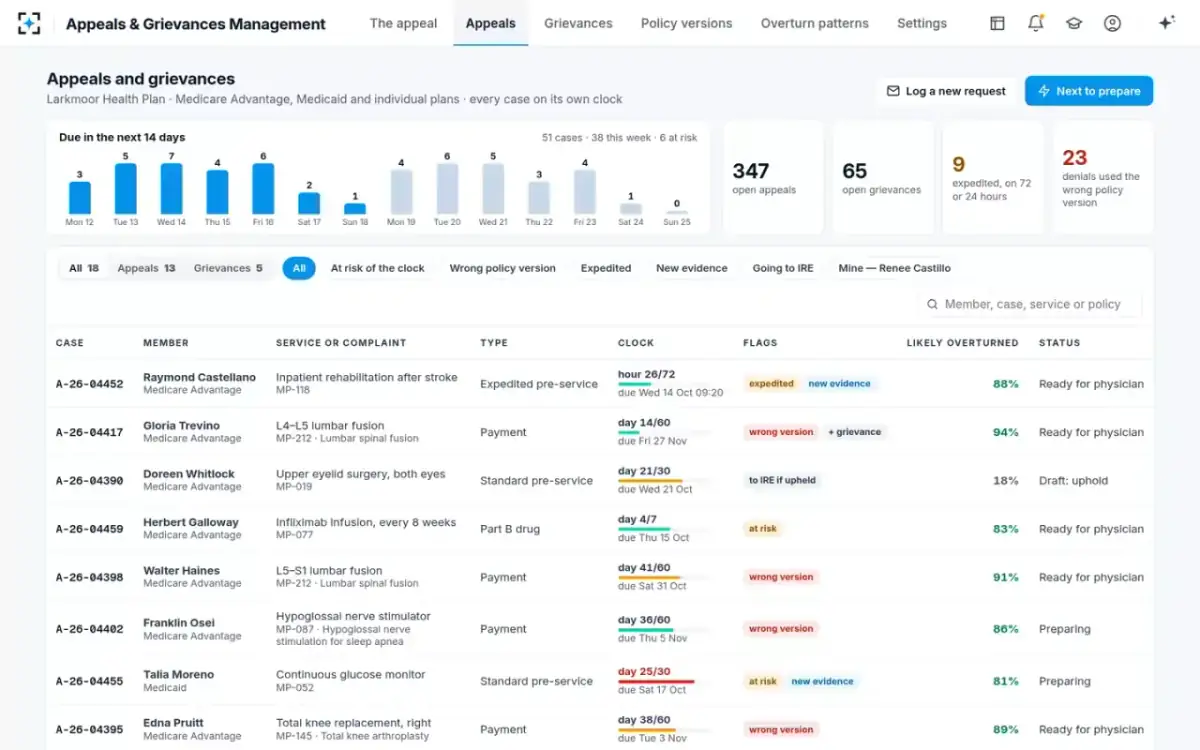
One queue for Medicare Advantage, Medicaid and other lines, each on its own clock
Where stand-alone workflows get integrated appeals wrong
Most errors come from running an integrated plan's cases through a Medicare Advantage or a Medicaid workflow built for something else. These are the checks we would run on any integrated plan's configuration.
Eight checks for an integrated appeals and grievances process
- Payment reconsiderations on 30 days, not 60
422.633(f)(1) sets one 30-day clock for all standard integrated reconsiderations.
- Extensions only with a reasonable likelihood of approval
The Medicare Advantage test, more evidence from a noncontract provider that may change the decision, is not the integrated one.
- Written acknowledgement of every request
422.629(g), on receipt; states may set a deadline.
- Oral inquiries logged as requests
422.633(d)(2) uses them to set the earliest filing date.
- Continuation of benefits tracked from the notice date
10 calendar days or the effective date, whichever is later (422.632).
- Upheld decisions notified to the enrollee
With the next level under each program and how to get help (422.633(f)(4)).
- Reviewers checked for reporting lines, not just involvement
No subordinate of anyone involved earlier may decide (422.629(k)).
- State contract terms loaded
422.629(c) lets states set more protective timeframes and notices.
The last check deserves emphasis. A state may "implement standards for timeframes or notice requirements that are more protective for the enrollee", and the plan's contract with the state must include them (422.629(c)). CMS's addendum gives the example of a state requiring integrated reconsiderations to be decided faster than the federal 30 days. Software that holds only the federal clocks will be compliant with the CFR and late under the contract.
Integrated grievances: same clock, broader filing window
Integrated grievances follow the Medicare Advantage pattern more closely than appeals do: 30 calendar days to resolve, a 14-day extension when justified, and 24 hours when the complaint is about an extension or a refusal to expedite (422.630). Two Medicaid features carry over. The enrollee may file "at any time", not within 60 days, and may file a grievance about a Medicaid benefit with the state if the state accepts them. If the plan extends a grievance, it must send written notice of the reason within 2 calendar days.
Decision-makers for integrated grievances must not have been involved earlier or be subordinate to anyone who was, and must have clinical expertise when the grievance is about a denial of expedited resolution or involves clinical issues. How to tell a grievance from an appeal applies unchanged; the clocks after the split are what differ.
Running one process for two programs: where the solution fits
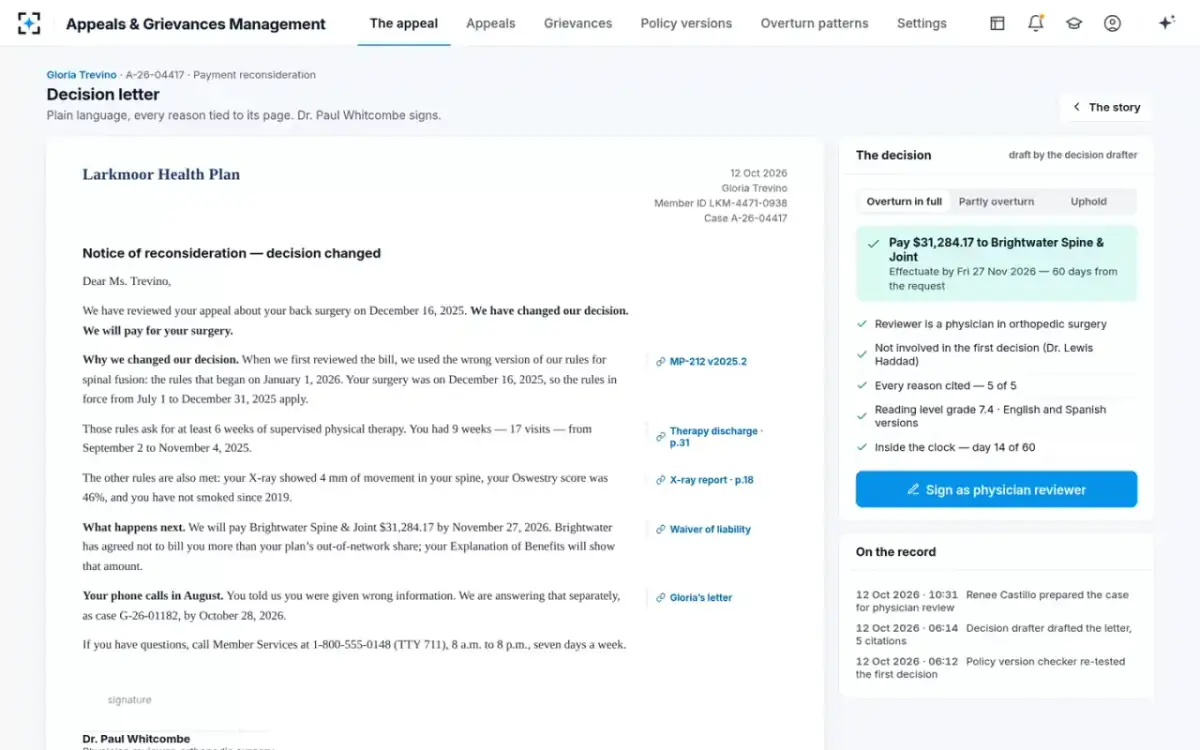
Appeals & Grievances Management treats clocks, notices and reviewer rules as settings by product line, versioned and audited, so an integrated plan's cases run on 422.633 rather than 422.590 without a separate system. The intake sorter logs oral requests the moment they are made, the clock keeper runs the 30-day clock for every integrated reconsideration and flags extensions that do not meet the integrated test, and the decision drafter writes a plain-language notice with the next level under each program for a person to approve.
A plain-language decision notice, every reason cited
What the solution does not do is decide which program a benefit belongs to when the state contract is ambiguous, or choose between conflicting decisions; the rule that favorable decisions bind is applied by people. To see the queue and clocks for a mixed book of business, start from Appeals & Grievances Management.
Questions people ask
Is a D-SNP an applicable integrated plan?
Only some are. Fully or highly integrated dual eligible special needs plans with exclusively aligned enrollment qualify, together with the affiliated Medicaid managed care organization, as do D-SNPs whose enrollment the state limits to members of an affiliated Medicaid plan meeting the coverage conditions in 422.561. Other D-SNPs run the ordinary Medicare Advantage process.
How many levels of plan appeal does an integrated plan have?
One. Under 422.633(a) an applicable integrated plan "may only have one level of integrated reconsideration for an enrollee". After it, Medicare benefits go to the independent review entity and Medicaid benefits to a state fair hearing.
Do integrated appeals cover Part D drugs?
No. Integrated appeals and grievances do not include Part D benefits, which follow the Part D coverage determination and redetermination rules in 42 CFR Part 423, as CMS's addendum for applicable integrated plans confirms.
What must an integrated plan's records show?
For every integrated grievance and appeal: a description of the reason, the date of receipt, the date of each review or review meeting, the resolution and its date at each level, the enrollee's name and the date the enrollee was notified (422.629(h)). The records must be accessible to the state and available to CMS on request.
Can an integrated plan dismiss a request?
Only for the reasons in 422.633(h): an improper party, an invalid request, a late filing without good cause, the death of the enrollee with no remaining financial interest, or a withdrawal. The dismissal notice must explain the right to ask the plan to vacate it and to have the independent entity review it.