Appeals and grievances software is the system a health plan uses to take every appeal and grievance from the request in, through review, to a decision, a letter and, where required, a forward to an independent reviewer, inside its regulatory clock and with every step recorded. Most products track cases well; what separates a project that works from one that stalls is whether the software can reach the inputs a decision depends on: the original prior authorization request or claim, the denial notice, the reviewer's notes, the medical records, the medical policy version that applied on the date of service, the true receipt time and the clock rules for each line of business. Botminds' Appeals & Grievances Management is an agentic case management solution that reads those inputs from the systems that hold them, rebuilds each appeal as a cited timeline and drafts the decision for a physician to sign. This guide is the list of what to bring.
Eight inputs to gather before any appeals and grievances software goes live
- Every intake channel, with its receipt time
Mail, fax, phone, portal and delegated vendors. The standard clock starts when any of them receives the request.
- The original determination file
The prior authorization request or claim, the denial notice and the first reviewer's notes, from the systems that hold them.
- The medical records, first and new
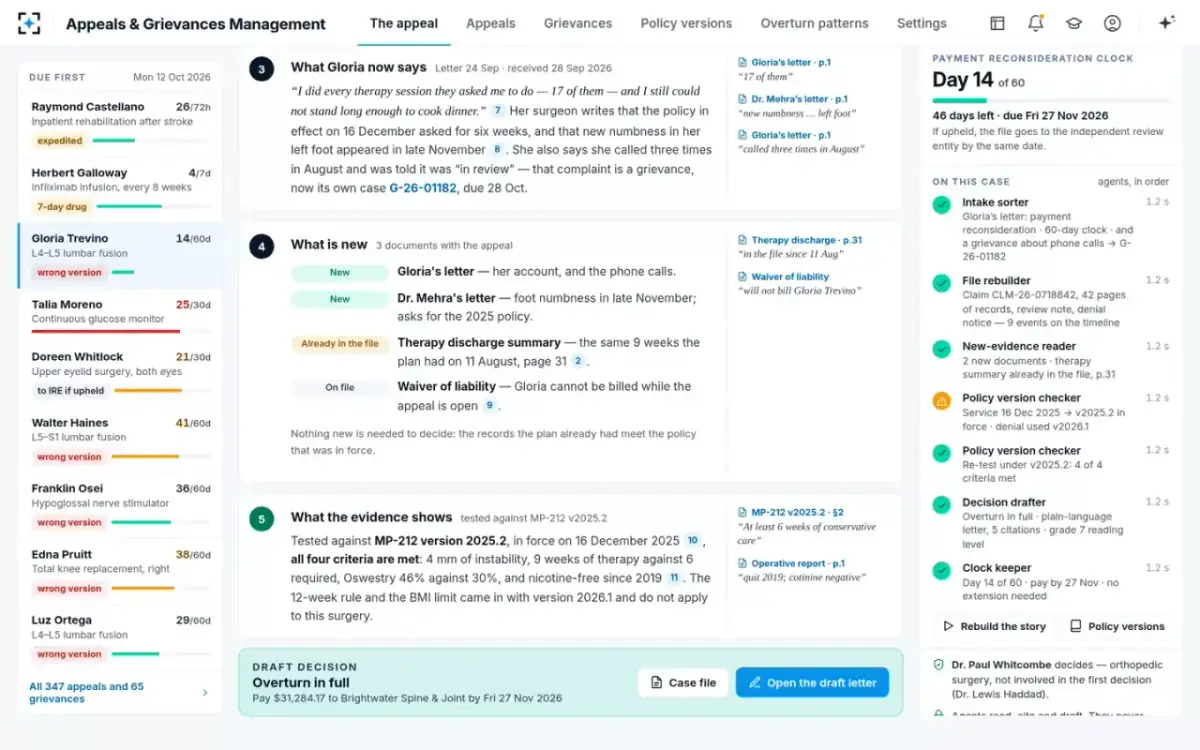
What the first reviewer saw, and what arrives with the appeal, with dates received.
- The medical policy library, every version
Each policy with its effective dates, not only the current text.
- Clock rules for each product line
Medicare Advantage, Part D, Medicaid by state contract, integrated plans, employer and individual plans.
- The physician reviewer roster
Fields of expertise, licences and who made each first decision.
- Letter and notice templates
Current model notices and state versions, in each language the plan supports.
- The forwarding path to independent review
For Medicare Advantage, the Part C independent review entity's submission method and case file contents.
What is appeals and grievances software?
It is case management software built around regulatory clocks. Each case is a request with a type, a receipt time, a deadline, a file, a decision-maker, a notice and, for upheld Medicare Advantage denials, a forward to the independent review entity. Grievances add their own requirement: a Medicare Advantage plan "must have an established process to track and maintain records on all grievances received both orally and in writing, including, at a minimum, the date of receipt, final disposition of the grievance, and the date that the MA organization notified the enrollee of the disposition" (42 CFR 422.564(g)).
The category ranges from tracking tools, which hold the case and its dates, to systems that also assemble the file and draft the letter. Botminds' solution sits at the second end: seven agents sort each letter into appeals and grievances, rebuild the original file, mark what is new, re-test the denial against the medical policy in force on the date of service, track every clock and draft a plain-language decision with every reason cited, and a physician reviewer who was not part of the first decision signs.
What should appeals and grievances software include?
At a minimum: classification of each contact as an appeal, grievance, coverage request or a mix; clocks by case type and product line, computed from the true receipt time; assembly of the original file; checks on who may decide; letters; forwarding to independent review; and the data a CMS auditor will ask for. Each maps to a rule. A Medicare Advantage plan must tell the enrollee promptly whether a complaint will be handled as a grievance or an appeal (422.564(b)). The reconsideration must be done by someone "not involved in making the organization determination", and by a physician for medical necessity (422.590(h)). Upheld cases go to the independent review entity with "a written explanation" and the case file.
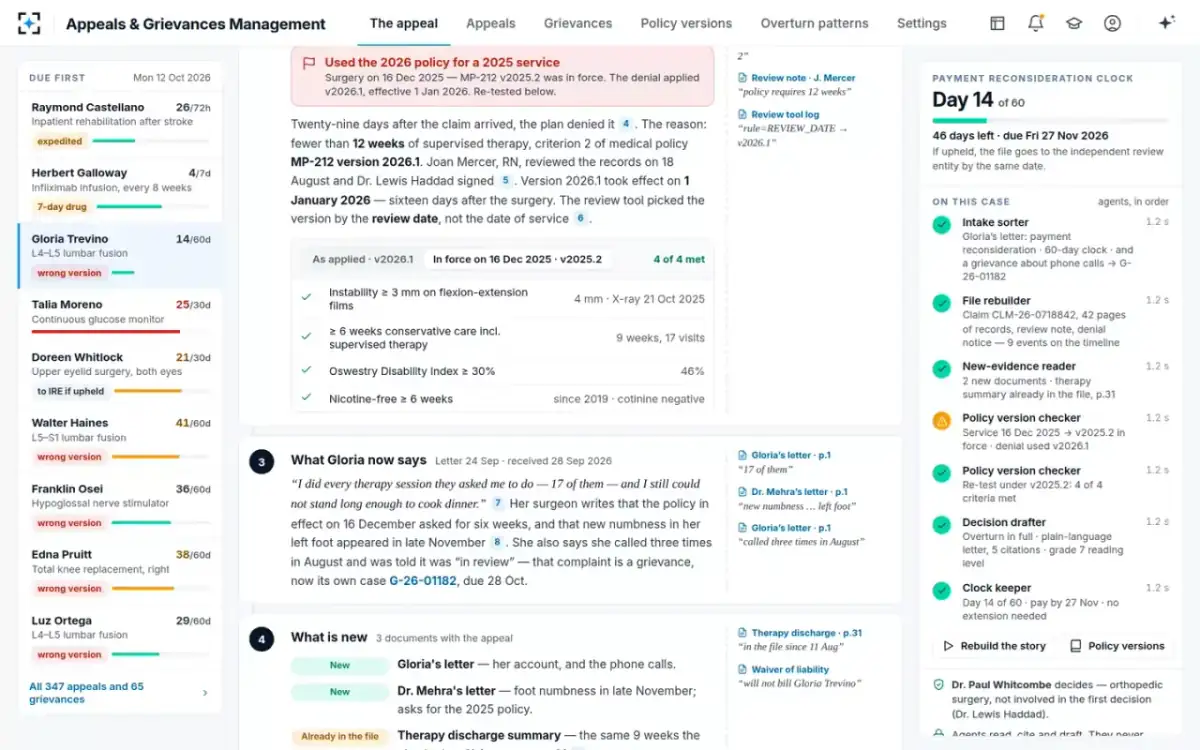
Two capabilities are worth asking about specifically because few systems have them. The first is version control on medical policies: the ability to show which version of a policy applied on a date of service and to re-test a denial against it. The rules require plans to keep their criteria current and reviewed: the utilization management committee must "at least annually, review the policies and procedures for all utilization management" (422.137), and internal coverage criteria must be published with their evidence (422.101(b)(6)). Each review produces a new version, and appeals arrive months after the service. The second is citation: whether each statement in a case summary or letter can be traced to the page it came from.
The case file, grouped by where each document came from
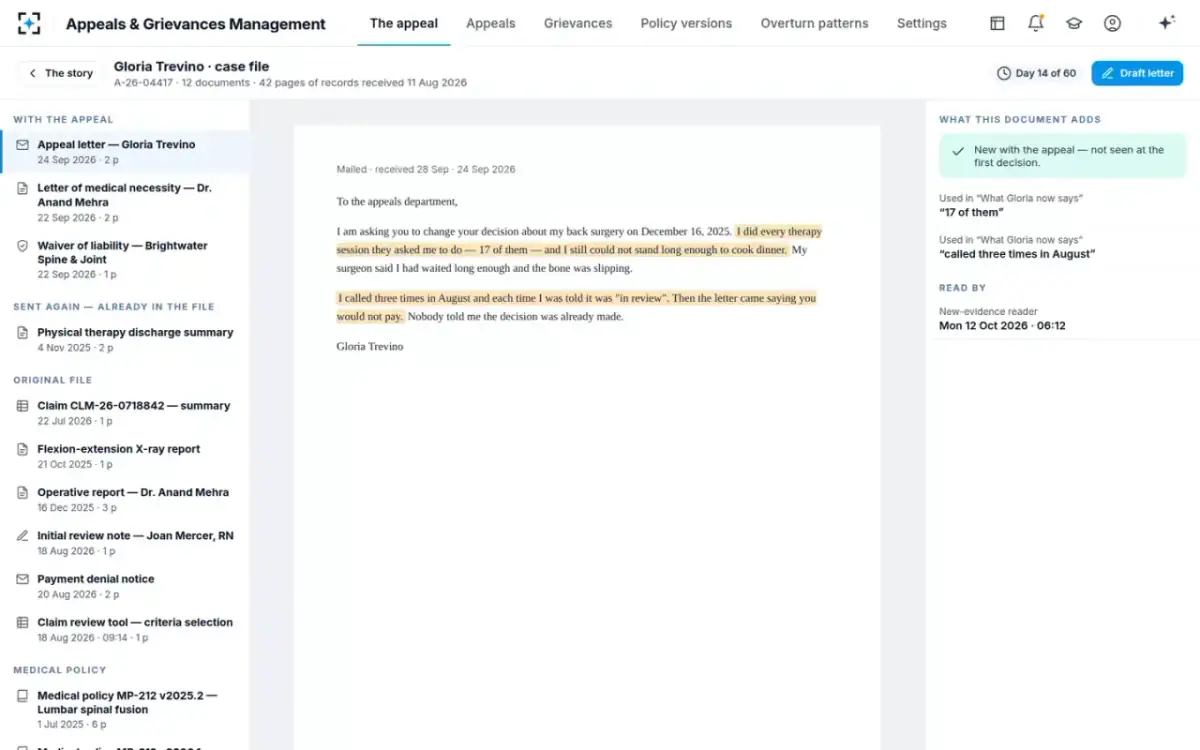
What data does appeals software need?
Enough to rebuild the case and enough to prove it was handled on time. The second list is set by CMS. For a Medicare Advantage program audit, the reconsideration universe asks, among other fields, for the delegated entity that processed the request, the authorization or claim number, the date and time the request was received (or upgraded to expedited), the date the plan received information establishing good cause "after the 65-day filing timeframe", the date and time any appointment of representative arrived, whether the request was processed as standard or expedited, whether an extension was taken, and the date and time of the determination and of each notification (CMS, revised Part C audit protocol, October 2026).
Every one of those fields is easier to capture on the day than to reconstruct a year later, and CMS sets the reconstruction deadline: universes are due "within 15 business days of the audit engagement letter date", and a submission that departs from the record layout is rejected. Software that captures the fields as the work happens turns a three-week scramble into an export. Integrated plans for dual-eligible members carry a parallel list in 422.629(h), including the date of each review and the date the plan notified the enrollee.
Criteria re-tested against the policy in force on the date of service
Does appeals and grievances software handle Medicaid and commercial?
It should, because most plans that run Medicare Advantage also run Medicaid, individual or employer business, and the clocks differ by more than a few days. The table shows the federal baseline for each line of business; states may tighten Medicaid timeframes, and state insurance law adds rules for insured commercial plans that software must hold as settings.
Appeal clocks the software must hold, by line of business (federal baseline, October 2026)
| Line of business | Plan-level appeal | Expedited | What follows an upheld denial |
|---|---|---|---|
| Medicare Advantage | 30 days for a service, 7 for a Part B drug, 60 for a payment | 72 hours | Automatic forward to the Part C independent review entity |
| Medicare Part D | 7 days for a drug, 14 for a payment | 72 hours | Enrollee may request review by the Part D independent review entity |
| Medicaid managed care | State-set, at most 30 calendar days; one level only | State-set, at most 72 hours | State fair hearing, requested within 90 to 120 days |
| Integrated dual plan | 30 calendar days, payments included | 72 hours | Medicare benefit: independent review entity. Medicaid benefit: state fair hearing |
| Employer group health plan (ERISA) | 30 days pre-service, 60 days post-service, for one appeal level | 72 hours | External review for non-grandfathered plans, then court |
| Individual and Marketplace plans | One internal level only, on the employer-plan clocks 45 CFR 147.136 incorporates | 72 hours for urgent care | External review: requested within 4 months, decided within 45 days |
Two rows are where configuration errors cluster. Integrated plans decide payment reconsiderations in 30 days, not Medicare Advantage's 60, and must send the enrollee written notice of an upheld decision. And employer plans live under the Department of Labor's claims procedure, in which a group health plan must give members at least 180 days after an adverse benefit determination to appeal it (29 CFR 2560.503-1(h)), with external review for non-grandfathered plans under 45 CFR 147.136. Disability claims under ERISA are a different discipline, with their own clocks, set out in the guide to the ERISA appeals process.
The gaps that stall appeals software projects
Projects rarely fail on the case screen. They stall on inputs nobody owned before the software asked for them. These are the seven we would look for first.
Seven gaps to close before go-live, and why each one matters
1Medical policies stored without their history
If the library holds only the current version, nobody can show which criteria applied on a past date of service, and every re-test becomes an argument.
2Receipt times lost at delegated vendors
A standard clock starts when any delegated entity receives the request. A mailroom or vendor that stamps the date but passes on only a scan resets nothing and hides days.
3The original determination split across systems
The prior authorization request sits in the utilization management system, the claim and denial in claims, the reviewer's notes in a third place. Software that cannot reach all three rebuilds nothing.
4A reviewer list without involvement history
The rule bars anyone involved in the first decision from the reconsideration. Without knowing who made each first decision, the system cannot check.
5Letter templates in many versions
Model notices change. CMS's 2025 audits found a new appeal timeframe applied inconsistently across systems and vendors.
6State Medicaid terms kept in a contract PDF
Medicaid timeframes are state-set within federal ceilings. Until they are written as rules, the software runs on the federal maximum.
7No clean list of open cases at cutover
Every open case must arrive with its true receipt time and clock. Migrating open cases without them creates late cases on day one.
The first gap is the most common and the most expensive. A plan that updates a medical policy on 1 January and keeps only the new text cannot test a December service against the criteria that applied to it, and claims for services delivered late in one year routinely arrive early in the next. The fourth gap matters for Medicaid too: there, the decision-maker must not have been involved in the earlier decision "nor a subordinate of any such individual", which software can only check if it knows the reporting lines.
How do you implement appeals and grievances software?
Start with closed cases, not open ones. Load a year of decided appeals, rebuild them in the new system and compare what it produces with what actually happened: the clocks, the files, the classification, the decision and the letter. That replay tests every input on the list against real cases before any member depends on it, and its findings, such as the share of overturns that turned on evidence already in the file, are usually the first useful output of the project. How the work divides between agents and people covers the design questions the replay will raise.
Then go live one product line at a time, on new cases only, with the old process running for cases already open. The order that usually works is the one with the clearest federal rules first, Medicare Advantage, then Medicaid by state contract, then commercial. Before each go-live, run the audit export and check every field against the CMS record layout; how a CMS ODAG audit samples cases shows what the auditors will do with it.
Who has to be in the room for appeals software to go live
Today
Owns the timeliness and the audit results, but not the systems the files come from.
With agents
Writes the plan's clock rules, classification rules and letters down once, as settings the whole team works to.
Still theirs: Every rule change, and the go-live decision for each product line.
Today
Receive one-off requests for copies of files, case by case.
With agents
Provide read access to the original requests, claims, denial notices and reviewer notes.
Still theirs: The systems of record; the appeals software reads, never edits.
Today
Publishes the current version of each policy.
With agents
Supplies every version with its effective dates, so each denial can be tested against the one in force.
Still theirs: Every policy and criterion; agents never change one.
Today
Rebuilds audit universes from logs after the engagement letter arrives.
With agents
Checks the fields CMS asks for are captured on every case from the start.
Still theirs: The interpretation of each rule, and the sign-off on templates.
Today
Assigns reviewers by availability.
With agents
Maintains the roster of reviewers, their fields of expertise and their first-decision history.
Still theirs: Who may sign which cases.
How long does it take to implement an appeals system?
No independent benchmark exists, and any vendor's figure depends on the inputs above. The honest answer is that the time goes into the gaps, not the configuration: a plan whose policy library already holds every version with effective dates, whose delegated vendors pass receipt times, and whose reviewer roster records first-decision history can be running on closed cases quickly; a plan that must build those first is running a data project with an appeals screen at the end.
A useful way to scope it is to ask, for each of the eight inputs, who owns it today, where it lives, and whether it can be read automatically. The answers sort the project into connections that already exist, data that needs cleaning, and decisions nobody has made, such as which policy version applies to a late claim. Only the third kind delays a go-live indefinitely.
What is new with the appeal, and what was already in the file
What are the best appeals and grievances systems?
The best system for a plan is the one that can reach its inputs and prove its clocks, and that is a test you can run rather than a ranking you can read. Ask each vendor to load ten of your closed appeals, including a mixed appeal-and-grievance letter, a payment case, a Medicaid case and one decided under a policy that has since changed, and show you the clock, the file, the classification, the letter and the audit export for each. The differences show up in an afternoon.
Appeals & Grievances Management fits a plan that already has claims, utilization management and medical policy systems and wants its appeals team to stop rebuilding files by hand. It does not replace those systems or make the medical necessity decision; it reads, cites and drafts, and a named person decides every case. It is not a member portal or a provider dispute tool, and an insurer's complaints to a state insurance department are a separate process. The decisions to make before choosing any tool come first, and to see the solution on a sample of your own decided appeals, start from Appeals & Grievances Management.
Questions people ask
How do you choose appeals and grievances software?
Test it on your own closed cases. Ten decided appeals, chosen to include a payment case, a Medicaid case, a mixed appeal-and-grievance letter and one decided under a policy that has since changed, will show whether the system can reach your files, compute your clocks and produce the fields CMS asks for within 15 business days of an audit engagement letter.
Does appeals software need to integrate with the claims system?
It needs to read from it. Payment reconsiderations turn on the claim, the edits applied and the denial notice, and the original determination for a service lives in the utilization management system. Software that cannot read both makes someone rebuild the file by hand, which is where most of a reconsideration's days go.
What records must a plan keep on grievances?
For Medicare Advantage, at a minimum the date of receipt, the final disposition and the date the plan notified the enrollee, for every grievance received orally or in writing (42 CFR 422.564(g)). CMS's guidance adds that grievances should be logged in a centralized location, with calls, correspondence and case notes.
Can appeals software handle a grievance hidden in an appeal letter?
It should, because CMS requires each issue to be processed separately and simultaneously under the appropriate procedure. In Appeals & Grievances Management the intake sorter splits the grievance into its own case with its own clock and quotes the sentence it relied on.
Is appeals and grievances software the same as complaint management software?
No. Health plan appeals and grievances follow federal program rules with fixed clocks and an independent review step. Complaints an insurer receives through a state insurance department follow state rules and timelines, which Botminds' Insurance Complaint Management covers, starting with the department of insurance complaint response timeline.