A Medicare Advantage appeal at the plan, called a reconsideration, takes at most 72 hours when it is expedited, 7 calendar days for a Part B drug, 30 calendar days for a service not yet provided (up to 14 more in limited cases) and 60 calendar days for a payment. If the plan upholds its denial, or misses its deadline, the case goes automatically to the independent review entity, which works to the same timeframes, and beyond that come a judge, the Medicare Appeals Council and federal court. For a health plan's appeals team every one of those clocks is a liability: a late case is treated as if the plan had upheld its own denial, leaves the plan's hands for the independent reviewer, and counts against the plan in its Star Ratings. Botminds' Appeals & Grievances Management is an agentic case management solution that computes every case's remaining time each hour, warns the owner and forwards upheld cases before the deadline.
The clocks below are from 42 CFR Part 422 (Medicare Advantage), Part 423 (Part D) and Part 438 (Medicaid managed care) as current on eCFR in October 2026, CMS's appeals guidance effective 6 July 2026 and CMS's independent review entity data. Examples are illustrative and the screens show a fictional sample health plan.
How long does a Medicare Advantage appeal take at the plan? Each clock drawn to scale
- Decide7 d
- Decide30 d
- Extension, listed reasons only+14 d
- Decide, or pay60 d
- Respond30 d
- Extension+14 d
How long does a Medicare Advantage appeal take?
The plan's reconsideration is the first level and the one a plan controls. Under 42 CFR 422.590, a standard reconsideration of a service or item must be decided "as expeditiously as the enrollee's health condition requires, but no later than 30 calendar days from the date it receives the request". A Part B drug has 7 calendar days, which "may not be extended". A payment has 60 calendar days. An expedited reconsideration has 72 hours, and if the plan upholds an expedited denial it must send the case file to the independent review entity "not later than within 24 hours of its affirmation".
Extensions exist only for services and items, and only for three reasons: the enrollee asks for one; it is "justified and in the enrollee's interest due to the need for additional medical evidence from a noncontract provider that may change an MA organization's decision to deny"; or it is justified by "extraordinary, exigent or other non-routine circumstances" and in the enrollee's interest (422.590(f)). The plan must tell the enrollee in writing why, and that they may file an expedited grievance about it. There is no extension for a payment or a Part B drug.
For members of a Part D plan, prescription drug redeterminations run on their own clock under 42 CFR 423.590: 7 calendar days for a standard request, 72 hours expedited and 14 calendar days for a payment. Integrated plans for dual-eligible members, and Medicaid managed care plans, use different clocks again, covered below.
How long do you have to file a Medicare appeal?
A member or other party has 60 calendar days to ask a Medicare Advantage plan for a reconsideration, counted from the day they receive the plan's written decision, and receipt is presumed to be 5 calendar days after the date on the notice unless there is evidence otherwise (422.582(b)). In practice that gives 65 days from the date printed on the denial, which is why CMS now describes the window as 65 days. The request counts as filed on the date the plan, or the delegated entity named in the notice, receives it, and a plan may extend the window for good cause.
For an appeals team the filing window matters because it decides which late requests must still be accepted. A request that arrives on day 63 after the notice date is on time under the presumption, and a dismissal for late filing in that case would be wrong. CMS's 2025 audits found exactly that risk: the change to a 65-day window was not applied consistently across plans' systems and delegated entities.
When the clock starts, and how the days are counted
The clock starts when anyone in the plan receives the request, not when the appeals team opens the case. For standard requests, CMS's guidance says the processing timeframe begins when "the plan, any unit in the plan, or a delegated entity (including a delegated entity that is not responsible for processing) receives a request"; for expedited requests, when the appropriate department receives it (CMS appeals guidance, §10.5.2). Plans must be able to accept requests 24 hours a day, seven days a week, including holidays.
The counting is calendar days, weekends and holidays included, and the day of receipt is not day one: "'Day one' is the day after receipt of the request." Hour-based clocks run hour for hour. So a standard reconsideration received on Friday 2 October 2026 has day one on Saturday 3 October and its 30th day on Sunday 1 November; there is no rolling forward to Monday. An expedited request received at 4:40 pm on a Friday is due at 4:40 pm on Monday.
Delivery has its own rule. Written notice counts as delivered when it leaves the plan's or vendor's possession, in the outgoing mail or sent electronically; "Placement into the plan or delegated entity's internal outgoing mail receptacle is not considered delivered." A decision made on day 30 and mailed on day 31 is late.
What happens if a plan misses the appeal deadline?
The plan loses the case at its own level and must send it on. Missing a standard reconsideration deadline "constitutes an affirmation of its adverse organization determination", and the plan must submit the file to the independent review entity (422.590(d)); missing an expedited deadline does the same, with 24 hours to forward the file (422.590(g)). CMS's guidance adds that the plan does not have to send the member an adverse notice, because the independent review entity will contact them, and that when a plan reaches a fully favorable decision within 24 hours after the deadline it should consider effectuating it rather than forwarding the case.
If CMS determines that the plan has a pattern of not processing level 1 appeals within the required timeframes, the plan may be considered to be out of compliance with the terms of its Medicare contract and/or subject to intermediate sanctions.
CMS, Parts C & D Enrollee Grievances, Organization/Coverage Determinations, and Appeals Guidance, §50.7.2
Three costs follow from one late case. The member waits longer, because the independent review entity starts its own clock. The plan spends staff time preparing a file for a review it may have avoided, often for a case it would have overturned itself. And the late case counts against the plan in its Star Ratings and in any program audit sample that covers the period, which is where the cost of a late day becomes a number.
What each late day costs: the Star Ratings arithmetic
The clearest price is in CMS's Star Ratings measure C30, "Plan Makes Timely Decisions about Appeals". It is the share of a plan's appeals reviewed by the independent review entity that the plan sent on time, and it carries a weight of 2. For the 2027 Star Ratings, based on 2025 appeals, the cut points were stark: five stars for 100%, four for 98% to under 100%, three for 95% to under 98%, two for 79% to under 95%, and one below 79% (CMS, 2027 Star Ratings Technical Notes).
How few late cases it takes to lose a star on timely appeals
The arithmetic shows why the first late case matters most: it costs the fifth star outright, on a measure weighted twice. It also shows why a team that tracks timeliness as an average misses the point. Nine late cases in a year, perhaps one bad week of mail backlog, move a 400-case contract from four stars to three. CMS also checks the completeness of the data the independent review entity holds against what plans report, and applies reductions of one to four stars where cases that should have been forwarded are missing.
How long does the independent review entity take?
The independent review entity must decide "as quickly as the enrollee's health requires, but no later than" 72 hours for expedited requests, 30 calendar days for standard pre-service requests, 7 calendar days for standard Part B drug requests and 60 calendar days for payment requests, with up to 14 more days in limited cases and none for Part B drugs (CMS, Reconsideration by Part C Independent Review Entity). Since 1 May 2026 the Part C entity has been C2C Innovative Solutions, replacing Maximus Federal Services for requests received from that date.
CMS's own data show how it performs. In the second quarter of 2026, 93.11% of expedited cases were decided in three days or less, 96.49% of standard pre-service cases in 8 to 30 days and 97.87% of payment (retrospective) cases in 30 to 60 days. Overall timeliness was 99.86% in April 2026, then 94.86% in May and 93.48% in June, the first two months after the contract changed hands (CMS Part C reconsideration appeals data, Q2 2026).
When the independent reviewer reverses the plan, a second clock starts for the plan. It must authorize a service within 72 hours of the notice, or provide it as fast as the enrollee's health requires and within 14 calendar days; pay within 30 calendar days; and authorize or provide a Part B drug within 72 hours (422.618(b)). Reversals at the hearing level or higher must be effectuated within 60 calendar days of the notice.
The whole Medicare Advantage appeal, level by level, with its clock
| Level | Who decides | Time to ask | Time to decide |
|---|---|---|---|
| 1. Reconsideration | The plan, by someone not involved in the denial; a physician for medical necessity | 60 days from receipt of the plan's notice (presumed 5 days after its date) | 72 hours, 7, 30 or 60 days by case type |
| 2. Independent review | The Part C independent review entity (C2C Innovative Solutions from 1 May 2026) | None: upheld or late cases are forwarded automatically | 72 hours, 7, 30 or 60 days by case type |
| 3. Hearing | An administrative law judge or attorney adjudicator at HHS's Office of Medicare Hearings and Appeals | 60 days from receipt of the independent reviewer's notice; at least $200 in controversy in 2026 | Set by Part 405 procedures |
| 4. Medicare Appeals Council | The Council, at HHS's Departmental Appeals Board | Any party, including the plan, after the hearing decision | 90 days for the Council's review of a hearing decision under Part 405 |
| 5. Federal court | A U.S. district court | After the Council; at least $1,960 in controversy in 2026 | No regulatory deadline |
Original Medicare runs a different first two levels: a redetermination by the Medicare Administrative Contractor, which CMS's provider guidance says generally decides within 60 days, and a reconsideration by a qualified independent contractor, also generally within 60 days, before the same hearing, Council and court levels (CMS, Medicare Parts A & B Appeals Process, October 2018). The five levels of Medicare appeals sets out which path applies to which member.
How long does an expedited appeal take?
Seventy-two hours from receipt, with two complications. The plan can extend an expedited reconsideration of a service by up to 14 days for the listed reasons, which turns a three-day appeal into one of up to seventeen; CMS's audit protocol tests expedited cases against exactly that, "72 hours (17 days with extension)". And the decision to expedite is itself a decision: if a physician says the standard timeframe could seriously jeopardize the enrollee's life, health or ability to regain maximum function, the plan must expedite; if the enrollee asks alone, the plan decides, and a refusal moves the case to the standard clock from the day the request arrived, with a written letter within 3 calendar days and a right to an expedited grievance (422.584).
Expedited cases also carry a records rule that is easy to miss. If the plan needs information from a provider outside its network, it must ask "within 24 hours of the initial request" and remains responsible for the deadline whether or not the records arrive (422.590(e)(4)). Requests for payment of services already furnished cannot be expedited.
Every case on its own clock, earliest deadline first
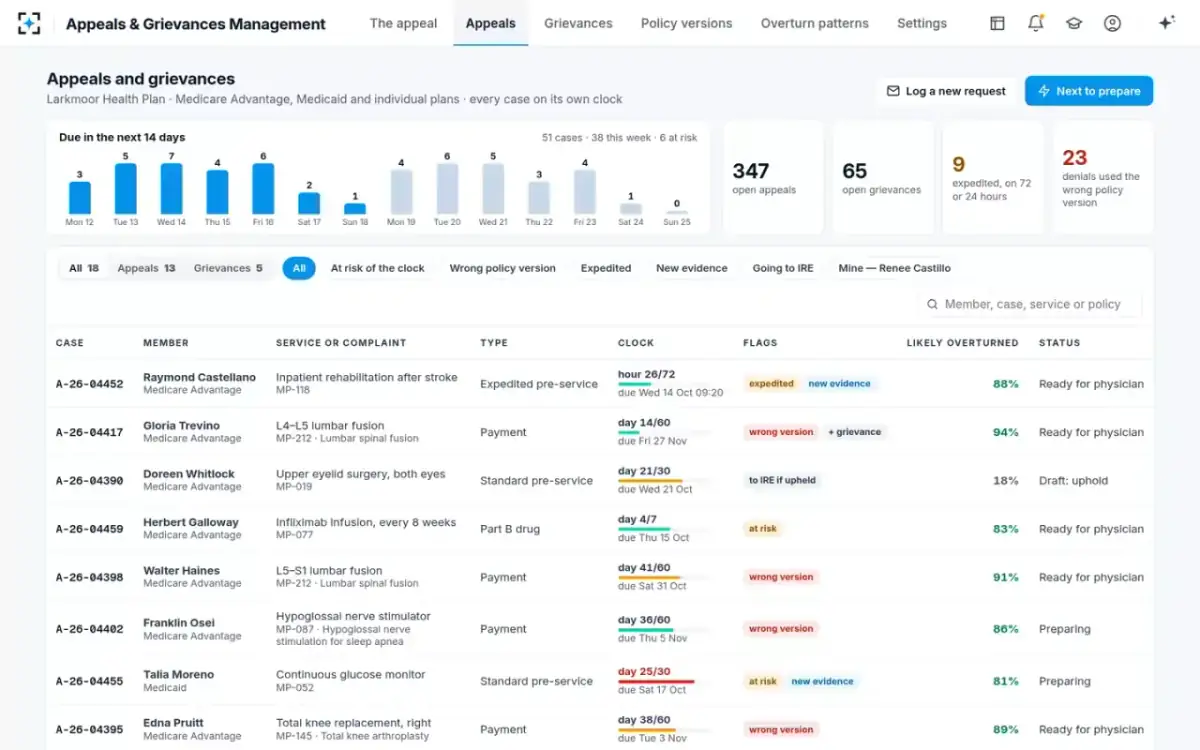
How long does a Medicaid managed care appeal take?
At most 30 calendar days for a standard appeal and 72 hours for an expedited one, and often less, because the state sets the timeframe within those ceilings (42 CFR 438.408). The plan may extend by up to 14 days if the enrollee asks or if it shows the state a need for more information that is in the enrollee's interest; when it extends on its own initiative it must give written notice of the reason within 2 calendar days. Grievances may take up to 90 days at the federal ceiling.
The member has 60 calendar days from the date on the adverse benefit determination notice to appeal to the plan, and only one level of plan appeal is allowed (438.402). Missing the plan's deadline does not send the case to an independent reviewer as in Medicare Advantage; instead the enrollee "is deemed to have exhausted" the plan's process and may go straight to a state fair hearing, which they may request within 90 to 120 days of the plan's notice, depending on the state. Integrated plans for dual-eligible members combine the two programs on one 30-day clock.
Keeping every clock: where Appeals & Grievances Management fits
A clock is only as reliable as the receipt time it starts from and the rule it applies. In the solution, the intake sorter sets the case type and starts the clock from the earliest receipt time in the file, including mail received by delegated entities. The clock keeper recomputes every case's remaining time each hour, warns the owner, proposes extensions only for the listed reasons and forwards upheld cases to the independent review entity before the deadline: 12 hours before it in the sample configuration, 4 hours for expedited cases.
The plan's clocks, written down once and versioned
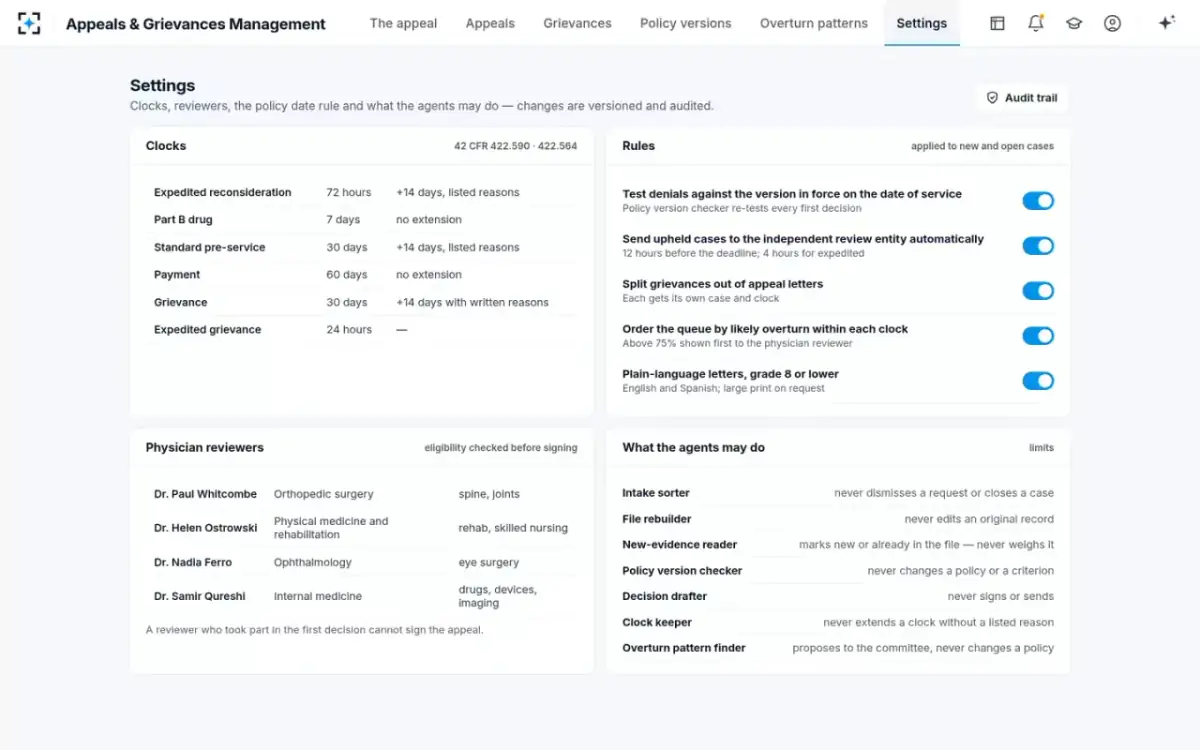
The agents never extend a clock without a listed reason and never send anything; a named person does. On the sample plan, 97.6% of reconsiderations were decided inside the clock, and the design target is all of them. How a CMS audit tests those clocks shows what an auditor does with the same data. To see the queue with live clocks, start from Appeals & Grievances Management.
Questions people ask
What is the deadline for a Medicare Advantage reconsideration?
For the plan, 30 calendar days for a standard request about a service (plus up to 14 for listed reasons), 7 for a Part B drug, 60 for a payment and 72 hours expedited, under 42 CFR 422.590. For the member, the request must be filed within 60 days of receiving the denial, presumed to be 5 days after the notice date.
Can a Medicare Advantage plan extend a payment appeal?
No. The 14-day extension in 422.590(f) applies only to requests for a service or item; payment reconsiderations have a fixed 60 calendar days, and Part B drug reconsiderations a fixed 7 days. A plan waiting for records on a payment case simply loses time.
How long does the Medicare Appeals Council take?
Under 42 CFR 405.1100 the Council issues its decision on review of a hearing decision within 90 calendar days of the request, or 180 days for a case escalated from the hearing level, unless the period is extended. Those Part 405 rules apply to Medicare Advantage cases to the extent appropriate.
Does a weekend or holiday extend a Medicare appeal deadline?
No. CMS counts calendar days, including weekends and holidays, starting the day after receipt. A 30-day deadline that lands on a Sunday is due that Sunday, and plans must be able to receive requests 24 hours a day, seven days a week.
How long does a Part D appeal take?
A Part D redetermination by the plan must be decided within 7 calendar days for a standard drug request, 72 hours when expedited and 14 calendar days for a payment request, under 42 CFR 423.590. Part D timeframes cannot be extended.