AI appeals automation, done properly, automates the work around an appeal decision and not the decision itself. A Medicare Advantage or Medicaid appeal involves logging the request, classifying it, starting its clock, rebuilding the original file, reading the new evidence, checking the medical policy, drafting the letter, deciding, signing, effectuating and, for upheld denials, forwarding the case to an independent reviewer. Federal rules reserve the medical necessity decision for a physician who took no part in the first denial; almost everything else is reading, sorting and drafting that software agents can do and a person can check. Botminds' Appeals & Grievances Management is built on that split: seven agents rebuild each appeal as a cited story and re-test the denial against the medical policy in force on the date of service, and a physician reviewer decides and signs.
This page is for appeals and grievances directors weighing automation. It draws on the Medicare Advantage and Medicaid regulations as current in October 2026, CMS's appeals guidance and a 2026 systematic review of AI in prior authorization. Product figures are Botminds' estimates or design targets, labelled as such, and the screens show the solution running on a fictional sample health plan.
Where a payment appeal's working days go, and how much of what remains is the physician's
Assembled by hand · about 11 working days (Botminds estimate)
- Logging and clock · 9%
- Rebuilding the file · 27%
- New vs already in file · 9%
- Policy check · 18%
- Drafting the letter · 18%
- Physician review and signature · 19%
With the agents · about 2.3 working days (estimate)
- Logging, file and new evidence · 13%
- Policy check · 22%
- Drafting · 22%
- Physician review and signature · 43%
Can AI automate health plan appeals?
AI can automate most of the steps in a health plan appeal, but not the decision in a medical necessity case, and a responsible design does not try. The regulation is direct. A reconsideration must be conducted by "a person or persons who were not involved in making the organization determination", and when the issue is a denial for lack of medical necessity, "the reconsidered determination must be made by a physician with expertise in the field of medicine that is appropriate for the services at issue" (42 CFR 422.590(h)). Medicaid managed care requires decision-makers who were "neither involved in any previous level of review or decision-making nor a subordinate of any such individual", with appropriate clinical expertise where the issue is clinical (438.406(b)(2)). Integrated plans for dual-eligible members carry the same requirement in 422.629(k).
So the useful question is not whether AI can decide appeals but how much of the work around the decision it can take, and with what controls. In the estimate above, the physician's day or two barely moves. What disappears is the days spent finding the original file, sorting it and typing a letter, which is why the physician's share of the remaining time more than doubles.
The dozen tasks inside one appeal, and who owns each
Laid out task by task, an appeal splits into reading and arithmetic that an agent can do and check-able, and judgement and accountability that stay with people. The line is not where most vendors draw it. Classifying a letter is reading, but deciding to dismiss it is accountability. Drafting a letter is drafting, but deciding to send it is a decision.
Twelve appeal tasks: what an agent can do, and what stays with a person
What an agent can do: Read the envelope date, fax report or portal time stamp and fix the receipt time.
What stays with a person, and why: Nothing, beyond checking exceptions such as mail received by a delegated vendor.
What an agent can do: Propose appeal, grievance, coverage request or a mix, quoting the sentence behind each.
What stays with a person, and why: Confirming the borderline cases; the plan must tell the member which process applies.
What an agent can do: Set the case type and deadline from the product, the item and the receipt time.
What stays with a person, and why: Any extension: only for reasons the rule lists, with a written notice.
What an agent can do: Match the requester to the enrollee, a representative form or a provider waiver.
What stays with a person, and why: Any dismissal, and the dismissal notice.
What an agent can do: Flag a physician's statement that delay could seriously jeopardize health; that request must be expedited.
What stays with a person, and why: An enrollee's unsupported request, which the plan judges.
What an agent can do: Send the request within hours, as the 24-hour rule for expedited cases requires.
What stays with a person, and why: Calls to a provider that has not answered.
What an agent can do: Pull the claim or request, notice, reviewer notes and records into one timeline with page citations.
What stays with a person, and why: Nothing, if the sources are complete; the nurse checks.
What an agent can do: Mark each point new or already in the file, citing both pages.
What stays with a person, and why: What the evidence means clinically.
What an agent can do: Find the version in force on the date of service and test each criterion with a citation.
What stays with a person, and why: Whether a criterion is met when the records are ambiguous.
What an agent can do: Nothing.
What stays with a person, and why: A physician with appropriate expertise who was not involved in the first decision.
What an agent can do: Write it in plain language, every reason tied to its page.
What stays with a person, and why: Editing and approving it.
What an agent can do: Prepare the case file and warn before the forwarding deadline.
What stays with a person, and why: The signature, the notice and the effectuation.
Does a physician have to decide an appeal?
A physician has to decide a Medicare Advantage appeal of a medical necessity denial, and the physician must have expertise appropriate to the service and must not have been involved in the first decision. Appeals that turn on something other than medical necessity, such as cost sharing or a benefit exclusion, need only someone who was not involved in the first decision. The physician "need not, in all cases, be of the same specialty or subspecialty as the treating physician", CMS's rule adds; CMS's guidance explains that where a reviewer is not of the same specialty, they "must have the appropriate level of training and expertise to evaluate the necessity" of the service (CMS appeals guidance, §50.6).
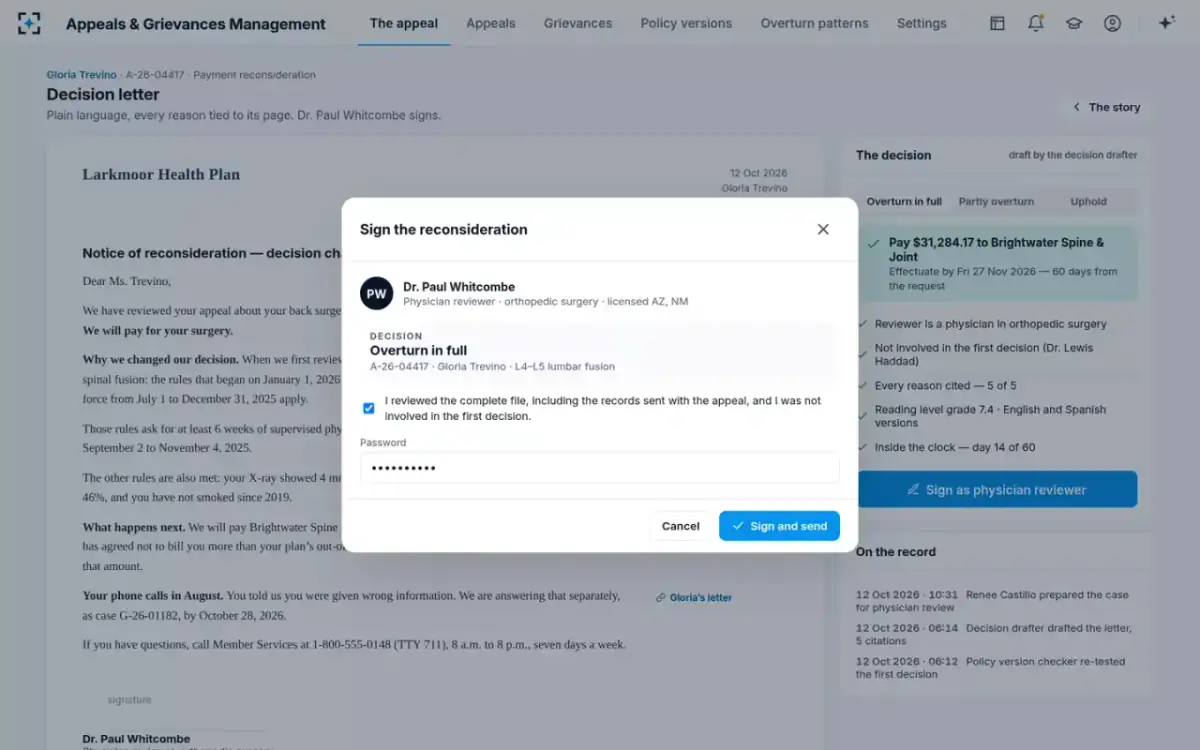
That rule shapes what an AI system may do. It may prepare the case so the physician decides faster and with the complete file, and it may check the physician's eligibility before a signature is accepted. It may not produce a decision the physician merely countersigns. In Appeals & Grievances Management the sign button does not work until the solution has checked that the reviewer is a physician with relevant expertise and was not involved in the first decision, and the reviewer must confirm having read the complete file.
The physician signs only after the eligibility checks pass
What the federal rules say about AI in coverage decisions
As of October 2026 there is no federal regulation written specifically about AI in Medicare Advantage coverage or appeal decisions. CMS proposed guardrails for AI and chose not to finalize them. In the 2026 Medicare Advantage final rule it dropped its proposed AI guardrails and said only that it would keep considering whether future rulemaking is appropriate (90 FR 15792, 15 April 2025). The guide to the WISeR model for prior authorization quotes that passage and shows where CMS drew the line when it did put technology into Medicare's own reviews.
The rules that bind are the ones about how any decision is made. A Medicare Advantage plan must base medical necessity determinations on, among other things, the enrollee's own history, physician recommendations and clinical notes (422.101(c)(1)(i); the guide to medical necessity review shows what that means criterion by criterion), and may not deny basic benefits on criteria the regulation does not allow. A tool that scores a case from a summary, or a model that predicts the outcome without reading the record, cannot satisfy that on its own. A tool that reads the whole record and cites where each point came from helps the physician satisfy it.
State law adds to this in some states, and the rules on AI in insurance are moving quickly. A plan buying automation should ask its compliance team which state rules apply to each line of business before the design is fixed, and should expect the answer to change.
What the evidence on AI in appeals shows, and does not
The published evidence is thin. A 2026 systematic review of AI in prior authorization opens with its sample: "Of 3,417 records, 16 studies met eligibility criteria." It found AI use was concentrated in payer review and decision-making, with post-denial appeals the subject of 18.8% of the studies. Its conclusion is the one a buyer should keep in mind: most studies reported model accuracy scores, and few showed faster decisions, fewer denials or lower cost (Journal of Managed Care & Specialty Pharmacy, September 2026). An appeals team can run the measurement the studies lacked on its own closed cases, much as the prior authorization automation pilot does for first decisions.
Two things follow. First, a vendor's accuracy figure says little about whether appeals get decided sooner or more correctly; ask for operational measures on your own closed cases. Second, the strongest case for automation in appeals is not prediction but assembly: the reading and citing that a nurse and coordinator do today, where the output can be checked line by line against the source. Replaying last year's overturned appeals is the cheapest way to test that on your own data before buying anything.
Seven agents and two people: who touches an appeal in Appeals & Grievances Management
Agent
Intake sorterReads each letter, call note and portal message; separates appeal from grievance; sets the case type and starts each clock, quoting the sentence it relied on.
Never: Dismisses a request or closes a case
Agent
File rebuilderPulls the claim or prior authorization request, the denial notice, the first reviewer's notes and the records into one timeline, each event tied to its source page.
Never: Edits an original document
Agent
New-evidence readerCompares each document sent with the appeal against the original file and marks each point new or already in the file, citing both pages.
Never: Weighs the evidence for the decision
Agent
Policy version checkerFinds the medical policy version in force on the date of service and re-tests the first decision criterion by criterion.
Never: Changes a policy or a criterion
A person decides
Appeals nurseChecks the rebuilt case and the new-evidence marks, asks for anything missing, and prepares the case for the physician.
Agent
Decision drafterDrafts the decision letter in plain language, each reason tied to its criterion and page; for upheld cases, the explanation for the independent review entity.
Never: Signs or sends
A person decides
Physician reviewerNot involved in the first decision; reads the case and the draft, changes what needs changing, and decides. The sign button works only after that eligibility is checked.
Agent
Clock keeperTracks every clock hourly, warns the owner, and forwards upheld cases to the independent review entity before the deadline.
Never: Extends a clock without a listed reason
Can AI write an appeal decision letter?
AI can draft an appeal decision letter, and a good draft saves more time than any other single step, but a person must approve and send it. What the letter has to say depends on the outcome and the program. For a favorable Medicare Advantage decision on a service, CMS's guidance requires written notice that explains "the conditions of the approval", including its duration and limitations. For a partly favorable or adverse decision, the plan does not send the member a denial; it sends "a copy of the complete case file with a written explanation" to the independent review entity (§50.10.1). In Medicaid managed care and integrated plans, an adverse notice must also explain the next level of appeal, such as a state fair hearing.
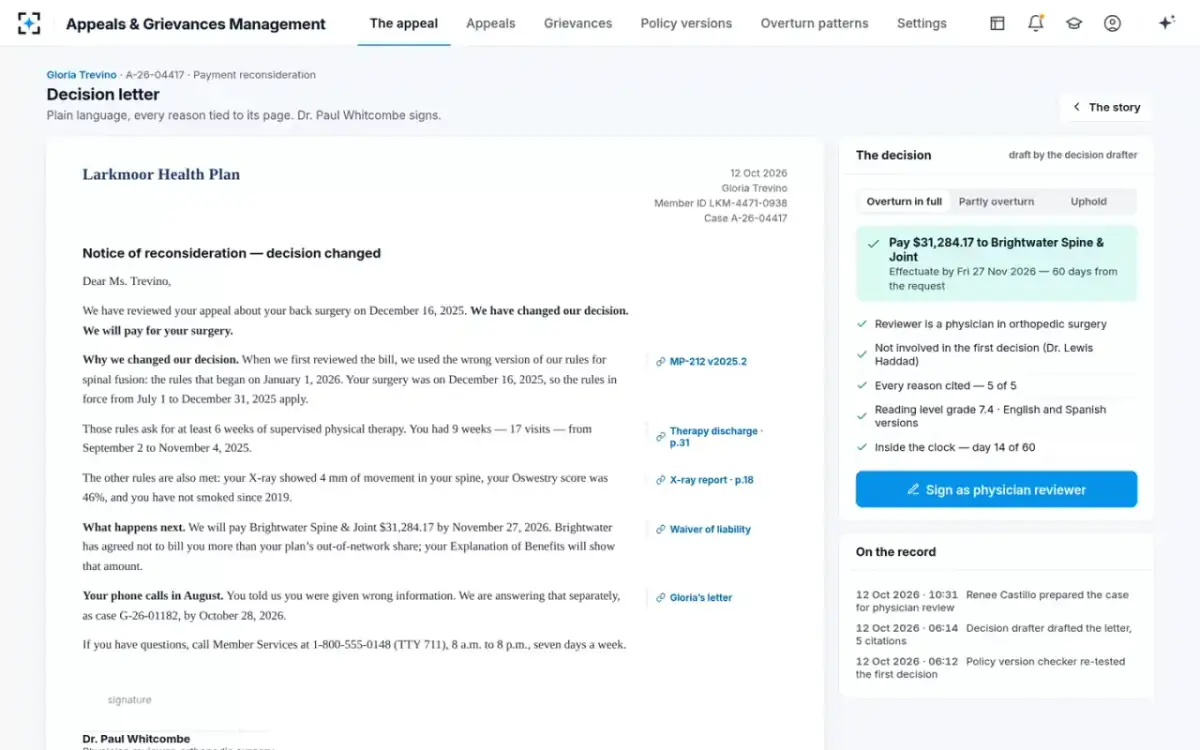
So a drafting agent has two audiences: the member, who needs the decision first and in plain words, and the independent reviewer, who needs the reasoning tied to the evidence. In the solution, each reason in the draft is linked to the criterion and the page it rests on, uncited text is marked and blocks sending, and the letter is written at grade 8 or lower in English and Spanish in the sample configuration.
A drafted letter in which every reason is tied to its page
What is the risk of automating appeals?
The main risks are a wrong classification that puts a case on the wrong clock, a system change that silently breaks processing, a draft that states something the record does not support, and a decision that is in effect made by the software. CMS has seen the second one already: among its 2025 audit findings, "Duplicate logic in a prior authorization system failed after system updates, causing appeals to process incorrectly" (CMS, CY 2025 Program Audit and Enforcement Report). Automation does not remove that risk; it concentrates it, which makes testing and monitoring part of the design rather than an afterthought.
Each risk has a control that can be checked. Classification is proposed with the sentence it rests on, so a person can see why. The clock is computed from the receipt time and the rule, and extensions are allowed only for the listed reasons. Every sentence in a draft cites its source, and uncited text cannot be sent. Agents cannot sign, send, dismiss, extend or edit an original document, and every action by a person or an agent is on the audit trail. The value of those controls is that a compliance analyst can test them on a sample, the same way an auditor will.
How much faster are automated appeals?
No published, independent study measures how much faster AI makes health plan appeals, and the 2026 systematic review found few studies reporting operational gains of any kind. Any figure a vendor gives is its own. Botminds' is labelled for what it is: the design target is a case ready for the physician about 12 minutes after it opens, against roughly 50 minutes assembled by hand, and the estimate in the chart at the top is about 2.3 working days of elapsed time for a payment reconsideration instead of about 11.
Two cautions apply to any speed claim. The clock usually runs on waiting, not working, so automation helps most where it removes waiting, such as requesting outside records the same hour. And speed is only valuable if it moves the outcome: a payment reconsideration decided on day 14 rather than day 50 pays the provider sooner and leaves time to ask for missing records, and the overturn decided early never reaches the independent review entity at all.
What to ask a vendor of AI appeals automation
Ask questions whose answers can be demonstrated on your own cases. The checklist below is the one we would use, including for our own solution.
Ten questions for any AI appeals automation vendor
- Which tasks does it do, and which can it never do?
Ask for the list of prohibited actions: signing, sending, dismissing, extending, editing originals.
- Show the sentence behind each classification
An appeal-or-grievance call you cannot trace is a call you cannot defend in an audit.
- How is the receipt time set?
Including mail and faxes received by delegated entities, which start the standard clock.
- Does every sentence in a draft cite a page?
And what happens to a sentence that does not?
- Which policy version does it test against?
The one in force on the date of service, or the one in the system today?
- How does it check the physician reviewer?
Expertise for the service and no involvement in the first decision, before the signature.
- What does it do with Medicaid and integrated cases?
Different clocks, notices and next levels of appeal.
- What is on the audit trail?
Every view, change, signature and letter, by people and by agents.
- Show results on our closed cases
Operational measures, not model accuracy.
- What do we have to supply on day one?
Files, policies with every version, clock rules, letters, reviewer lists.
Appeals & Grievances Management fits a plan that already has a claims and authorization system and a medical policy library and wants the appeals team to stop rebuilding files by hand. It does not replace those systems, make the medical necessity decision or change a medical policy; its overturn pattern finder proposes findings to the medical policy committee, which decides. What to bring on day one lists the inputs, and the decisions to make before buying any tool puts automation in its place in the sequence. To see the agents on a full case, start from Appeals & Grievances Management.
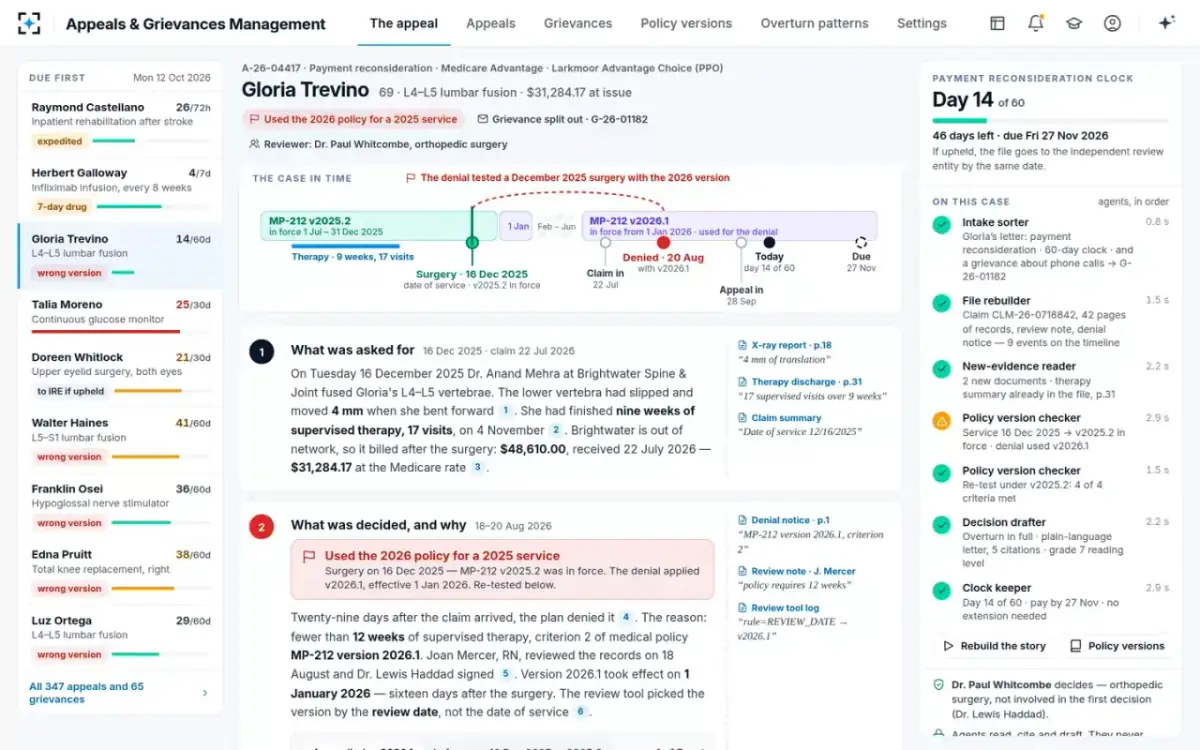
The appeal as a story, with the agents' work listed beside it
Questions people ask
What parts of an appeal can be automated?
Logging and time-stamping, classification proposals, clock setting, records requests, rebuilding the original file, marking new evidence, re-testing the medical policy, drafting letters and case files, and tracking deadlines. The medical necessity decision, dismissals, extensions and the signature stay with people, under 42 CFR 422.590(h) and the plan's own controls.
How do health plans use AI in appeals and grievances?
Mostly for reading and drafting: sorting incoming correspondence, summarizing records and drafting letters. A 2026 systematic review found that only 18.8% of published studies of AI in prior authorization looked at post-denial appeals, and few of any kind reported operational gains, so most plans are still testing rather than measuring.
Is there a federal rule on AI in Medicare Advantage appeals?
No AI-specific rule is in force. CMS proposed guardrails for AI and said in April 2025 that it did not intend to finalize them. The general rules apply: decisions based on the enrollee's own records, and a physician with appropriate expertise for medical necessity reconsiderations.
Can an AI system deny an appeal?
It should not. In Medicare Advantage a medical necessity reconsideration must be made by a physician, and an upheld denial goes to the independent review entity with the plan's written explanation. A system can draft that explanation; the physician decides whether to uphold.
Does automation help members as well as the plan?
It helps when it moves decisions earlier. KFF found that 80.7% of appealed Medicare Advantage prior authorization denials were overturned in 2024, fully or partly, so most appealing members eventually win; each day removed from preparation is a day sooner that care is approved or a bill is paid.