The WISeR model, short for Wasteful and Inappropriate Service Reduction, is a CMS Innovation Center test of prior authorization in traditional Medicare, run from 1 January 2026 to 31 December 2031 in New Jersey, Ohio, Oklahoma, Texas, Arizona and Washington. For a set list of services, such as electrical nerve stimulator implants, epidural steroid injections, cervical fusion and knee arthroscopy for osteoarthritis, providers either request prior authorization or face review of the claim before payment. The reviews are done by six technology companies using enhanced technologies, such as AI and machine learning, together with human clinical review, and CMS states that every recommendation for non-payment is determined by an appropriately licensed clinician. WISeR does not apply to Medicare Advantage. But it is Medicare's own design for AI in prior authorization, and it draws the same line that Botminds' Prior Authorization Automation draws for health plans: technology reads, organises and recommends; a licensed person decides any no.
A WISeR prior authorization request, from the provider's choice to the claim
1Provider
Chooses a route
For a listed service in a model state: request prior authorization from the participant or the Medicare contractor, or skip it and accept review of the claim before payment.
2Medicare contractor
Routes the request
A request sent to the Medicare Administrative Contractor goes to the model participant for that state, with its documentation.
3Technology participant
Reviews with enhanced technology
Against the statute, regulations and the NCD or LCD for the service, within the timeframe CMS sets.
4Licensed clinician
Determines any non-payment
Every recommendation for non-payment is determined by an appropriately licensed clinician; a non-affirmation carries a detailed reason.
5Medicare contractor
Ties the decision to the claim
Affirmed or not, a unique tracking number is generated and goes on the claim; a non-affirmed claim is denied.
6Provider
Resubmits, talks or appeals
Unlimited resubmissions, with a peer-to-peer on request; a denied claim keeps the normal Medicare appeal rights.
What is the WISeR model?
It is a six-year Innovation Center model, authorised under section 1115A of the Social Security Act, that tests whether technology-assisted prior authorization can reduce low-value and fraud-prone services in traditional Medicare. CMS describes it as working "with companies experienced in using enhanced technologies to expedite and improve the review process for a pre-selected set of services that are vulnerable to fraud, waste and abuse" (CMS). It runs in two three-year agreement periods, and CMS calls it the first Innovation Center model in which technology companies are the only participants.
Two design points matter to anyone reading it as a precedent. "WISeR does not change Medicare coverage or payment policy": the criteria are the existing statutes, regulations and coverage determinations, applied earlier. And the model "will require the same information and clinical documentation that is already required to support Medicare FFS payment but earlier in the process, namely, prior to the service being furnished" (90 FR 28749). It is a test of process and technology, not of new rules.
Which states are in the WISeR model, and which services need prior authorization?
Six states, one participant each, under four Medicare Administrative Contractor jurisdictions: New Jersey (JL), Ohio (J15), Oklahoma and Texas (JH), and Arizona and Washington (JF). CMS lists the participant companies on its model page. The services were chosen, CMS said, for evidence of potential fraud, waste and abuse, for having publicly available coverage criteria, and for already being subject to prior authorization in Medicare Advantage, while excluding inpatient-only services and services that would put patients at substantial risk if delayed.
The WISeR service list, as announced and as delayed
| Service | Coverage rule | Status |
|---|---|---|
| Electrical nerve stimulators | NCD 160.7 | From 1 Jan 2026 |
| Sacral nerve stimulation for urinary incontinence | NCD 230.18 | From 1 Jan 2026 |
| Phrenic nerve stimulator | NCD 160.19 | From 1 Jan 2026 |
| Vagus nerve stimulation | NCD 160.18 | From 1 Jan 2026 |
| Induced lesions of nerve tracts | NCD 160.1 | From 1 Jan 2026 |
| Epidural steroid injections for pain, excluding facet joint injections | Contractor LCDs | From 1 Jan 2026 |
| Percutaneous vertebral augmentation for vertebral compression fracture | Contractor LCDs | From 1 Jan 2026 |
| Cervical fusion | Contractor LCDs | From 1 Jan 2026 |
| Arthroscopic lavage and debridement for the osteoarthritic knee | NCD 150.9 | From 1 Jan 2026 |
| Hypoglossal nerve stimulation for obstructive sleep apnea | Contractor LCDs | From 1 Jan 2026 |
| Incontinence control devices | NCD 230.10 | From 1 Jan 2026 |
| Diagnosis and treatment of impotence | NCD 230.4 | From 1 Jan 2026 |
| Skin and tissue substitutes for lower-extremity wounds | LCDs L35041, L36690 | Only where the contractor has an active LCD |
| Deep brain stimulation for essential tremor and Parkinson’s disease | NCD 160.24 | Delayed on 6 Apr 2026 to a date to be announced |
| Percutaneous image-guided lumbar decompression for spinal stenosis | NCD 150.13 | Delayed on 6 Apr 2026 to a date to be announced |
Does the WISeR model use AI for prior authorization, and who makes the final decision?
Yes, and a licensed clinician makes every decision not to pay. CMS describes the model as using "enhanced technologies, such as Artificial Intelligence (AI) and Machine Learning (ML), along with human clinical review", and it chose as participants "companies with expertise providing recommendations on medical necessity of coverage for payers using enhanced technology like AI", which "are required to have clinicians with the expertise to conduct medical reviews to validate determinations" (CMS). The decisive sentence is on the same page:
“All recommendations for non-payment are determined by appropriately licensed clinicians who will apply standardized, transparent and evidence-based procedures to their review.”
CMS Innovation Center, WISeR Model page
Note what the sentence covers and what it does not. A non-payment recommendation must be determined by a licensed clinician. An affirmation, a yes, is not said to need one. That is the same asymmetry Medicare Advantage rules contain, where professional review is required before an adverse medical necessity decision issues but not before an approval (42 CFR 422.566(d)), and the same one Prior Authorization Automation is built around, with the difference that the solution also has a nurse click every approval.
The final word on payment stays with Medicare's existing machinery. A non-affirmation does not stop the provider from billing; the claim goes to the Medicare Administrative Contractor, which denies it, and that denial is an initial determination with the full Medicare appeal process behind it. A non-affirmed request can be resubmitted "an unlimited number of times", and the provider can ask for a peer-to-peer review when resubmitting.
Does WISeR apply to Medicare Advantage?
No. CMS says so plainly: "WISeR does not apply to people with Medicare Advantage and will have no impact on them" (CMS). Medicare Advantage plans already run prior authorization under their own rules, at far greater volume: KFF counts 52.8 million Medicare Advantage determinations in 2024 against about 628,000 prior authorization reviews in traditional Medicare in fiscal 2024.
Prior authorization in traditional Medicare before WISeR, and the model's scope
628,243
traditional Medicare prior authorization reviews completed in fiscal 2024
KFF, from CMS reports
22.9%
of those requests denied (non-affirmed)
KFF, from CMS reports
6states
in WISeR, one technology participant each
CMS
6years
1 Jan 2026 to 31 Dec 2031, two three-year periods
CMS
Why WISeR matters to Medicare Advantage plans anyway
WISeR reads as a statement of terms for the Medicare Advantage debate, because of what CMS did not do there. In April 2025, finalizing its 2026 Medicare Advantage rule, CMS wrote that it did "not intend to finalize the following provisions from the proposed rule", a list that ended with "Ensuring Equitable Access to Medicare Advantage Services— Guardrails for Artificial Intelligence (AI)", while acknowledging "the broad interest in regulation of AI" (90 FR 15792). Less than three months later it published the design of its own AI prior authorization program, with licensed clinicians determining every non-payment. The AI rule it declined to finalize for plans and the program it built for itself sit side by side.
WISeR and Medicare Advantage prior authorization, side by side
WISeR (traditional Medicare): One technology company per state, chosen by CMS.
Medicare Advantage plans: The plan, or a reviewer it delegates to.
WISeR (traditional Medicare): Existing statute, regulations, NCDs and LCDs; WISeR changes no coverage policy.
Medicare Advantage plans: Medicare coverage rules first; published internal criteria only where those are not fully established.
WISeR (traditional Medicare): An appropriately licensed clinician, for every non-payment recommendation.
Medicare Advantage plans: A physician or other appropriate health care professional reviews any adverse medical necessity decision first.
WISeR (traditional Medicare): Written into the model’s design: technology recommends, clinicians determine non-payment.
Medicare Advantage plans: None specific to AI; CMS declined to finalize proposed guardrails in April 2025.
WISeR (traditional Medicare): Resubmit without limit, with a peer-to-peer; claim denials keep full Medicare appeal rights.
Medicare Advantage plans: Reconsideration by the plan, then the independent review entity, under Subpart M.
WISeR (traditional Medicare): “Gold card” exemptions for providers with records of compliance, possible in future.
Medicare Advantage plans: Plan programs, or state law for state-regulated plans; no federal requirement.
WISeR (traditional Medicare): A share of averted expenditures, adjusted for performance including provider experience.
Medicare Advantage plans: Capitated plan finances; delegated reviewers under contracts the plan sets.
What WISeR's participants are paid for, and why plans should notice
WISeR participants are paid from what they save. CMS: "Model participants receive a percentage of the expenditures associated with averted wasteful, inappropriate care as a result of their reviews. That percentage is adjusted based on the participant’s performance on measures related to the process, including provider experience" (CMS). The notice adds that CMS will hold participants "accountable for the accuracy and timeliness of prior authorization determinations through quality adjustments to model payments".
This is the design question every plan faces with a delegated reviewer or a technology vendor, stated openly; the guide to utilization management vendors turns it into contract questions. Paying a share of averted spending creates an incentive to refuse; adjusting for accuracy, timeliness and provider experience pushes back. A plan that pays a vendor per review, per denial or per dollar saved should ask the same question CMS built into WISeR: what in the contract penalises a wrong no? Botminds' Prior Authorization Automation sidesteps it by design: the agents never recommend a denial, so there is no recommendation to reward.
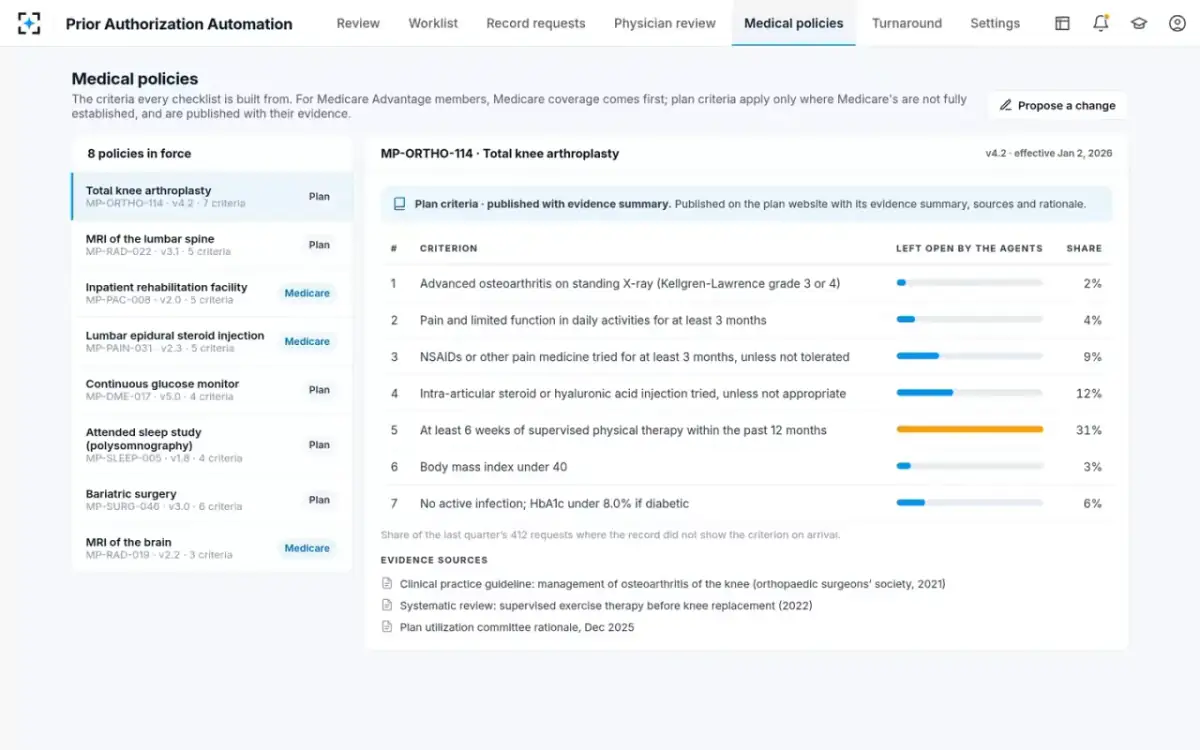
Each policy marked as Medicare coverage or the plan's own criteria
Gold card exemptions inside WISeR
CMS has signalled that WISeR will not review compliant providers forever. Its model page says that "Providers and suppliers with demonstrated records of compliance may be exempt from the WISeR review process in the future", calling the exemption a "gold card", and the July 2025 notice described a possible approach based on a provider's provisional affirmation rate in a periodic assessment, aligned with the exemption policy CMS already uses for its hospital outpatient prior authorization program. As of October 2026 the model page describes the exemption as future. Gold carding prior authorization works through the 90% arithmetic on a plan's own data.
What a health plan can take from Medicare's own test
Four lessons transfer directly, whatever a plan thinks of WISeR's purpose. Keep coverage rules and technology separate: the criteria are the policy, and the software applies them. Put a licensed person on every no, and say so. Give a detailed reason with every refusal, and make resubmission easy. And measure the reviewer, human or machine, on accuracy, timeliness and the experience of the providers on the other end, not on savings alone.
WISeR's design choices, as questions a plan can ask of its own prior authorization
- Does our technology apply our published criteria, or its own?
WISeR changes no coverage policy; the software applies existing NCDs and LCDs.
- Does a licensed clinician determine every denial?
WISeR requires it for every non-payment recommendation; Medicare Advantage rules require professional review before an adverse decision.
- Does every refusal carry a detailed reason?
WISeR participants must give one with every non-affirmation; Medicare Advantage plans must give a specific reason from 2026.
- Can a provider fix and resubmit easily?
WISeR allows unlimited resubmission with a peer-to-peer; a records request inside the clock does the same job before a denial.
- What do we pay our reviewers and vendors for?
WISeR adjusts payment for accuracy, timeliness and provider experience; check what your contracts reward.
- Do we exempt providers who have earned it?
WISeR plans gold-card exemptions; a plan’s own decision history can support the same test.
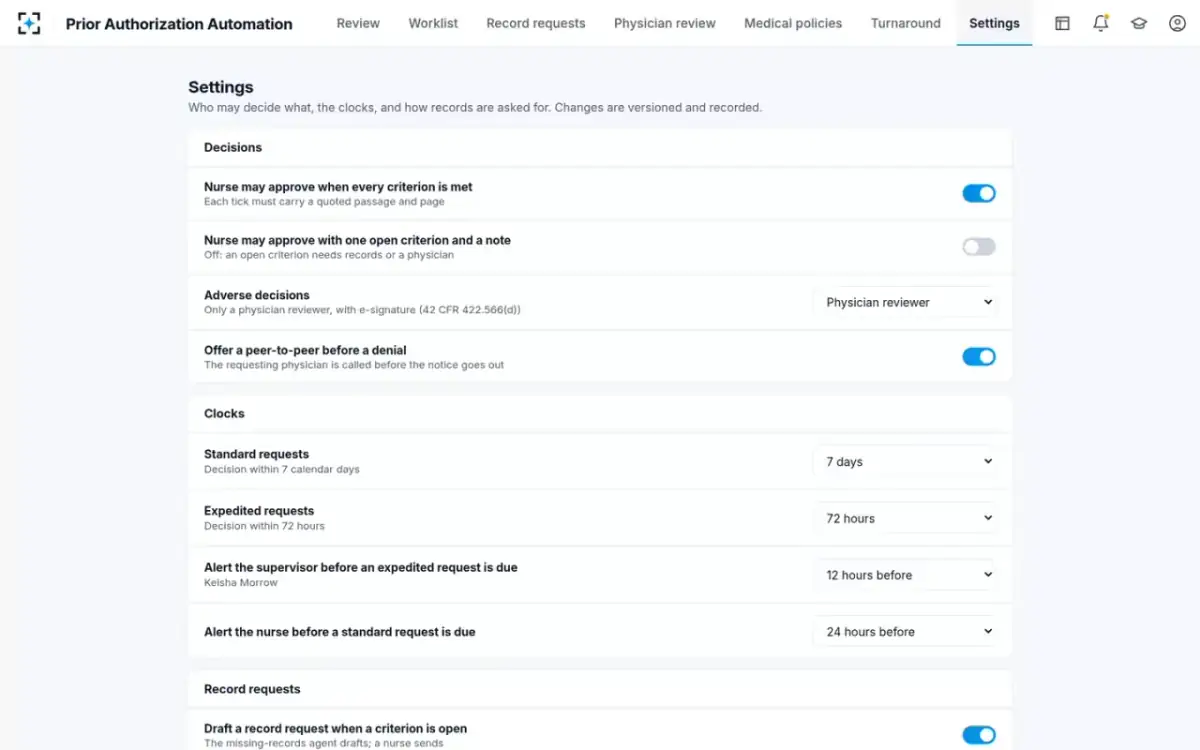
The same line in a plan's settings: a licensed person on every no, and a peer-to-peer first
The agent design that follows from those choices is laid out in prior authorization AI agents: what each does, and never does, and the questions to put to any vendor, including how it is paid and what it does with a refusal, in the twelve questions for prior authorization software.
Questions people ask
When did the WISeR model start?
On 1 January 2026, the effective date of CMS's July 2025 notice. It runs for six performance years, to 31 December 2031. Two services, deep brain stimulation and percutaneous image-guided lumbar decompression, were delayed by a notice effective 6 April 2026 until a date to be announced.
Is WISeR prior authorization mandatory for providers?
Requesting prior authorization is voluntary, but a provider in a model state who furnishes a listed service without it has the claim held for pre-payment medical review by the model participant, which may request documentation. Either way, the same Medicare coverage, coding and documentation requirements apply.
Who are the WISeR model participants?
Six technology companies, one per state, each covering a Medicare Administrative Contractor jurisdiction; CMS lists them by name on its WISeR model page. CMS describes them as companies with expertise giving payers recommendations on medical necessity using enhanced technology like AI, required to have clinicians to conduct medical reviews.
Does WISeR change what Medicare covers?
No. CMS states that WISeR does not change Medicare coverage or payment policy, and that payment for covered items and services does not change. It requires the same documentation Medicare already requires for payment, earlier, before the service is furnished.
What happens if a WISeR request is not affirmed?
The provider receives a detailed reason and may resubmit an unlimited number of times, with a peer-to-peer review if requested. If the provider furnishes the service and bills anyway, the Medicare contractor denies the claim, and the provider and beneficiary keep the full Medicare fee-for-service appeal rights.