Gold carding in prior authorization means exempting a physician or other provider from prior authorization for a particular service because nearly all of their past requests for it were approved. A plan that gold cards stops reviewing requests it would almost certainly approve and spends its reviewers' time where denials and overturns concentrate. The test is arithmetic on the plan's own decisions, and Texas law, which spells the test out in detail, sets it at 90 percent of requests approved over a one-year evaluation, with at least five services performed. Botminds' Prior Authorization Automation keeps every request, decision and appeal with the provider, service and policy it concerns, so the approval history a gold-card test needs is a query over decisions already recorded, each one backed by cited criteria.
The idea has moved from a few plans' programs into policy. In June 2025 insurers pledged, in a voluntary commitment announced by CMS, to "Reduce the volume of medical services subject to prior authorization by January 1, 2026." (CMS). Medicare itself exempts high-performing providers in its own prior authorization programs. And KFF, describing Medicare Advantage, notes that some insurers waive prior authorization "through “gold carding” programs that exempt providers with a history of complying with the insurer’s prior authorization policies" (KFF).
Who qualifies: a gold-card calculation for one service, on the Texas test
| Provider | Requests | Approved | Denied, later approved | Rate, first decision | Rate, counting reversals | Performed | Qualifies at 90%? |
|---|---|---|---|---|---|---|---|
| Provider A · pain medicine group | Requests64 | Approved61 | Denied, later approved1 | Rate, first decision95.3% | Rate, counting reversals96.9% | Performed58 | Qualifies at 90%?Yes |
| Provider B · orthopaedic practice | Requests22 | Approved19 | Denied, later approved2 | Rate, first decision86.4% | Rate, counting reversals95.5% | Performed20 | Qualifies at 90%?Only if reversals count |
| Provider C · solo anaesthesiologist | Requests9 | Approved9 | Denied, later approved0 | Rate, first decision100.0% | Rate, counting reversals100.0% | Performed4 | Qualifies at 90%?No: fewer than 5 performed |
| Provider D · multispecialty clinic | Requests41 | Approved33 | Denied, later approved3 | Rate, first decision80.5% | Rate, counting reversals87.8% | Performed35 | Qualifies at 90%?No |
| Provider E · hospital outpatient | Requests18 | Approved17 | Denied, later approved0 | Rate, first decision94.4% | Rate, counting reversals94.4% | Performed16 | Qualifies at 90%?Yes |
What is gold carding in prior authorization?
It is a standing exemption, granted provider by provider and service by service, from the requirement to obtain prior authorization. A gold card is not an approval of every future request; it removes the request. The provider performs the service and bills it, and the plan's remaining check is after the fact, on a sample of claims, under whatever limits the law or the program sets.
The logic is the one behind the calculation above. If a pain medicine group's lumbar injection requests are approved 95% of the time, reviewing them costs the plan a nurse's time on sixty requests to find three denials, and costs the provider sixty requests' worth of paperwork and delay. An exemption trades that review for a smaller retrospective sample and a right to withdraw the card. Whether the trade is good depends on what the denials were for, which is why the calculation needs each decision's reason, not just its outcome.
Do health plans have to offer gold carding?
Under federal law, no; under some state laws, yes, for the plans those laws regulate. CMS asked for comments on gold-carding in the rulemaking that became CMS-0057-F, including whether to fold it into Star Ratings, and then declined to act: "Since no policies were proposed, we are not finalizing policies in this area at this time." (CMS-0057-F preamble). Medicare Advantage, Medicaid managed care and Marketplace plans therefore have no federal gold-card mandate as of October 2026. The June 2025 pledge to reduce the volume of services under prior authorization is voluntary.
Texas has written the requirement into statute in detail, and its text is the model quoted here. Since September 2021 its Insurance Code has required HMOs and insurers offering PPO and EPO plans to exempt qualifying physicians and providers. In its current text, as amended effective 1 September 2025 by H.B. 3812, providers are evaluated once a year and requests are counted across all of a carrier's and its affiliates' plans (Tex. Ins. Code ch. 4201, subch. N). The subchapter does not apply to the state's Medicaid program or its children's health plans. Texas's terms are not universal, and a plan regulated elsewhere should read its own state's insurance code for any exemption requirement rather than assume them.
The Texas gold card test, step by step, after the 2025 amendments
The test has two parts and a long list of procedures around it. The heart of it is section 4201.653(a):
“A health maintenance organization or an insurer that uses a preauthorization process for health care services may not require a physician or provider to obtain preauthorization for a particular health care service if, in the most recent one-year evaluation period ... (1) the health maintenance organization or insurer, including any affiliate, has approved or would have approved not less than 90 percent of the preauthorization requests submitted by the physician or provider for the particular health care service; and (2) the physician or provider has provided the particular health care service at least five times during the evaluation period.”
Texas Insurance Code § 4201.653(a), as amended effective 1 September 2025
The Texas gold card rules a plan has to operate, section by section
| Rule | What the statute says | Section |
|---|---|---|
| Threshold | Approved or would have approved at least 90% of the provider’s requests for the service in the most recent one-year evaluation period. | 4201.653(a)(1) |
| Minimum volume | The provider performed the service at least five times in the period. | 4201.653(a)(2) |
| What counts | All the provider’s requests to the carrier or its affiliates, across all their policies and plans, whether or not those plans are subject to the subchapter. | 4201.653(a-1) |
| How often | Evaluated once every year; an exemption may be continued without re-evaluation; the provider need not apply. | 4201.653(b)–(d) |
| Notice | Within five days of qualifying, the provider is told which services and plans the exemption covers and for how long. | 4201.659(d) |
| Payment | No denial or reduction of payment for an exempted service on medical necessity grounds, except knowing material misrepresentation or failure to substantially perform it. | 4201.659(a) |
| Annual report | Exemptions granted, denied and rescinded, and independent review outcomes, reported to the Texas Department of Insurance; public without identifying information. | 4201.660 |
Computing who qualifies from your own determinations
The calculation is one line per provider per service, and every input should already exist in the plan's utilization management records. A plan needs, for each request in the evaluation year: the requesting provider, the service, the decision, the date, and what happened after a denial. It also needs, from claims, how many times the provider performed the service, because the five-time minimum counts services provided, not requests.
Read the table at the top of the page row by row. Provider A qualifies on first decisions alone. Provider C has a perfect approval rate but performed the service only four times, so it does not. Provider B's first-decision rate is 86.4%, and it reaches 95.5% only if the two denials later reversed count as requests the plan "would have approved". That phrase is the hardest part of the test to operate, and the statute does not define it in the sections quoted here; the plan should take the counting rule from its regulator's rules and apply it the same way to every provider. Provider D is below the line on either count.
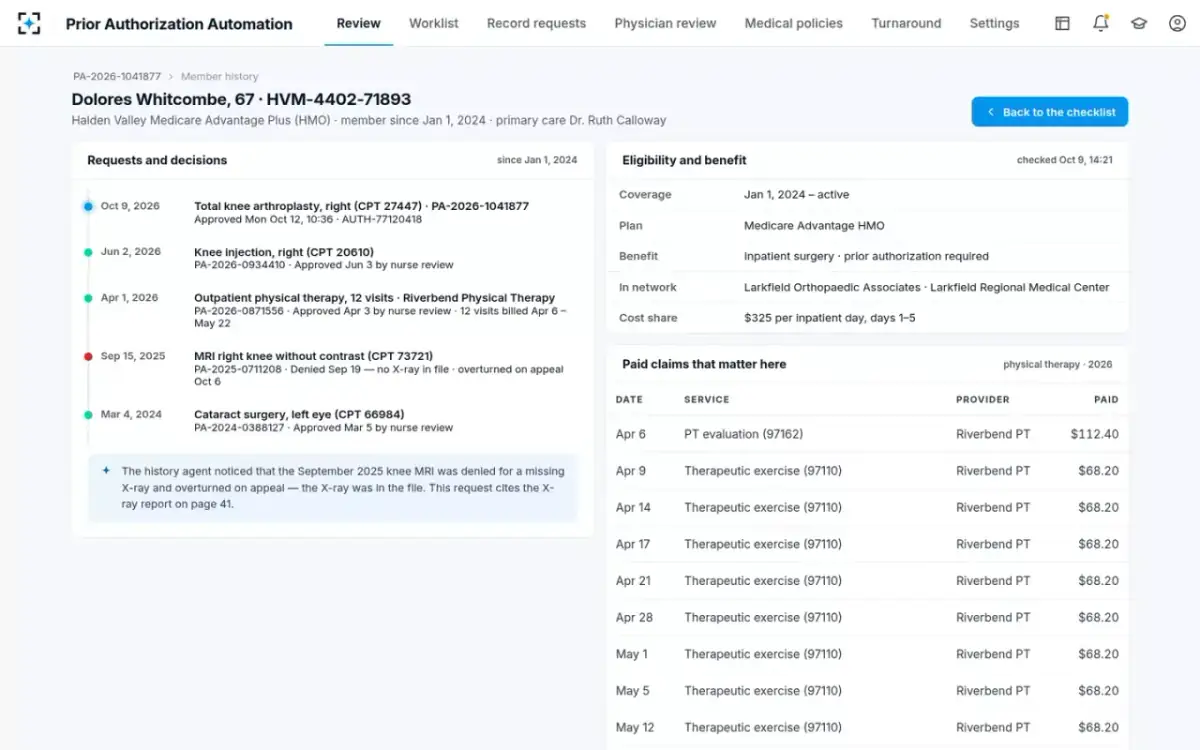
Three data problems spoil most first attempts. Provider identity: the same group appears under several tax and billing identifiers, so its requests must be rolled up the way the regulator defines "physician or provider". Service identity: a "service" in the statute is not always one procedure code, so the plan must decide, and document, how codes group into services. And decisions without reasons: if a denial's reason was administrative (no eligibility, wrong form), it may belong in the count differently from a clinical denial, which the plan can tell only if each decision recorded its reason.
Each decision is stored with its service, reason, reviewer and appeal outcome
What approval rate is needed for gold card status?
Ninety percent is the figure every public model uses. Texas sets it in statute. In traditional Medicare, CMS may exempt hospital outpatient departments from its prior authorization program on a demonstration of compliance (42 CFR 419.83(c)), and when it designed its WISeR model it described aligning with that program's exemption approach:
“A provider/supplier could be exempt from prior authorization if they achieve a prior authorization provisional affirmation threshold of 90 percent during a periodic assessment, thereby demonstrating a sufficient understanding of the requirements for submitting an accurate claim.”
CMS, WISeR model notice, 90 FR 28749 (1 Jul 2025)
CMS added that "100 percent compliance may not be necessary as there could be unintentional or sporadic errors". KFF reports that a December 2025 CMS rule set up an exemption process for certain durable medical equipment items, allowing qualifying suppliers, such as those with an affirmation rate of 90% or higher, to be exempt. A plan designing its own program can choose another threshold, but 90% is the benchmark its providers and regulators will compare it to. The WISeR model guide covers how Medicare's pilot treats its future exemptions.
What happens to prior authorization volume after gold carding?
It falls by the share of requests that came from qualifying providers, which can be well above their share of providers when the high-volume providers qualify, as in the fictional table. In the fictional table, two of five providers qualify on first decisions, and they account for 82 of 154 requests for the service, 53%.
Requests a plan would still review for one service, by gold-card counting rule
The volume removed is mostly approvals, by construction. That matters for staffing: the reviews that remain are the harder ones, with a higher share of denials, contradictions and records requests, so the nurse hours saved are less than the requests removed. A plan should model the remaining mix, not just the count, before it plans headcount.
What an exemption does to your published metrics and your risk
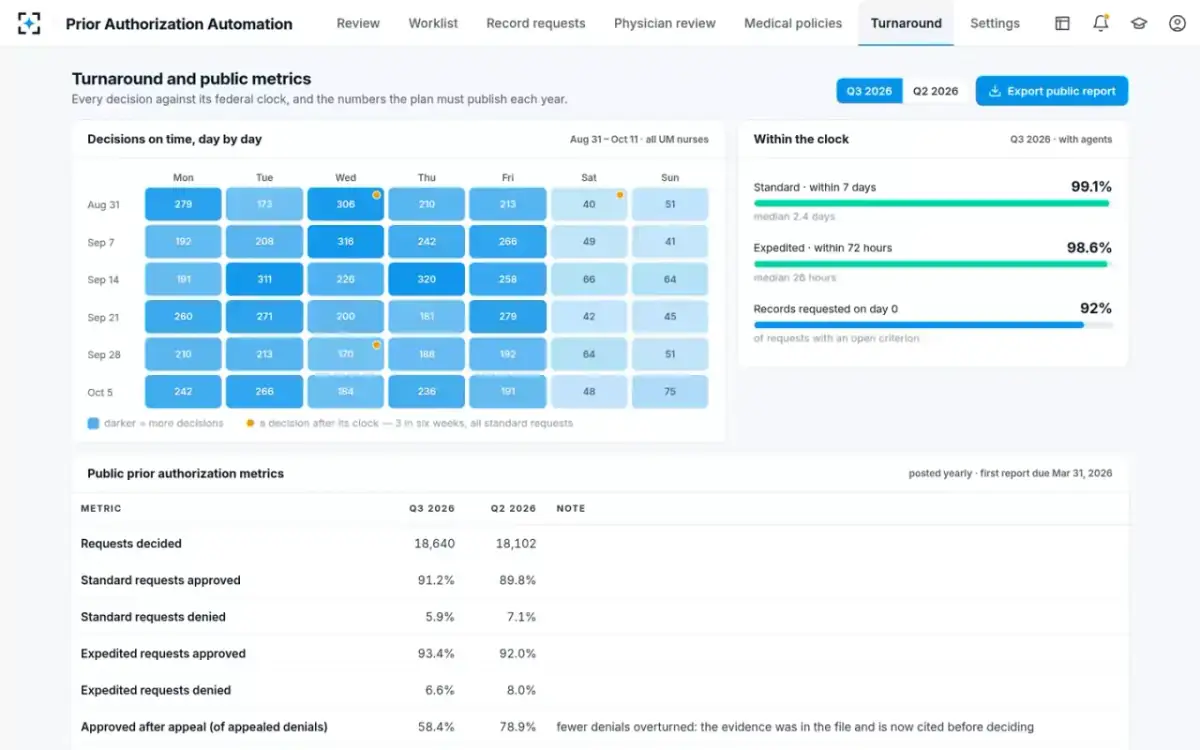
It moves the plan's public numbers in a direction that looks worse. Medicare Advantage organizations must post each year, at contract level, the percentage of standard and expedited requests approved and denied (42 CFR 422.122(c)). Gold-carded providers stop submitting requests, and they were the ones being approved, so the remaining requests have a higher denial rate even if nothing about the plan's decisions changed. The list of items and services requiring prior authorization, which the plan must also post, does not change at all, because the exemption is for the provider, not the service. A plan launching gold cards should explain that shift in advance, to its board and to anyone reading its metrics; how each posted measure is built is traced in prior authorization metrics reporting.
The published percentages are computed only over requests actually made
The risk side is smaller than it looks for Medicare Advantage, and different from what many plans assume. Once a Medicare Advantage plan approves a service through prior authorization, it already may not later deny it for lack of medical necessity (42 CFR 422.138(c)). Texas goes further for exempted services: no payment denial on medical necessity grounds except for knowing misrepresentation or failure to perform, and no retroactive denial even if the exemption is later rescinded (section 4201.657(b)). The protection a plan keeps is the retrospective sample and the right to rescind.
Can a gold card be revoked?
Yes, on a schedule and by a procedure, at least in Texas. Under section 4201.655 a carrier may rescind an exemption only in January, and only if a retrospective review of a random sample of five to twenty of the provider's claims from the evaluation period shows that fewer than 90% met the medical necessity criteria the carrier would have used. The finding must be made by a physician licensed in Texas, of the same or similar specialty when the provider is a physician; the provider must be notified at least 25 days ahead with the sample used and how to appeal; and an independent review organization must complete its review within 30 days if asked, at the carrier's expense. If the review overturns the rescission, the carrier may not try again before the end of the next evaluation period.
Before launching a gold card program: the data and decisions a plan needs
- One identity per provider
Billing and tax identifiers rolled up the way the governing law or program defines a physician or provider.
- A written definition of each service
Which procedure codes count as one service for the test, documented and applied consistently.
- Every decision with its reason and appeal outcome
Administrative and clinical denials separated; reversals linked to the original request.
- Services performed, from claims
The five-time minimum counts services provided, not requests made.
- A sampling and review procedure for rescission
Random selection, the criteria applied, a same-specialty physician reviewer, notice and appeal timelines.
- A note for whoever reads the metrics
Explaining why the published denial percentage may rise as volume falls.
Gold carding is one of the clearest uses of a plan's decision history, and one of the most demanding. It needs every past decision to be attributable, reasoned and linked to its appeal. A plan that has kept its decisions as cited criteria can run the test and defend it; one that has kept them as free-text notes will spend the first program year cleaning data. For the overturns that feed the "would have approved" question, see prior authorization denial rates, and to test the data before committing to a program, a pilot on closed requests uses the same history.
Questions people ask
How does a provider qualify for gold carding?
Under the Texas statute, by having at least 90% of its prior authorization requests for a particular service approved, or requests the carrier would have approved, during the most recent one-year evaluation period, and by having performed the service at least five times in that period. The provider does not need to apply. Plans' voluntary programs set their own terms.
Which states have gold carding laws?
Texas has a detailed gold card statute, in chapter 4201, subchapter N of its Insurance Code, amended effective 1 September 2025. A plan should check the insurance code of each other state where it is regulated directly, since terms differ where they exist. Federal programs such as Medicare Advantage carry no gold-card mandate.
Does Medicare have gold carding?
Traditional Medicare can exempt providers from some of its own prior authorization programs: hospital outpatient departments under 42 CFR 419.83(c), and certain durable medical equipment suppliers under a December 2025 rule, as KFF reports. CMS said in its WISeR notice that a 90% provisional affirmation threshold could be used for future exemptions in that model. Medicare Advantage plans are not required to gold card.
Does gold carding increase fraud risk?
It removes a pre-service check, so the protection moves to retrospective review. Texas lets carriers deny payment for an exempted service only for knowing material misrepresentation or failure to substantially perform it, and lets them rescind exemptions after a sampled review. A plan should keep claims-based monitoring for exempted providers rather than rely on the exemption threshold alone.
How long does a gold card last?
In Texas, until the carrier rescinds it through the January procedure and any appeal is exhausted: the exemption stays in effect until the 30th day after notice if the provider does not appeal, or the fifth day after an independent review organization affirms the rescission. The carrier may also continue an exemption without re-evaluating it.