Prior authorization denial reasons fall into a few families: the service is not medically necessary under the plan's criteria for this member, the documentation sent does not support the request, the member is not eligible or the benefit does not cover the service, or the request duplicates care already given. From 2026 the family is not enough. Medicare Advantage organizations, state Medicaid and CHIP programs, Medicaid managed care plans and Marketplace issuers on the federal exchanges must give the requesting provider a specific reason for each denied prior authorization, whatever channel the request came by, on dates set by CMS-0057-F. A specific reason names the criterion, the evidence that failed it and what would change the answer. Botminds' Prior Authorization Automation drafts that reason from the review itself: the notice writer takes the criterion a physician found not met, with the quoted passage and page, and writes the notice for the physician to sign or reject.
Vague denial reasons and specific ones, for the same five requests
A vague reason: Does not meet medical necessity criteria.
A specific reason: Criterion 3 of the lumbar MRI policy (six weeks of conservative care) is not met: the office note of 2 Sep (page 4) records two weeks of physical therapy and no medication trial.
A vague reason: Patient does not meet criteria for inpatient rehabilitation.
A specific reason: The criterion of about three hours of therapy a day is contradicted: the occupational therapy note of 14 Oct (page 22) records that sessions stopped after 45 minutes because of fatigue.
A vague reason: Insufficient documentation submitted.
A specific reason: The policy requires sleep study results; none of the 31 pages received is a sleep study report. Send the report of the study dated in August 2026.
A vague reason: Service previously authorized.
A specific reason: Authorization 77-104 already covers 12 physical therapy visits through 30 Nov 2026; this request for 12 more overlaps those dates.
A vague reason: Not a covered benefit.
A specific reason: The member’s plan excludes this service under the Evidence of Coverage, chapter 4, section 2.1 (services not covered).
What are the common prior authorization denial reasons?
CMS describes three in its 2024 rule: payers deny prior authorizations "because the payer does not consider the items or services to be medically necessary, the patient exceeded limits on allowable covered care for a given type of item or service, or documentation to support the request was missing or inadequate" (CMS-0057-F preamble). To those, a plan's own list usually adds eligibility (the member was not covered on the date), benefit exclusions, out-of-network providers without an exception, and duplicates of care already authorized or paid.
No national dataset breaks prior authorization denials down by reason. The nearest public data, KFF's analysis of claims denied by Marketplace insurers in 2024, covers claims for services already given rather than prior authorizations, but it shows the problem a specific-reason rule is meant to fix: the largest single category of reasons was "Other".
Denial reasons reported by Marketplace insurers for in-network claims, 2024: the largest category is 'Other'
Does CMS require a specific reason for prior authorization denials?
Yes, for the payers CMS-0057-F covers, and regardless of channel. For Medicare Advantage the rule reads: "Beginning January 1, 2026, if the MA organization denies a prior authorization request ... the response to the provider must include a specific reason for the denial, regardless of the method used to communicate that information" (42 CFR 422.122(a)). CMS's fact sheet adds that "Such decisions may be communicated via portal, fax, email, mail, or phone." A fax denial carries the same obligation as an electronic one.
The dates differ by payer. The requirement applied from 1 January 2026 for Medicare Advantage and state Medicaid and CHIP fee-for-service programs, from the rating period beginning on or after that date for Medicaid managed care and CHIP managed care, and for plan years beginning on or after that date for Marketplace issuers on the federal exchanges. It does not apply to prior authorization decisions for drugs. Employer plans under ERISA are outside CMS-0057-F but have had their own specific-reason rule for years, discussed below.
The provider-facing rule sits on top of the member-facing one. A Medicare Advantage denial notice to the member must already "State the specific reasons for the denial", inform the member of the right to a reconsideration and describe both the standard and expedited processes (42 CFR 422.568(e)). In Medicaid fee-for-service, the notice content rules require "a clear statement of the specific reasons supporting the intended action", as the CMS-0057-F preamble summarises them. What 2026 added is the provider's copy, and the expectation that it be specific enough to act on.
What is a specific reason for denial, in CMS's own words?
CMS declined to put a definition in the regulation but gave one in the preamble, and it is the best available guide to what an auditor will expect:
“A specific reason for denial could include reference to the specific plan provisions on which the denial is based; information about or a citation to coverage criteria; how documentation did not support a plan of care for the therapy or service; a narrative explanation of why the request was denied, and specifically, why the service is not deemed necessary or that claim history demonstrated that the patient had already received a similar service or item.”
CMS, CMS-0057-F final rule preamble (89 FR 8758, 8 Feb 2024)
Read the list as a test. A reason that cites no plan provision and no coverage criterion, explains no gap in the documentation and gives no narrative fails every element. "Does not meet medical necessity criteria" is such a reason. CMS was blunt about the status quo it was correcting: denial information "varies substantially between payers", and "in general, providers do not have consistent direction on the next steps for a denied authorization".
The same preamble describes CMS's standard Medicare Advantage denial form as capturing "a specific and detailed explanation of why the medical services were denied", including the coverage rule or plan policy relied on and "a specific explanation about what information is needed to approve coverage if applicable". That last element is the one most vague notices omit, and it is the one that saves the most work for both sides.
Can a denial just say "not medically necessary"?
Not if it is to meet the 2026 rule as CMS described it, and employer plans have long needed more. The Labor Department's claims rule requires an adverse benefit determination to set out "The specific reason or reasons for the adverse determination", a "Reference to the specific plan provisions on which the determination is based" and, for a group health plan, any internal criterion relied on (29 CFR 2560.503-1(g)). For medical necessity denials it goes further:
“If the adverse benefit determination is based on a medical necessity or experimental treatment or similar exclusion or limit, either an explanation of the scientific or clinical judgment for the determination, applying the terms of the plan to the claimant's medical circumstances, or a statement that such explanation will be provided free of charge upon request.”
29 CFR 2560.503-1(g)(1)(v)(B), employer group health plans
"Applying the terms of the plan to the claimant's medical circumstances" is the whole idea of a specific reason in one phrase. A denial that states a conclusion without connecting the criterion to the member's record has not applied anything. For Medicare Advantage the same connection is implied by the requirement that decisions rest on the member's medical history, physician recommendations and clinical notes; a medical necessity file that holds up is what makes the connection writable.
The five parts of a specific denial reason
A specific reason has five parts, and the first three come straight from the review if the review was documented criterion by criterion. The example below is invented.
A specific reason taken apart: five parts, each with its job
1The criterion
Criterion 2 of the plan’s cardiac rehabilitation policy, edition 2.0: an approved qualifying event within the past 12 months.
Names which test failed, so the provider knows what to fix.
2What the record shows
The discharge summary of 3 Feb 2025, page 6, records the qualifying event 20 months before the request date.
Quotes or cites the page, so the provider can check it.
3What was missing or contradicting
No later qualifying event appears in the 38 pages received; the cardiology note of 1 Oct 2026 (page 31) refers to “stable symptoms”.
Separates absence from contradiction, which call for different responses.
4What would change the decision
A record of a qualifying event after 1 Oct 2025, such as a hospital discharge summary or procedure note.
Turns the denial into a next step rather than an appeal.
5Rights and clocks
Reconsideration, standard and expedited, how to ask, and the right to talk to the physician reviewer.
Required in the member’s notice; useful in the provider’s.
The fourth part, what would change the decision, is where a denial for missing evidence becomes a records request instead. If the plan can name the document that would close the criterion, it should usually ask for it before denying, inside the clock; a denial that names a document the provider could have sent in a day is a resubmission or an appeal the plan has chosen to create. Insufficient documentation denials covers that decision and the check that proves a document is truly absent.
Codes and words: the X12 decision reason and the sentence the provider reads
A code alone is not a specific reason. When a denial travels by the HIPAA standard transaction, the X12 278, CMS noted that payers "must use the codes from the external code set maintained by X12" (CMS-0057-F preamble). But CMS also said it "did not propose standardized denial codes or a specific set of denial reasons for payers to use". A code tells a provider's system which family the denial belongs to; the specific reason tells the provider's staff what to do.
From 2027 the Prior Authorization API that Medicare Advantage and the other covered payers must run will carry the decision too, and it "must include a specific reason for the denial" when it denies (422.122(b)). A plan building its reason text now should write it once and send it on every channel: the 278 code for the system, the sentence for the person, the same sentence in the member's notice in plainer words.
Before a prior authorization denial goes out: the specific-reason check
- Does it name the criterion and the policy edition?
Criterion number and text, and whether the policy is Medicare coverage or the plan’s published criteria.
- Does it cite the record?
The document, date and page that failed the criterion, or the statement that no such document was received.
- Does it say absent or contradicted?
Missing evidence and contrary evidence lead to different next steps.
- Does it say what would change the answer?
A named document, a date range, a test result. If the plan can name it, consider asking for it first.
- Does it go to the provider by the channel the request came in?
Portal, fax, email, mail or phone; the specific reason travels with it.
- Did the right person sign?
In Medicare Advantage an adverse medical necessity decision must be reviewed by a physician or other appropriate professional first.
Partial approvals are denials, and need a reason too
Approving part of a request denies the rest, and the rules treat it that way. KFF found that 73% of Medicare Advantage prior authorization denials in 2024 were denials in full, so the remaining 27% were partial, such as approving 10 of 14 requested therapy sessions (KFF). The written-notice rule covers a decision "to deny a service or an item ... in whole or in part" (422.568(d)), the professional-review rule covers a "partially or fully adverse" medical necessity decision, and Medicaid managed care plans must notify the provider of any decision "to authorize a service in an amount, duration, or scope that is less than requested" (42 CFR 438.210(c)).
Partial denials are where reasons are most often missing, because the approval part of the notice looks like good news. A specific reason for the four sessions not approved names the criterion that limits the number, such as a policy allowing a set number of visits before a progress re-evaluation, and says what record would justify more, such as a progress note showing measurable gains. Without it, the provider asks again in four weeks with the same records, and the plan reads them a second time.
Who writes the reason, and who signs it
The reviewer who found the criterion not met should write the reason, because only they know which passage decided it; in practice it is often written later, from notes, by someone else. That is where specific reasons turn vague. In Prior Authorization Automation the order is reversed: the notice writer drafts the reason at the moment a physician reviewer is looking at the contradicted criterion, from the same quoted passages the physician is weighing, and nothing is sent without the physician's e-signature.
The draft denial names the criterion, the rule and the page, before the physician decides
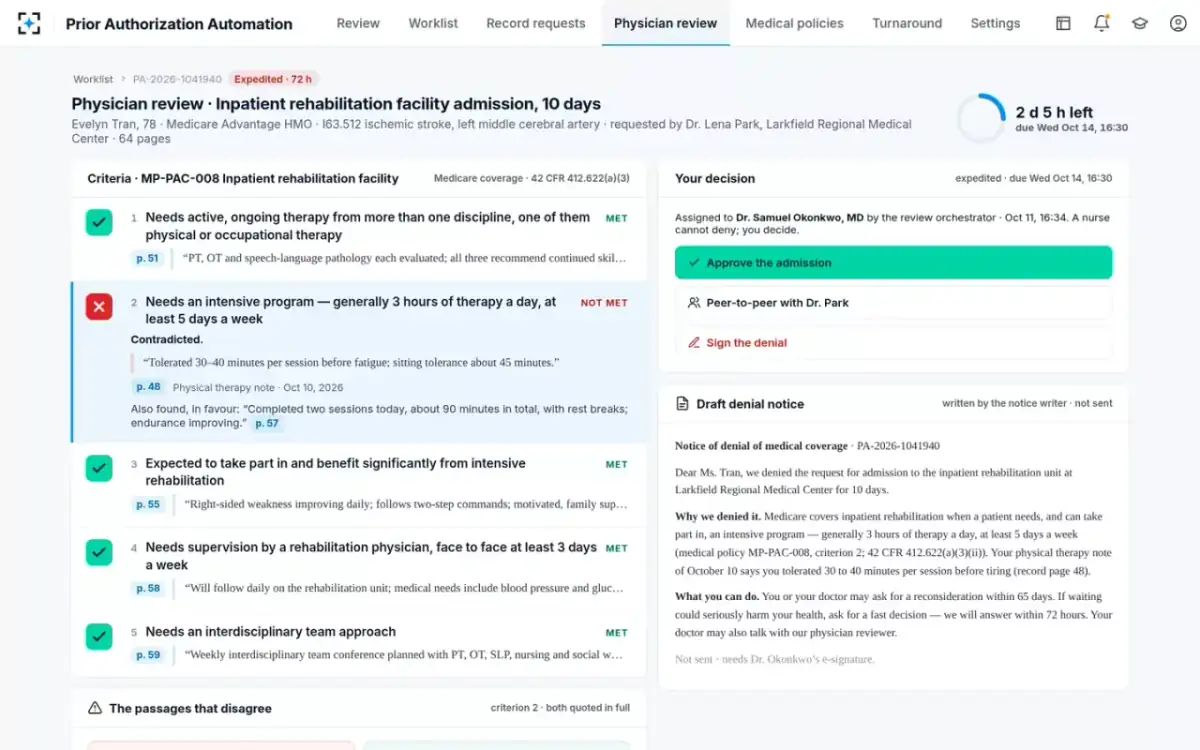
The notice in the screen does what the checklist asks. It names the criterion and the Medicare rule it comes from, quotes the therapy note and gives its page, and tells the member what they can do and how fast. It does not weigh the passage on page 57 against the one on page 48; that is the physician's job, and the screen shows both. If the physician concludes the chart supports the admission after all, the denial is never written.
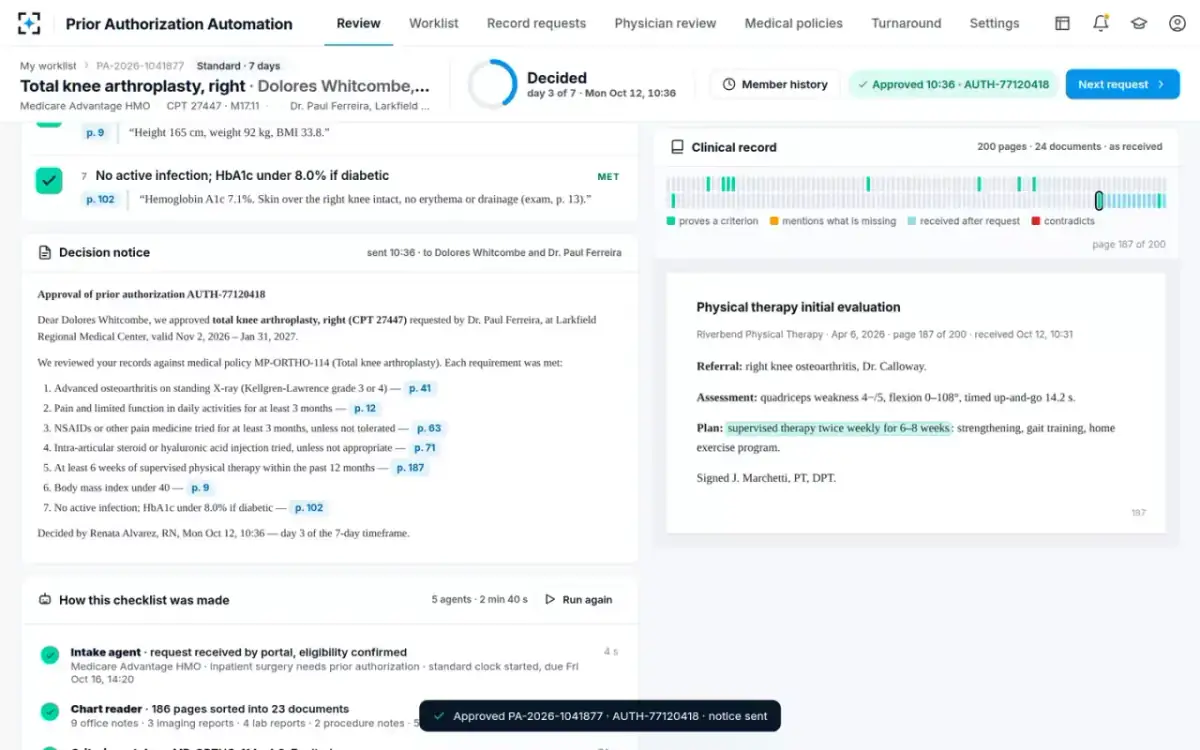
The same discipline on an approval: every criterion listed with its page
One practical consequence for a plan writing its notice templates: the specific reason should be a field the reviewer completes from the evidence, not a dropdown of stock phrases. Dropdowns produce exactly the "Other" and "does not meet criteria" categories the 2026 rule was written to end. The nurse's role in preparing that evidence is described in the prior authorization nurse's day.
Questions people ask
What must a prior authorization denial letter include?
In Medicare Advantage the member's notice must use approved language, state the specific reasons for the denial, explain the right to a reconsideration and describe both the standard and expedited processes, under 42 CFR 422.568(e). Since 2026 the response to the provider must also include a specific reason, whatever the channel. ERISA plans must also cite the plan provisions and any internal criterion relied on.
What changed for denial reasons in 2026?
CMS-0057-F made a specific reason mandatory in the response to the provider for every denied prior authorization, by portal, fax, email, mail or phone. It applied from 1 January 2026 for Medicare Advantage and Medicaid and CHIP fee-for-service, from rating periods starting on or after that date for Medicaid managed care, and from plan years starting then for Marketplace issuers on the federal exchanges. Drug prior authorizations are excluded.
How should a plan explain a prior authorization denial to a provider?
By naming the criterion, citing the page of the record that failed it or stating that no such record was received, and saying what would change the decision. CMS's own description of a specific reason includes plan provisions, coverage criteria, how documentation fell short and a narrative of why. A provider who can act on the reason resubmits instead of appealing.
Is a denial code enough to meet the specific reason requirement?
A code from the X12 list is required when the denial travels by the X12 278 transaction, but CMS described a specific reason in terms of plan provisions, criteria and a narrative explanation, which a code alone does not give. Send the code for the provider's system and the sentence for the provider's staff.
Do Medicare Advantage denials need a physician's signature?
An adverse medical necessity decision must be reviewed by a physician or other appropriate health care professional with relevant expertise before it issues, under 42 CFR 422.566(d). Many plans require a physician for every such decision, and Prior Authorization Automation's default setting allows only a physician reviewer to sign an adverse decision.